Overtime Pay Calculator: Know Every Dollar
Enter your hourly rate, regular hours, and overtime hours to see your regular pay, overtime pay, and total earnings, with the full breakdown.

Formulas verified against standard references. Calculator logic tested with verified worked examples. Last reviewed: October 2026. Our methodology
How Overtime Pay Works
Overtime pay compensates hourly workers for hours beyond the standard workweek. In the United States, the Fair Labor Standards Act requires time-and-a-half, 1.5 times the regular hourly rate, for hours over 40 in a week for covered non-exempt employees. Some states, contracts, and employers go further with double time for very long days or seventh consecutive days.
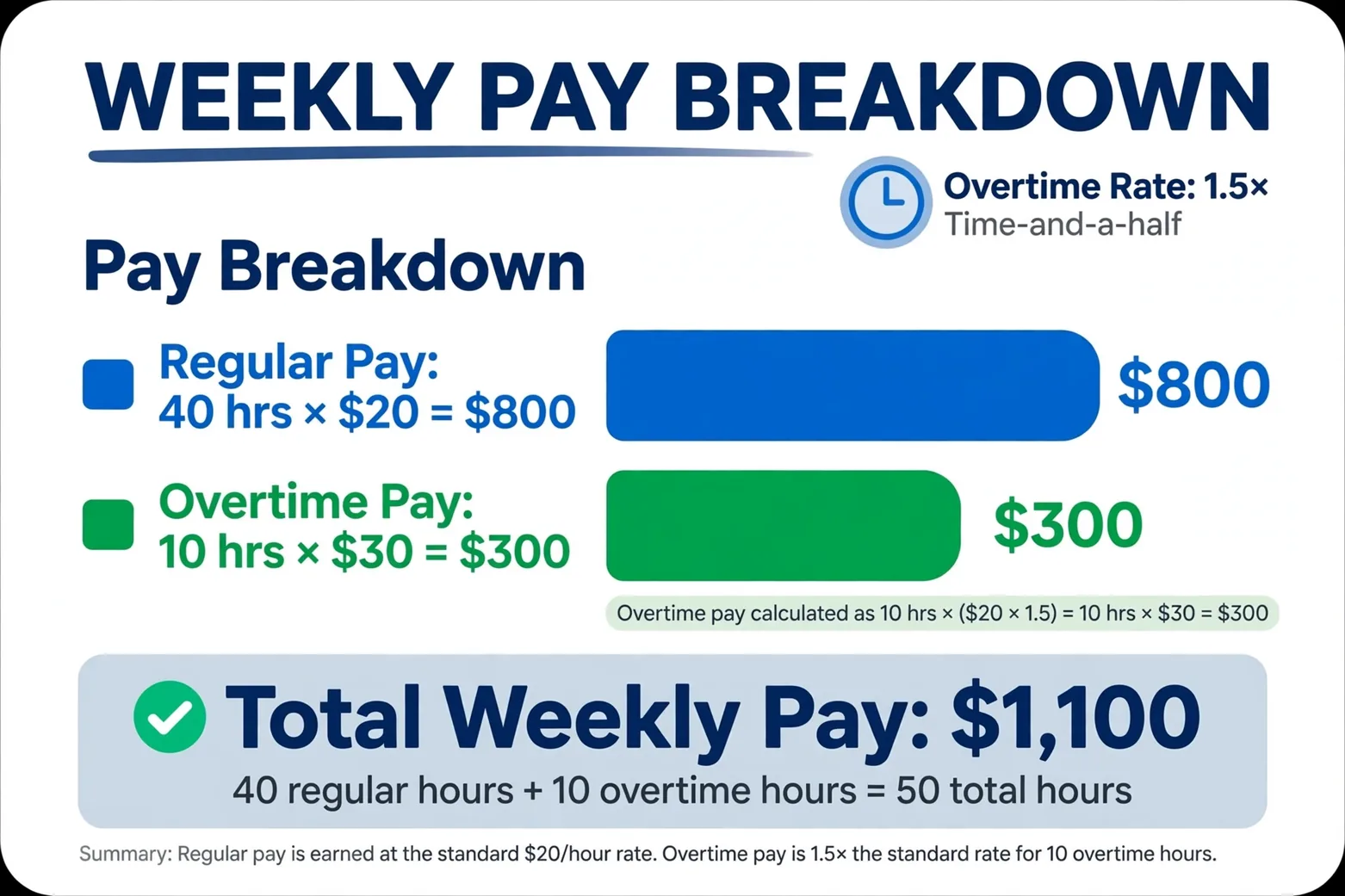
The math is simple once the hours are split. Regular pay is the hourly rate times regular hours. Overtime pay is the rate times the multiplier times overtime hours. Add them for total gross pay. The calculator shows each piece so you can check a pay stub line by line.

Time-and-a-Half and Double Time
Time-and-a-half means every overtime hour earns 1.5 times the normal rate: at $20 an hour, overtime pays $30 an hour. Double time means twice the rate, or $40 an hour at a $20 base. The multiplier field accepts any value, so you can model 1.5x, 2x, or a contract-specific rate like 1.75x.
Salaried non-exempt workers get overtime too, computed from their regular rate: weekly salary divided by 40 gives the hourly equivalent, then the multiplier applies. If your pay stub shows a blended rate, that is the weighted average across regular and overtime hours.
| Multiplier | Name | $20/hr overtime rate |
|---|---|---|
| 1.0x | Straight time | $20.00 |
| 1.5x | Time-and-a-half | $30.00 |
| 2.0x | Double time | $40.00 |
Worked Examples
Example 1: $20 an hour, 40 regular hours, 10 overtime hours at 1.5x. Regular pay is $800, overtime is $20 x 1.5 x 10 = $300, total $1,100. Example 2: $25 an hour, 40 regular, 5 overtime at double time. Regular $1,000, overtime $25 x 2 x 5 = $250, total $1,250.
Example 3: $18 an hour, 32 regular hours, no overtime. Total is simply $576, and the effective rate equals the base rate. Example 4: a $22 rate with 8 overtime hours at 1.5x adds $264 on top of regular pay, showing how quickly overtime lifts a paycheck.
| Rate | Regular h | OT h | Multiplier | Total |
|---|---|---|---|---|
| $20 | 40 | 10 | 1.5x | $1,100 |
| $25 | 40 | 5 | 2.0x | $1,250 |
| $18 | 32 | 0 | 1.5x | $576 |
Checking Your Pay Stub
Compare the calculator's total against the gross pay line on your stub, not the net pay, because taxes and deductions come out afterward. If the numbers differ, check three things: whether all overtime hours were recorded, which multiplier your employer applied, and whether any shift differentials or bonuses were folded into the rate.
Keep your own log of hours and compare it weekly. Small undercounts compound over months, and a written record makes any correction conversation straightforward. The hourly to salary calculator converts the same hourly rate into annual, monthly, and weekly equivalents for budgeting.
Common Mistakes
The most common mistake is applying the multiplier to all hours instead of only the overtime hours. Time-and-a-half applies to the overtime portion; the first 40 hours stay at the base rate. The second mistake is forgetting that the result is gross pay: taxes, Social Security, and deductions still come out.
A third mistake is mixing pay periods. Weekly overtime rules apply per workweek, so 50 hours one week and 30 the next do not average out to 40 and 40 for overtime purposes. Enter the hours for a single week at a time.
Beyond the Paycheck
Knowing your true hourly value helps you decide whether overtime is worth it. Divide the total by total hours for the effective rate: in example 1 above it is $22 an hour, not $20. That effective rate is the right number to compare against freelance work, a second job, or simply an evening off.
For the full picture after taxes, the paycheck calculator estimates take-home pay from gross earnings, so you can see what the overtime actually adds to your bank balance.

Frequently asked questions
What is time-and-a-half?
1.5 times your regular hourly rate, paid for overtime hours. At $20 an hour, time-and-a-half is $30 an hour.
How do I calculate overtime pay?
Multiply your hourly rate by regular hours for regular pay, then rate times 1.5 times overtime hours for overtime pay, and add both for the total.
Is overtime calculated weekly or biweekly?
Under US federal law it is weekly: hours over 40 in a single workweek earn overtime. Some states and contracts have daily overtime rules on top of that.
Does salary earn overtime?
Salaried non-exempt employees do. Their regular hourly rate is the weekly salary divided by hours worked, and overtime is 1.5 times that rate for hours over 40.
What is double time?
Twice the regular hourly rate, sometimes required for very long shifts or seventh consecutive workdays under certain state laws and union contracts.
Is the result before or after taxes?
Before. The calculator shows gross pay. Taxes, Social Security, Medicare, and any deductions are taken out afterward to reach net pay.
What if my employer uses a different multiplier?
Enter it in the overtime multiplier field. Contracts sometimes specify 1.75x or other rates, and the calculator handles any positive multiplier.