Hourly to Salary Calculator: Hourly Wage to Annual Salary
Enter your hourly rate, hours per week, and weeks worked per year, and get your annual, monthly, weekly, and daily pay in one clear breakdown.

Formulas verified against standard references. Calculator logic tested with verified worked examples. Last reviewed: October 2026. Our methodology
How Hourly Pay Becomes a Salary
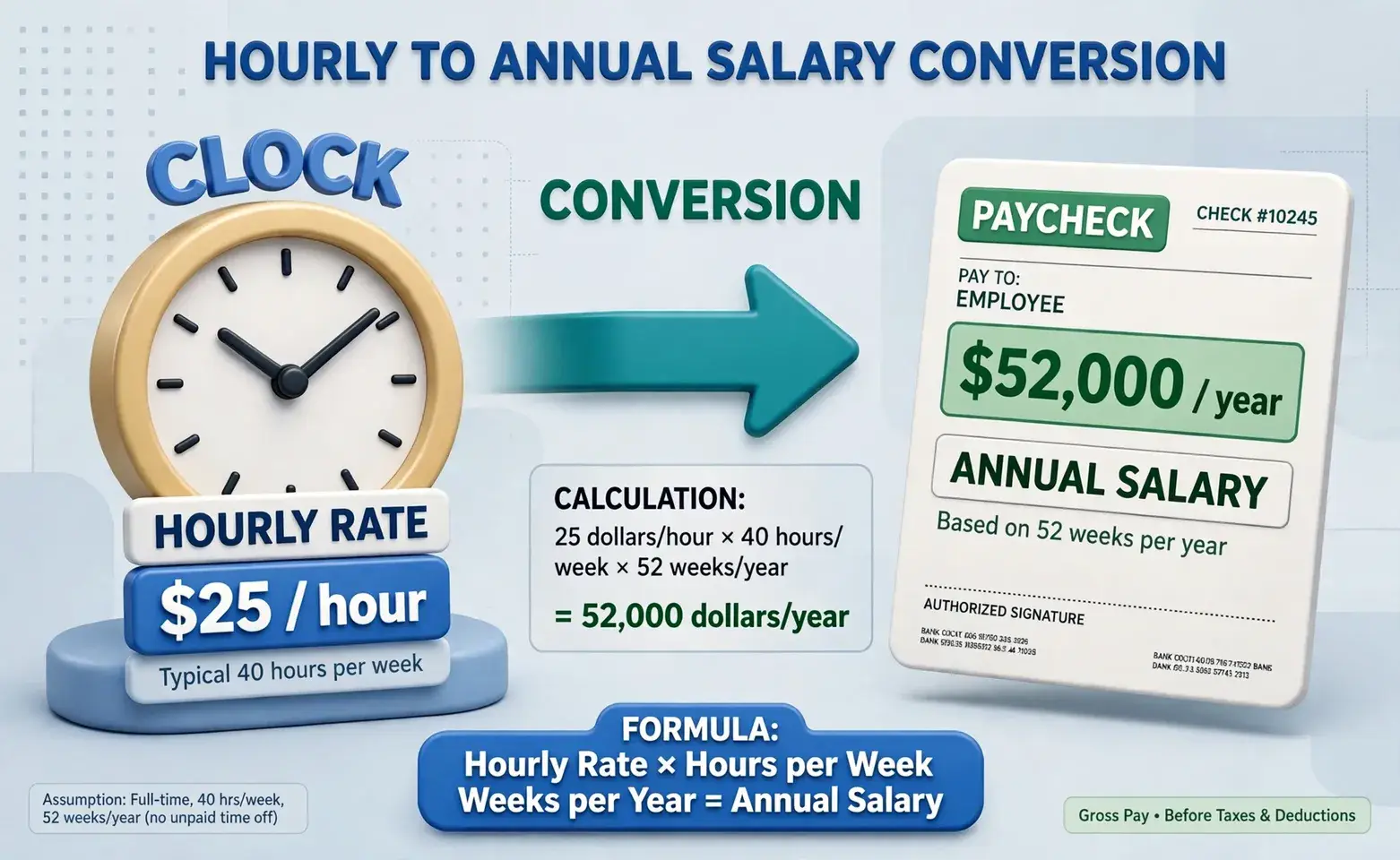
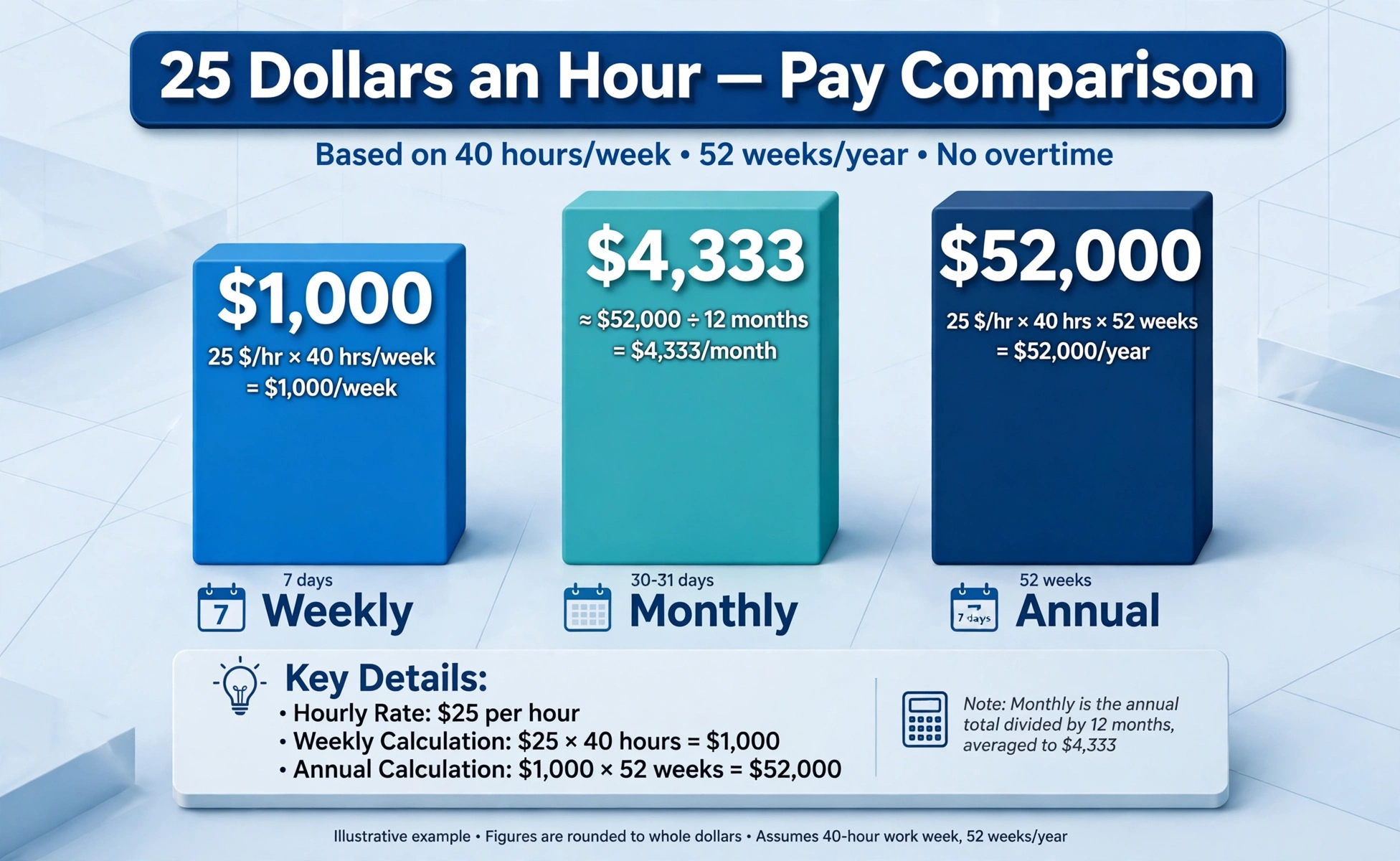
Annual salary is hourly rate times hours per week times weeks worked per year. At $25 an hour, 40 hours a week, and 52 weeks a year, that is 25 times 40 times 52, which is $52,000 a year. Monthly pay divides the annual figure by 12, giving $4,333.33, weekly pay is $1,000, and daily pay over a 5-day week is $200.
Weeks worked per year is where most conversions go wrong. A full year has 52 weeks, but paid holidays and unpaid leave reduce the weeks actually worked. If you take 2 unpaid weeks off, use 50 weeks, not 52, and the same $25 rate gives $50,000, not $52,000. Always use weeks you are actually paid for.
The Conversion Formulas
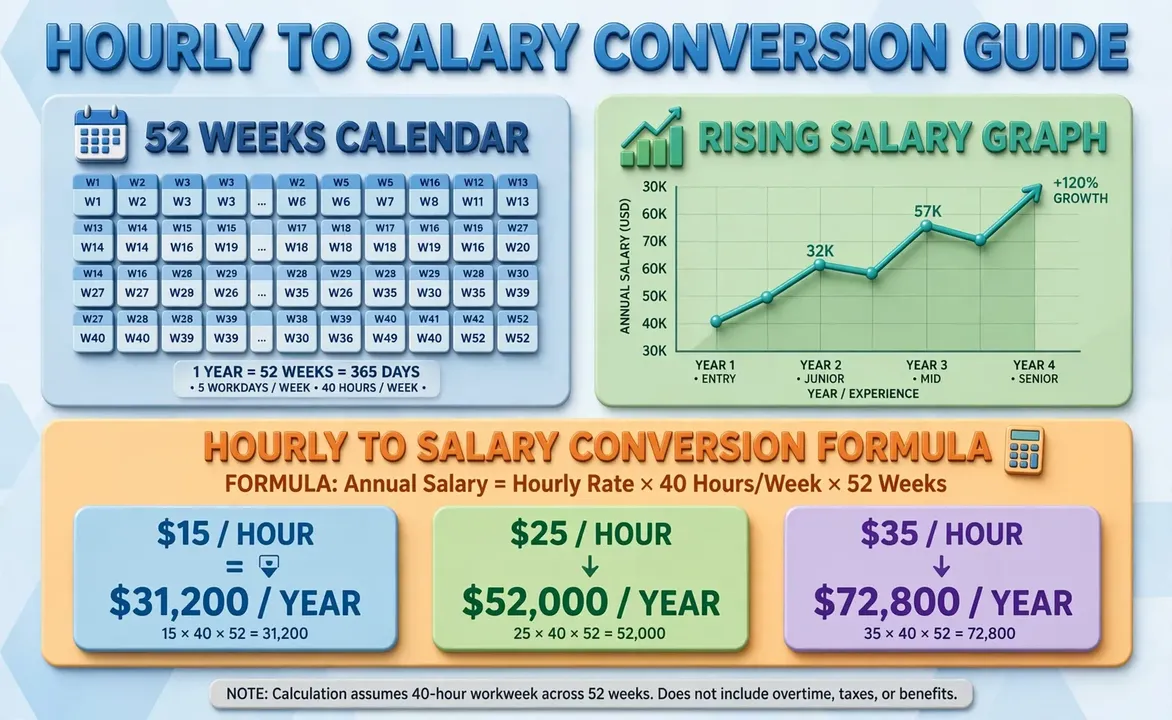
Weekly pay is hourly rate times hours per week. Annual pay is weekly pay times weeks per year. Monthly pay is annual pay divided by 12, and biweekly pay is weekly pay times 2. Daily pay is weekly pay divided by work days per week, which is usually 5, but shift workers should use their actual days.
To go the other way, from salary to hourly rate, divide the annual salary by weeks per year and then by hours per week. A $52,000 salary over 52 weeks at 40 hours a week is $25 an hour. A salary calculator handles the same conversions with overtime and different pay periods.
| Pay period | Formula | $25 an hour, 40 hours, 52 weeks |
|---|---|---|
| Weekly | Hourly x hours per week | $1,000 |
| Biweekly | Weekly x 2 | $2,000 |
| Monthly | Annual / 12 | $4,333.33 |
| Annual | Hourly x hours x weeks | $52,000 |
Worked Examples
Example 1: $25 an hour, 40 hours a week, 52 weeks gives $52,000 a year, $4,333.33 a month, $1,000 a week, and $200 a day over 5 days. Example 2: $18 an hour, 30 hours a week, 50 weeks gives $27,000 a year, $2,250 a month, and $540 a week.
Example 3: $40 an hour, 45 hours a week, 52 weeks gives $93,600 a year before overtime rules, which is $7,800 a month and $1,800 a week. In many jurisdictions, hours above 40 in a week are paid at a higher overtime rate, so check local rules before treating all hours as straight time.
| Hourly rate | Hours and weeks | Annual salary |
|---|---|---|
| $25 | 40 hours, 52 weeks | $52,000 |
| $18 | 30 hours, 50 weeks | $27,000 |
| $40 | 45 hours, 52 weeks | $93,600 |
Gross Pay Is Not Take-Home Pay
These figures are gross pay, before income tax, social contributions, pension deductions, and any other withholdings. Take-home pay is lower, and the gap depends on tax bands, allowances, and local rules, so never budget a gross salary as if it were all spendable.
Benefits also change the comparison between hourly and salaried roles. A salaried role may include paid holidays, sick pay, pension contributions, and health cover that an hourly role does not, so two jobs with the same gross annual figure can have very different total value. Compare the full package, not just the rate.
Common Mistakes
The most common mistake is multiplying by 52 weeks without subtracting unpaid leave. A second mistake is dividing annual pay by 52 to get weekly pay when the job is not year-round, such as seasonal or school-term work. A third mistake is using 4 weeks to get monthly pay, which gives 48 weeks a year; the correct divisor is 12 months, not 4 weeks times 12.
A fourth mistake is forgetting overtime: hours above the standard week may be paid at time and a half, so a 45-hour week at $40 an hour is more than $1,800 a week where overtime applies. Check the contract and local law for the overtime threshold and rate.
Negotiating With the Conversion
Converting an offer to an annual figure makes hourly and salaried offers comparable. A $2 an hour raise at 40 hours a week for 52 weeks is $4,160 a year, which is a concrete number to weigh against a salaried offer. Conversely, a $5,000 salary increase is about $2.40 an hour at 40 hours a week over 52 weeks.
Use the calculator during negotiations to test scenarios: fewer hours at a higher rate, more weeks, or a shift pattern with different days. Small hourly changes compound over a year, so a rate that looks minor per hour can be the difference between two offers.
Frequently asked questions
What is $25 an hour as a yearly salary?
$52,000 a year at 40 hours a week for 52 weeks: 25 x 40 x 52 = 52,000.
How do I convert hourly pay to monthly pay?
Multiply hourly rate by hours per week and weeks per year, then divide by 12. At $25 an hour, 40 hours, 52 weeks, monthly pay is $4,333.33.
Should I use 52 weeks or fewer?
Use the weeks you are actually paid for. With 2 unpaid weeks off, use 50 weeks, which lowers the same $25 rate to $50,000 a year.
Is this gross or net pay?
Gross pay, before taxes and deductions. Take-home pay will be lower, depending on tax and local rules.
How do I convert salary back to an hourly rate?
Divide the annual salary by weeks per year, then by hours per week. $52,000 over 52 weeks at 40 hours is $25 an hour.
What about overtime?
This calculator uses straight time for all hours. Where hours above 40 a week are paid at time and a half, actual pay will be higher.
Why is monthly pay not weekly pay times 4?
Because a month averages 4.333 weeks, not 4. Monthly pay is annual pay divided by 12, which is the correct figure.