Paycheck Calculator: Estimate Your Take-Home Pay
Your salary is not what lands in your bank account. Enter your annual gross pay, pay frequency and filing status, and this paycheck calculator estimates your federal income tax, Social Security, Medicare and state tax — and shows what each paycheck is really worth.
Tax figures follow the 2026 federal brackets used on this site. Calculator logic tested with verified worked examples. Last reviewed: October 2026. Our methodology
How take-home pay is calculated
A paycheck is your gross pay minus every withholding line. The calculator works through them in order, annualising everything first and dividing by the number of paychecks only at the end.
- Wages: w = gross pay − pretax deductions
- Federal income tax: sum of (each income slice × its 2026 bracket rate) applied to w
- Social Security: 6.2% × min(w, $184,500) — the 2026 wage base caps it
- Medicare: 1.45% × w — no cap
- State income tax: w × (state rate ÷ 100) — flat-rate simplification
- Annual take-home: gross − pretax − federal − Social Security − Medicare − state
- Per paycheck: annual take-home ÷ paychecks per year
Sources: 2026 federal income tax brackets (single-filer schedule, as published by the IRS and used in this site's income tax calculator); IRS Publication 15 (2026), Employer's Tax Guide, for the 6.2% / 1.45% FICA rates and the $184,500 Social Security wage base.
Worked example
Take $80,000 of annual gross pay, a Single filer, paid biweekly (26 paychecks), a 5% state tax rate and no pretax deductions:
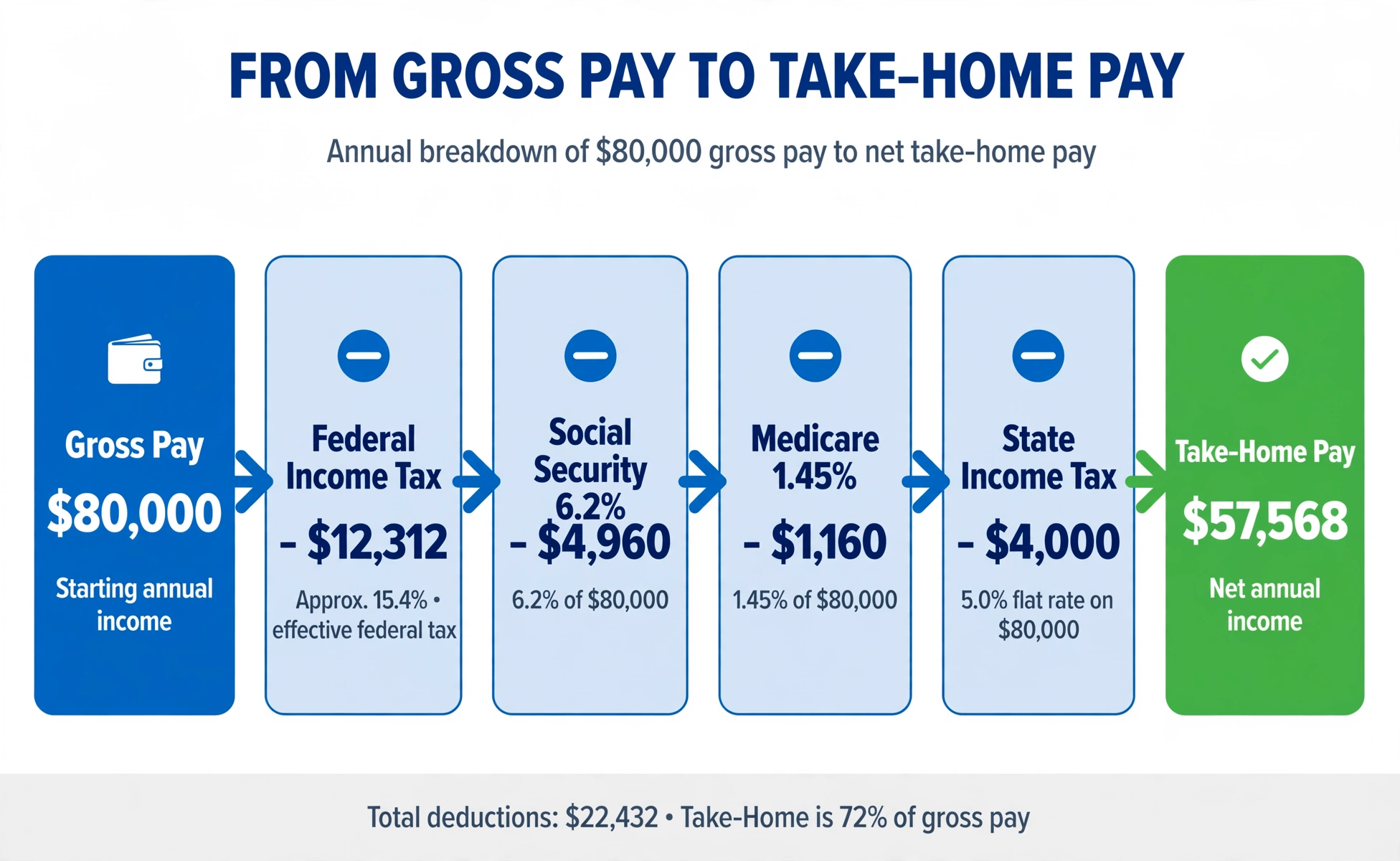
- Federal tax (2026 brackets): $12,400 × 10% = $1,240; $38,000 × 12% = $4,560; $29,600 × 22% = $6,512 → $12,312
- Social Security: $80,000 × 6.2% = $4,960.00 (under the $184,500 wage base)
- Medicare: $80,000 × 1.45% = $1,160.00
- State tax: $80,000 × 5% = $4,000.00
- Annual take-home: $80,000 − $12,312 − $4,960 − $1,160 − $4,000 = $57,568
- Per paycheck: $57,568 ÷ 26 = $2,214.15
The effective tax rate is $22,432 ÷ $80,000 = 28.04% — the paycheck keeps about 72 cents of every dollar earned.
How to use the paycheck calculator
Step by step
- Enter your annual gross pay. Use the full salary or wage figure before any deductions — the number on your offer letter.
- Pick your pay frequency. Biweekly (every two weeks) is the most common in the US, but weekly, semi-monthly and monthly are all supported.
- Choose your filing status. This version applies the single-filer federal schedule to every status — see the filing-status section below for why.
- Add your state rate and pretax deductions. Enter 0 for the state rate if you live in a no-income-tax state, and add 401(k), HSA or health-premium deductions as pretax.
- Press Calculate. Read the per-paycheck and annual breakdown, including the bracket-by-bracket federal math.
If you are comparing two job offers, convert hourly and weekly offers to a yearly figure first with a salary calculator, then paste the annual number here to see what each offer actually pays you.
Pay frequency: same annual pay, different paychecks
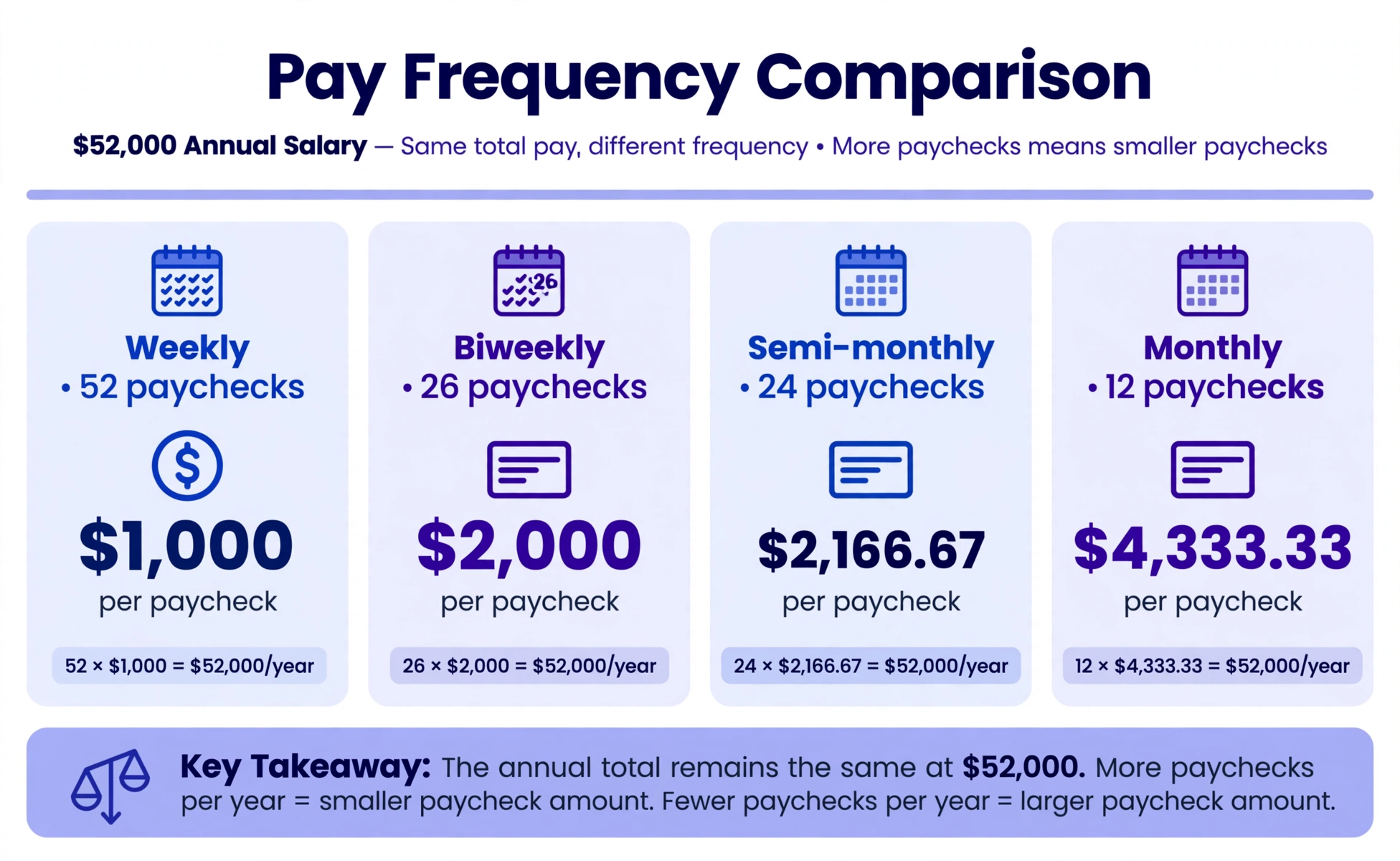
Pay frequency changes the size of each paycheck, never the annual total. Splitting the same salary across more checks makes each one smaller; fewer, larger checks arrive less often but add up to the same yearly number. For a $52,000 salary:
Paychecks per year
| Pay frequency | Paychecks / year | $52,000 gross per paycheck |
|---|---|---|
| Weekly | 52 | $1,000.00 |
| Biweekly | 26 | $2,000.00 |
| Semi-monthly | 24 | $2,166.67 |
| Monthly | 12 | $4,333.33 |
| Annually | 1 | $52,000.00 |
Biweekly vs semi-monthly
A classic source of confusion: biweekly is every two weeks (26 checks, with two "bonus" three-paycheck months a year), while semi-monthly is twice a calendar month (24 checks, always two per month). The calculator keeps them distinct because the divisor is what sets the per-paycheck amount.
Federal tax brackets and filing status
Federal income tax is marginal: each slice of your income is taxed at its own rate, and the calculator adds the slices up. This version uses the 2026 single-filer bracket schedule published on this site — the same brackets as our income tax calculator — for every filing status, which keeps the math verifiable while the full W-4 version is built.
2026 federal brackets (single-filer schedule)
| Rate | Income slice (up to) |
|---|---|
| 10% | $12,400 |
| 12% | $50,400 |
| 22% | $105,700 |
| 24% | $201,775 |
| 32% | $256,225 |
| 35% | $640,600 |
| 37% | above $640,600 |
Filing-status notes
| Filing status | How this version treats it |
|---|---|
| Single | Full match — the brackets above are the single-filer schedule |
| Married Filing Jointly | Single-filer schedule used; real joint brackets are wider, so actual tax may be lower |
| Married Filing Separately | Single-filer schedule used; treated as an estimate |
| Head of Household | Single-filer schedule used; actual tax may differ from a full return |
FICA: Social Security and Medicare
FICA is simpler than income tax because it is flat. Social Security takes 6.2% of wages up to the 2026 wage base of $184,500 — wages above that are exempt, so the maximum employee Social Security tax for 2026 is $11,439. Medicare takes 1.45% of all wages with no cap, per IRS Publication 15 (2026), Employer's Tax Guide. This version does not include the additional 0.9% Medicare surtax on high wages.
What this simplified version leaves out
This is version 1 of the paycheck calculator — a transparent estimator, not a payroll system. It deliberately leaves out:
- Graduated state taxes: states use their own brackets and rules, so v1 applies one flat rate you enter.
- City and local taxes: local income taxes are not included.
- The standard deduction: the brackets apply directly to wages after pretax deductions, matching this site's income tax calculator.
- Tax credits: child tax credit, earned income credit and others are not modelled.
- The additional Medicare surtax: the extra 0.9% above $200,000 of wages is excluded.
- Status-specific federal schedules: all filing statuses use the single-filer bracket schedule in v1.
A full W-4-style version with status-specific brackets, standard deductions and graduated state taxes is planned. Once you know your take-home number, put it to work: a savings goal calculator turns the per-paycheck figure into a concrete monthly savings plan.
Frequently asked questions
How is take-home pay calculated?
Take-home pay equals gross pay minus pretax deductions, then minus federal income tax, Social Security (6.2%), Medicare (1.45%) and state tax. This calculator annualises everything, applies the 2026 federal brackets to wages after pretax deductions, and divides the annual result by your number of paychecks.
What is the difference between gross pay and net pay?
Gross pay is your full salary before anything is taken out. Net pay — take-home pay — is what remains after federal income tax, FICA taxes, state tax and any pretax deductions. On an $80,000 salary with a 5% state rate, gross pay is $80,000 but net pay is $57,568.
How does pay frequency affect my paycheck?
Pay frequency changes the size of each paycheck, not your annual total. A $52,000 salary pays $2,000 per biweekly check (26 checks) but $4,333.33 per monthly check (12 checks). Biweekly means every two weeks; semi-monthly means twice a calendar month.
How much Social Security tax will I pay in 2026?
Employees pay 6.2% of wages up to the 2026 Social Security wage base of $184,500, so the most you can owe for the year is $11,439. Wages above $184,500 are exempt from Social Security tax. Medicare is separate: 1.45% on all wages with no cap.
Does this calculator include state income taxes?
Yes, as a flat-rate estimate: it multiplies your wages by the state rate you enter. Real state taxes use their own brackets and rules, so for exact state withholding use a dedicated state calculator. Enter 0 if you live in a no-income-tax state.
Why is my actual paycheck different from this estimate?
This is a simplified version 1. It does not include the standard deduction, tax credits, city or local taxes, graduated state brackets, status-specific federal schedules, or the additional Medicare surtax — and your employer's withholding follows your W-4. Treat the result as an estimate, not a payroll figure.
What is the additional Medicare surtax, and is it included here?
The additional Medicare tax is an extra 0.9% on wages above $200,000 ($250,000 for joint filers). This calculator does not include it, so high earners will see a slightly optimistic estimate. It is a planned addition for the full W-4 version.
Related calculators

Income Tax Calculator
Estimate your income tax for the USA, UK, Pakistan, India, Canada or Australia with verified 2026 brackets.
Use calculatorSalary Calculator
Convert your salary between hourly, weekly, biweekly, monthly and annual pay, with overtime rates.
Use calculatorSavings Goal Calculator
Find the monthly savings needed to reach your target, with a clear plan to get there.
Use calculator