Debt-to-Income Ratio Calculator: Front-End and Back-End DTI
Enter your gross monthly income, housing payment, and other monthly debt payments to get your front-end and back-end DTI ratios and what lenders usually make of them.
Formulas verified against standard references. Calculator logic tested with verified worked examples. Last reviewed: October 2026. Our methodology
What Debt-to-Income Ratio Means
Your debt-to-income ratio, or DTI, is the share of your gross monthly income that goes to required monthly debt payments. It is calculated from payments, not from total balances: a 200,000 mortgage and a 20,000 car loan can have similar monthly payments, and DTI cares about the monthly payment, because that is what must be paid each month.
Lenders use DTI to judge whether you can take on another payment without strain. A lower ratio means more income left over after debts, which means more room for emergencies, savings, and the new payment. A higher ratio means most of your income is already committed before the month starts.
For paying debts off rather than measuring them, a debt payoff calculator compares payoff strategies.
Front-End and Back-End DTI
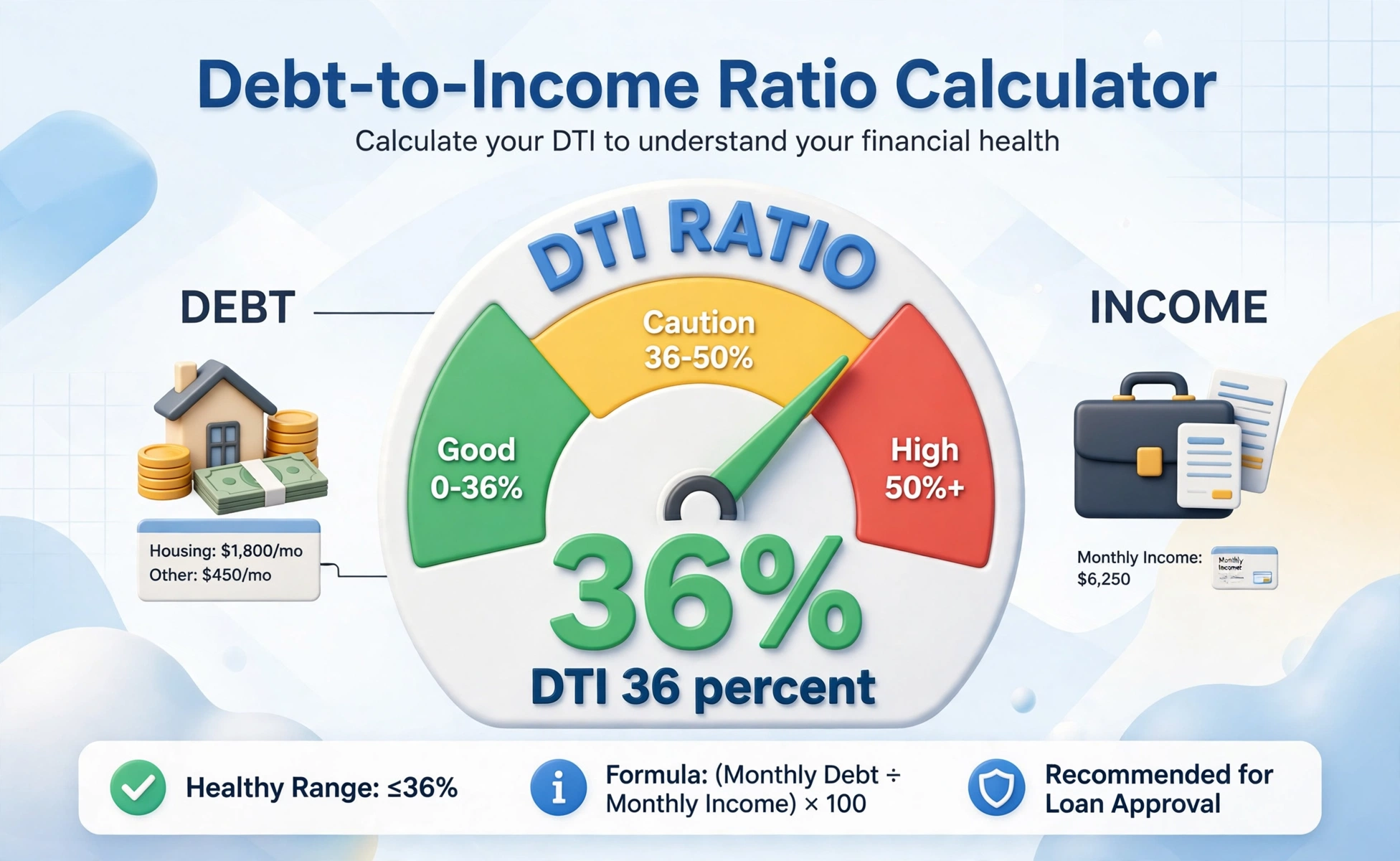
The front-end ratio uses housing only: housing payment divided by gross monthly income, times 100. The classic guideline is 28 percent or less. The back-end ratio uses all recurring debts: housing plus cards, auto, student, personal loans, and support obligations, divided by gross monthly income, times 100. The classic guideline is 36 percent or less.
Groceries, utilities, insurance premiums, and subscriptions are not counted in DTI, even though they matter for what you can actually afford. DTI is a lender measure, not a full budget, so a comfortable DTI can still feel tight if everyday costs are high, and a high DTI can still work if housing is the only large debt and income is stable.
| Ratio | Formula | Classic guideline |
|---|---|---|
| Front-end | Housing / gross income x 100 | 28% or less |
| Back-end | All debts / gross income x 100 | 36% or less |
| Mortgage ceiling | Many programs allow up to | About 43%, sometimes higher |
Worked Examples
Example 1: housing 1,800, car 450, student 250, cards 200, total 2,700, against gross income 7,500. Front-end DTI is 1,800 divided by 7,500, which is 24 percent. Back-end DTI is 2,700 divided by 7,500, which is 36 percent, right on the classic guideline.
Example 2: total debts 1,100 against income 6,000. Back-end DTI is 18.33 percent, comfortably in the comfort zone, with 4,900 left after debts. Example 3: total debts 1,800 against income 5,000. Back-end DTI is 36 percent, the same ratio as example 1, even though the dollar amounts differ, which shows why lenders use a ratio rather than a dollar limit.
| Housing | Other debts | Income | Front-end | Back-end |
|---|---|---|---|---|
| 1,800 | 900 | 7,500 | 24% | 36% |
| 0 | 1,100 | 6,000 | 0% | 18.33% |
| 1,800 | 600 | 7,500 | 24% | 32% |
What Lenders Usually Make of DTI
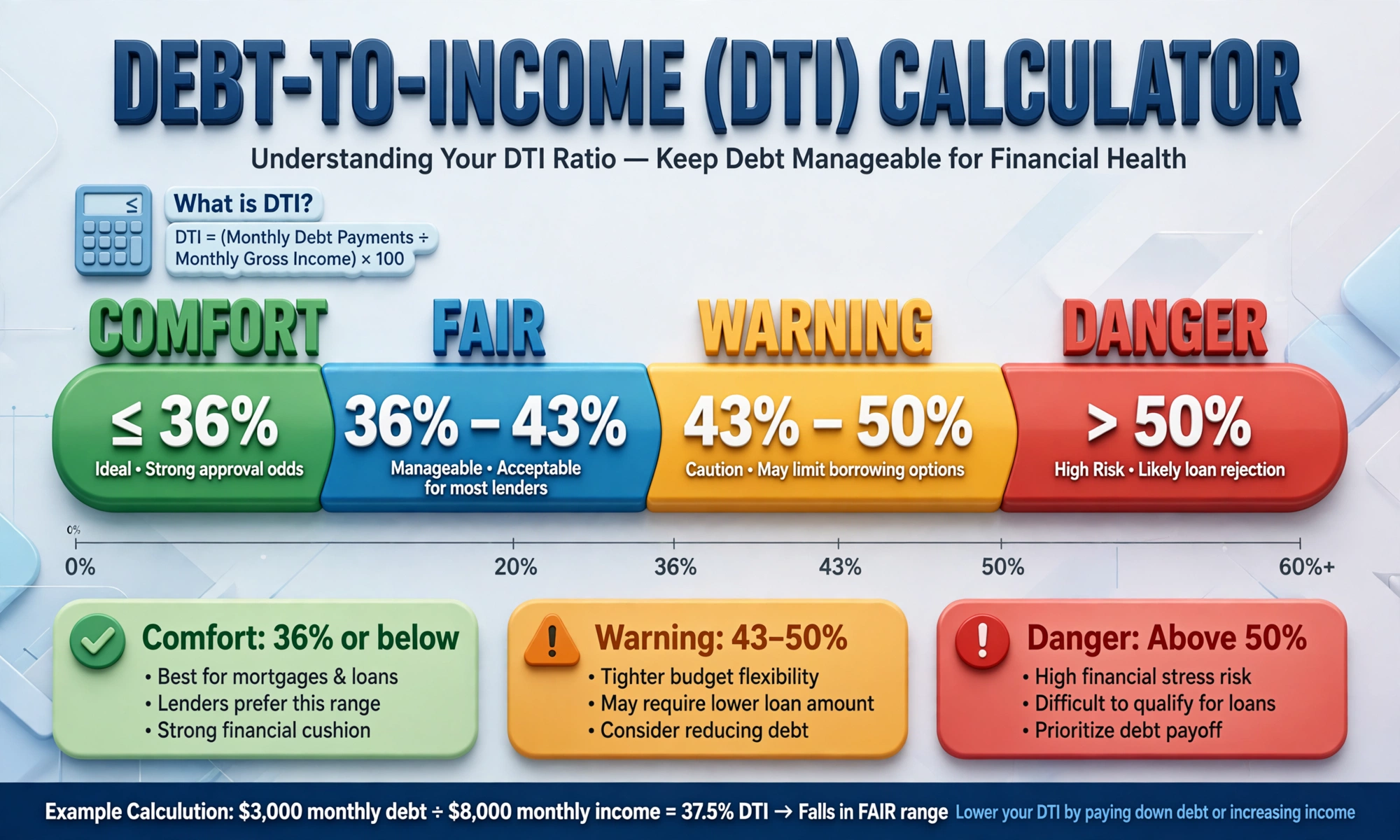
At or below 36 percent back-end DTI, most lenders view the application favorably, and the best rates are usually available. From 36 to 43 percent, approval is still common for conventional mortgages, but lenders may ask for larger reserves or a larger down payment. From 43 to 50 percent, options narrow, and above 50 percent most lenders decline without strong compensating factors such as large savings or excellent credit.
Different programs differ: FHA loans may allow up to about 55 percent with compensating factors, while VA loans focus more on residual income than on a strict DTI cap. These are guidelines, not guarantees, and the final decision always rests with the lender and the full application.
| Back-end DTI | Usual lender view | What it means |
|---|---|---|
| 36% or less | Excellent | Broad approval, best rates usually |
| 37% to 43% | Fair | Approval common, some conditions |
| 44% to 50% | Warning zone | Mortgage approval harder |
| Over 50% | Danger zone | Most lenders decline |
Common Mistakes
The most common mistake is using take-home pay instead of gross income. DTI uses gross, pre-tax income, so using net income inflates the ratio and makes a healthy profile look risky. Another mistake is counting total balances instead of monthly payments, which turns a manageable mortgage into an impossible ratio.
A third mistake is leaving out a debt: a small minimum payment still counts, and lenders find it anyway. A fourth is counting everyday spending as debt, which understates nothing for the lender but confuses the result, since DTI deliberately excludes groceries, utilities, and subscriptions.
How to Improve Your DTI
DTI improves from either side of the fraction: lower the debts, or raise the income. Paying off a small debt entirely removes its whole payment at once, which is why the snowball method, clearing small balances first, moves DTI quickly. Refinancing to a lower payment also helps, as does adding income through a raise, overtime, or a side income that a lender will count.
Before applying for a mortgage, avoid taking on new monthly payments, since a new car payment right before an application raises back-end DTI at the worst moment. For a housing budget check, a mortgage calculator turns a home price into the monthly payment that DTI will count.

Frequently asked questions
What is a good debt-to-income ratio?
36 percent or below back-end DTI is generally considered strong. Many mortgages allow up to about 43 percent, and some programs go higher with compensating factors.
What is front-end DTI?
Housing payment divided by gross monthly income, times 100. The classic guideline is 28 percent or less for housing alone.
What counts as debt in DTI?
Minimum monthly payments on mortgage or rent, car loans, student loans, personal loans, credit cards, and support obligations. Utilities, groceries, and subscriptions are not counted.
Should I use gross or net income?
Gross, pre-tax income. Using take-home pay inflates the ratio and makes a healthy profile look riskier than lenders see it.
Does DTI affect my interest rate?
Not directly, since rates are driven mainly by credit score, but a high DTI can push you into loan programs with higher rates or stricter terms.
How fast can I lower my DTI?
Paying off a small debt entirely removes its payment at once, which moves DTI faster than small extra payments spread across many debts.
What is the maximum DTI for a mortgage?
Conventional loans often look for about 43 to 50 percent at most, FHA loans may allow up to about 55 percent with compensating factors, and VA loans use residual income guidelines instead of a strict cap.