Debt Payoff Calculator
Find out exactly when you will be debt-free. Enter your total debt, interest rate and monthly payment to see your payoff date, total interest paid and a month-by-month payoff timeline. Free, private, no sign-up needed.
How the debt payoff calculator works
Enter three numbers — your total debt, the annual interest rate (APR), and what you pay each month — and the calculator tells you exactly when the balance hits zero, how much interest you will pay along the way, and what the balance looks like at each yearly milestone.
It uses standard loan amortization math: each month, interest is added to the balance first, then your payment is subtracted. If your payment does not even cover the monthly interest charge, the calculator warns you instead of showing a payoff date, because the balance would grow forever.
This tool answers "when will I be debt-free?" If instead you want to know what monthly payment a new loan requires, try our loan EMI calculator.
The formula behind the calculation
The number of payments comes from the amortization formula. With a monthly rate r, a principal P and a monthly payment M:
n = -log(1 - rP/M) / log(1+r)
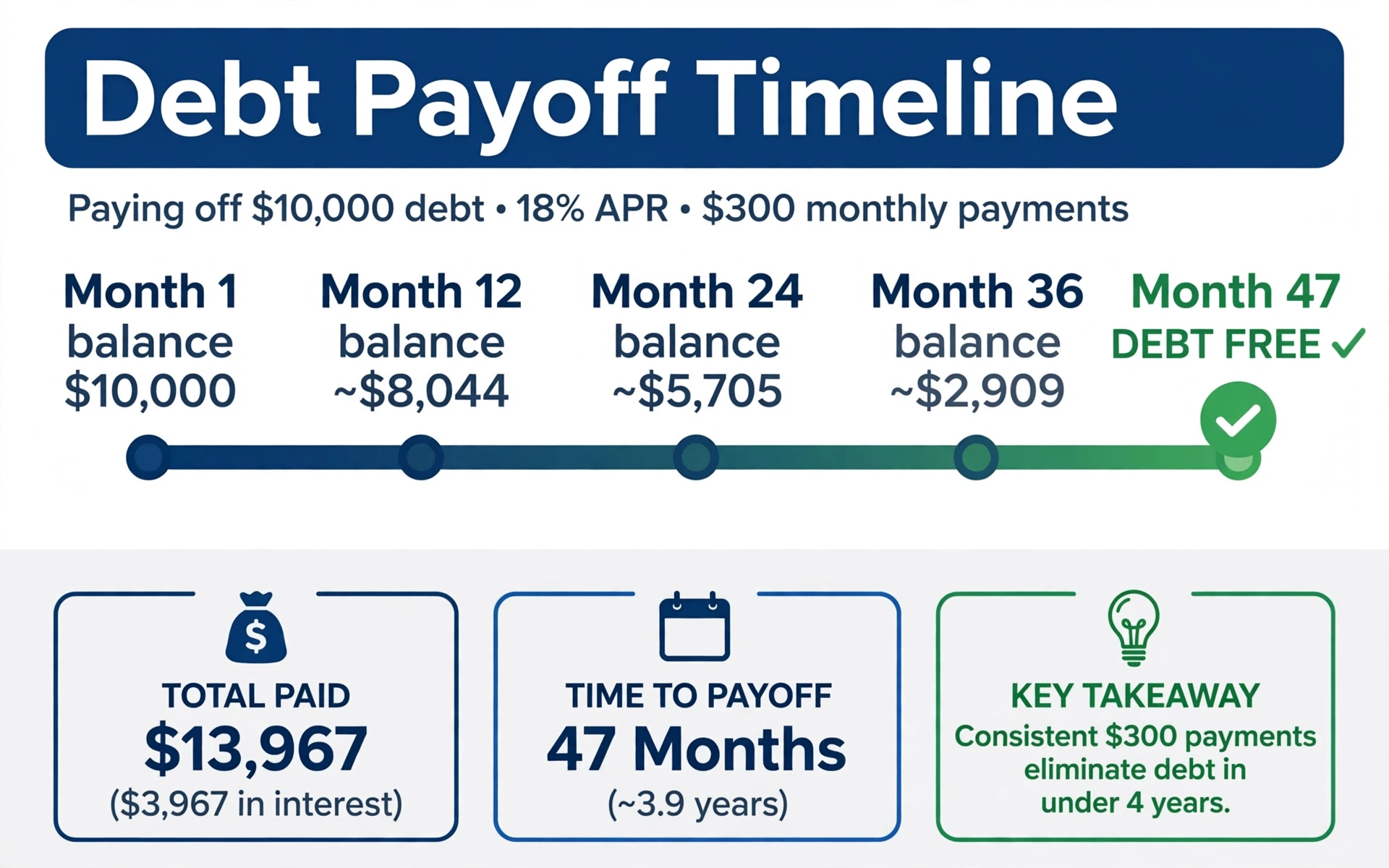
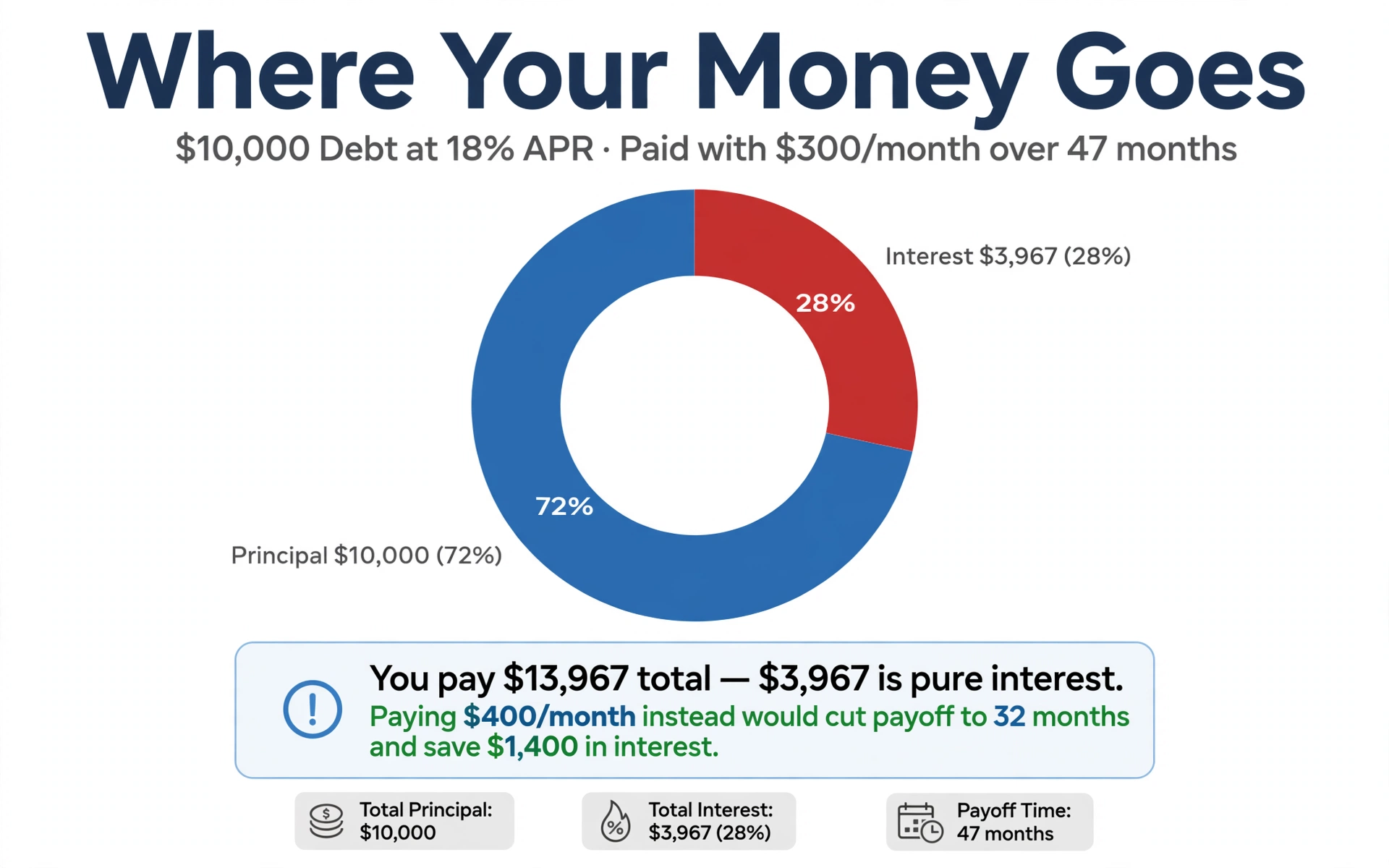
Here r is the APR divided by 12 and by 100. For a $10,000 balance at 18% APR with $300 payments, r = 0.015, so n = -log(1 - 0.5) / log(1.015) = 46.6, which rounds up to 47 payments. Total interest is simply (total paid) minus the original principal.
The formula only works when M is greater than rP — the monthly interest charge. On $10,000 at 18%, the first month's interest is $150, so any payment of $150 or less never reduces the balance.
Avalanche vs snowball: which payoff method wins?
When you have more than one debt, the order you attack them matters. The two popular strategies are the avalanche and the snowball.
| Method | Rule | Best for | Interest paid |
|---|---|---|---|
| Avalanche | Pay minimums on all debts, throw extra cash at the highest APR first | Saving the most money | Lowest |
| Snowball | Pay minimums on all debts, throw extra cash at the smallest balance first | Motivation and quick wins | Slightly higher |
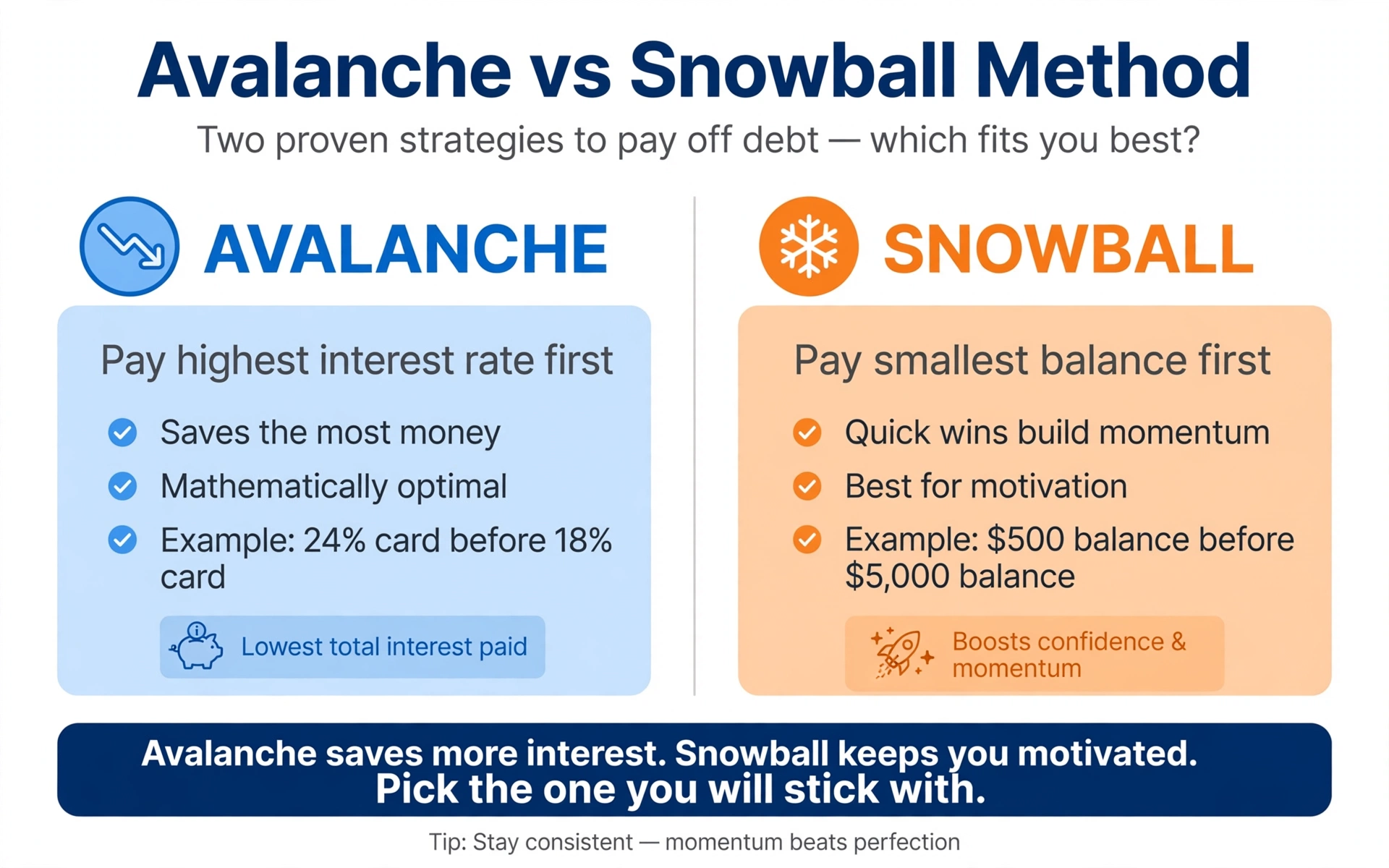
The avalanche always costs less in interest, because high-rate balances compound against you the fastest. Interest on debt works exactly like compound interest on savings, only in reverse — every month you carry a balance, the lender's money grows at your expense.
The snowball costs a little more but clears entire debts sooner, which keeps many people motivated. Studies of real payoff behavior suggest the best method is the one you follow through on, so be honest about what keeps you going.
Worked example: $10,000 at 18% APR
Take a $10,000 credit card balance at 18% APR with $300 monthly payments:
- Monthly rate: 18% / 12 = 1.5% (0.015)
- First month's interest: $10,000 x 0.015 = $150, so $150 of the $300 payment goes to principal
- Payments needed: -log(1 - 150/300) / log(1.015) = 46.6, rounded up to 47 payments
- Total paid: 46 full payments of $300 plus a final payment of $167.21 = $13,967.21
- Total interest: $13,967.21 - $10,000 = $3,967.21
Almost 40% of every dollar you pay in the early months goes straight to interest. That is why the balance barely moves at first and then falls faster near the end.
How bigger payments change your payoff date
Small increases in your monthly payment have an outsized effect, because extra money goes entirely to principal. Here is the same $10,000 debt at 18% APR with different payments:
| Monthly payment | Payoff time | Total interest | Interest saved vs $300 |
|---|---|---|---|
| $300 | 47 months | $3,967 | — |
| $400 | 32 months | $2,628 | $1,339 |
| $500 | 24 months | $1,978 | $1,989 |
| $600 | 20 months | $1,594 | $2,373 |
Doubling the payment from $300 to $600 more than halves the payoff time and saves $2,373 in interest. Even $100 extra per month saves $1,339 and gets you debt-free 15 months sooner.
7 tips to pay off debt faster
- Pay more than the minimum. Minimums are designed to keep you in debt; any extra goes straight to principal.
- Pick avalanche or snowball and commit. Avalanche saves the most; snowball keeps momentum. Either beats drifting.
- Stop adding new debt. Pause the card you are paying off — new charges reset your progress.
- Automate the payment. Automatic transfers remove willpower from the equation and avoid late fees.
- Put windfalls to work. Tax refunds, bonuses and cash gifts make outsized dents when applied as lump sums.
- Negotiate or transfer the rate. A lower APR — through a balance-transfer offer or a call to your issuer — shortens the timeline without raising payments.
- Track the balance monthly. Watching the number fall keeps the goal real. The calculator above gives you the milestones to aim for.
For impartial guidance on dealing with problem debt, the Consumer Financial Protection Bureau's Ask CFPB answers hundreds of common debt questions.
Frequently asked questions
How long will it take to pay off $10,000 in credit card debt?
It depends on your APR and payment. At 18% APR with $300 monthly payments, $10,000 takes 47 months and costs $3,967 in interest. Raise the payment to $500 and it drops to 24 months with $1,978 in interest.
What happens if my payment only covers the interest?
The balance never shrinks — you are treading water. On $10,000 at 18% APR, the monthly interest is $150, so any payment at or below $150 leaves the principal untouched. The calculator warns you when this happens.
Is the avalanche or snowball method better?
Avalanche (highest rate first) always pays less interest. Snowball (smallest balance first) clears individual debts sooner, which helps motivation. The research consensus: the best method is the one you will stick with for the full payoff period.
How is credit card interest calculated each month?
Most cards use the average daily balance method, but for planning purposes the standard approximation is monthly rate = APR / 12. Interest for the month = balance x monthly rate, then your payment is subtracted. This calculator uses that standard method.
Should I pay off debt or save money first?
High-interest debt (above roughly 7-8%) usually costs more than savings earn, so paying it down first wins mathematically. Keep a small emergency buffer of $500-$1,000 so surprise expenses do not land back on the card, then attack the debt aggressively.
Does making extra payments really save that much?
Yes. On $10,000 at 18% APR, adding $100 to a $300 payment saves $1,339 in interest and finishes 15 months sooner. Extra payments go entirely to principal, so each one also reduces every future interest charge.
Why does my balance barely move at first?
Because early payments are mostly interest. On $10,000 at 18%, the first $300 payment includes $150 of interest — only half reduces the balance. As the balance falls, the interest portion shrinks and more of each payment hits principal, so payoff accelerates near the end.
Related calculators
Loan EMI Calculator
Estimate your monthly loan payment from amount, rate and term.
Use calculatorCompound Interest Calculator
See how your savings grow with compounding interest over time.
Use calculatorMortgage Calculator
Estimate your monthly mortgage payment with taxes and insurance.
Use calculatorLoan EMI Calculator
Estimate your monthly loan payment from amount, rate and term.
Use calculator