401(k) Calculator: Project Your Retirement Balance
Enter your current balance, salary, contribution rate, employer match, expected return, and years to retirement to see your projected balance and how much of it is growth.
Formulas verified against standard references. Calculator logic tested with verified worked examples. Last reviewed: October 2026. Our methodology
How a 401(k) Grows
A 401(k) grows from three sources: money you put in, money your employer adds as a match, and investment growth on everything already in the account. Because growth compounds, money added early earns returns for longer, which is why starting early usually beats contributing more later. A dollar contributed at age 25 has about 40 years to compound, while the same dollar at age 55 has only about 10.
Contributions come out of your paycheck before income tax in a traditional 401(k), so they reduce your taxable income now, and the account grows tax-deferred until withdrawal. An employer match is extra money on top of your contribution, and it is the closest thing to a guaranteed return in investing, which is why capturing the full match comes first for most savers.
For a single lump sum growing over time, a compound interest calculator shows the same compounding idea without contributions.
The Match Formula
Your annual contribution is salary times your contribution rate. Your employer match is salary times the smaller of your rate and the match cap, times the match rate. For example, with a 60,000 salary, a 10 percent contribution, and a 50 percent match up to 6 percent of salary, you contribute 6,000 a year, and your employer adds 60,000 times 6 percent times 50 percent, which is 1,800 a year, because the match only applies up to the 6 percent cap.
This calculator compounds monthly: each month the balance grows by the monthly return, then that month's employee and employer contributions are added. Salary is held constant in this estimate, and fees, taxes, and salary growth are left out, so treat the result as a planning estimate, not a promise.
| Item | Formula | Example at 60,000 salary |
|---|---|---|
| Your yearly contribution | Salary x your rate | 60,000 x 10% = 6,000 |
| Employer match | Salary x min(your rate, cap) x match rate | 60,000 x 6% x 50% = 1,800 |
| Total yearly in | Your contribution plus match | 7,800 |
| Monthly growth | Balance x (return / 12) | At 7%, about 0.583% a month |
Worked Example
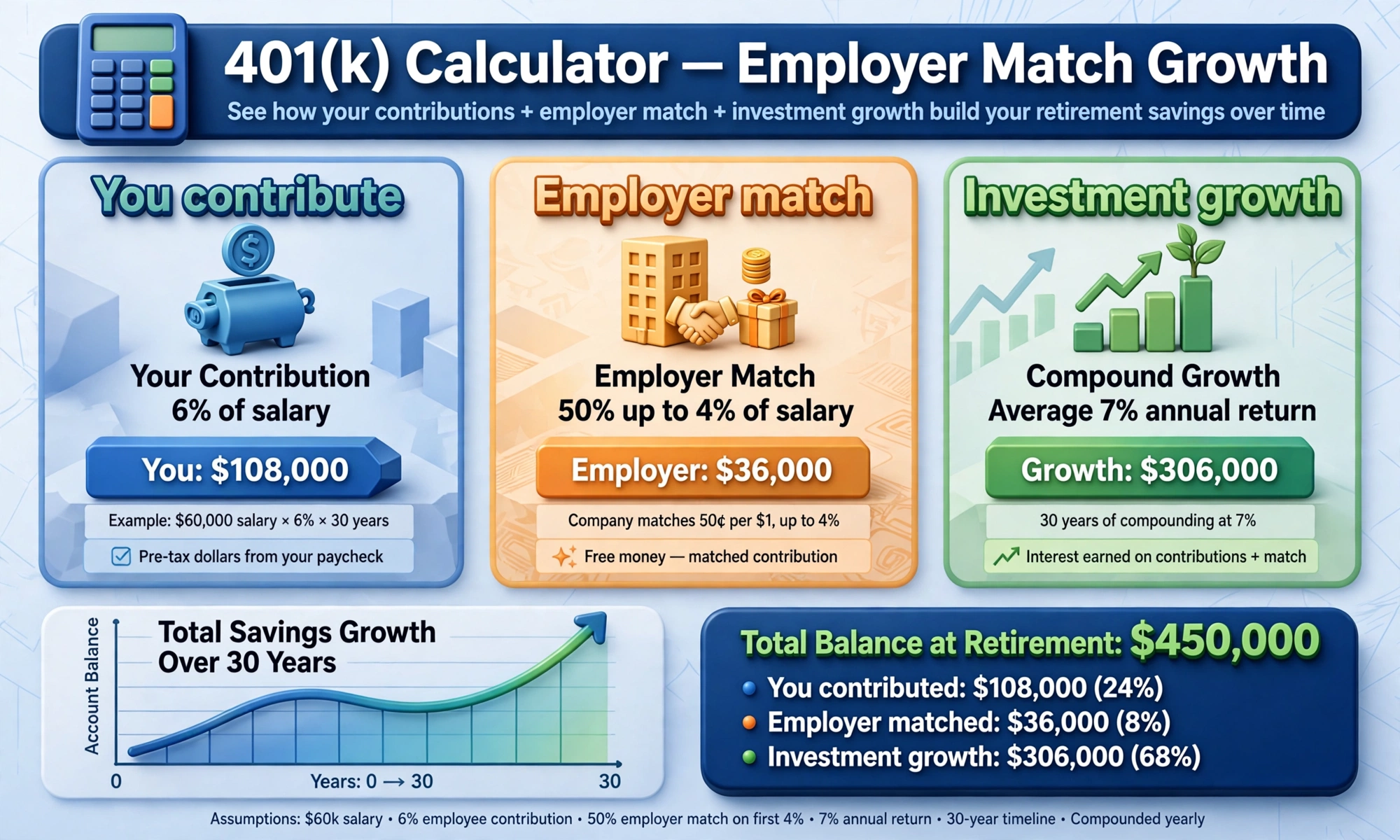
Start with a 10,000 balance, a 60,000 salary, a 10 percent contribution, a 50 percent match up to 6 percent, a 7 percent return, and 20 years. You contribute 6,000 a year, or 120,000 over 20 years. Your employer adds 1,800 a year, or 36,000 over 20 years. Monthly compounding at 7 percent grows the account to about 378,989.72, of which about 212,989.72 is investment growth.
Stretch the same plan to 30 years with no starting balance, a 6 percent contribution, and the same 50 percent match up to 6 percent, and the projection reaches about 548,986.95, with 108,000 of your money, 54,000 of employer match, and about 386,986.95 of growth. Time does most of the work in the later years, which is exactly why early contributions matter so much.
| Scenario | You contribute | Employer adds | Projected balance |
|---|---|---|---|
| 10,000 start, 10%, 20 years | 120,000 | 36,000 | 378,989.72 |
| 0 start, 6%, 30 years | 108,000 | 54,000 | 548,986.95 |
| 500 a month, 7%, 30 years | 180,000 | 0 | About 610,000 |
2026 Contribution Limits
For 2026, the employee deferral limit is 24,500 if you are under 50, with an extra 8,000 catch-up at age 50 and older, for a 32,500 personal cap. At ages 60 to 63, the catch-up is 11,250 instead, for a 35,750 personal cap. Employer matching does not count against your personal limit, so a generous match never reduces how much you may contribute yourself.
If your planned contribution exceeds the limit, this calculator still shows the projection, because limits change and some plans differ, but check your plan and the current IRS limit before relying on a contribution above the cap. Many planners suggest working toward 10 to 15 percent of salary including the match as a long-term target.
| Who | 2026 employee limit | Catch-up |
|---|---|---|
| Under 50 | 24,500 | None |
| Age 50 to 59 | 32,500 | 8,000 |
| Age 60 to 63 | 35,750 | 11,250 |
| Age 64 and older | 32,500 | 8,000 |
Common Mistakes
The biggest mistake is contributing below the match cap and leaving free money unclaimed. If your employer matches up to 6 percent and you contribute 3 percent, you receive only half the available match. Raising your contribution to the cap doubles the match at no extra cost beyond your own contribution, which is already money you keep.
Another mistake is assuming the projected return is guaranteed. A 7 percent average hides years of losses and gains, and fees, inflation, and taxes all reduce what you can spend in retirement. A third mistake is stopping contributions during a market fall, which is when each contribution buys more shares and future growth has the most room to recover.
Practical Uses
Use this calculator to test trade-offs: a higher contribution rate, an extra five years, or a lower assumed return, each changes the projection in a way that is hard to guess without running the numbers. It is also useful before a job change, since a weaker match at a new employer can be worth thousands a year, and that belongs in any salary comparison.
For retirement income planning, a retirement calculator turns a balance into monthly income. Use this 401(k) calculator first to build the balance, then plan withdrawals from it.
Frequently asked questions
How much should I contribute to my 401(k)?
At minimum, contribute enough to capture your full employer match. Many planners suggest working toward 10 to 15 percent of salary including the match over time.
What is the 2026 401(k) contribution limit?
24,500 if you are under 50, 32,500 at age 50 and older with the 8,000 catch-up, and 35,750 at ages 60 to 63 with the 11,250 super catch-up. Employer match does not count against your limit.
How does an employer match work?
Your employer adds a percentage of your contribution up to a cap. A 50 percent match up to 6 percent of salary adds 3 percent of salary when you contribute at least 6 percent.
Does salary growth change the projection?
Yes, in real life raises usually raise contributions too. This calculator holds salary constant for a conservative, easy-to-read estimate, so a rising salary would generally give a larger balance.
Is the projected balance guaranteed?
No. Returns vary year to year, and fees, inflation, and taxes are not included. Treat the result as a planning estimate under the return you entered.
What happens if I withdraw before age 59 and a half?
Withdrawals are generally taxed as income, plus a 10 percent early withdrawal penalty, with some exceptions. Check the rules before withdrawing early.
Traditional or Roth 401(k)?
Traditional contributions reduce taxable income now and are taxed on withdrawal, while Roth contributions are taxed now and withdrawals are generally tax-free. The better choice depends on your current and expected future tax rates.