Roth IRA Calculator: Project Your Tax-Free Retirement Balance
A Roth IRA grows tax-free and pays out tax-free in retirement, so the real question is how much your contributions can compound into. Enter your balance, yearly contribution, ages and expected return to project your balance at retirement — and see what the same money would look like in a taxable account.
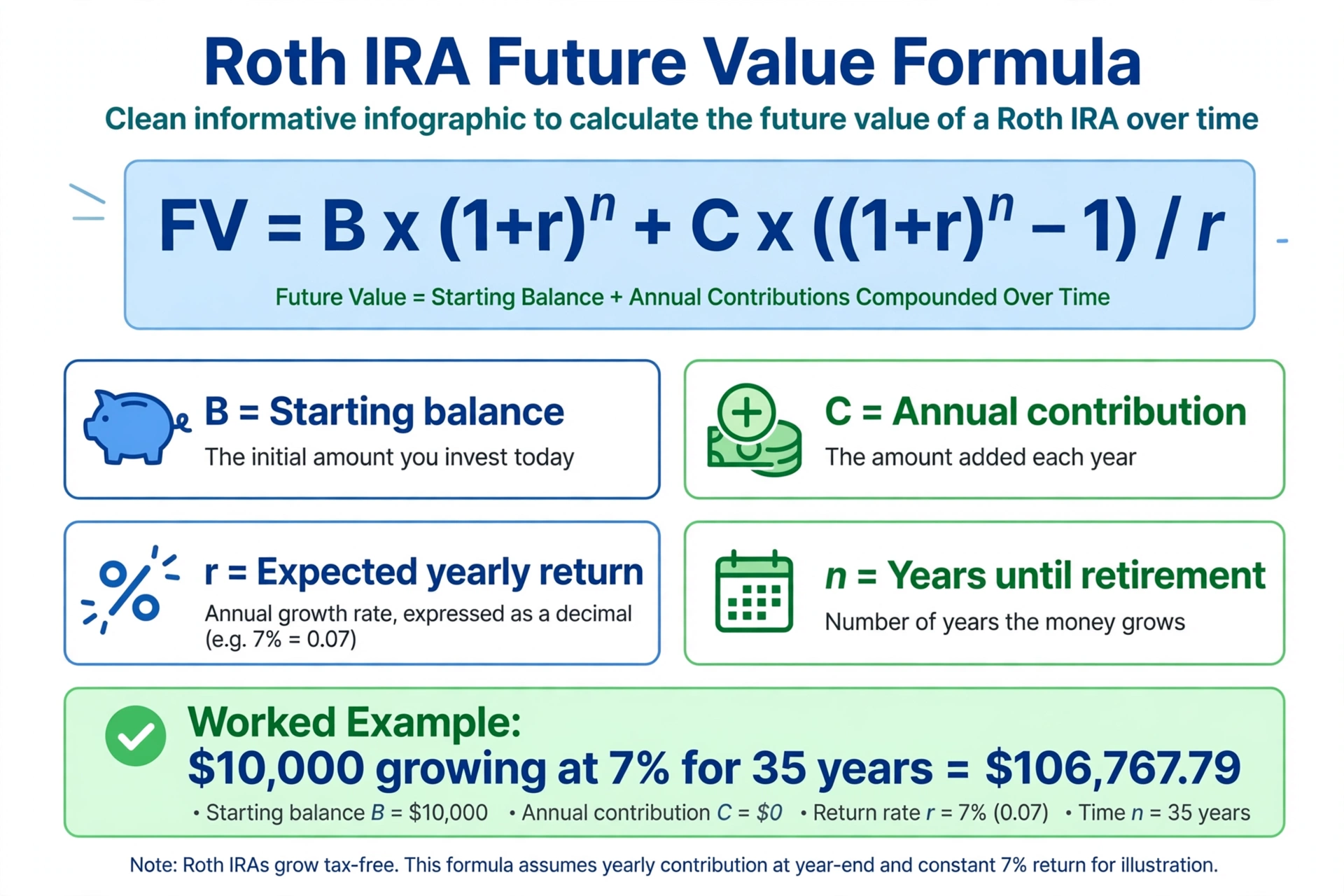
The Roth IRA future value formula
The calculator projects your balance with two parts: the future value of what you already have, plus the future value of an ordinary annuity (your annual contributions, assumed to land at the end of each year):
FV = B × (1+r)n + C × ((1+r)n − 1) ÷ r
- B — current balance
- C — annual contribution
- r — expected annual return as a decimal (7% = 0.07)
- n — retirement age minus current age, in years
End-of-year contributions are the conservative timing: money added in January would compound a little longer. The formula also assumes one constant return, which smooths out the market's real ups and downs.
Worked example
A 30-year-old with $10,000 already in a Roth IRA contributes $7,000 a year until age 65, earning 7% a year:
- Years of growth: n = 65 − 30 = 35
- Growth factor: (1.07)35 = 10.676582
- Starting balance grows to: $10,000 × 10.676582 = $106,765.81
- Contributions grow to: $7,000 × (10.676582 − 1) ÷ 0.07 = $967,658.15
- Total at 65: $106,765.81 + $967,658.15 = $1,074,423.96, all withdrawable tax-free
Total contributions were $255,000, so $819,423.96 of the final balance is growth the IRS never touches.
How to use the Roth IRA calculator
Seven inputs and one click. Here is what each field means and how to choose sensible values.
Step by step
- Enter your current balance — what is in your Roth IRA today. Use 0 if you are starting fresh.
- Enter your annual contribution — what you plan to add each year until retirement.
- Enter your current age and retirement age. The gap between them is how many years your money compounds.
- Enter your expected annual return. Many planners use 6–7% after inflation for a stock-heavy portfolio. Higher numbers are not free money — they assume more risk and more volatility.
- Enter your marginal tax rate now and your expected rate at retirement. These only affect the taxable-account comparison, not the Roth projection.
- Press Calculate. Everything runs in your browser; nothing is uploaded or stored.
What you get
- Projected Roth IRA balance at your retirement age
- Total contributions — your starting balance plus every annual contribution
- Total growth — the tax-free earnings your money produced
- Taxable-account comparison — a simplified estimate of the same plan in a regular taxable account, and how much tax the Roth saves you
- The arithmetic — the working behind the numbers, so you can check it
If you also hold a 401(k) or a traditional IRA alongside your Roth, project the full picture with our retirement calculator.
Roth IRA vs taxable account: where the gap comes from
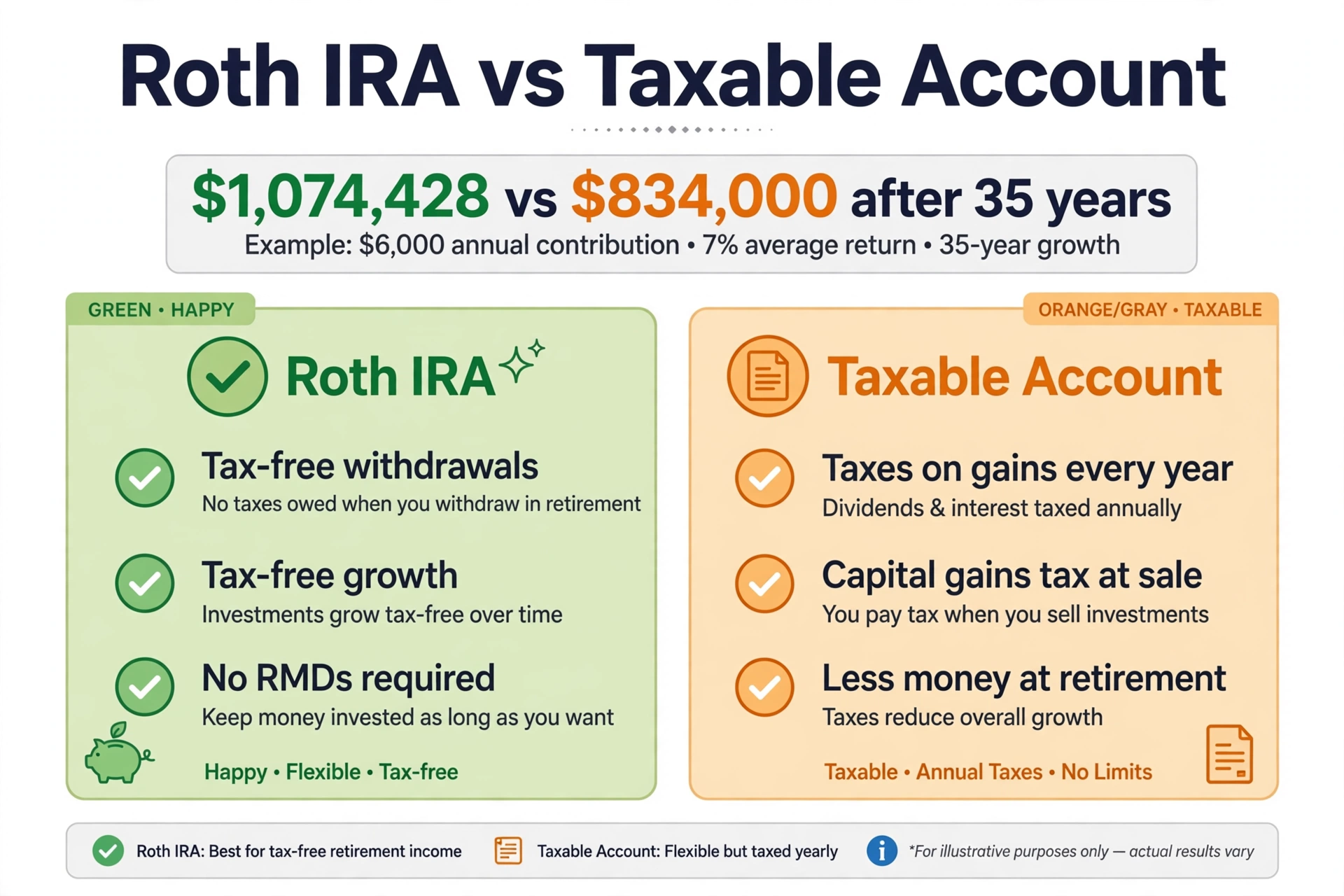
Two forces make the taxable account smaller. First, taxes nibble every year: dividends and interest are taxed as they arrive, so less money stays invested to compound. The calculator models this by shrinking the yearly return — effective return = return × (1 − your tax rate now). Second, when you sell at retirement, the gains still owe tax, which the calculator models at your expected retirement tax rate.
Same plan, two accounts (default inputs)
| Measure | Roth IRA | Taxable account (estimate) |
|---|---|---|
| Balance at 65 | $1,074,423.96 | $684,393.83 |
| Total contributions | $255,000.00 | $255,000.00 |
| Total growth | $819,423.96 | $429,393.83 |
| Tax paid (estimate) | $0.00 | $390,030.13 |
The taxable column is a simplified estimate, not a tax forecast. Real taxable investing can defer some taxes by holding investments, and tax rates change over decades. Use the comparison to see the size of the Roth advantage, not an exact dollar figure. You can cross-check the projection model against calculator.net's Roth IRA calculator, which uses the same end-of-year contribution timing.
Roth IRA limits and rules that change your result
The calculator does not enforce IRS rules, so check these before you act on your numbers.
2026 contribution limits
| Age | Annual limit (2026) |
|---|---|
| Under 50 | $7,500 |
| 50 or older | $8,600 (includes a $1,100 catch-up) |
The limit applies across all of your IRAs combined — Roth and traditional together — and you must have earned income at least equal to what you contribute. Contributions for a tax year can be made until the filing deadline, April 15, 2027 for 2026.
2026 income limits (direct contributions)
| Filing status | Phase-out range (MAGI) | Above the range |
|---|---|---|
| Single or head of household | $153,000–$168,000 | No direct contribution |
| Married filing jointly | $242,000–$252,000 | No direct contribution |
Inside the phase-out range you can make a reduced contribution; above it, you cannot contribute directly at all (a backdoor Roth conversion through a traditional IRA is a separate strategy with its own tax wrinkles — talk to a tax professional first).
Earnings can be withdrawn tax-free once you are 59½ and the account has been open at least five years. Your own contributions can be withdrawn anytime, tax-free and penalty-free. To see how different return assumptions move the final balance, run the same inputs through our investment calculator.
Frequently asked questions
How does the Roth IRA calculator project my balance?
It compounds your current balance for the years until retirement, then adds the future value of your annual contributions, assuming each contribution lands at the end of the year and the return stays constant. The formula is FV = B × (1+r)^n + C × ((1+r)^n − 1) ÷ r.
Why does the taxable account end up smaller than the Roth IRA?
Two reasons: taxes are taken out of the investment gains every year, which slows compounding, and the remaining gains are taxed again when you sell at retirement. The calculator estimates both effects from the two tax rates you enter. It is a simplified model — real taxable investing can defer some taxes by holding — so treat it as an illustration of the advantage, not a forecast.
How much can I contribute to a Roth IRA in 2026?
For 2026 the limit is $7,500 if you are under 50, or $8,600 if you are 50 or older, including a $1,100 catch-up contribution. The limit covers all your IRAs combined, Roth and traditional together, and you need earned income at least equal to your contribution.
What if my income is above the Roth IRA limit?
Direct Roth contributions phase out with income. For 2026 the phase-out ranges are $153,000–$168,000 of modified adjusted gross income for single filers and heads of household, and $242,000–$252,000 for married couples filing jointly. Above the top of the range you cannot contribute directly, though some high earners use a backdoor Roth conversion through a traditional IRA — get tax advice before trying it.
Are Roth IRA withdrawals really tax-free?
Qualified withdrawals are: you must be at least 59½ and the account must have been open for at least five years. Your own contributions are different — they can be withdrawn at any time, tax-free and penalty-free, because you already paid tax on that money.
What annual return should I assume?
Many retirement planners use 6–7% a year after inflation for a portfolio heavy in stocks, which is below the stock market's long-run historical average of roughly 10% before inflation. The calculator applies your rate as a smooth constant, so treat the result as one scenario, not a promise — real returns bounce around.
Does the calculator include the tax I pay on contributions?
No, and that is by design. Roth contributions are made with after-tax dollars, so the income tax on them is paid before the money ever enters the account. The calculator projects what happens after that: tax-free growth and tax-free qualified withdrawals.
Related calculators

Investment Calculator
Project how your lump sum and monthly contributions grow with compound returns over time.
Use calculatorCompound Interest Calculator
See how your savings grow with compounding interest over time.
Use calculatorSavings Goal Calculator
Find the monthly savings needed to reach your target from your goal, current savings, rate and timeframe.
Use calculatorRetirement Calculator
Project your retirement nest egg from age, savings, contributions and expected returns.
Use calculatorFuture Value Calculator
Project lump-sum and monthly-deposit growth with compound interest.
Use calculatorCAGR Calculator
Compute compound annual growth rate from start and end values.
Use calculator