Future Value Calculator: How Much Will Your Money Grow?
How much will your money be worth in 10, 20 or 30 years? Enter a starting amount, an optional regular deposit, the expected annual return and the time horizon, and this free future value calculator will project the exact maturity value — and show how much of it is pure compound growth.
Formulas verified against standard references. Calculator logic tested with verified worked examples. Last reviewed: October 2026. Our methodology
How future value is calculated
Future value answers one question: what is money worth later, if it grows at a steady rate? The engine is compound interest — every period, earnings are added to the balance and start earning themselves.
- Lump sum: FV = PV × (1 + r ÷ n)(n × t), where PV is the starting amount, r the annual rate, n compounding periods per year, t years.
- Regular deposits: FV = PMT × [((1 + r ÷ n)(n × t) − 1) ÷ (r ÷ n)], the future value of an annuity — each deposit compounds for the time remaining.
- Total future value is the sum of both parts; interest earned is the total minus everything you put in.
| Scenario ($10,000 start, 10 years) | At 5% | At 7% | At 10% |
|---|---|---|---|
| No deposits | $16,288.95 | $19,671.51 | $25,937.42 |
| +$200/month | $46,581.44 | $54,713.58 | $71,100.52 |
Two percentage points of return nearly double the outcome over a decade — and regular deposits matter even more than the rate. Time is the real multiplier: the same $10,000 at 7% becomes $19,672 in 10 years but $76,123 in 30.
Worked example
You invest $10,000 at 7% annual interest, compounded monthly, for 10 years, with no extra deposits. Monthly rate: 0.07 ÷ 12 = 0.005833. Periods: 12 × 10 = 120.
FV = 10,000 × (1.005833)120 = 10,000 × 2.00966 = $20,096.61. Interest earned: $20,096.61 − $10,000 = $10,096.61 — the growth alone exceeds the original deposit.
Add $200 every month: deposits grow to 200 × ((1.005833120 − 1) ÷ 0.005833) = $34,616.96, for a total of $54,713.58.
How to use the future value calculator
Pick a realistic rate — historical US stock returns average around 7–10% before inflation — and let compounding do the talking.
Step by step
- Enter the initial amount. The lump sum you are starting with today; 0 is fine if you are starting from scratch.
- Enter the regular deposit (optional). What you will add each compounding period — set compounding to monthly and enter your monthly contribution.
- Enter the annual interest rate. Use the expected average return, not the best year you hope for.
- Enter the years and compounding frequency. Match compounding to how the investment actually credits interest.
- Press Calculate. Read the future value, total invested and interest earned.

Why the rate matters less than you think — and time matters more
Investors obsess over finding an extra 1% of return. The math says time usually wins that argument:
| $10,000 invested at 7% | Future value | Interest earned |
|---|---|---|
| 10 years | $20,097 | $10,097 |
| 20 years | $40,387 | $30,387 |
| 30 years | $81,165 | $71,165 |
Each extra decade roughly doubles the result. Starting ten years earlier beats earning two extra percentage points for thirty years. If you are young, the single highest-value move is simply to start — a compound interest calculator shows the same effect from the growth-rate side.
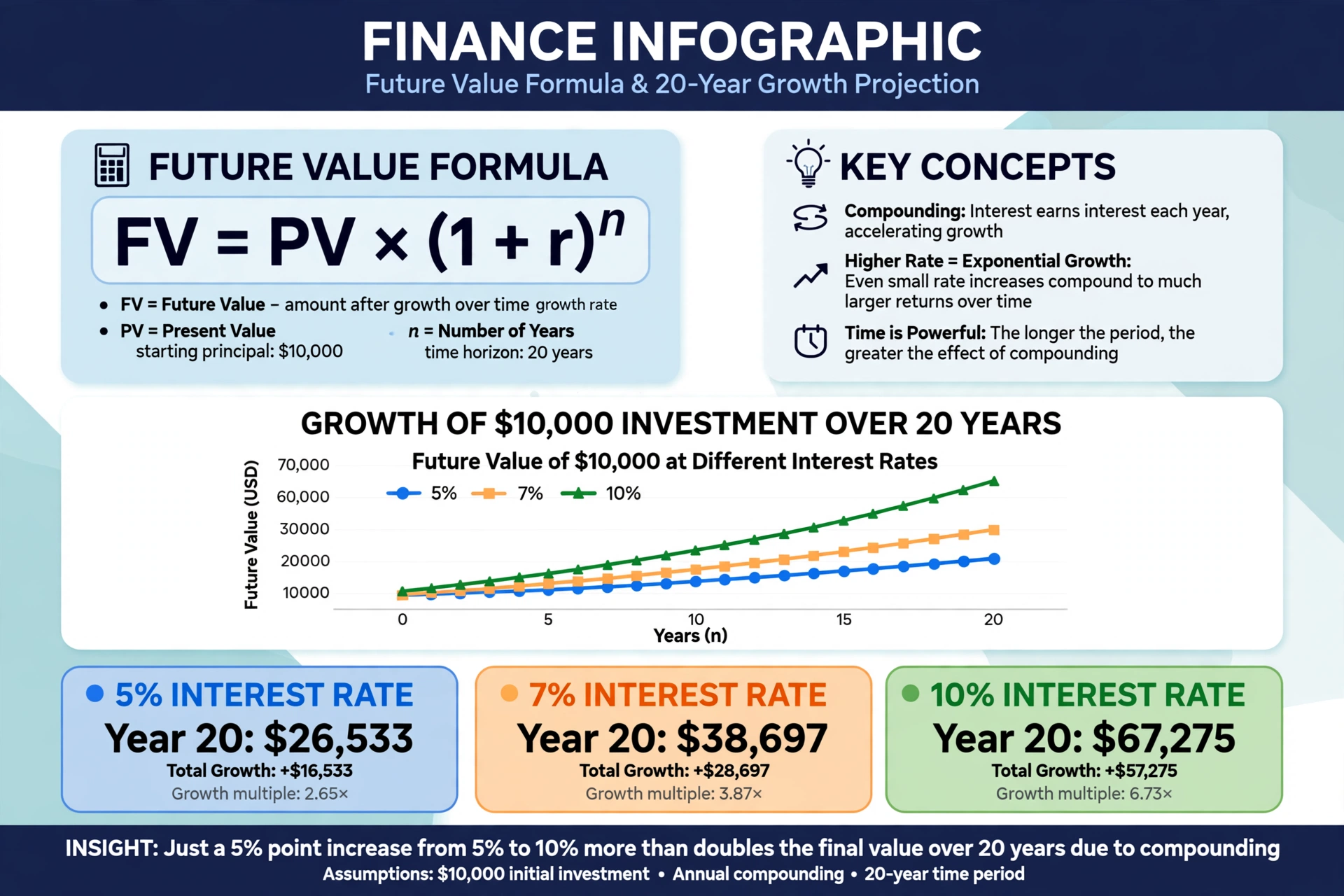
Lump sum vs. monthly deposits: which builds more?
A windfall and a habit lead to the same formula but feel very different. Compare $10,000 once against $200 a month for 10 years at 7%:
- $10,000 lump sum: $20,097 — your money works the full decade.
- $200/month ($24,000 total in): $34,617 from deposits alone — you put in more, so you end with more.
- Both together: $54,714 — the lump sum compounds longest while deposits keep feeding the fire.
Deposits win on totals because more money goes in; the lump sum wins on efficiency because every dollar compounds longest. Most real plans combine both: invest the windfall now, automate the monthly deposit, and let time multiply the pair. A savings goal calculator works the problem backwards — it tells you the monthly deposit a target needs.
Nominal vs. real future value: inflation takes a cut
The calculator shows nominal future value — the number on the statement. Real future value is what that money will actually buy after inflation.
- Real return ≈ nominal return − inflation. 7% growth with 3% inflation is about 4% real growth.
- $54,714 in 10 years at 3% inflation buys what about $40,700 buys today — still excellent, but a third less impressive.
- For retirement planning, run the calculator at a real rate (say 4–5%) to see purchasing power directly.
Never compare a future value to today's prices without the inflation haircut. Run your result through an inflation adjustment before deciding what "enough" means.

Frequently asked questions
How do you calculate future value?
For a lump sum: FV = PV × (1 + r)^t, where r is the periodic rate and t the number of periods. For regular deposits, add the future value of an annuity: PMT × (((1+r)^t − 1) ÷ r). The calculator combines both parts automatically.
What is a good annual return to assume?
For US stocks, 7–10% nominal (about 4–7% after inflation) is the long-run historical range. For savings accounts or CDs, use the quoted APY (2–5%). Pick the rate that matches the actual investment, not the one you wish for.
Does compounding frequency matter much?
Modestly. $10,000 at 7% for 10 years is $19,672 annual vs $20,097 monthly compounding — about a 2% difference. Your choice of rate and time horizon moves the result far more.
How does inflation affect future value?
The calculator shows nominal dollars. To get purchasing power, subtract inflation: at 3% inflation, divide the result by 1.03^t. Or enter a 'real' rate (nominal minus inflation) directly.
Lump sum or monthly deposits — which is better?
Both together win. A lump sum compounds longest per dollar; monthly deposits let you invest far more total money. $10,000 once at 7% for 10 years is $20,097; $200/month alone is $34,617; combined they reach $54,714.
What is the rule of 72?
A shortcut: divide 72 by your rate to get the years needed to double your money. At 7%, money doubles every ~10.3 years; at 10%, every 7.2 years. It is an approximation of the same compounding math.
Can future value be guaranteed?
No — the calculator projects a steady assumed rate, but real investments fluctuate. Treat the result as a planning scenario, not a promise, and rerun it at a lower rate to stress-test your plan.