Pay Raise Calculator: Your New Salary After a Raise
Enter your current salary and your raise percent to see your new salary, how much extra you earn each month, and your new hourly rate.
Formulas verified against standard references. Calculator logic tested with verified worked examples. Last reviewed: October 2026. Our methodology
How a Raise Is Calculated
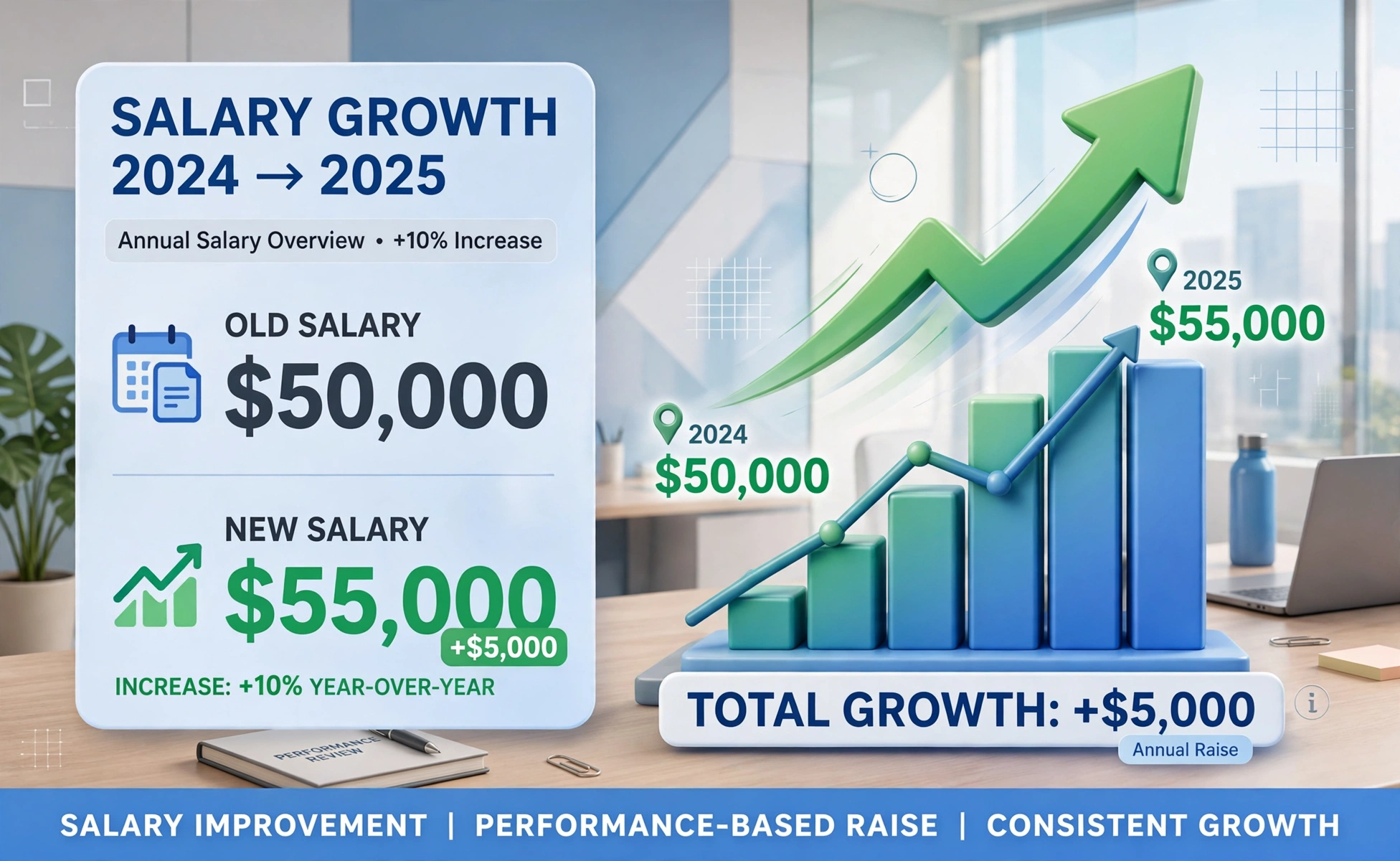
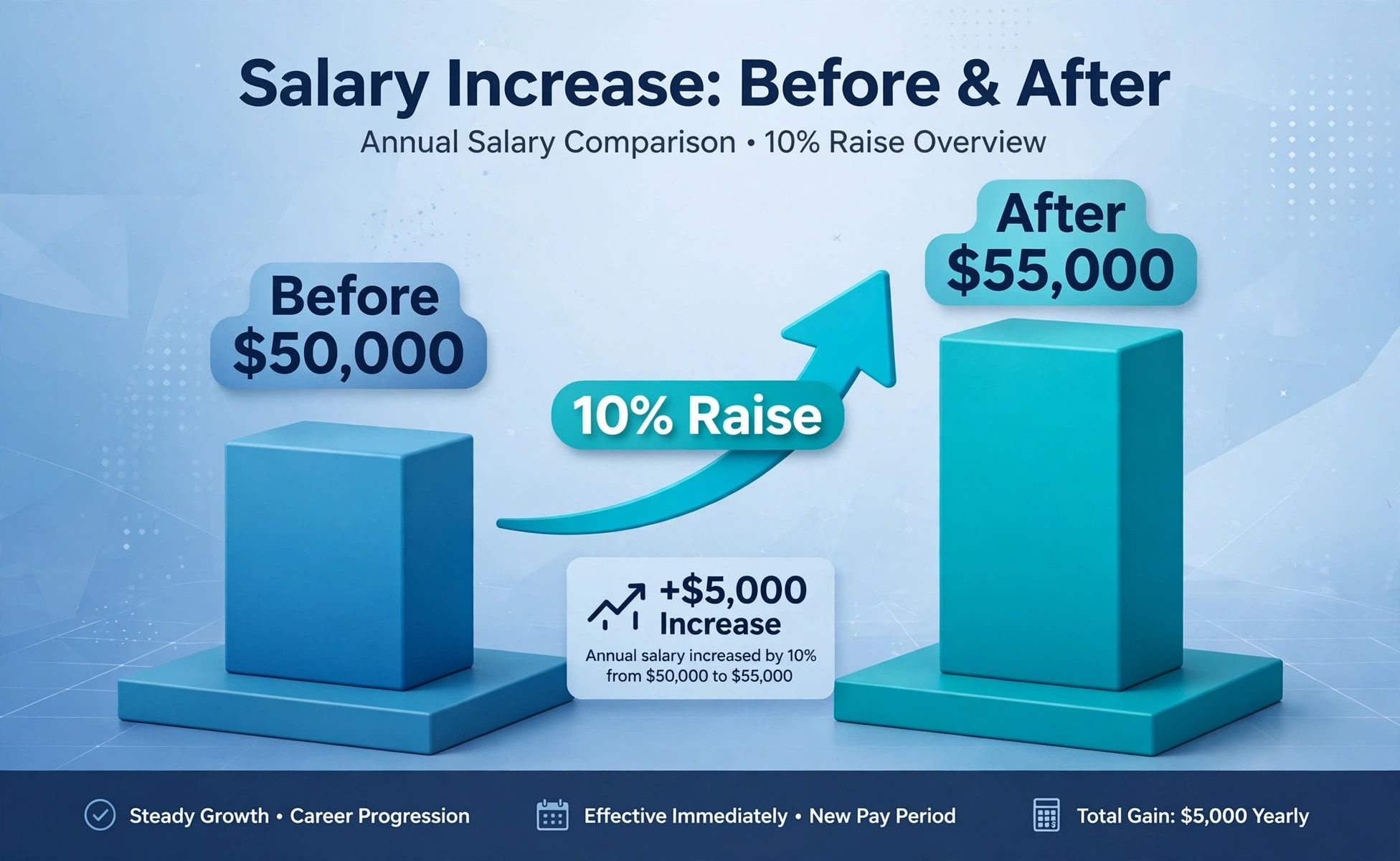
A raise percent applies to your current salary: new salary equals current salary times 1 plus raise percent divided by 100. So a 10 percent raise on $50,000 adds $5,000, giving $55,000. The increase itself is current salary times raise percent divided by 100.
Monthly increase is the yearly increase divided by 12, and hourly rate is yearly salary divided by hours worked in a year, usually hours per week times 52 weeks. At 40 hours a week, $50,000 is $24.04 an hour, and $55,000 is $26.44 an hour.
For converting between hourly and yearly pay in the other direction, a salary calculator handles hourly, weekly, monthly, and annual conversions.
Percent Versus Flat Raises
A percent raise scales with your salary: 10 percent on $50,000 is $5,000, but 10 percent on $100,000 is $10,000. A flat raise, like $3,000 for everyone, is worth a bigger percent to lower earners and a smaller percent to higher earners, which is why companies usually talk in percents.
When comparing offers, convert everything to the same basis. A $5,000 raise on $50,000 is 10 percent, while the same $5,000 on $80,000 is only 6.25 percent. Percent is the fair way to compare raises across different salaries.
| Current salary | Raise | Increase | New salary |
|---|---|---|---|
| $50,000 | 10% | $5,000 | $55,000 |
| $50,000 | 5% | $2,500 | $52,500 |
| $80,000 | 5% | $4,000 | $84,000 |
| $80,000 | 10% | $8,000 | $88,000 |
Worked Examples
Example 1: $50,000 with a 10 percent raise. Increase $5,000, new salary $55,000, monthly increase $416.67, new hourly rate at 40 hours $26.44. Example 2: $65,000 with a 3 percent raise. Increase $1,950, new salary $66,950, monthly increase $162.50.
Example 3: $40,000 with a 7.5 percent raise. Increase $3,000, new salary $43,000. Example 4: a pay cut of 5 percent on $60,000. Enter -5 as the percent: change -$3,000, new salary $57,000.
| Current salary | Raise | New salary | Monthly change |
|---|---|---|---|
| $50,000 | 10% | $55,000 | $416.67 |
| $65,000 | 3% | $66,950 | $162.50 |
| $40,000 | 7.5% | $43,000 | $250.00 |
| $60,000 | -5% | $57,000 | -$250.00 |
Raises Versus Inflation
A raise only improves your spending power if it beats inflation. If prices rose 4 percent and your raise is 3 percent, your real pay fell about 1 percent, even though the number on your paycheck went up. Real raise equals nominal raise minus inflation, approximately, and that is the number that decides whether you are actually better off.
That is why a 10 percent raise in a 3 percent inflation year is a strong result, while a 2 percent raise in a 6 percent inflation year is a real pay cut. Always compare your raise with the inflation rate for the same year before celebrating or negotiating.
| Nominal raise | Inflation | Real change | Verdict |
|---|---|---|---|
| 10% | 3% | About 7% up | Real gain |
| 5% | 4% | About 1% up | Small real gain |
| 3% | 4% | About 1% down | Real pay cut |
| 2% | 6% | About 4% down | Real pay cut |
Common Mistakes
The most common mistake is adding percents that apply to different bases: a 10 percent raise followed by a 10 percent raise is not a 20 percent raise on the original, it is 21 percent, because the second raise applies to the already raised salary. Compounding works for raises just like for interest.
A second mistake is comparing gross and net figures: a $5,000 gross raise may be $3,500 or less after tax, depending on your bracket. A third mistake is forgetting benefits: a raise with worse health coverage or no bonus may be worth less than a smaller raise that keeps them.
Practical Uses
Use this calculator when an offer lands, when review season comes, or when comparing two jobs: enter the salary and the raise percent and see the monthly difference, which is what your budget actually feels. A $416 monthly increase covers a car payment, while $162 covers groceries for a week or two.
Also use it to set a negotiation target: decide the monthly increase you need, multiply by 12, and divide by your current salary to get the percent to ask for. Walking in with a number backed by arithmetic beats asking for a vague bigger raise.

Frequently asked questions
How do I calculate a 10 percent raise on $50,000?
Multiply $50,000 by 10 percent to get a $5,000 increase, so the new salary is $55,000.
What is the formula for a pay raise?
New salary equals current salary times 1 plus raise percent divided by 100. The increase alone is current salary times raise percent divided by 100.
How much is a 5 percent raise per month?
It depends on salary: on $60,000 it is $3,000 a year, or $250 a month before tax.
Can this calculator handle a pay cut?
Yes. Enter a negative percent, like -5, and it shows the reduced salary and the monthly decrease.
Is a raise above inflation good?
Yes. If your raise beats inflation, your real spending power grows. If it trails inflation, your real pay falls even though the number rises.
How do I convert salary to an hourly rate?
Divide annual salary by hours per week times 52. At 40 hours a week, $55,000 is $26.44 an hour.
Are these figures before or after tax?
Before tax. Your take home increase will be smaller after income tax and payroll deductions.