Running Pace Calculator
Find your pace from any distance and time, predict a finish time from a target pace, or see how far a pace and time will carry you.

Formulas verified against standard references. Calculator logic tested with verified worked examples. Published: November 3, 2026 | Last updated: November 3, 2026. Fact-checked: November 3, 2026. Our methodology
What a Running Pace Calculator Does
A running pace calculator turns distance and time into pace, in minutes and seconds per kilometer or per mile. This one solves the equation in three directions. Find pace from distance and time, predict a finish time from a target pace, or work out how far a pace and time will take you.
Pace is how runners compare efforts and plan races. A 5:00 per km pace means each kilometer took five minutes. The calculator accepts kilometers, miles, or meters, so track workouts and road races both work.
The Running Pace Formulas
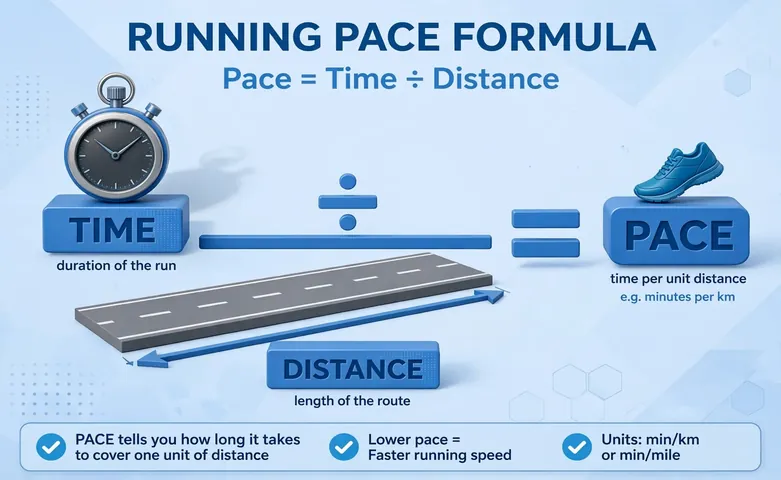
The three formulas rearrange one relationship. Pace in seconds per km equals total time in seconds divided by distance in km. Flip it and finish time in seconds equals pace in seconds per km times distance in km. Flip it again and distance in km equals total time in seconds divided by pace in seconds per km.
Two conversions complete the picture. Pace per mile equals pace per km times 1.609344, because one international mile is exactly 1.609344 km. Speed in km/h equals 3,600 divided by pace in seconds per km, the number your treadmill shows.
Worked Example
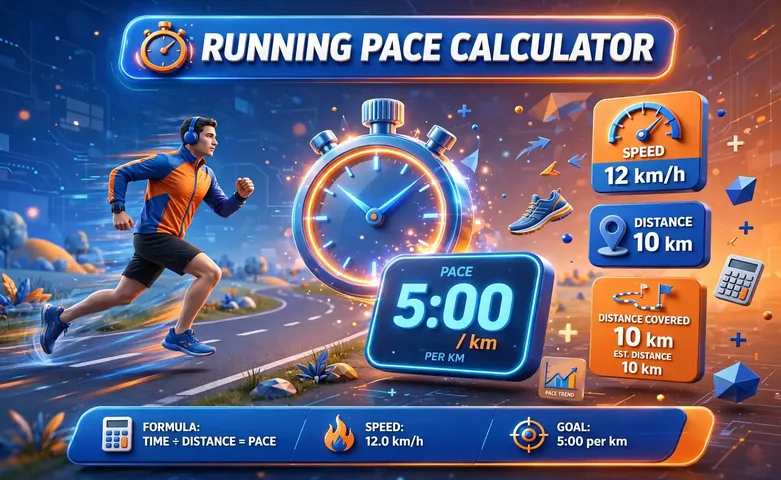
A runner covers 10 km in 50 minutes. First convert the time, so 50 minutes is 3,000 seconds. Pace is 3,000 divided by 10, which is 300 seconds per km, or 5:00 per km. For the per-mile figure, 300 times 1.609344 is 482.8 seconds, which rounds to 8:03 per mile. Speed is 3,600 divided by 300, which is 12.0 km/h.
The same math predicts a finish. Hold 6:00 per km for 5 km and the time is 360 seconds times 5, which is 1,800 seconds, or 30:00. Every result on this page shows these steps with your own numbers.
How to Read Your Pace
Lower pace means faster running, which trips up beginners. A 5:00 per km runner beats a 6:00 per km runner, while the speed numbers run the opposite way, so 12 km/h beats 10 km/h. Treadmill runners read the speed column and GPS watch racers read the pace column.
Compare pace only over the same distance. A 5:00 per km 5K does not mean you can hold 5:00 per km in a marathon, because fatigue slows almost everyone as distance grows. Pair pace with heart rate to see the full picture, and the target heart rate calculator shows which effort zone each run should sit in.
Common Pacing Mistakes
The first mistake is mixing up pace and speed. Pace is time per distance and speed is distance per time, so they are inverses. The second mistake is timing the warm-up with the run. If your time includes walking or jogging before the fast part, your true pace is faster than the calculator shows.
The third mistake is trusting a short-race pace for a long race. Multiply your 5K pace by the marathon distance and you get an optimistic number, not a prediction, because endurance fades. If you only need pace from one run, the simpler pace calculator gives the same answer with fewer fields.
When Pace Math Is Not Enough
The formulas assume perfectly even running on flat ground in calm weather. Hills, heat, wind, and a crowded start all cost time no formula can see, so treat every prediction as a planning number. Most runners race better starting a few seconds per km slower than target and speeding up if they feel strong.
Pace tells you how fast you went, not how the effort felt. If you are building a training plan or returning from injury, talk to a coach or a clinician before chasing a faster number. To estimate what the run cost in energy, use the calories burned calculator. This calculator gives general fitness estimates, not medical advice, and the disclaimer page has the full details.

Frequently asked questions
How do I calculate my running pace?
Divide total time by distance. For example, 25 minutes over 5 km is 5:00 per km. Enter hours, minutes, and seconds in Find pace mode and the calculator does the rest.
How do I convert pace per km to pace per mile?
Multiply per-kilometer pace by 1.609344, since one international mile is exactly 1.609344 km. So 5:00 per km is 8:03 per mile. The calculator shows both automatically.
How do I predict my race finish time?
Multiply target pace by race distance. Hold 6:00 per km for 5 km and you finish in 30:00. Use Predict finish time mode with your distance and goal pace.
What is the difference between pace and speed?
Pace is time per distance, such as minutes per km. Speed is distance per time, such as km/h. They are inverses. A lower pace means faster running, and a higher speed means faster running.
Will I hold the same pace in a longer race?
Usually not. Fatigue slows most runners as distance grows, so a time predicted from a short-race pace is optimistic for a longer race. Treat it as a planning number.
Related calculators

Pace Calculator
Find your pace from distance and time.
Use calculatorCalories Burned Calculator
Estimate calories burned while running.
Use calculatorTarget Heart Rate Calculator
Find your training heart rate zones.
Use calculatorSteps Calculator
Convert steps to distance and back.
Use calculatorVO2 Max Calculator
Estimate your aerobic fitness level.
Use calculatorOne Rep Max Calculator
Estimate your one-rep max strength.
Use calculatorBMI Calculator
Body mass index from height and weight.
Use calculatorTDEE Calculator
Daily calorie burn from activity level.
Use calculatorWater Intake Calculator
Daily water needs for your body.
Use calculatorCalorie Calculator
Daily calorie needs for your goal.
Use calculator