Water Intake Calculator: How Much Water Should You Drink Daily?
Enter your weight, daily exercise and climate to get a personal daily water target — shown in liters, milliliters, US cups and fluid ounces.
The water intake formula
The calculator builds your daily target from three parts:
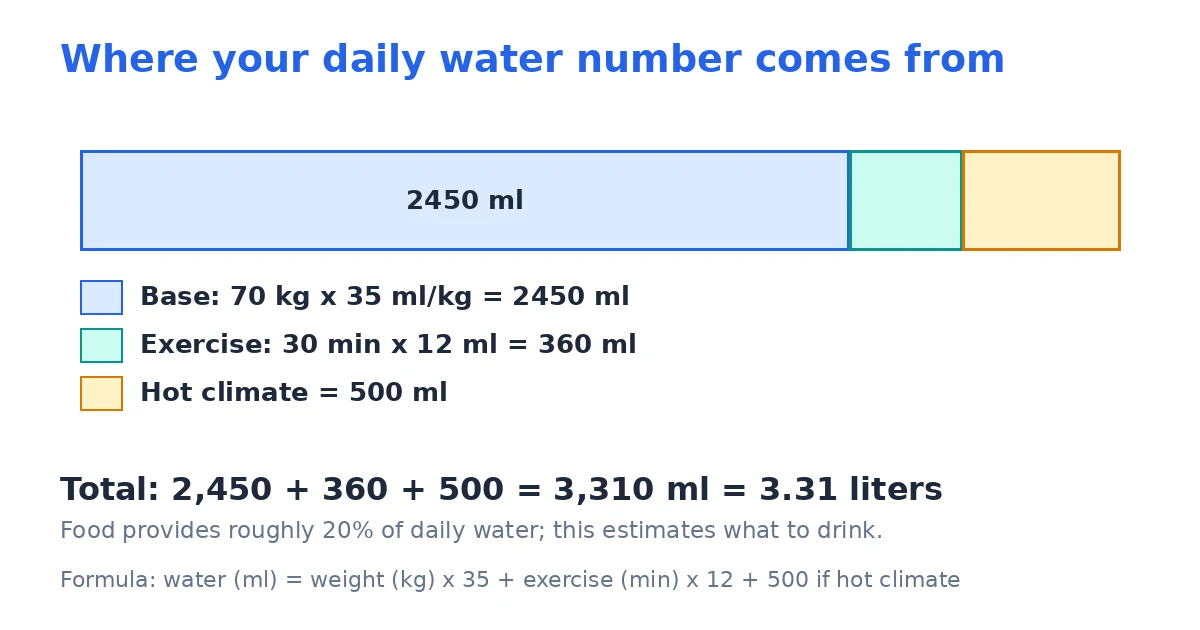
Daily water (ml) = weight (kg) × 35 + exercise (min) × 12 + 500 (hot climate only)
The 35 ml per kg rule is a widely used estimator of baseline fluid needs. Exercise adds about 12 ml per minute to replace sweat, and a hot climate adds 500 ml because you lose more water through sweat and breathing. Pounds are converted to kilograms first (1 lb = 0.453592 kg).
Worked example
A person who weighs 70 kg, exercises 30 minutes a day, in a normal climate:
- Base need: 70 × 35 = 2,450 ml
- Exercise: 30 × 12 = 360 ml
- Hot climate: not selected = 0 ml
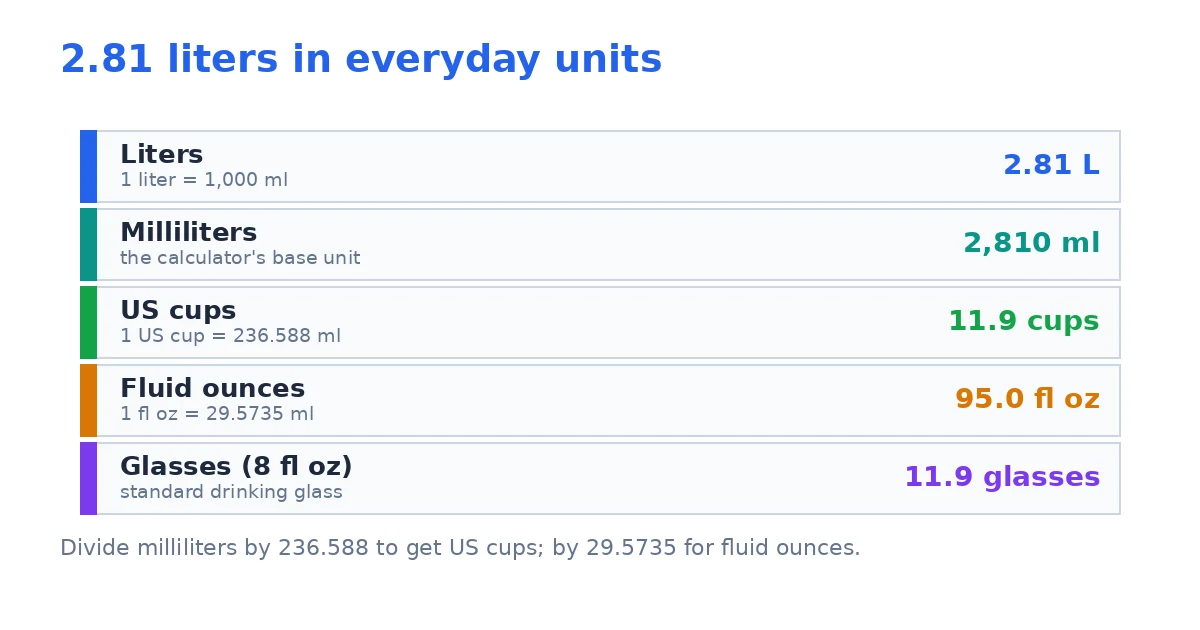
- Total: 2,450 + 360 = 2,810 ml = 2.81 liters = 2,810 ÷ 236.588 ≈ 11.9 US cups (about 12 glasses)
How to use the water intake calculator
- Enter your body weight and pick kilograms or pounds.
- Enter your daily exercise in minutes — anything that makes you sweat counts. Leave it at 0 on rest days.
- Tick the hot climate box if it is around 35°C (95°F) or warmer where you live or work.
- Press Calculate. Your target appears in liters, milliliters, US cups, fluid ounces and 8-oz glasses, with the calculation shown step by step.
The number is a target for total drinking water. Food contributes a share of daily water too — soups, fruit and vegetables add up — so you do not need to drink the entire target as plain water. If hydration is part of a bigger health plan, our calorie calculator estimates your daily energy needs from the same kind of inputs.
Daily water needs by body weight
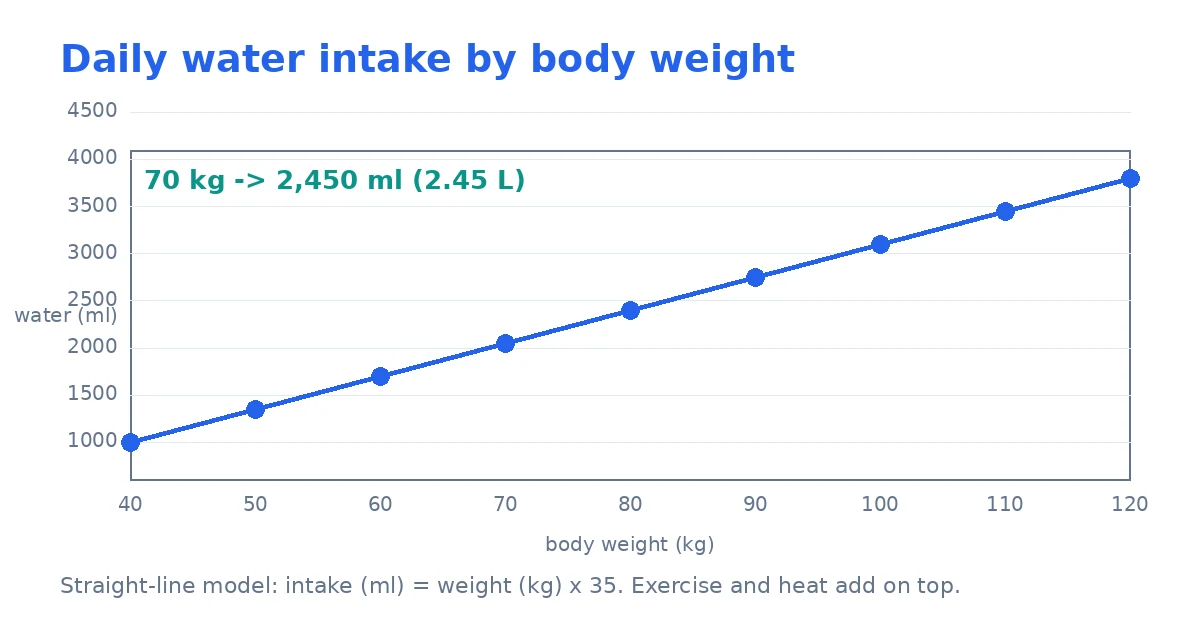
Bigger bodies need more water — that is why the calculator starts from weight rather than a one-size rule like "8 glasses". The 35 ml per kg baseline is a widely used clinical estimator, and the table below shows what it gives for common weights (rest day, normal climate).
| Body weight | Base daily water | US cups (approx) |
|---|---|---|
| 50 kg (110 lb) | 1.75 L | 7.4 |
| 60 kg (132 lb) | 2.10 L | 8.9 |
| 70 kg (154 lb) | 2.45 L | 10.4 |
| 80 kg (176 lb) | 2.80 L | 11.8 |
| 90 kg (198 lb) | 3.15 L | 13.3 |
| 100 kg (220 lb) | 3.50 L | 14.8 |
The Mayo Clinic's guide to daily water needs notes that needs vary with exercise, environment, health and pregnancy, and that about 20% of daily fluid typically comes from food. Use the table as a starting point, then adjust with the calculator.
Exercise and climate adjustments
Sweat is the main extra loss. The calculator adds 12 ml for every minute of exercise — roughly what an average adult loses through light-to-moderate activity — and 500 ml for hot climates.
| Situation | Added water | Example |
|---|---|---|
| 15 min light exercise | + 180 ml | Short walk |
| 30 min moderate exercise | + 360 ml | Brisk walk or easy cycle |
| 60 min workout | + 720 ml | Gym session or run |
| 90 min intense training | + 1,080 ml | Long run or sports practice |
| Hot climate (~35°C / 95°F+) | + 500 ml | Summer heatwave, outdoor work |
These stack: a 80 kg person (2.80 L base) who trains 60 minutes (+720 ml) in a hot climate (+500 ml) lands at 4.02 liters for the day. Heavy endurance sessions and illness can push needs beyond this simple model — drink to thirst and watch your urine color (pale yellow is the usual sign you are on track). Weight is the biggest lever in the formula, so if you are unsure of your numbers, check your BMI calculator result and use your current weight as the input.
Hydration tips and limits
A target only helps if it fits your day. Spread drinking across the day rather than chugging it at once, keep water with you at work, and drink before, during and after exercise. Tea and coffee count toward hydration for most people; alcohol does the opposite.
You can also drink too much: forcing far more water than you lose can dilute blood sodium (hyponatremia), which is dangerous. Rare, but a reason not to treat a calculator number as a minimum to exceed. People with kidney, heart or liver conditions, children, and pregnant or breastfeeding women have different needs — ask a doctor rather than using this model.
The US National Academies' dietary reference intakes for water set adequate total-water intakes of 3.7 liters a day for men and 2.7 liters a day for women (including water from food) — a useful sanity check alongside your calculator result. This page is an estimator, not medical advice.
Frequently asked questions
How is daily water intake calculated?
Multiply your weight in kilograms by 35 to get your base need in milliliters, then add 12 ml for every minute of exercise and 500 ml if you live in a hot climate. For example, a 70 kg person who exercises 30 minutes a day needs 70 × 35 + 30 × 12 = 2,810 ml, or 2.81 liters.
How much water should a 70 kg person drink per day?
At rest in a normal climate, 70 × 35 = 2,450 ml, or 2.45 liters (about 10.4 US cups). Add 360 ml for 30 minutes of exercise and 500 ml in hot weather, which brings it to 2.81 liters and 3.31 liters respectively.
Is the 8 glasses a day rule accurate?
Eight 8-ounce glasses equal 1.9 liters, which is a reasonable floor for a smaller, sedentary person but short of the 2.45-liter base for a 70 kg adult — and it ignores exercise and heat entirely. A weight-based target like this calculator's is a better starting point.
Do tea and coffee count toward daily water intake?
Yes, for most people. Moderate amounts of caffeinated drinks hydrate about as well as water, and soups, fruit and vegetables contribute too. Alcohol does not count — it increases water loss.
How much extra water do I need when exercising?
The calculator adds 12 ml per minute of activity: 30 minutes adds 360 ml, an hour adds 720 ml. Longer or very intense sessions in heat can need more, plus electrolytes — plain water alone is not always enough beyond about 90 minutes.
Can you drink too much water?
Yes. Drinking far more than you lose can dilute blood sodium, a dangerous condition called hyponatremia. Use the calculator's target as a guide, drink to thirst rather than forcing intake, and talk to a doctor if you have kidney, heart or liver disease.
Is this calculator suitable for children or pregnant women?
No — the model is built for average healthy adults. Children, teenagers, and pregnant or breastfeeding women have different fluid needs and should follow guidance from a doctor or dietitian instead.