BMR Calculator: Find Your Basal Metabolic Rate
Calculate how many calories your body burns at rest with the Mifflin-St Jeor equation, plus daily needs for five activity levels.
The BMR formula (Mifflin-St Jeor)
This calculator uses the Mifflin-St Jeor equation, the most widely used method for estimating basal metabolic rate:
- Men: BMR = 10 × weight (kg) + 6.25 × height (cm) − 5 × age + 5
- Women: BMR = 10 × weight (kg) + 6.25 × height (cm) − 5 × age − 161
The result is the number of calories your body burns per day at complete rest — before any activity, digestion, or exercise is counted.
Worked example
A 30-year-old man who is 180 cm tall and weighs 80 kg:
- 10 × 80 = 800
- 6.25 × 180 = 1,125
- 5 × 30 = 150
- 800 + 1,125 − 150 + 5 = 1,780 calories/day
His BMR is about 1,780 calories per day. With moderate exercise (3–5 days a week), his total daily needs are roughly 1,780 × 1.55 = 2,759 calories/day.
What is BMR?
Your basal metabolic rate is the minimum energy your body needs to keep you alive — breathing, circulating blood, regulating temperature, and running your organs. It typically accounts for 60–75% of the calories you burn each day.
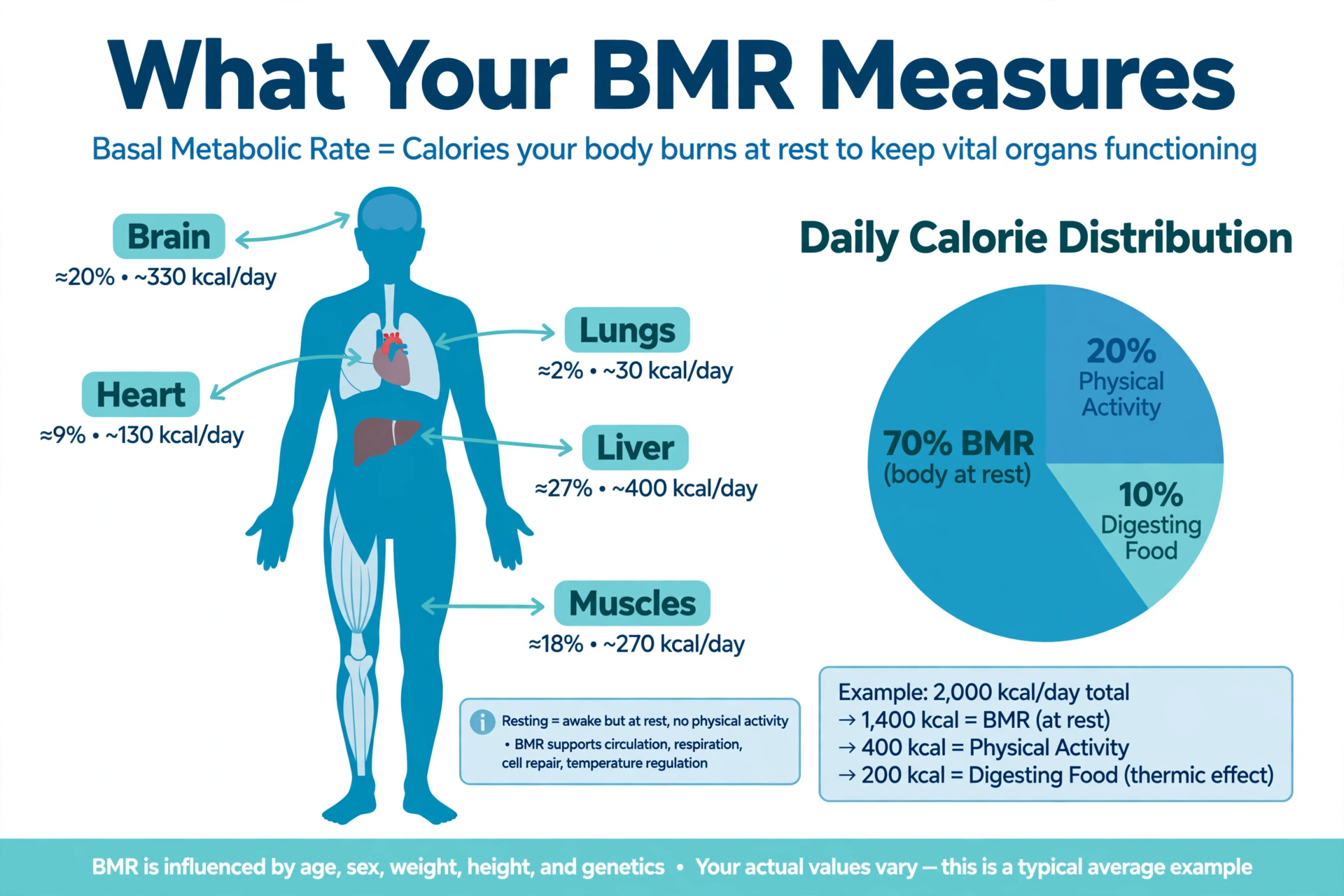
BMR is not the same as the total calories you need. To find your total daily energy expenditure (TDEE), you multiply BMR by an activity factor. That is why two people with the same BMR can need very different amounts of food — a desk worker and a construction worker burn different totals.
Knowing your BMR is the starting point for any calorie plan. If you eat below your BMR for long stretches, your body may slow its metabolism to conserve energy, which is why crash diets often backfire. A sustainable plan starts at or above BMR and adjusts from there.
From BMR to daily calorie needs (TDEE)
Multiply your BMR by the factor that best matches your lifestyle to estimate your total daily energy expenditure:
| Activity level | Description | Multiplier |
|---|---|---|
| Sedentary | Little or no exercise, desk job | × 1.2 |
| Lightly active | Light exercise 1–3 days/week | × 1.375 |
| Moderately active | Moderate exercise 3–5 days/week | × 1.55 |
| Very active | Hard exercise 6–7 days/week | × 1.725 |
| Extra active | Very hard exercise or physical job | × 1.9 |
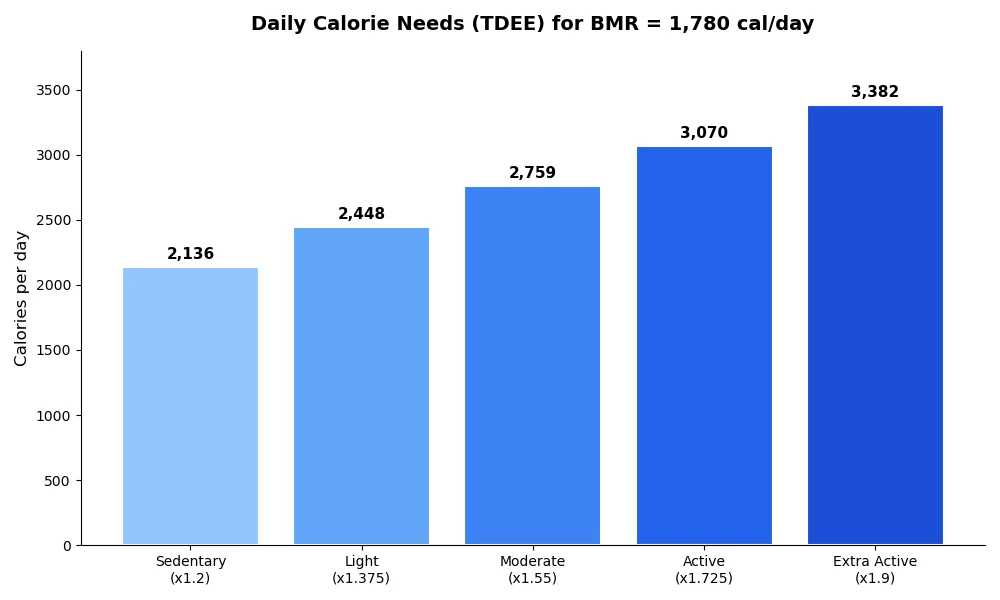
For example, a woman with a BMR of 1,320 who exercises lightly needs about 1,320 × 1.375 = 1,815 calories/day to maintain her weight. To lose weight, she would eat modestly below that; to gain, modestly above.
Once you know your maintenance calories, our calorie calculator can help you plan meals around your target.
What affects your BMR and how to use the number
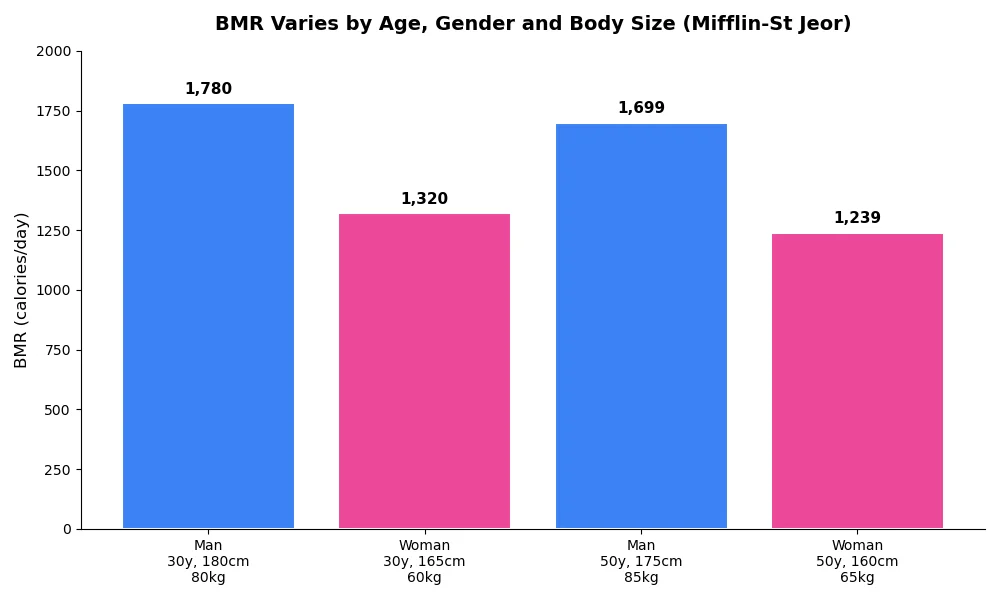
Several factors move BMR up or down. Muscle tissue burns more calories at rest than fat tissue, so two people at the same weight can have different BMRs. Age slowly lowers BMR — roughly 1–2% per decade after 20 — mainly because muscle mass declines.
Practical ways to use your BMR
- Weight loss: aim for a daily intake between your BMR and your TDEE. A deficit of 300–500 calories per day leads to gradual, sustainable loss.
- Weight gain: eat 200–300 calories above your TDEE, with enough protein to build muscle rather than fat.
- Maintenance: match your intake to your TDEE and recheck every few weeks as your weight changes.
Strength training 2–3 times per week is the most reliable way to raise BMR over time, because it preserves and builds calorie-hungry muscle. Your BMI alongside BMR gives a fuller picture of body composition goals.
| Goal | Daily calorie target | Example (TDEE 2,500) |
|---|---|---|
| Lose ~0.5 kg/week | TDEE − 500 | 2,000 cal/day |
| Maintain weight | TDEE | 2,500 cal/day |
| Gain ~0.25 kg/week | TDEE + 250 | 2,750 cal/day |
Frequently asked questions
What is a good BMR?
There is no single good BMR — it depends on your size, age, and sex. For reference, an average adult man often lands near 1,600–1,800 calories per day and an average adult woman near 1,200–1,400. What matters is how your BMR compares to your actual intake and goals, not hitting a specific number.
Is the Mifflin-St Jeor equation accurate?
It is the most widely validated prediction equation for resting energy needs and is generally accurate within about 10% for most adults. It is an estimate, not a lab measurement — factors like muscle mass, hormones, and medical conditions can shift your true BMR.
What is the difference between BMR and TDEE?
BMR is the calories your body burns at complete rest. TDEE (total daily energy expenditure) is BMR multiplied by an activity factor, so it includes everything you do — moving, working, exercising, and digesting food. Use BMR as the base and TDEE as your real-world calorie target.
Can I eat below my BMR to lose weight faster?
It is not recommended. Eating well below BMR for extended periods can slow your metabolism, cause muscle loss, and leave you fatigued. A safer approach is a moderate deficit below your TDEE (not below BMR) of 300–500 calories per day.
Does BMR change with age?
Yes. BMR declines roughly 1–2% per decade after age 20, mostly because muscle mass decreases with age. Regular strength training and enough protein can slow this decline significantly.
Why is my BMR lower than my friend's?
BMR scales with body size, muscle mass, age, and sex. A taller, heavier, more muscular, or younger person will usually have a higher BMR. Comparing raw BMR numbers between different bodies is not meaningful — compare each person's intake against their own TDEE.
How often should I recalculate my BMR?
Recalculate whenever your weight changes by more than a few kilograms, or every 2–3 months during an active weight-loss or weight-gain phase. As you lose weight your BMR drops, so your calorie target needs periodic adjustment.
Related calculators

BMI Calculator
Check your body mass index from height and weight with healthy range guidance.
Use calculatorCalorie Calculator
Estimate daily calorie needs for your goals from activity level and body stats.
Use calculator
Age Calculator
Find your exact age in years, months, and days from any birth date.
Use calculator