Steps Calculator: Steps to Distance, Time and Calories
Enter your steps, height, and weight, choose a walking pace, and get the distance walked, the walking time, and the calories burned.
Formulas verified against standard references. Calculator logic tested with verified worked examples. Last reviewed: October 2026. Our methodology
How Steps Become Distance and Calories
A step count alone says little until you know how far each step carries you. This calculator estimates stride length from height, using the common rule that stride is about 41.5 percent of height, then multiplies stride by steps for distance, divides distance by walking speed for time, and applies a MET-based formula for calories.
For a person 170 cm tall, stride is about 0.71 metres, so 10,000 steps cover about 7.05 kilometres, or 4.38 miles. At a normal pace of 5 kilometres per hour, that walk takes about 85 minutes. The calorie formula is MET times 3.5 times body weight in kilograms, divided by 200, times minutes: at 3.8 METs, 70 kilograms, and 85 minutes, the gross burn is about 394 kilocalories.
For pace-based running estimates, a pace calculator works from a target pace and distance.
The Formulas
Distance in kilometres equals steps times stride in metres, divided by 1000. Stride in metres equals height in centimetres times 0.415, divided by 100. Miles come from dividing kilometres by 1.609344. Walking time in minutes equals distance in kilometres divided by speed in kilometres per hour, times 60.
Calories use the standard MET equation: calories equals MET times 3.5 times weight in kilograms, divided by 200, times minutes. Gross calories include what the body would burn at rest during the same time, while net calories subtract one MET, the resting component, leaving only the extra cost of walking. This calculator reports both, so you can use whichever your plan needs.
| Pace | Speed | METs | Use |
|---|---|---|---|
| Slow | 4 km/h | 3.0 | Easy stroll |
| Normal | 5 km/h | 3.8 | Everyday walking |
| Fast | 6 km/h | 4.8 | Brisk walking |
Worked Examples
Example 1: 10,000 steps at 170 cm, 70 kg, normal pace. Stride is 0.7055 metres, distance is 7.05 kilometres or 4.38 miles, time is about 84.7 minutes, gross calories about 394, and net about 290. Example 2: 5000 steps with the same body numbers. Distance halves to about 3.53 kilometres, time to about 42 minutes, and gross calories to about 197.
Example 3: a taller, heavier walker, 185 cm and 90 kg, taking 12,000 steps at a fast pace. Stride is about 0.77 metres, distance about 9.21 kilometres, time about 92 minutes at 6 kilometres per hour, and gross calories about 580 at 4.8 METs. Height changes distance, weight changes calories, and pace changes both time and METs, which is why all three inputs matter.
| Steps | Height / weight | Pace | Distance | Gross calories |
|---|---|---|---|---|
| 10,000 | 170 cm / 70 kg | Normal | 7.05 km | About 394 kcal |
| 5000 | 170 cm / 70 kg | Normal | 3.53 km | About 197 kcal |
| 12,000 | 185 cm / 90 kg | Fast | 9.21 km | About 580 kcal |
Step Counts by Distance
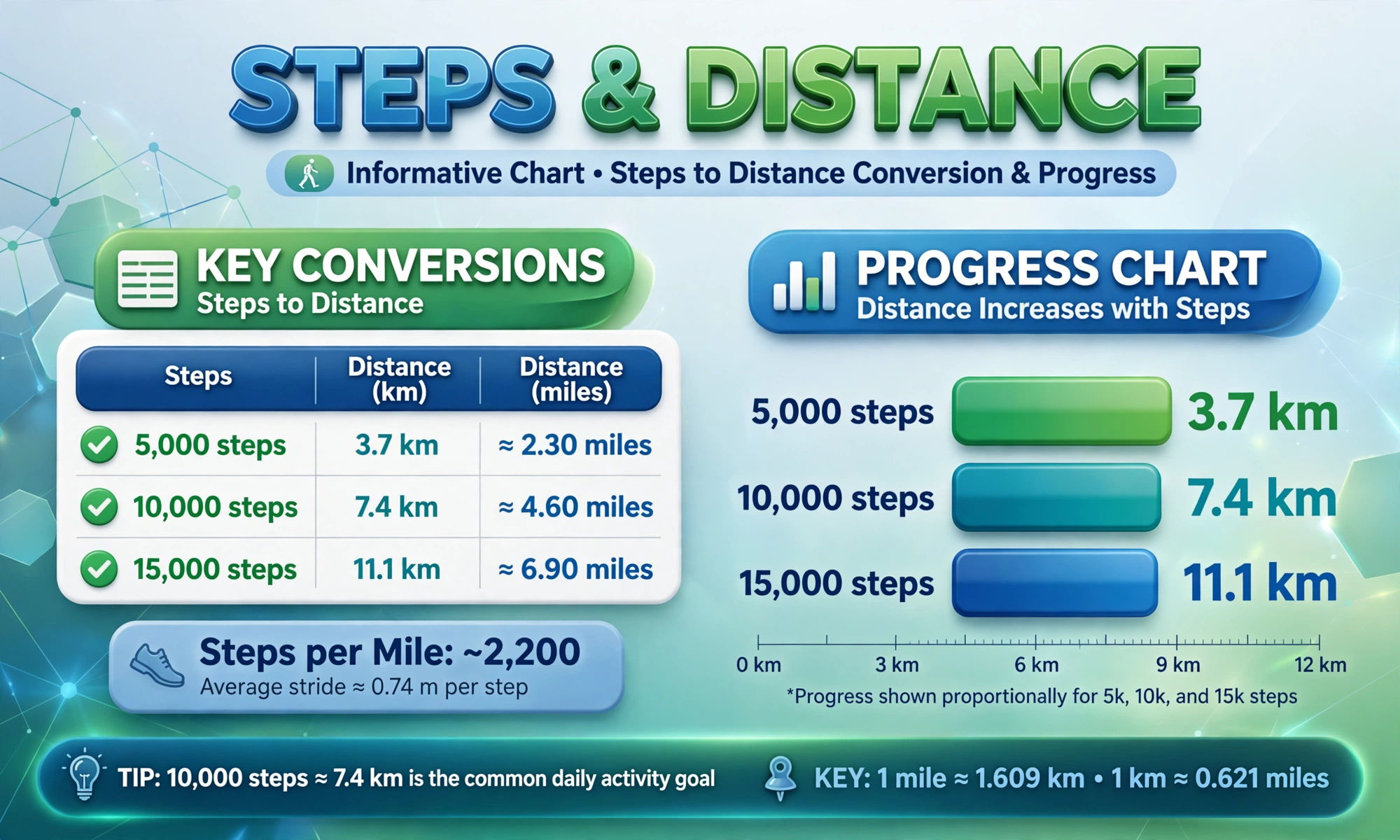
Most adults take roughly 2000 to 2500 steps per mile, with taller people at the low end and shorter people at the high end, because stride scales with height. A mile at a normal pace takes about 20 minutes, so a 30-minute walk covers about 1.5 miles, or roughly 3400 steps for an average adult.
The famous 10,000-step goal began as a pedometer marketing slogan, not a medical prescription, but the habit behind it is sound: risk falls as daily steps rise, levelling off around 8000 to 10,000 steps for younger adults and 6000 to 8000 for older adults. Any increase from a low baseline helps, and the first thousand steps matter more than the last thousand.
| Steps | Distance (approx.) | Time at 5 km/h | Gross calories (70 kg) |
|---|---|---|---|
| 3000 | 2.1 km | 25 min | About 118 kcal |
| 5000 | 3.5 km | 42 min | About 197 kcal |
| 10,000 | 7.1 km | 85 min | About 394 kcal |
| 15,000 | 10.6 km | 127 min | About 591 kcal |
Common Mistakes
The most common mistake is using a fixed step length for everyone: a 150 cm walker and a 190 cm walker cover different distances in the same step count, by about 25 percent. Another mistake is treating gross calories as extra burn: part of the gross total is resting metabolism, which the body spends anyway, so net calories are the honest figure for weight planning.
A third mistake is trusting a step count to the last digit. Trackers miscount on stairs, treadmills, and bumpy rides, and stride varies with speed and fatigue, so treat distance and calories as estimates within about 20 percent, not as measurements. A fourth is ignoring pace: the same distance at a fast pace burns more per minute, though the total for a fixed distance rises only modestly.
Making Step Goals Work
Set the goal in steps, but check it in time and distance too, because a step goal without a time budget is easy to miss. Ten thousand steps need about 85 minutes of walking for most adults, which is easier split into two or three walks than done in one block. A morning walk, a lunch walk, and an evening walk each add up, and the calculator shows what each block contributes.
For total daily energy, a calories burned calculator covers other activities beyond walking. Use this steps calculator for the walking part, and keep the goal realistic for a week before raising it.
Frequently asked questions
How many miles is 10,000 steps?
About 4.4 miles for an average adult, or about 7.1 kilometres, taking roughly 85 minutes at a normal pace. The exact figure depends on stride length, which scales with height.
How many steps are in a mile?
Roughly 2000 to 2500 for most adults. Taller people take fewer steps per mile, because each stride is longer.
How many calories does 10,000 steps burn?
Roughly 350 to 450 kilocalories gross for a 70 kg adult at a normal pace, with about 290 kilocalories above resting. Heavier walkers burn more, lighter walkers less.
How is stride length estimated?
As about 41.5 percent of height: stride in metres equals height in centimetres times 0.415, divided by 100. Measuring ten real steps and dividing by ten gives a personal figure.
What is the difference between gross and net calories?
Gross calories include resting metabolism during the walk, while net calories subtract it, leaving only the extra cost of walking. Net is the better figure for weight planning.
Do I need to enter my weight?
Only for calories. Distance and time come from steps, height, and pace, while calories scale with body weight.
Is 10,000 steps a day necessary?
No. It is a useful goal, but health benefits level off around 8000 to 10,000 steps for younger adults and 6000 to 8000 for older adults, and any increase from a low baseline helps.