Pace Calculator: Pace, Time and Distance
Pace, time and distance are three sides of the same triangle — know any two and you can find the third. Choose what to calculate, enter your numbers, and this pace calculator returns your pace per kilometre and per mile plus your speed, so one workout can answer race-day questions.
The pace formulas
Pace is simply time divided by distance. Speed is the mirror image: distance divided by time. Once you have one, converting to the other is one division, which is why the calculator can hop between pace per kilometre, pace per mile and km/h without breaking a sweat.
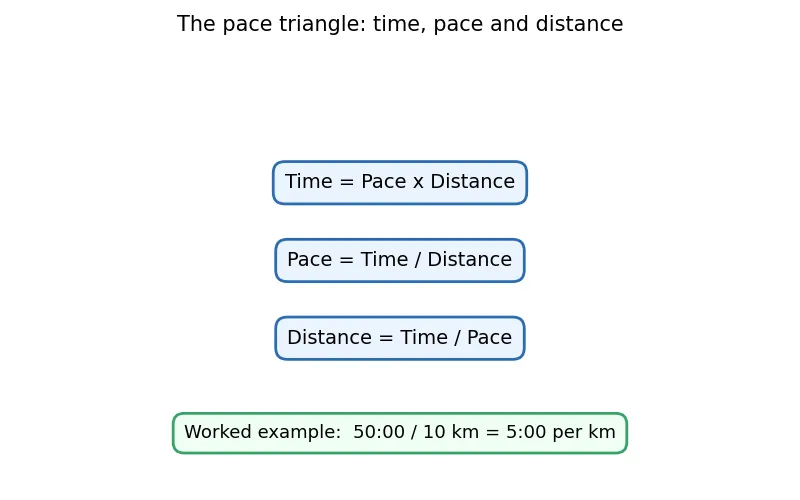
- Pace = time ÷ distance (e.g. minutes per kilometre)
- Time = pace × distance
- Distance = time ÷ pace
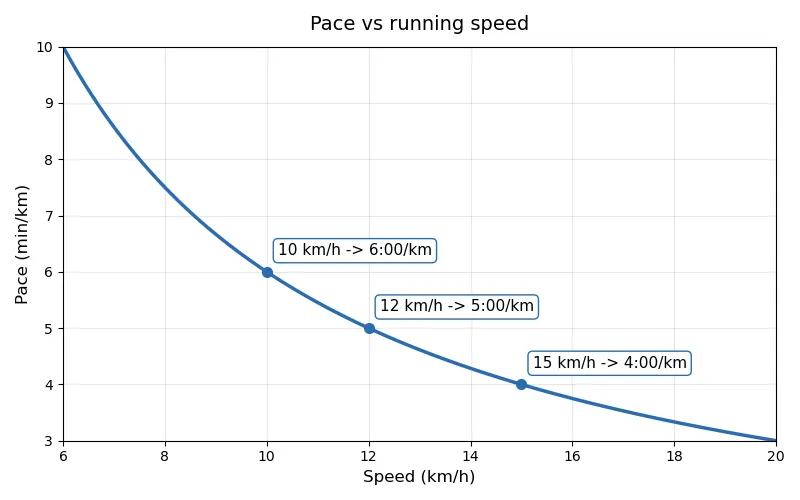
- Speed = 60 ÷ pace in min/km (km/h)
Worked example
You run 10 km in 50 minutes. Convert the time to seconds: 50 × 60 = 3000 seconds. Pace per kilometre = 3000 ÷ 10 = 300 seconds = 5:00/km. Pace per mile = 300 × 1.60934 = 482.8 seconds = 8:02.8/mi. Speed = 10 km ÷ (50/60 h) = 12 km/h. One run, four useful numbers.
How to use the pace calculator
Start by choosing what you want to find. "Pace" answers "how fast did I run", "Time" predicts a finish time from a target pace, and "Distance" tells you how far a pace and a time will take you.
Step by step
- Choose what to calculate. Pace from a completed run, time for a goal pace, or distance from a pace and a duration.
- Set the distance unit. Kilometres or miles — the calculator converts both ways in the results.
- Enter your numbers. Times as mm:ss (50:00) or h:mm:ss (1:20:00); pace as m:ss per unit (5:00).
- Press Calculate. You get the missing value plus pace per km, pace per mile and speed.
Entering times correctly
The most common mistake is typing 1:20 when you mean 1 hour 20 minutes — the calculator reads that as 1 minute 20 seconds. Always include the hours: 1:20:00. Seconds round to the nearest whole second in the display, but the full precision is used in the maths.
From pace to race: finish-time table
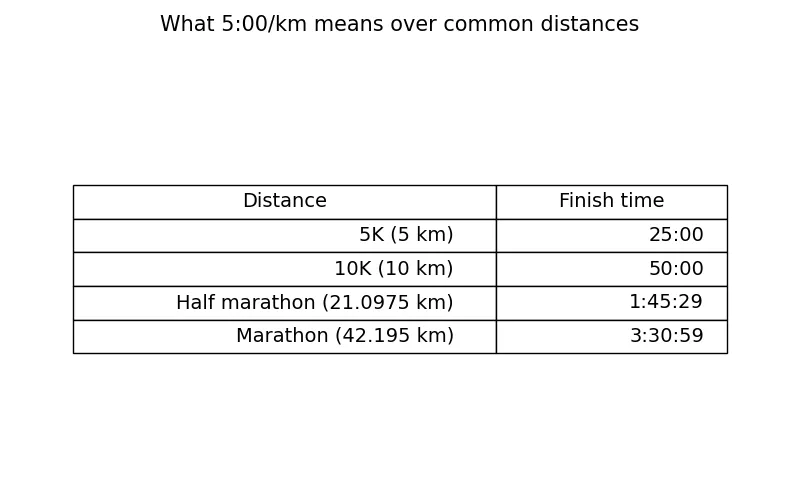
Multiply your pace by the race distance and you have a finish-time estimate, assuming you can hold the pace. The table below does that multiplication for three common training paces across the standard race distances.
| Distance | At 6:00/km | At 5:00/km | At 4:00/km |
|---|---|---|---|
| 5K | 30:00 | 25:00 | 20:00 |
| 10K | 1:00:00 | 50:00 | 40:00 |
| Half marathon (21.0975 km) | 2:06:35 | 1:45:29 | 1:24:23 |
| Marathon (42.195 km) | 4:13:10 | 3:30:59 | 2:48:47 |
Why estimates drift at long distances
Simple multiplication assumes perfect pacing, but fatigue, hills, heat and fuelling all cost time. For a half marathon and beyond, add 2 to 5 percent to the raw estimate as a reality buffer — a 3:30:59 marathon on paper becomes roughly 3:38 to 3:42 in the real world. Use the table for goal-setting, not promises.
Pace, speed and effort
Runners talk pace, treadmills talk speed, and the two are reciprocals: speed in km/h = 60 ÷ pace in min/km. A 5:00/km pace is 12 km/h; double the speed to 24 km/h and the pace halves to 2:30/km. The curve is not linear, which is why shaving the last 10 seconds off your kilometre feels much harder than the first 10.
| Pace (per km) | Pace (per mile) | Speed (km/h) | Typical use |
|---|---|---|---|
| 7:00 | 11:16 | 8.6 | Easy recovery jog |
| 6:00 | 9:39 | 10.0 | Comfortable long run |
| 5:00 | 8:03 | 12.0 | Steady tempo run |
| 4:00 | 6:26 | 15.0 | Fast interval session |
| 3:30 | 5:38 | 17.1 | Race-pace reps |
Fuel the work you are doing
Faster running burns more energy per minute, so a pace jump from easy to tempo meaningfully raises the calories a session costs. If you are training with pace targets, a calorie calculator that includes exercise will show how those harder sessions change your daily needs — useful whether you are fuelling performance or managing weight.
Training with your pace numbers
Pace zones turn one number into a training plan. Most coaches prescribe easy runs well below your 5K pace, tempo runs near your one-hour race pace, and intervals faster still. Calculate each from a recent race or time trial, then hold the paces with a watch rather than by feel — feel lies when you are tired.
| Session type | How to set the pace | Example (5:00/km runner) |
|---|---|---|
| Easy / recovery | 60–90 seconds slower than 5K pace | 6:00–6:30/km |
| Long run | 30–60 seconds slower than 5K pace | 5:30–6:00/km |
| Tempo | Pace you could hold for one hour | 5:00–5:10/km |
| Intervals | Faster than 5K pace, with recoveries | 4:30–4:45/km reps |
Hydration on longer efforts
Sessions over an hour — the long runs where pace discipline matters most — are also where dehydration starts to cost you speed. Plan fluids before you head out, and a water intake calculator gives you a daily baseline so training-day drinking starts from the right level rather than from thirst, which lags behind need.
Frequently asked questions
How do I calculate my running pace?
Divide your time by your distance. If you ran 10 km in 50 minutes, that is 3000 seconds / 10 = 300 seconds per kilometre, or 5:00/km. The calculator above does this and also converts to pace per mile and speed.
What is a good running pace for a beginner?
A comfortable beginner jogging pace is often around 7:00 to 8:00 per kilometre, where you can still hold a conversation. Pace varies hugely with age, fitness and terrain, so compare against your own past runs rather than other people's numbers.
How do I convert pace per mile to pace per kilometre?
Divide the per-mile pace by 1.60934. For example, 8:03 per mile is 483 seconds / 1.60934 = 300 seconds per kilometre, or 5:00/km. Going the other way, multiply the per-km pace by 1.60934.
How do I predict my marathon finish time from my pace?
Multiply your sustainable pace by 42.195 km. At 5:00/km that is 211 minutes, or 3:30:59. For a realistic estimate, add 2 to 5 percent for fatigue, hills and fuelling — so plan for roughly 3:38 to 3:42.
What is the difference between pace and speed?
Pace is time per distance (minutes per kilometre); speed is distance per time (kilometres per hour). They are reciprocals: speed = 60 / pace in min/km. Runners use pace because it is easier to hold steady on a watch.
Why does my pace slow down on long runs?
Glycogen depletion, dehydration, heat and accumulated fatigue all raise the cost of each kilometre. This is normal and expected — long-run pace is deliberately slower than race pace, typically 30 to 60 seconds per kilometre slower than 5K pace.
How should I enter my time in the calculator?
Use mm:ss for times under an hour (50:00) and h:mm:ss for longer times (1:20:00). Enter pace as m:ss per unit (5:00). Do not type 1:20 for 1 hour 20 minutes — the calculator would read it as 1 minute 20 seconds.
Related calculators

Calorie (BMR/TDEE) Calculator
Find your daily calorie needs: BMR, TDEE, goal targets and macros in grams.
Use calculatorWater Intake Calculator
Find out how much water to drink each day from your body weight, exercise and climate.
Use calculatorBMR Calculator
Estimate your basal metabolic rate with the Mifflin-St Jeor equation and daily calorie needs.
Use calculator