TDEE Calculator: How Many Calories Do You Burn Daily?
Your body burns calories all day — even asleep. Enter your stats and activity level, and this free TDEE calculator will estimate your total daily energy expenditure using the Mifflin-St Jeor equation, plus calorie targets for cutting, maintaining or bulking.
Formulas verified against standard references. Calculator logic tested with verified worked examples. Last reviewed: October 2026. Our methodology
How TDEE is calculated
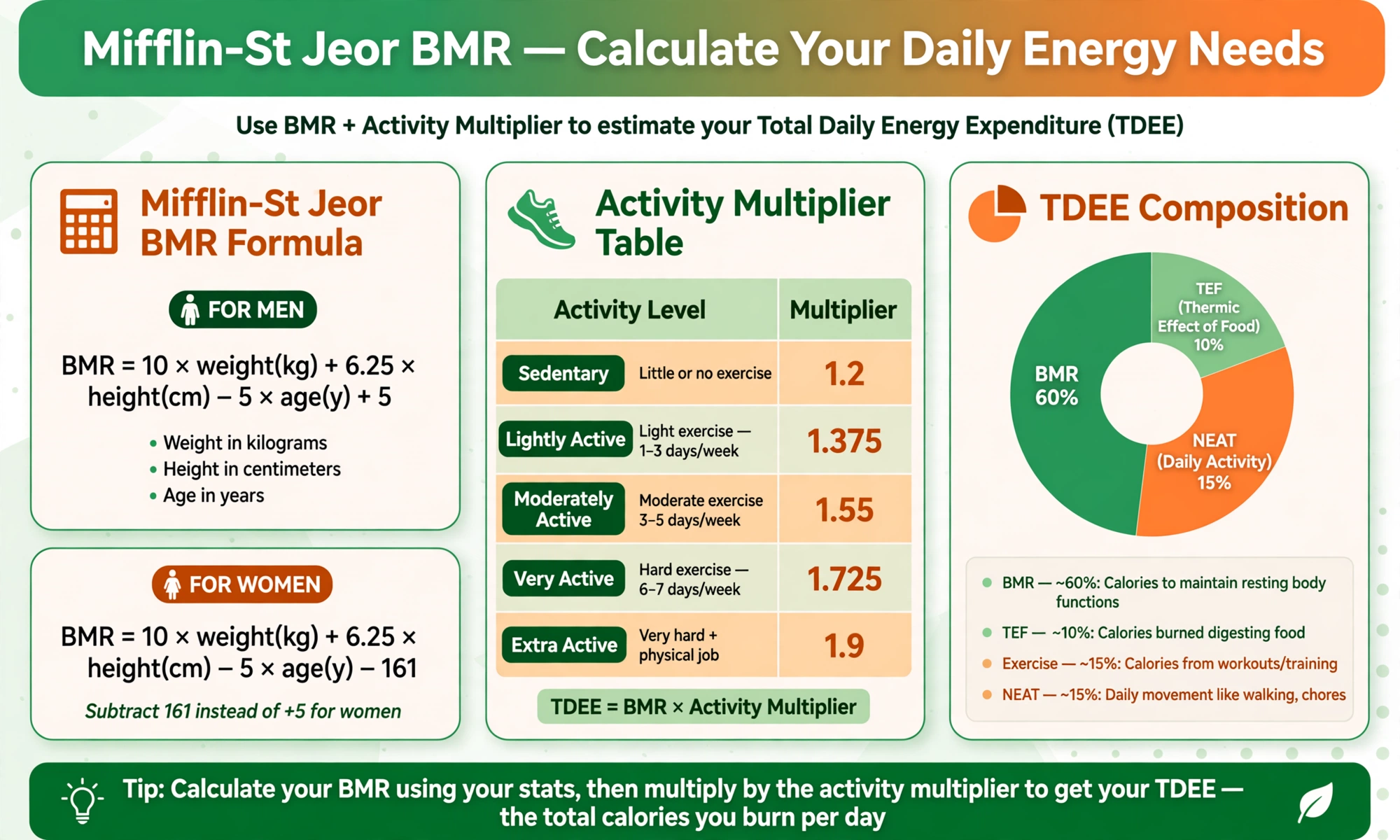
TDEE has two layers: first your basal metabolic rate (what you burn at rest), then an activity multiplier. This calculator uses the Mifflin-St Jeor equation, the most validated BMR formula:
- Men: BMR = 10 × weight(kg) + 6.25 × height(cm) − 5 × age + 5
- Women: BMR = 10 × weight(kg) + 6.25 × height(cm) − 5 × age − 161
- TDEE = BMR × activity factor (1.2 sedentary → 1.9 extra active)
| Activity level | Factor | Example |
|---|---|---|
| Sedentary | 1.2 | Desk job, no exercise |
| Lightly active | 1.375 | Light exercise 1–3 days/week |
| Moderately active | 1.55 | Moderate exercise 3–5 days/week |
| Very active | 1.725 | Hard exercise 6–7 days/week |
| Extra active | 1.9 | Physical job plus hard training |
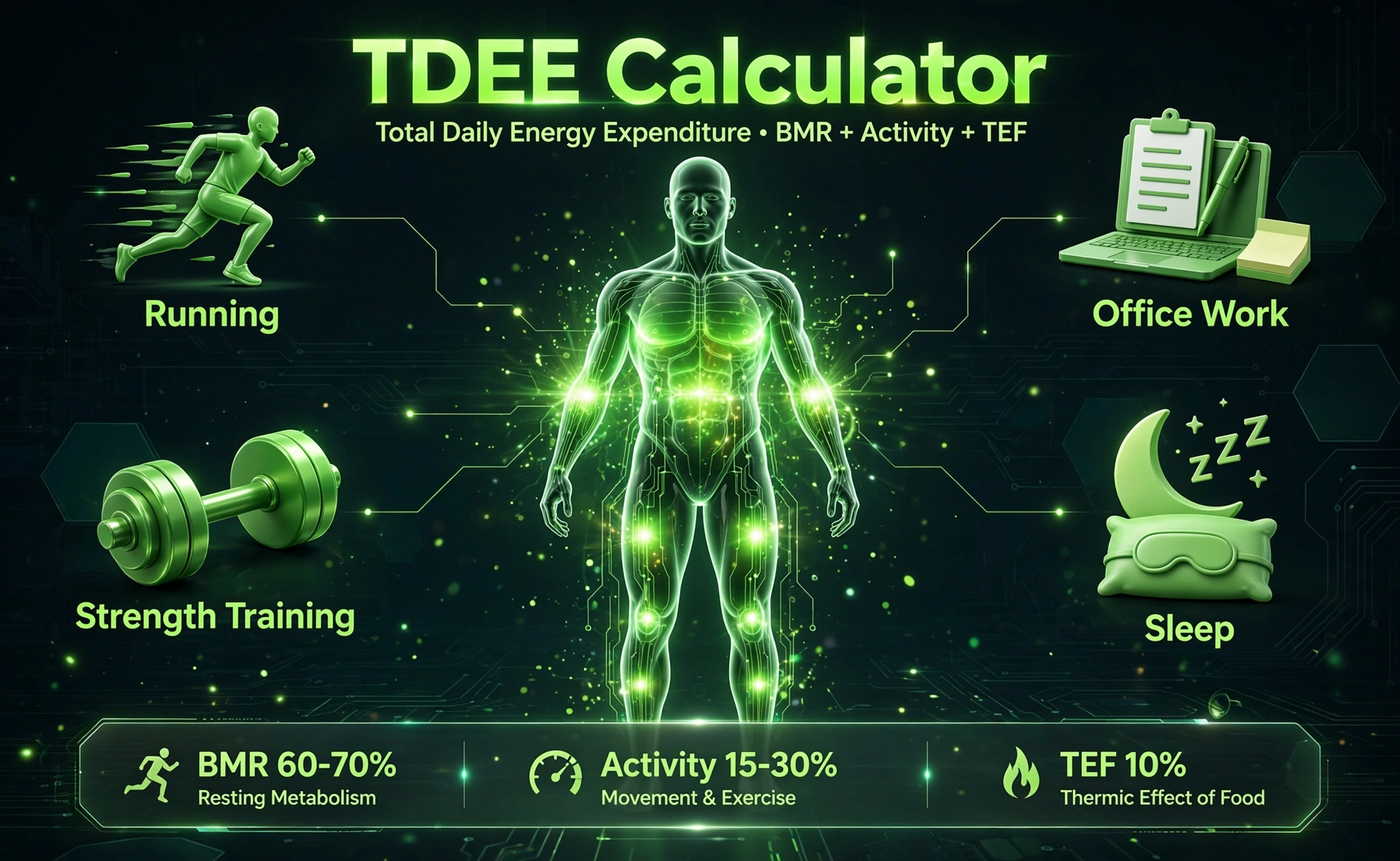
Your TDEE splits roughly into: BMR (~60–70%), daily movement and exercise (~20–30%), and the thermic effect of food (~10% — the energy cost of digestion).
Worked example
A 30-year-old man, 70 in tall, 180 lb, moderately active. Convert: 180 ÷ 2.20462 = 81.6 kg; 70 × 2.54 = 177.8 cm.
BMR = 10 × 81.6 + 6.25 × 177.8 − 5 × 30 + 5 = 816 + 1,111 − 150 + 5 = 1,783 cal/day. TDEE = 1,783 × 1.55 = 2,763 cal/day. To lose about a pound a week he would eat roughly 2,263; to gain, roughly 3,013.
How to use the TDEE calculator
Be honest about activity — most people pick one level too high. When in doubt, choose the lower one and adjust after two weeks of tracking.
Step by step
- Select gender and enter age. Both feed the Mifflin-St Jeor equation directly.
- Enter height in inches and weight in pounds. The calculator converts to metric internally.
- Pick your activity level. Count real exercise plus daily movement — a desk worker who lifts three times a week is "lightly active", not "very".
- Press Calculate. Read your BMR and TDEE, then the cut/maintain/bulk targets underneath.
- Track and adjust. If weight does not move after 2–3 weeks at the target, shift by 200 cal and reassess.
Cutting, maintaining, bulking: picking your target
Your TDEE is maintenance — eat that and weight stays roughly flat. Goals sit around it:
| Goal | Daily target | Expected pace |
|---|---|---|
| Mild cut | TDEE − 250 | ~0.5 lb/week loss |
| Standard cut | TDEE − 500 | ~1 lb/week loss |
| Maintain | TDEE | Weight stable |
| Lean bulk | TDEE + 250 | ~0.5 lb/week gain, mostly muscle |
Faster cuts work but cost more muscle and energy; aggressive bulks add fat alongside muscle. Protein (0.7–1 g per lb of body weight) and resistance training decide whether the weight you lose or gain is the kind you want. A protein intake calculator can set that number precisely.
Why your TDEE changes as you lose weight
TDEE is not a fixed number — it falls as you get lighter, which is why weight loss stalls. Three things shrink it:
- Less body to maintain. A smaller body burns fewer calories at rest; every 10 lb lost cuts BMR by roughly 50–70 cal/day.
- Less cost of movement. Carrying less weight means walking, stairs and workouts all burn less.
- Metabolic adaptation. In a sustained deficit the body gets thrifty, trimming unconscious movement (fidgeting, posture) — often another 100–300 cal/day.
Practical fix: recalculate your TDEE every 10–15 lb lost, and break long cuts into phases with 1–2 week diet breaks at maintenance. Plateaus are math, not failure.
TDEE vs. BMR vs. calories burned exercising
These get mixed up constantly:
- BMR is what you burn lying still for 24 hours — breathing, heartbeat, brain, organs. For most people, 60–70% of TDEE.
- Exercise calories are the smallest slice people overestimate: an hour of hard lifting burns ~200–400 cal; fitness trackers often read 20–40% high.
- TDEE is everything added together — BMR plus all movement plus digestion. It is the number your diet should be built on, not the tracker’s workout figure.
Do not "eat back" exercise calories from a tracker on top of a TDEE-based target — the activity multiplier already counted your training. Double-counting is the most common reason calorie targets mysteriously fail.

Frequently asked questions
How is TDEE calculated?
In two steps: first BMR from the Mifflin-St Jeor equation (10×kg + 6.25×cm − 5×age ± 5/161), then multiply by an activity factor from 1.2 (sedentary) to 1.9 (extra active). A 30-year-old, 180 lb, 70 in moderately active man lands near 2,763 cal/day.
What is the difference between BMR and TDEE?
BMR is what you burn at complete rest for 24 hours (60–70% of the total). TDEE adds all movement, exercise and digestion on top. BMR is the engine idling; TDEE is the full day of driving.
How many calories should I eat to lose weight?
About 500 below your TDEE for ~1 lb/week, or 250 below for ~0.5 lb/week. Recalculate every 10–15 lb lost, since a lighter body burns less. Keep protein high (0.7–1 g/lb) to protect muscle.
Why has my weight loss stalled?
Usually a shrinking TDEE: less body mass burns fewer calories, movement costs less, and the body trims unconscious activity in a deficit. Recalculate TDEE at your new weight, verify you are tracking accurately, and consider a 1–2 week diet break at maintenance.
Are fitness tracker calorie numbers accurate?
Often 20–40% high for workouts. Use your tracker for trends, not absolute truth — and do not add its exercise calories on top of a TDEE-based target, since the activity multiplier already includes your training.
What activity level should I pick?
Be conservative: a desk worker who lifts 3x/week is lightly active (1.375), not very active. Most people overestimate by one level, which inflates TDEE by 200–400 cal and erases a cut. Start lower and adjust from real weight data.
Does muscle really burn a lot of calories?
Less than gym lore claims — roughly 6 cal/lb/day for muscle vs ~2 for fat. Gaining 10 lb of muscle adds ~40–60 cal/day to BMR. Worth doing for strength and body composition, but it will not let you eat whatever you want.