Protein Intake Calculator: How Much Protein Per Day
Find your daily protein target in grams from your body weight and activity level — plus a per-meal goal and the 0.8 g/kg minimum for comparison.
The protein intake formula
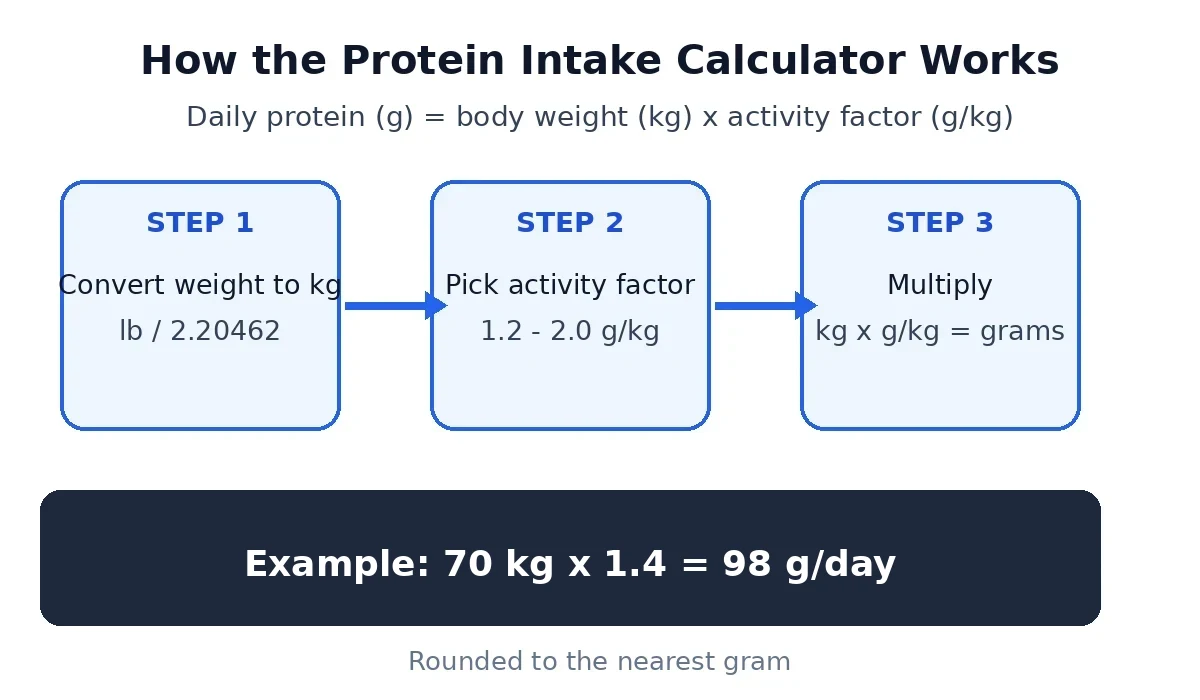
Daily protein needs scale with body weight, so the standard formula multiplies your weight by a per-kilogram factor that reflects how active you are:
Daily protein (g) = body weight (kg) × activity factor (g/kg)
If you weigh yourself in pounds, convert first: weight (kg) = weight (lb) ÷ 2.20462. The result is rounded to the nearest gram. The calculator also shows two reference numbers: your per-meal target (daily grams ÷ 3) and the sedentary minimum (weight × 0.8 g/kg, the RDA floor).
Worked example
A 70 kg person who is moderately active (factor 1.4 g/kg):
- Daily protein = 70 × 1.4 = 98 g
- Per meal (3 meals) = 98 ÷ 3 = about 33 g
- Sedentary minimum = 70 × 0.8 = 56 g
The same person weighing 154 lb gets the same answer: 154 ÷ 2.20462 = 69.9 kg, and 69.9 × 1.4 = 97.8 g, which rounds to 98 g.
How to use the protein intake calculator
Three inputs give you a daily protein target: your weight, the unit, and how active you are.
Step by step
- Enter your body weight. Use your morning weight for consistency.
- Choose kg or lb. The calculator converts pounds to kilograms for you (÷ 2.20462).
- Pick your activity level. Moderately active is the default; athletes and heavy trainers should pick the higher factors.
- Press Calculate and read your daily target, per-meal goal, and the sedentary minimum.
What you get
- Daily protein target in grams, rounded to the nearest gram
- Per-meal target — your daily grams divided across 3 meals
- Sedentary minimum — the 0.8 g/kg RDA floor for comparison
Protein works best inside a sensible eating plan. If you are also tracking energy, run your numbers through our calorie calculator to set the daily budget your protein target sits inside.
Daily protein needs by activity level
The more active you are, the more protein your body uses for repair and growth. The table below shows the factors this calculator uses, plus the RDA minimum for reference.
| Activity level | Factor (g/kg) | Who it fits |
|---|---|---|
| RDA minimum (reference) | 0.8 | Average sedentary adult — the floor, not a target |
| Sedentary | 1.2 | Little exercise or desk-bound days |
| Moderately active | 1.4 | Exercise or active lifestyle 3–5 days a week |
| Very active | 1.6 | Hard training 6–7 days a week |
| Athlete | 2.0 | Intense training, strength or endurance athletes |
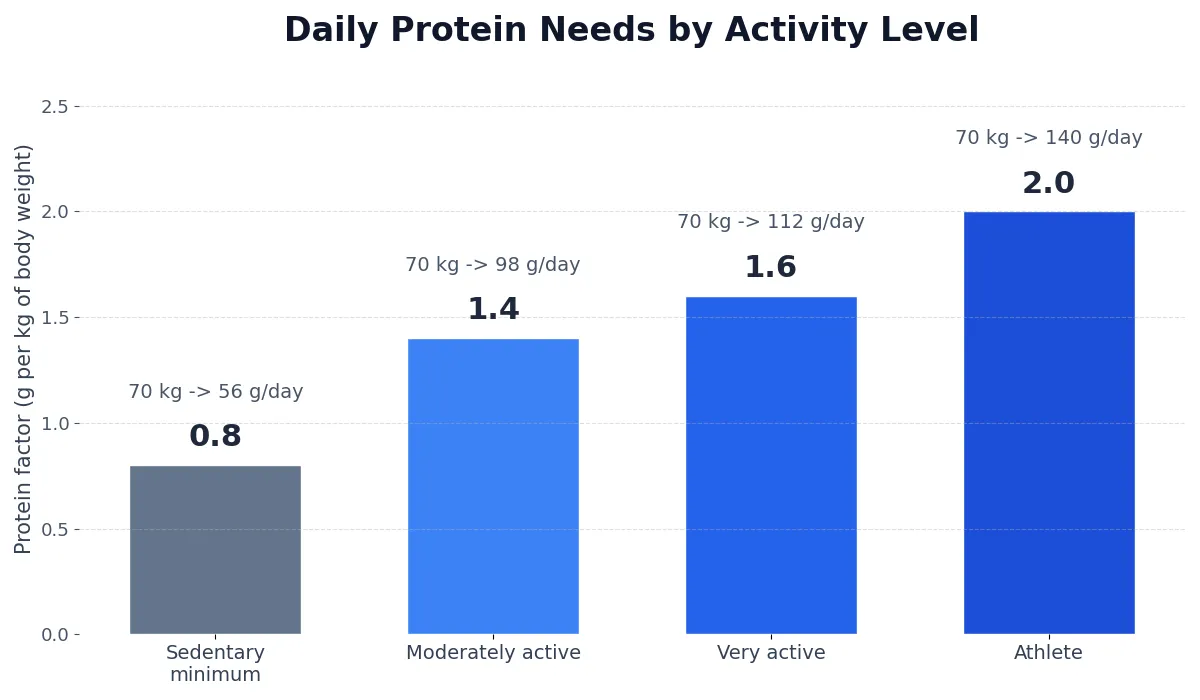
The athlete range is consistent with the position stand of the International Society of Sports Nutrition, which supports 1.4–2.0 g/kg per day for building and maintaining muscle mass. If you are older, dieting, or new to training, lean toward the higher end of your band rather than the lower.
Hitting your target: protein per meal and food sources
A daily number is only useful if you can eat it. Splitting your target across meals makes it concrete: 98 g over three meals is about 33 g each — roughly a palm-and-a-half of chicken breast or a bowl of Greek yogurt per meal.
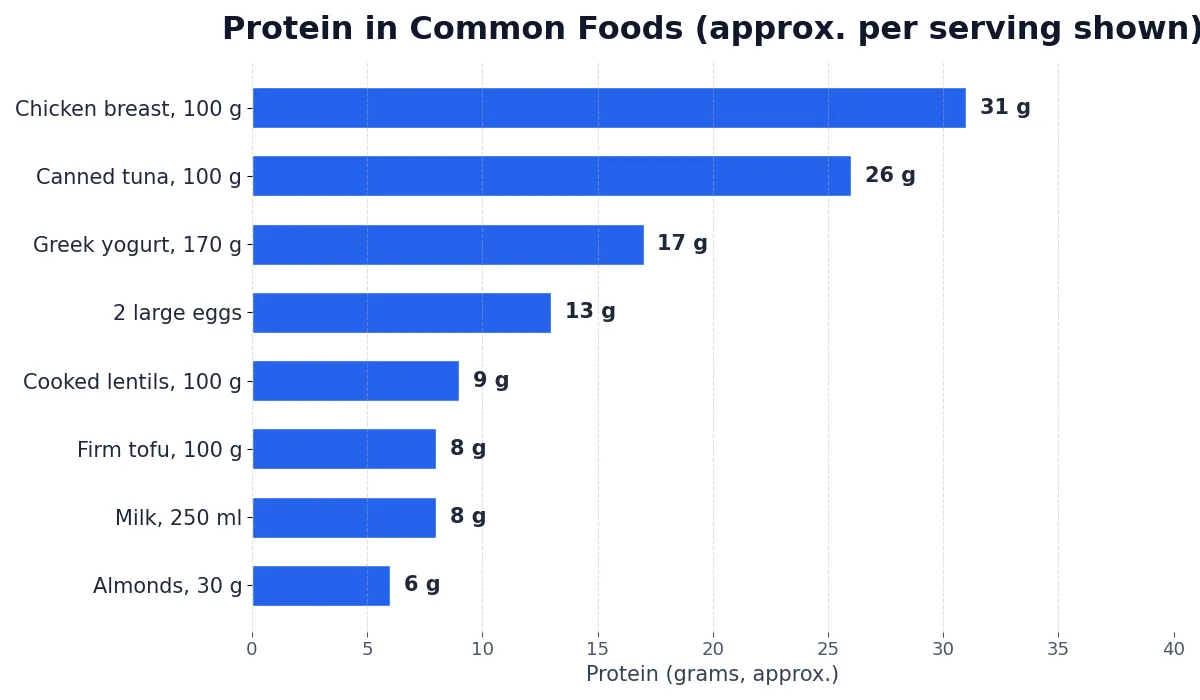
Protein in common foods (approximate)
| Food | Serving | Protein (approx.) |
|---|---|---|
| Chicken breast, cooked | 100 g | 31 g |
| Canned tuna | 100 g | 26 g |
| Greek yogurt | 170 g | 17 g |
| Eggs | 2 large | 13 g |
| Lentils, cooked | 100 g | 9 g |
| Firm tofu | 100 g | 8 g |
| Milk | 250 ml | 8 g |
| Almonds | 30 g | 6 g |
Animal foods deliver more protein per bite, but plant foods add up quickly in combination — lentils plus grains, or tofu with nuts, can cover a meal target without meat. Spreading protein across the day, rather than loading it into one dinner, is the common strategy for muscle maintenance.
Your protein target is one half of the nutrition picture; the other half is total energy. Your resting burn is the starting point for that — check it with our BMR calculator when you plan your meals.
Is there such a thing as too much protein?
For healthy people, the evidence does not show that higher protein intakes damage the kidneys or bones; protein your body cannot use for repair is simply burned as energy. The 2.0 g/kg athlete factor in this calculator is within the range studied in active populations.
When to be cautious
- Kidney disease: people with diagnosed kidney problems should follow their doctor's protein guidance, not a general calculator.
- Very high intakes: consistently eating far above 2 g/kg adds calories without extra benefit and can crowd out fiber, fruit, and vegetables.
- Supplements: whole foods should cover most of your target; powders are a convenience, not a requirement.
A MedlinePlus overview of protein in the diet is a good plain-language reference for what protein does and where it comes from. This calculator gives an estimate for healthy adults — it is not medical advice.
Frequently asked questions
How much protein do I need per day?
Multiply your body weight in kilograms by an activity factor: 1.2 g/kg if sedentary, 1.4 g/kg if moderately active, 1.6 g/kg if very active, and 2.0 g/kg if you train like an athlete. For example, a 70 kg person who is moderately active needs 70 x 1.4 = 98 g of protein per day. The calculator above does this math for you.
What is the 0.8 g/kg minimum shown in the results?
It is the US Recommended Dietary Allowance (RDA) for protein: 0.8 grams per kilogram of body weight per day for an average sedentary adult. It is a floor to avoid deficiency, not an optimal target — most active people do better above it.
How do I convert my weight from pounds to kilograms?
Divide your weight in pounds by 2.20462. For example, 154 lb / 2.20462 = 69.9 kg, which rounds to 70 kg. The calculator does this conversion automatically when you select pounds.
How much protein should I eat per meal?
A practical approach is to divide your daily target across your meals. A 98 g/day target split over 3 meals is about 33 g per meal. Spreading protein through the day is a common strategy for people focused on muscle maintenance and growth.
Can I use this calculator for weight loss or muscle gain?
Yes. During weight loss, a higher protein intake helps preserve muscle and keeps you fuller, which makes a calorie deficit easier to sustain. For muscle gain, lifters commonly aim for the 1.6 to 2.0 g/kg range alongside progressive training.
Is too much protein bad for the kidneys?
In healthy people, research has not shown that higher protein intakes damage the kidneys; excess protein is simply used for energy or stored. People with existing kidney disease are an exception and should follow their doctor's guidance.
Does protein timing matter — should I eat right after a workout?
Total daily intake matters more than exact timing. Eating a protein-containing meal within a few hours of training is the widely used recommendation, and the position stand of the International Society of Sports Nutrition supports 1.4 to 2.0 g/kg per day for building and maintaining muscle mass.