Calories Burned Calculator: What Your Workout Really Burns
Pick an activity, enter your weight and time, and get the calories burned from the MET formula used by exercise scientists.
The calories burned formula
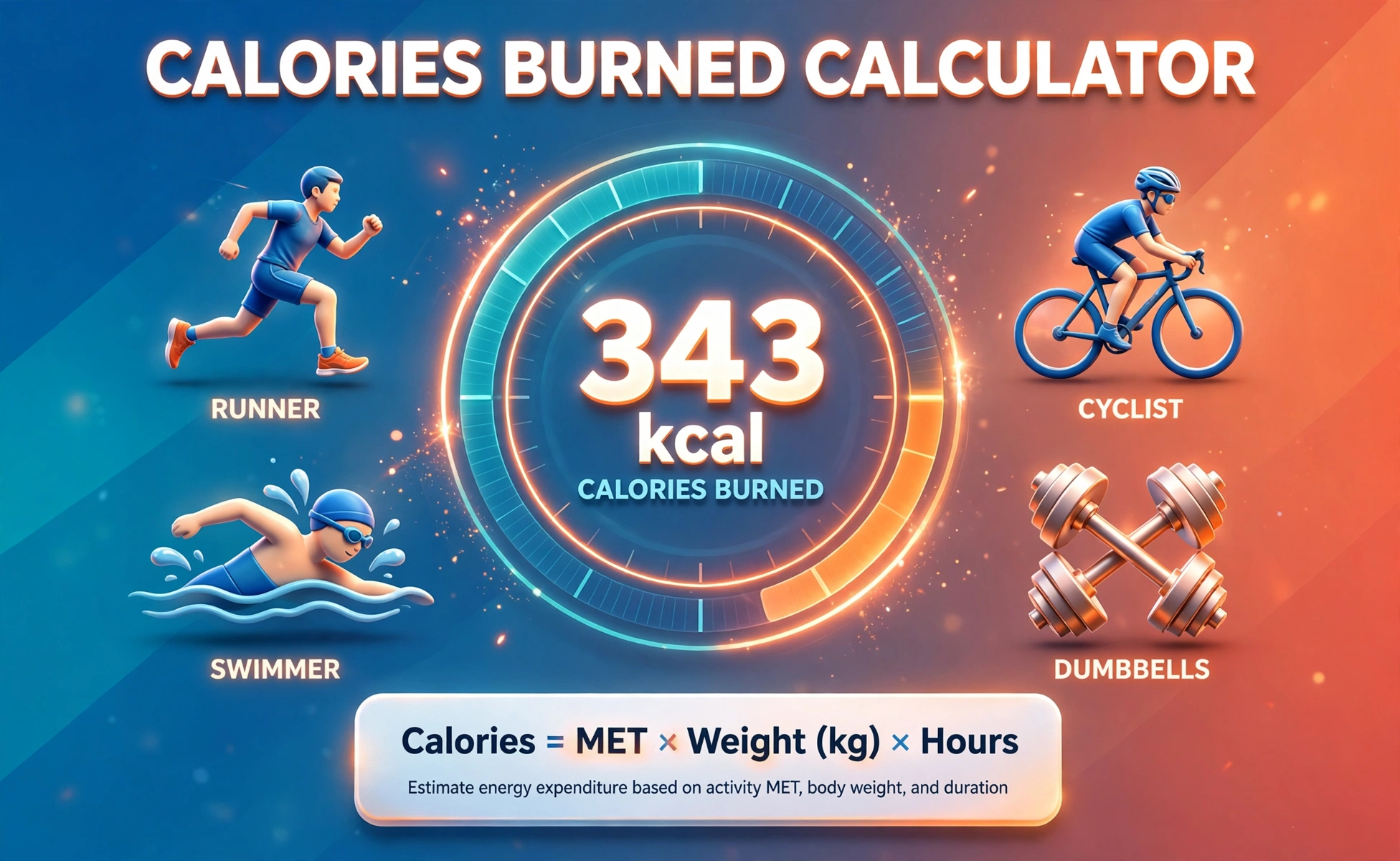
This calculator uses the standard MET formula from exercise physiology:
Calories burned = MET × weight (kg) × duration (hours)
A MET (metabolic equivalent of task) measures how much energy an activity costs compared with sitting quietly, which is defined as 1 MET. So a 9.8 MET run demands about 9.8 times the energy of resting. The values used here come from the Compendium of Physical Activities, the peer-reviewed reference behind most fitness trackers.
Worked example
A 70 kg person running at 6 mph (9.8 MET) for 30 minutes:
- Convert minutes to hours: 30 ÷ 60 = 0.5 hours
- Multiply: 9.8 × 70 × 0.5 = 343 kcal
- In kilojoules: 343 × 4.184 = 1,435 kJ
- Per minute: 343 ÷ 30 = 11.4 kcal/min
Try the same numbers in the calculator above — you will get the same answer.
How to use this calories burned calculator
Pick the activity that best matches what you did, enter your body weight and how long you kept moving, then press Calculate. The result is your estimated energy expenditure for that session. If you weigh yourself in pounds, flip the unit toggle — the conversion to kilograms happens automatically.
Step by step
- Choose an activity. Running, walking and cycling each offer speed-based options, because a faster pace carries a higher MET value and burns more.
- Enter your body weight. Select kg or lb first, then type the number. Heavier bodies move more mass, so the same workout burns more calories.
- Enter the duration in minutes. Only count the time you were actually active — skip warm-up chatting and rest breaks between sets if you want a tighter estimate.
- Press Calculate. You get total kcal, the kilojoule equivalent, the burn rate per minute, and a comparison showing how many minutes of brisk walking would burn the same.
If you track what you eat as well as what you burn, our Calorie (BMR/TDEE) Calculator estimates your full daily needs including food, rest and activity.
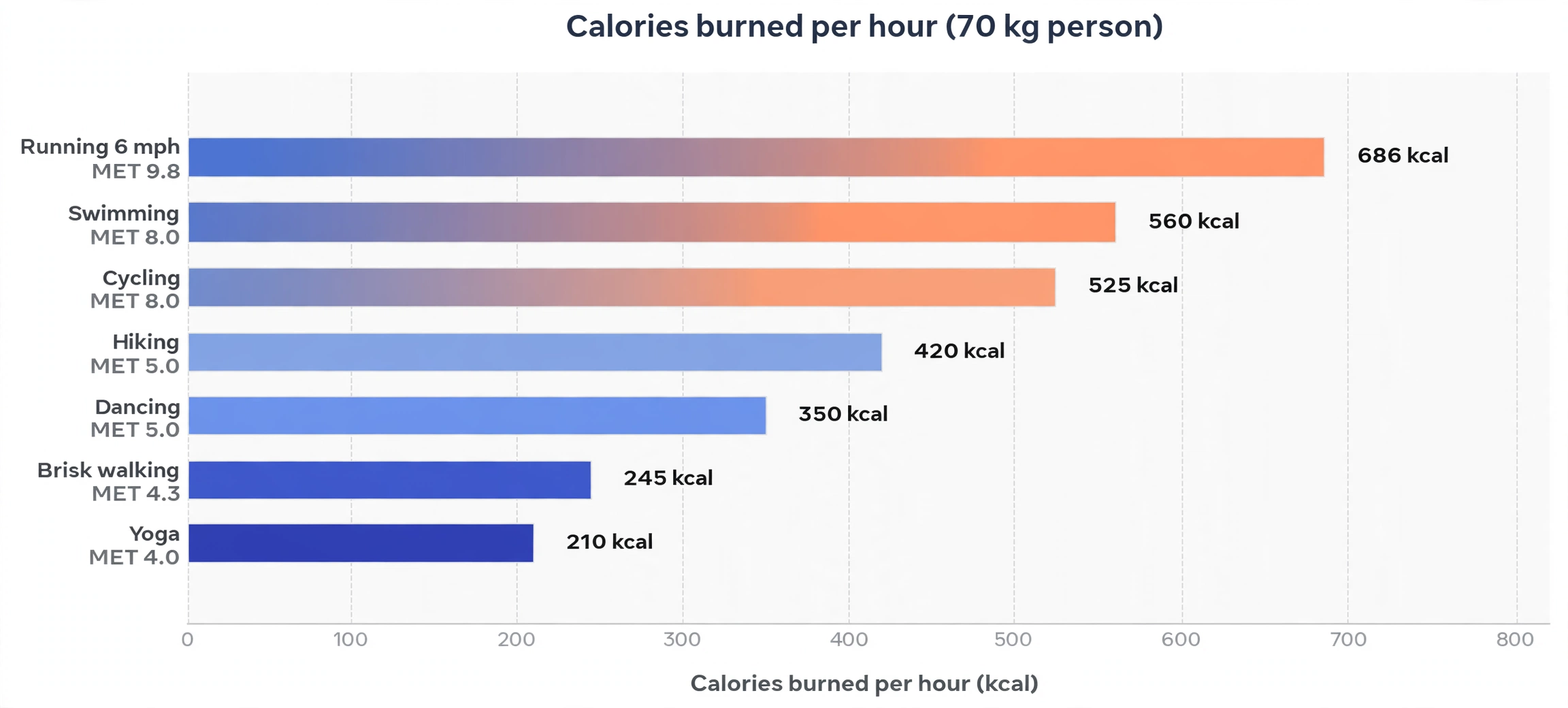
Calories burned per hour by activity
The table below shows what one hour of each activity burns for a 70 kg person, using the same MET values the calculator uses. It is also why small pace changes matter: bumping a run from 5 mph to 7 mph raises the hourly burn from 560 to 805 kcal.
| Activity | MET | kcal per hour (70 kg) |
|---|---|---|
| Running, 7 mph | 11.5 | 805 |
| Running, 6 mph | 9.8 | 686 |
| Running, 5 mph | 8.0 | 560 |
| Swimming, freestyle moderate | 8.0 | 560 |
| Cycling, moderate | 7.5 | 525 |
| Jogging, light | 7.0 | 490 |
| Hiking | 6.0 | 420 |
| Weight training, vigorous | 6.0 | 420 |
| Cycling, light | 5.5 | 385 |
| Walking, very brisk | 5.0 | 350 |
| Dancing, general | 5.0 | 350 |
| Walking, brisk | 3.5 | 245 |
| Yoga | 3.0 | 210 |
Values are estimates from the Compendium of Physical Activities. Your real burn shifts with fitness level, body composition, terrain and conditions, but the ranking between activities stays roughly the same.
What the estimate does not capture
The MET formula is the standard tool exercise scientists use, and it usually lands within about 10 to 15 percent of lab-measured values for steady activities. It still has limits worth knowing.
Known limitations
- Body composition. The formula scales with total weight, but muscle burns more than fat at the same weight. Two 70 kg people can differ.
- Fitness level. Fit people move more efficiently, so they often burn slightly less than the formula says for a familiar activity.
- Terrain and conditions. Hills, wind, water temperature and altitude all move the real number off the estimate.
- Strength work. Weight training METs measure the lifting itself, not the post-workout afterburn, so the estimate can run low.
- Resting calories are included. The total counts the energy you would have spent sitting still anyway — subtract 1 MET worth if you want only the extra burn from the activity.
For planning purposes — comparing workouts, sizing a snack, or tracking a weekly total — the estimate is more than good enough. If you are building a weight-loss plan around the numbers, pair this tool with our Weight Loss Calculator, which turns a daily calorie target into a timeline.
Turning your burn into food equivalents
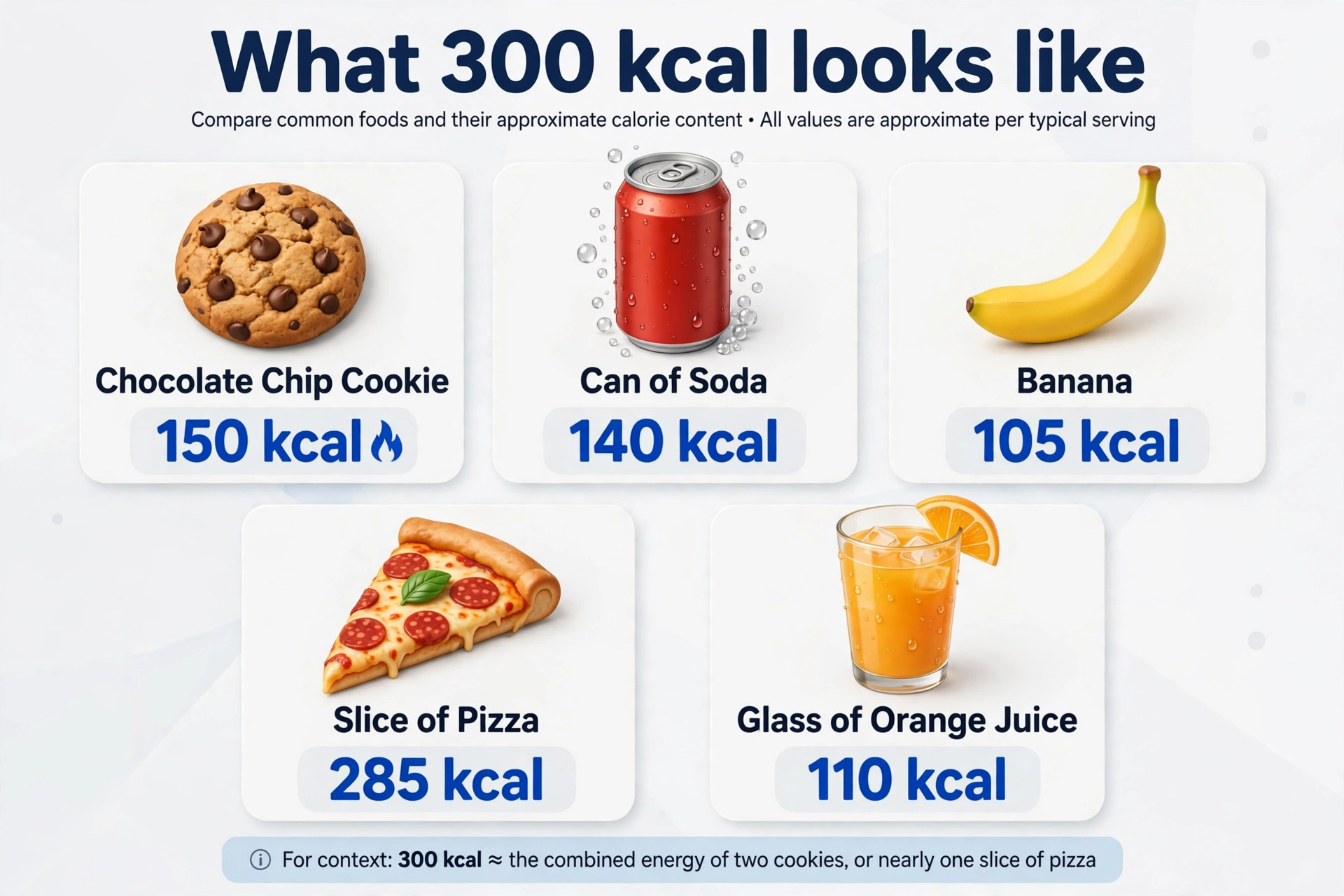
Calories feel abstract until you match them to food. Use these rough equivalents to read your result:
| Workout result | Roughly equals |
|---|---|
| 210 kcal (1 hour of yoga) | 2 medium bananas (105 kcal each) |
| 245 kcal (1 hour brisk walking) | 1 slice of pizza (approx. 285 kcal) minus a cookie |
| 343 kcal (30 min running) | 1 can of soda (140 kcal) plus 1 cookie (150 kcal), plus a banana |
| 560 kcal (1 hour swimming) | 2 slices of pizza (approx. 570 kcal) |
| 805 kcal (1 hour fast running) | A full restaurant burger meal |
These are ballpark figures for motivation and portion sense, not nutrition advice — actual food calories vary by brand and recipe.
Frequently asked questions
How does this calories burned calculator work?
Select an activity with its MET value, enter your body weight and the duration in minutes, then press Calculate. The calculator applies the formula calories = MET × weight (kg) × duration (hours) and also shows kilojoules, calories per minute, and how many minutes of brisk walking would burn the same amount.
What is a MET?
MET stands for metabolic equivalent of task. It rates how much energy an activity uses compared with sitting quietly, which is defined as 1 MET. An activity rated 6 METs, such as hiking, uses about six times the resting energy. MET values come from the Compendium of Physical Activities, a peer-reviewed research database.
How accurate is the calories burned estimate?
For steady activities like running or cycling, MET-based estimates usually land within 10 to 15 percent of lab measurements. Accuracy drops for stop-start sports and strength training, where the estimate misses post-exercise afterburn. Body composition, fitness level, terrain and weather also shift the real number.
Can I enter my weight in pounds?
Yes. Flip the kg/lb toggle next to the weight field, then enter your weight in pounds. The calculator converts it to kilograms automatically before applying the MET formula.
Which activity burns the most calories per hour?
Of the activities in this calculator, running at 7 mph (11.5 MET) burns the most — about 805 kcal per hour for a 70 kg person. Vigorous cycling and fast swimming follow. In general, higher speed and more muscle groups engaged mean a higher MET and more calories per minute.
Does the result include the calories I would burn resting anyway?
Yes. The MET formula gives total energy expenditure during the activity, which includes roughly 1 MET of resting metabolism. If you want only the extra burn caused by the exercise, subtract about 1 MET worth — for a 70 kg person over one hour, that is roughly 70 kcal.
How many calories do I burn running for 30 minutes?
It depends on your weight and pace. A 70 kg person running at 6 mph burns about 343 kcal in 30 minutes (9.8 × 70 × 0.5). A 90 kg runner at the same pace burns about 441 kcal, while a lighter 55 kg runner burns about 270 kcal. Enter your own numbers above for an exact figure.
Related calculators

BMR Calculator
Estimate your basal metabolic rate with the Mifflin-St Jeor equation and daily calorie needs.
Use calculatorCalorie (BMR/TDEE) Calculator
Find your daily calorie needs: BMR, TDEE, goal targets and macros in grams.
Use calculatorWeight Loss Calculator
Get your daily calorie target, macros and timeline for healthy weight loss.
Use calculatorTDEE Calculator
Find your total daily calorie burn from BMR and activity level.
Use calculatorTarget Heart Rate Calculator
Find your heart rate training zones by age and resting heart rate.
Use calculatorPace Calculator
Convert between running pace, time and distance for any run.
Use calculator