Target Heart Rate Calculator: Find Your Training Zones
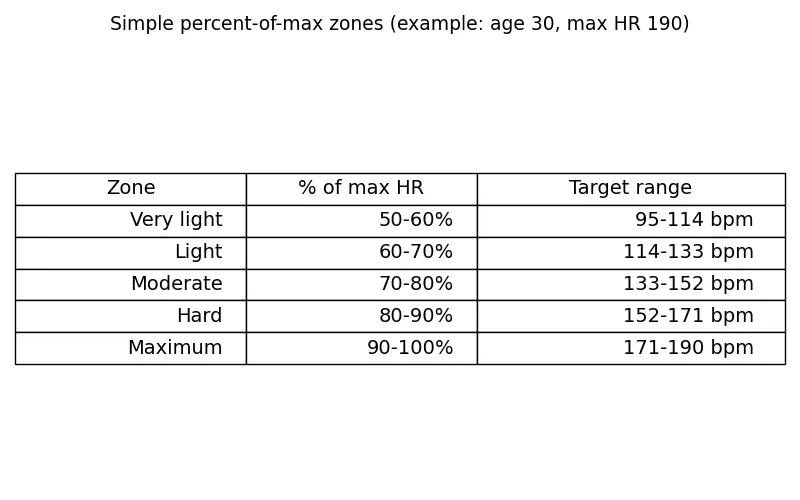
Training in the right heart rate zone is what turns exercise time into results. Enter your age and resting heart rate, and this target heart rate calculator gives you personalised zones — both the Karvonen method, which accounts for your fitness level, and simple percentages of your maximum heart rate.
The target heart rate formulas
The calculator uses two approaches. The simple method takes a percentage of your estimated maximum heart rate. The Karvonen method is more personal: it works from your heart rate reserve — the gap between your resting and maximum heart rate — so two people of the same age with different fitness levels get different targets.
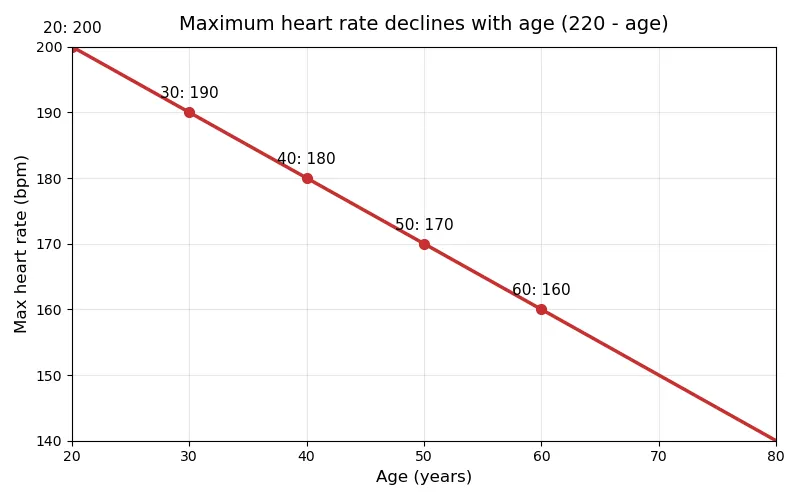
- Maximum heart rate = 220 − age
- Heart rate reserve = maximum heart rate − resting heart rate
- Karvonen target = (heart rate reserve × intensity) + resting heart rate
- Simple target = maximum heart rate × intensity
Worked example
Take a 30-year-old with a resting heart rate of 60 bpm. Maximum heart rate = 220 − 30 = 190 bpm. Heart rate reserve = 190 − 60 = 130 bpm. For a 70% intensity target with the Karvonen method: (130 × 0.70) + 60 = 91 + 60 = 151 bpm. The simple method at the same intensity gives 190 × 0.70 = 133 bpm — noticeably lower, because it ignores how fit this person is.
How to use the target heart rate calculator
You need two numbers: your age and your resting heart rate. The resting value is the one people usually guess — do not guess it, because every zone target shifts with it.

Step by step
- Measure your resting heart rate. Sit quietly for five minutes, then count your pulse for 60 seconds — or take it first thing in the morning before getting up. Repeat on two or three mornings and use the average.
- Enter your age and resting heart rate. Age estimates your maximum; resting heart rate personalises the zones.
- Press Calculate. You get your maximum heart rate, five Karvonen zones and the simple percentage zones.
- Pick the zone that matches your goal. Zone 2 for easy aerobic base, zone 3 for steady cardio, zone 4 for hard intervals — see the zone guide below.
Why resting heart rate matters
A lower resting heart rate usually means a fitter heart, and the Karvonen method rewards it with higher targets. In the example above, dropping resting heart rate from 70 to 60 raises the 70% target from 144 to 151 bpm. As your fitness improves, re-measure and recalculate — your zones should move with you.
What the five training zones mean
Each zone trains a different energy system. Most of your weekly training — for general fitness, roughly four out of five sessions — belongs in the easy zones, with only short efforts in the hard ones. The American Heart Association's guide to target heart rates explains the same zone logic for everyday exercisers.
| Zone (Karvonen) | Intensity | Feels like | Good for |
|---|---|---|---|
| Zone 1 | 50–60% | Very easy, could talk freely | Warm-ups, recovery, beginners |
| Zone 2 | 60–70% | Easy, steady breathing | Aerobic base, fat metabolism, long sessions |
| Zone 3 | 70–80% | Moderate, talking in phrases | Cardio fitness, tempo efforts |
| Zone 4 | 80–90% | Hard, short sentences only | Speed, intervals, race pace |
| Zone 5 | 90–100% | Maximum, cannot talk | Short sprints, experienced athletes |
Karvonen or simple percentages?
Use Karvonen when you know your resting heart rate — it is the more personal answer. Use simple percentages for a quick check mid-workout, since they need only your age. The calculator shows both so you can compare; expect Karvonen targets to run a little higher for fit people and a little lower for beginners.
Maximum heart rate and its limits
The 220-minus-age estimate is a population average, not a personal measurement. Individual maximums commonly differ by 10 to 15 beats either way, and some people fall further outside. Treat your zones as starting points and adjust by feel: if zone 2 feels hard, your true maximum is probably lower than estimated.
When to get a real measurement
If you train seriously, a graded exercise test or a hard field test (a well-rested, all-out 3-minute effort after a thorough warm-up) gives a truer maximum than any formula. Athletes on heart medication should ask their doctor first — beta blockers, for example, lower heart rate and make these zones unreliable.
Pair zones with fuel
Harder zones burn more energy per minute, so zone-based training works best alongside an eating plan. Once you know your typical training mix, a calorie calculator can estimate your daily needs including exercise, so your harder weeks are properly fuelled rather than accidentally under-eaten.
Practical tips for zone training
Zones only work if your heart rate reading is trustworthy. Wrist sensors are fine for steady efforts but lag during intervals; a chest strap is more accurate when the pace changes quickly. Take readings in similar conditions — heat, dehydration and caffeine all push heart rate up for the same effort.
| Situation | What to do |
|---|---|
| First 2–3 weeks | Stay in zones 1–2 to build base fitness safely |
| Hot weather | Expect 5–10 bpm higher; judge by effort too |
| Illness or poor sleep | Train easy or rest — resting HR will be elevated |
| Intervals day | Warm up 10 minutes, then use zones 4–5 for short reps |
| Long slow session | Cap yourself at the top of zone 2, even if it feels too easy |
Do not forget hydration
Dehydration raises heart rate for a given pace, which can push you into a higher zone than your effort deserves — a phenomenon runners call cardiac drift. Drinking to a plan keeps the numbers honest, and a water intake calculator gives you a daily baseline to adjust for training days.
Frequently asked questions
What is a good target heart rate for exercise?
For moderate exercise, aim for 50 to 70% of your maximum heart rate; for vigorous exercise, 70 to 85%. A 30-year-old, for example, has an estimated maximum of 190 bpm, so moderate exercise means roughly 95 to 133 bpm by the simple method, or 125 to 151 bpm by the Karvonen method with a resting rate of 60.
How do I calculate my target heart rate with the Karvonen formula?
First find your heart rate reserve: (220 - age) - resting heart rate. Then multiply by your chosen intensity and add back your resting heart rate. For age 30, resting 60, at 70% intensity: (130 x 0.70) + 60 = 151 bpm.
What is the difference between Karvonen and percent of max?
Percent of max uses only your age-estimated maximum, so everyone of the same age gets the same zones. Karvonen also uses your resting heart rate, so fitter people get higher, more personal targets. Use Karvonen when you know your resting heart rate.
How do I measure my resting heart rate accurately?
Measure first thing in the morning before getting out of bed, or after sitting quietly for five minutes. Count your pulse for a full 60 seconds. Repeat on two or three mornings and average the results — avoid caffeine, exercise and stress beforehand.
Is 220 minus age accurate for maximum heart rate?
It is a reasonable population average but individuals commonly differ by 10 to 15 beats per minute either way. Treat zones based on it as starting points, adjust by perceived effort, and consider a real max test if you train seriously.
Which heart rate zone burns the most fat?
Zone 2 (60 to 70%) uses the highest proportion of fat as fuel, which is why it is called the fat-burning zone. But higher zones burn more total calories per minute, so total fat loss depends more on overall energy balance than on staying in one zone.
Is it dangerous to exceed my maximum heart rate?
Exceeding the 220-minus-age estimate is common and usually just means your true maximum is higher than estimated. True overexertion feels unmistakable — dizziness, chest pain or nausea. Stop and seek medical advice if you feel those symptoms, especially if you have a heart condition.
Related calculators

Calorie (BMR/TDEE) Calculator
Find your daily calorie needs: BMR, TDEE, goal targets and macros in grams.
Use calculatorWater Intake Calculator
Find out how much water to drink each day from your body weight, exercise and climate.
Use calculatorBMR Calculator
Estimate your basal metabolic rate with the Mifflin-St Jeor equation and daily calorie needs.
Use calculator