Weight Loss Calculator: Calorie Target and Timeline
Healthy weight loss comes down to a sustained calorie deficit: burn more energy than you eat. Enter your age, gender, height, weight, activity level and goal, and this weight loss calculator estimates your BMR, your maintenance calories (TDEE), your daily calorie target, a macro breakdown and a projected timeline to your target weight.
Formulas follow the standard Mifflin-St Jeor method. Results are estimates, not medical advice — consult a professional for personal plans. Calculator logic tested with verified worked examples. Last reviewed: October 2026. Our methodology
The weight loss formulas
Weight loss is arithmetic: eat fewer calories than you burn, and the body covers the gap from stored energy. The calculator chains four standard steps to turn your stats into a daily eating target.
- BMR (Mifflin-St Jeor): Men: BMR = 10 × weight(kg) + 6.25 × height(cm) − 5 × age + 5. Women: BMR = 10 × weight(kg) + 6.25 × height(cm) − 5 × age − 161
- TDEE (maintenance calories): TDEE = BMR × activity factor (1.2 sedentary → 1.9 very active)
- Daily deficit: deficit = weekly goal (lb) × 3,500 ÷ 7 — so 1 lb per week means a 500 kcal daily deficit
- Daily calorie target: target = TDEE − deficit
- Timeline: days = (lb to lose × 3,500) ÷ daily deficit
- Macros: protein = target × 30% ÷ 4, carbs = target × 40% ÷ 4, fat = target × 30% ÷ 9 (kcal per gram)
Sources: Mifflin MD, St Jeor ST, Hill LA, Scott BJ, Daugherty SA, Koh YO. A new predictive equation for resting energy expenditure in healthy individuals. Am J Clin Nutr. 1990;51(2):241-247. CDC guidance: people who lose weight gradually and steadily (about 1–2 lb per week) are more successful at keeping weight off.
Worked example
Take a 30-year-old man, 180 cm tall, weighing 90 kg, sedentary, targeting 80 kg at 1 lb per week. BMR = 10×90 + 6.25×180 − 5×30 + 5 = 900 + 1,125 − 150 + 5 = 1,880 kcal/day. TDEE = 1,880 × 1.2 = 2,256 kcal/day. A 1 lb weekly goal needs a 500 kcal daily deficit, so his target is 2,256 − 500 = 1,756 kcal/day. He needs to lose 10 kg (22.05 lb): 22.05 × 3,500 ÷ 500 ≈ 154 days, about 22 weeks. His macros: protein 1,756×0.30÷4 ≈ 131.7 g, carbs 1,756×0.40÷4 ≈ 175.6 g, fat 1,756×0.30÷9 ≈ 58.5 g.
How the calorie deficit works
Your body burns calories around the clock — that baseline is your basal metabolic rate (BMR). Everything on top of that, from walking to workouts, lifts the total to your TDEE, your maintenance intake. Eat exactly your TDEE and your weight holds; eat less and the shortfall — the deficit — comes from stored body fat.
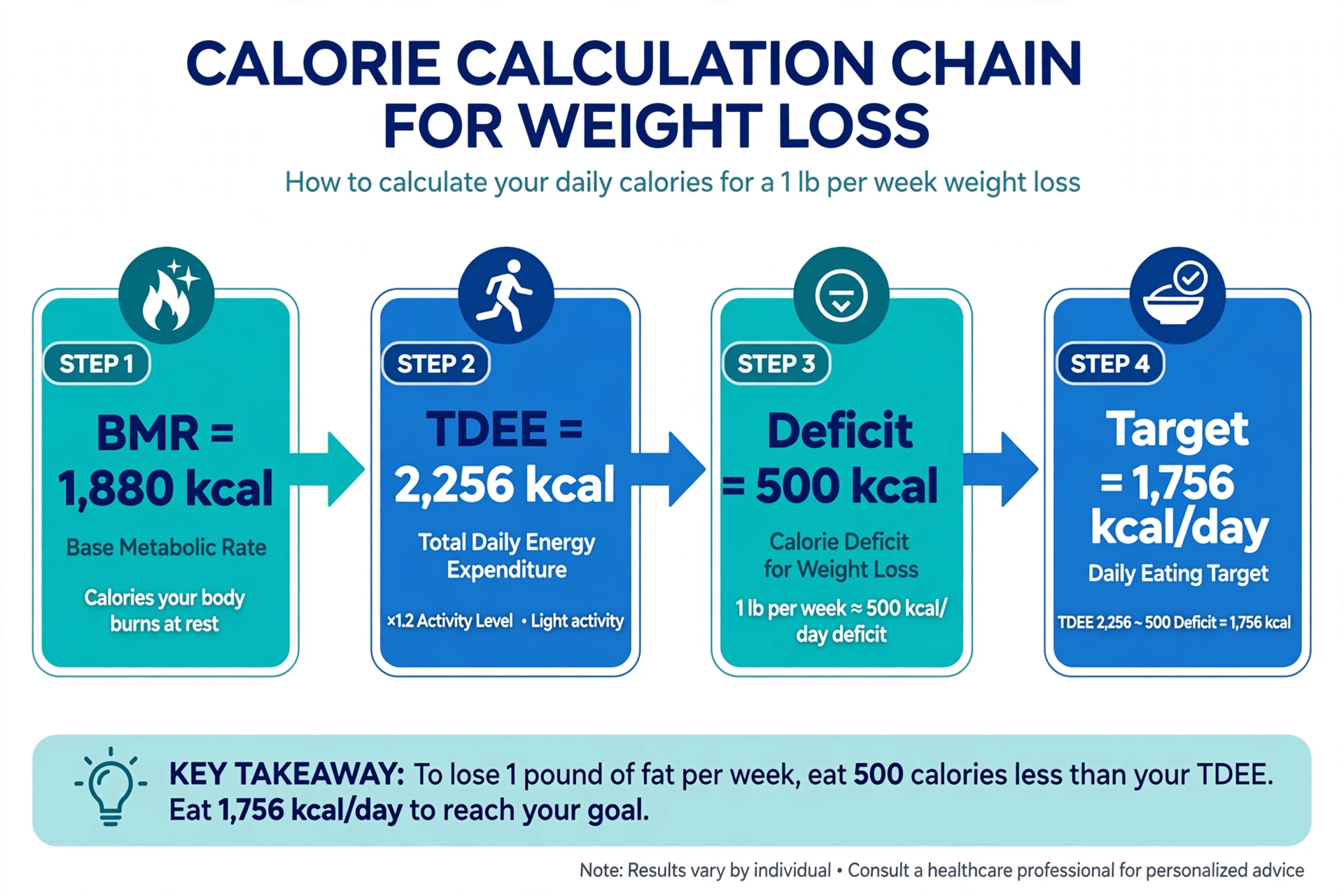
The rule of thumb behind the math is that one pound of body fat stores roughly 3,500 kcal. Spread over a week, a 500 kcal daily deficit totals 3,500 kcal — hence the classic "1 lb per week at a 500-calorie deficit". Real bodies are messier than the rule (water, glycogen and muscle shift too), but it predicts timelines surprisingly well over a few months.
Because the chain starts from your BMR, accuracy matters most at the first step: a wrong BMR throws off everything downstream. That is why this calculator uses the Mifflin-St Jeor equation rather than a rough guess, and why you can cross-check your baseline with a dedicated calorie calculator before setting your deficit.
Activity levels and your TDEE
Two people with identical BMRs can have maintenance calories hundreds of calories apart, purely from daily movement. The activity multiplier is the biggest source of error in calorie planning, so pick honestly: most desk workers are sedentary or lightly active, not "moderately active".
| Activity level | Multiplier | Typical day |
|---|---|---|
| Sedentary | ×1.2 | Desk job, little or no exercise |
| Lightly active | ×1.375 | Light exercise or sports 1–3 days/week |
| Moderately active | ×1.55 | Moderate exercise 3–5 days/week |
| Active | ×1.725 | Hard exercise 6–7 days/week |
| Very active | ×1.9 | Physical job plus daily hard training |
When in doubt, choose the lower level. Overestimating activity inflates your TDEE, shrinks your real deficit, and leaves you wondering why the scale is not moving — the most common stall in self-managed weight loss.
Safe deficits: how fast should you lose weight?
Faster is not better. Public-health guidance (including the CDC) points to roughly 1–2 lb per week as the gradual, steady pace most likely to stay off long term. Bigger deficits burn more muscle, raise hunger hormones, and make the plan unlivable — which is why crash diets so often end in regain.
| Weekly goal | Daily deficit | What to expect |
|---|---|---|
| 0.5 lb/week | 250 kcal | Gentle; easiest to sustain, least muscle loss |
| 1 lb/week | 500 kcal | The classic steady target for most people |
| 1.5 lb/week | 750 kcal | Aggressive; only suitable with a high enough TDEE |
There is also a floor. As general guidance (not medical advice), daily intake should generally not drop below about 1,200 kcal for women or 1,500 kcal for men without professional supervision — below that it is very hard to get enough protein, vitamins and minerals. If your numbers land under that floor, this calculator flags it: consider a smaller deficit or a longer timeline instead.
Setting your macro targets
Calories decide how much weight you lose; macros decide what kind of weight. Enough protein protects muscle while you are in a deficit, carbs fuel training, and fats keep hormones and nutrient absorption working. This calculator splits your target into a balanced 30/40/30 plan — 30% protein, 40% carbs, 30% fat — converted to grams using 4 kcal/g for protein and carbs and 9 kcal/g for fat.
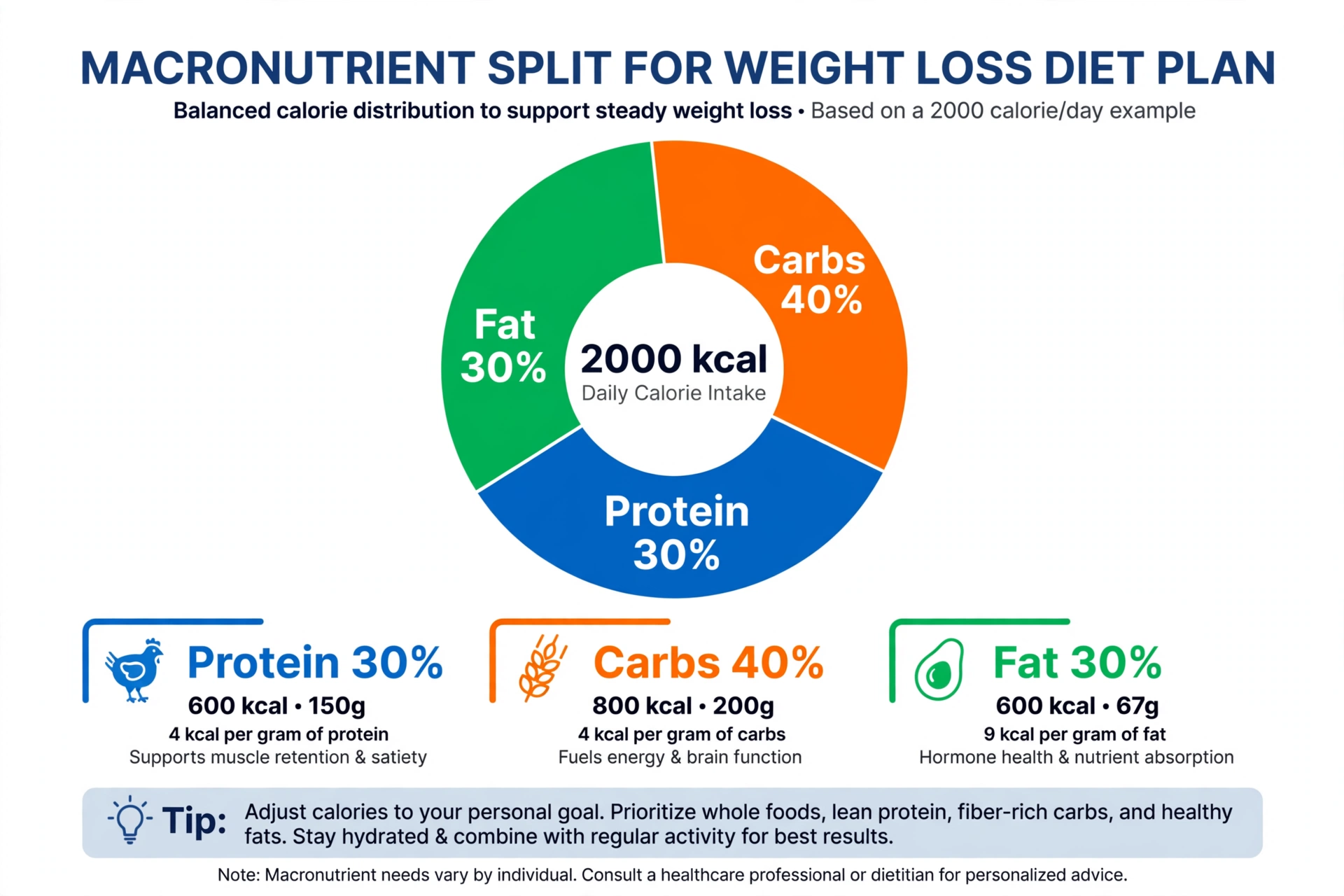
Protein deserves special attention: aim for the higher end of your range if you lift weights, and spread it across meals rather than saving it all for dinner. To fine-tune protein specifically for your body weight and activity, use a protein intake calculator alongside this plan.
Frequently asked questions
How many calories should I eat per day to lose weight?
Multiply your BMR by your activity level to get your TDEE (maintenance calories), then subtract your daily deficit: 250 kcal for 0.5 lb per week, 500 kcal for 1 lb per week, or 750 kcal for 1.5 lb per week. For example, a TDEE of 2,256 with a 500 kcal deficit gives a daily target of 1,756 kcal. This calculator runs the full chain for you.
What is the Mifflin-St Jeor equation?
It is a formula that estimates basal metabolic rate from weight, height, age and sex. Men: 10 x weight(kg) + 6.25 x height(cm) - 5 x age + 5. Women: 10 x weight(kg) + 6.25 x height(cm) - 5 x age - 161. It is widely regarded as one of the most accurate prediction equations for healthy adults.
What is TDEE?
Total Daily Energy Expenditure: the calories you burn in a full day, including your BMR plus all movement and exercise. This calculator estimates it by multiplying your BMR by an activity factor from 1.2 (sedentary) to 1.9 (very active). Eating below your TDEE creates the deficit that drives weight loss.
How does 1 lb of body weight relate to 3,500 calories?
Roughly one pound of body fat stores about 3,500 kcal. A 500 kcal daily deficit totals 3,500 kcal over a week, which is why it corresponds to about 1 lb of fat loss per week. Real results vary because water, glycogen and muscle also shift during weight loss.
Is a 1,500-calorie diet safe?
It depends on the person. General guidance suggests not dropping below about 1,200 kcal per day for women or 1,500 kcal per day for men without professional supervision, because very low intakes make it hard to meet basic nutrient needs. If your calculated target falls below that floor, this calculator flags it.
Why am I not losing weight even with a calorie deficit?
Common reasons include underestimating intake (portions, snacks, drinks), overestimating activity, water retention masking fat loss, and metabolic adaptation over long deficits. Track consistently for 2-4 weeks, weigh under the same conditions each time, and adjust the plan rather than cutting harder every week.
Should I exercise while losing weight?
Yes. Exercise raises your TDEE, helps preserve muscle on a deficit, and supports long-term weight maintenance. A mix of resistance training and regular activity, such as brisk walking, pairs well with a moderate deficit; diet alone usually produces slower, less durable results.
Related calculators

Calorie Calculator
Estimate your daily calorie needs for maintenance, weight loss or muscle gain.
Use calculatorBMI Calculator
Calculate your Body Mass Index and see your healthy weight range.
Use calculatorProtein Intake Calculator
Find your daily protein target from body weight and activity level.
Use calculator