One Rep Max Calculator: Estimate Your 1RM
Your one rep max (1RM) is the heaviest weight you can lift for a single repetition. Enter a recent set — the weight you lifted and how many reps you managed — and this one rep max calculator estimates your 1RM with the Epley, Brzycki or Lombardi formula, plus full max-rep and percentage-of-1RM training load tables.
Formulas are standard strength-training estimation methods. Calculator logic tested with verified worked examples. Last reviewed: October 2026. Our methodology
Estimation methods
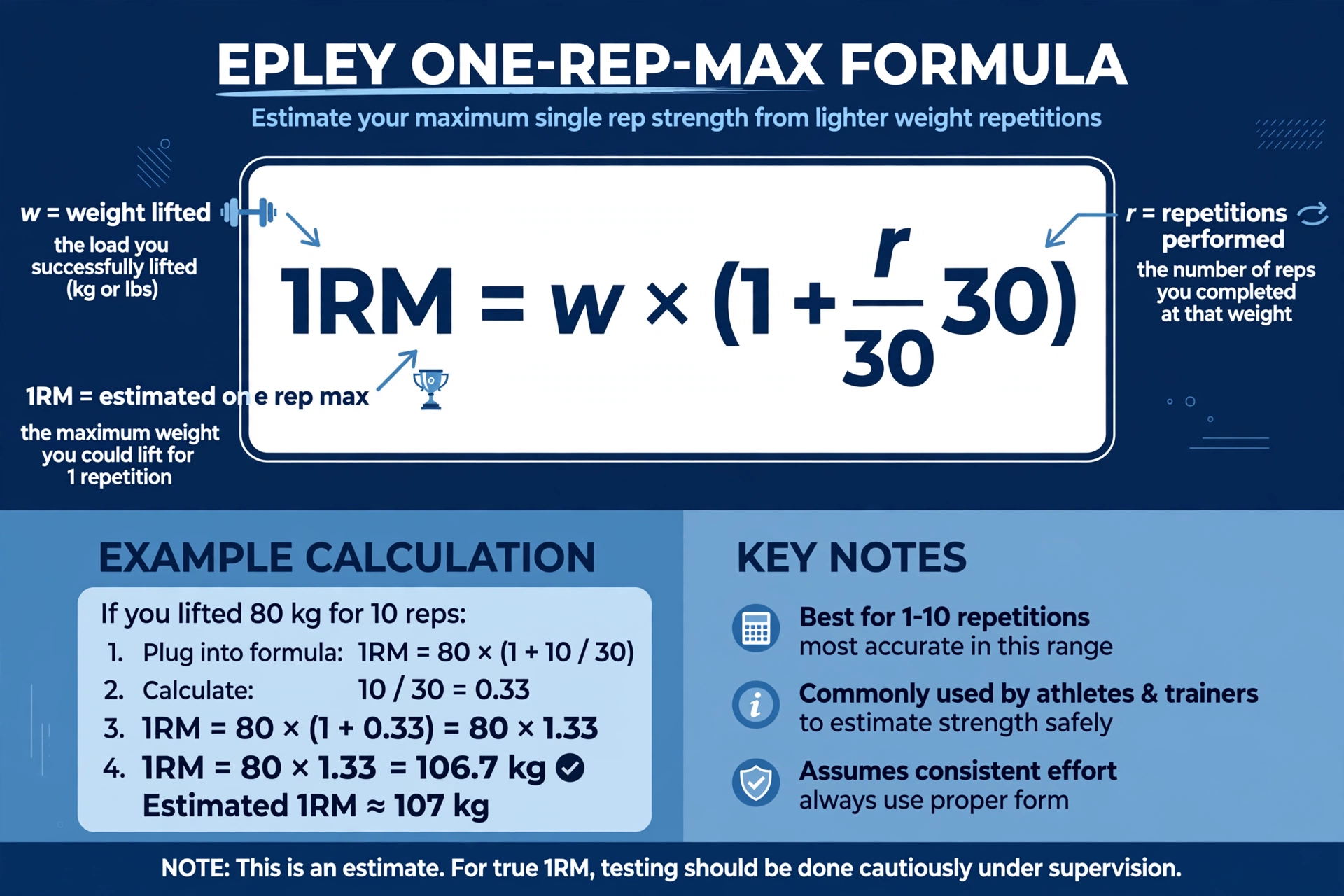
Testing a true one rep max is risky and exhausting, so lifters use rep-based formulas to estimate it from a lighter sub-maximal set. All three formulas below take the weight you lifted (w) and the reps you performed (r) and extrapolate what you could lift for a single rep.
- Epley: 1RM = w × (1 + r ÷ 30)
- Brzycki: 1RM = w ÷ (1.0278 − 0.0278 × r)
- Lombardi: 1RM = w × r0.1
Formula comparison
| Formula | Equation | Best used for |
|---|---|---|
| Epley | 1RM = w × (1 + r ÷ 30) | General use; the most popular choice and the default in this calculator |
| Brzycki | 1RM = w ÷ (1.0278 − 0.0278 × r) | Lower rep ranges; gives slightly more conservative estimates than Epley |
| Lombardi | 1RM = w × r0.1 | Higher rep ranges; treats the rep-to-weight curve as logarithmic |
These are estimates, not guarantees. Different formulas can disagree by several pounds, and individual strength, fatigue, form and the specific exercise all shift the real number. Treat the result as a planning tool, not a promise.
Sources: Epley formula — Epley, B. (1985), "Poundage chart"; Brzycki formula — Brzycki, M. (1993), Strength Testing — Predicting a One-Rep Max from Reps-to-Fatigue; conversion factor 1 kg = 2.20462 lb. See also the National Strength and Conditioning Association.
Worked example
You bench press 100 lb for 5 reps. Here is what each formula estimates:
- Epley: 100 × (1 + 5 ÷ 30) = 100 × 1.1667 = 116.67 lb
- Brzycki: 100 ÷ (1.0278 − 0.0278 × 5) = 100 ÷ 0.8888 = 112.51 lb
- Lombardi: 100 × 50.1 = 117.46 lb
With the Epley estimate of 116.67 lb, the estimated-max-reps table says you should manage about 92.11 lb for 8 reps (78.9% of 1RM), and the percentage table says 50% of 1RM is 58.33 lb — a typical warm-up or endurance weight.
How to use the one rep max calculator
Pick a recent set you performed close to failure on the lift you want to test — for example your last bench press or squat set — and enter it below. The calculator does the rest.
Step by step
| Step | What to enter | Tip |
|---|---|---|
| 1 | Weight lifted | Use the actual working weight of the set, in lb or kg |
| 2 | Repetitions | Sets of 1–10 reps give the most reliable estimates |
| 3 | Formula | Epley is the safe default; Brzycki is slightly conservative |
| 4 | Output unit | Results convert automatically — no need to pre-convert your input |
After pressing Calculate you get the estimated 1RM, the full estimated-max-reps table (1 to 20 reps) and the percentage-of-1RM table (100% down to 50%). Use the Reset button to clear the results and try a different set.
Reading your training-load tables
The estimated max reps table answers "how much can I lift for N reps?" — each row is derived by inverting the Epley formula, so row 1 shows 96.8% of your 1RM rather than 100%. The percentage-of-1RM table answers the training question: "what weight is 80% of my max?"
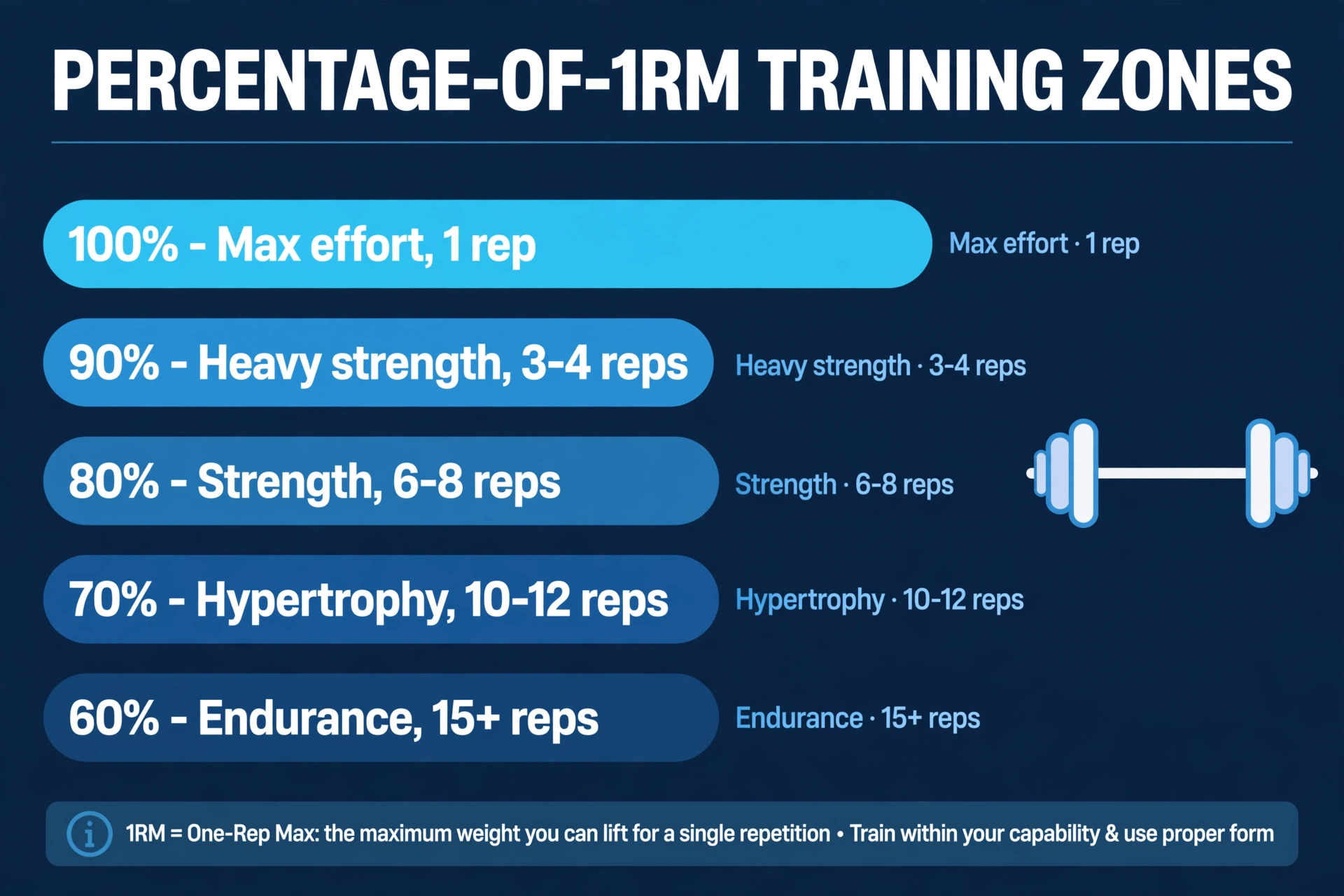
Typical training zones
| % of 1RM | Typical reps | Training focus |
|---|---|---|
| 95–100% | 1–2 | Maximal strength, peaking |
| 85–95% | 3–5 | Heavy strength |
| 75–85% | 6–10 | Strength and hypertrophy |
| 65–75% | 10–15 | Hypertrophy |
| 50–65% | 15+ | Muscular endurance, technique work |
Most programs work with percentages rather than absolute weights, because percentages scale with your strength. When a program says "5 × 5 at 80%", look up the 80% row in the percentage table and load that weight.
Why your 1RM matters for programming
Strength programs like 5/3/1, Starting Strength progressions and most periodized plans are written in percentages of your 1RM. Without knowing your max, "lift at 75%" is meaningless — the percentage tables above turn it into a number you can actually load on the bar.
Your 1RM is also a useful progress metric alongside body composition. If your max goes up while your body weight is stable, you are getting stronger pound for pound — and a BMI calculator gives you a quick read on where that body weight sits.
Strength gains are built on recovery as much as training. Protein intake drives muscle repair, so lifters tracking their 1RM often check a protein intake calculator to make sure their nutrition supports the numbers they are chasing.
Accuracy, limits and safety
Rep-based formulas are most accurate for 1–10 reps. Past 10 reps, fatigue and conditioning skew the estimate upward — the calculator flags these sets so you know to take the number with a grain of salt.
No formula knows your sleep, your form, or the exercise. Estimates from a leg press overstate your squat max; estimates from fresh morning sets overstate what you can do at the end of a long session. Retest every 8–12 weeks and adjust when real lifts beat the estimate.
Never attempt a true 1RM alone or without safety equipment. Use a spotter, safety pins or a power rack, warm up through the percentage table (50%, 70%, 85%) and stop a rep when form breaks down — the calculator is a planning tool, not a spotter.
Frequently asked questions
What is a one rep max (1RM)?
Your one rep max is the heaviest weight you can lift for a single complete repetition of an exercise with good form. It is the standard measure of maximal strength and the basis for percentage-based training programs.
How does the Epley formula work?
The Epley formula estimates your 1RM as weight × (1 + reps ÷ 30). It assumes each rep you can do beyond one means your max is 1/30th of the lifted weight higher. For 100 lb × 5 reps: 100 × (1 + 5/30) = 116.67 lb.
Which 1RM formula is most accurate?
No single formula wins for everyone, but Epley is the most widely used and a safe default. Brzycki runs slightly more conservative, and Lombardi fits higher-rep sets better. Differences are usually a few pounds; real strength varies more than that day to day.
How many reps should I test with for the best estimate?
Use a set of 1–10 reps performed close to failure. Accuracy drops past 10 reps because fatigue, conditioning and form start to dominate. A 3–6 rep set usually gives the sweet spot between safety and accuracy.
How do I use my 1RM in training?
Pick the percentage your program prescribes and read the weight from the percentage-of-1RM table. For example, 5 sets of 5 at 80% of a 116.67 lb max means loading about 93.33 lb per set.
How often should I retest my 1RM?
Every 8–12 weeks is enough for most lifters, or at the start and end of a training block. Strength changes slowly; retesting too often wastes training days and adds injury risk.
Are one rep max calculators accurate?
They are accurate enough for programming — usually within 5% for sets of 1–10 reps — but they are estimates, not guarantees. Exercise choice, fatigue, form and day-to-day variation all shift the real number, so treat the result as a planning tool.
Related calculators

BMI Calculator
Check your body mass index and see which weight category you fall into.
Use calculatorProtein Intake Calculator
Find your daily protein target based on weight, activity and goals.
Use calculatorIdeal Weight Calculator
Estimate your healthy target weight range from your height.
Use calculator