Ideal Weight Calculator: Find Your Healthy Weight Range
Ideal body weight formulas estimate a healthy target weight from your height and sex. Enter your height, choose your sex, and this ideal weight calculator shows results from four classic formulas — Devine, Robinson, Miller and Hamwi — in kilograms and pounds, so you can compare them instead of trusting a single number.
The ideal weight formulas
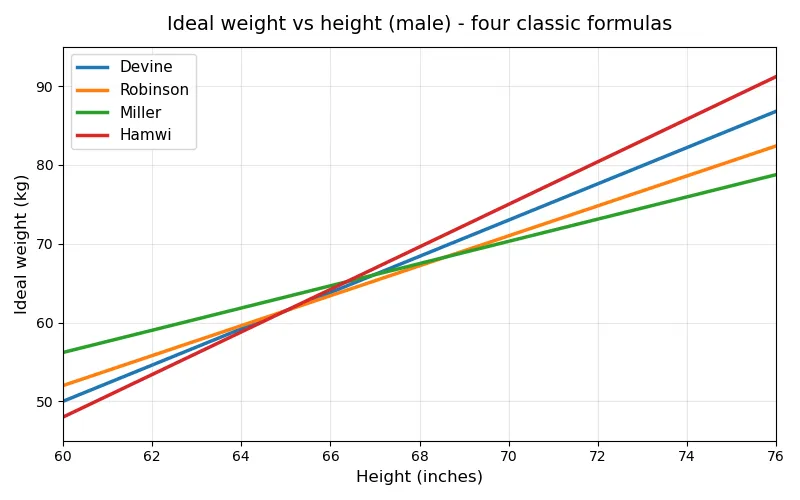
All four formulas work the same way: they start from a base weight at 5 feet (60 inches) and add a fixed amount for every inch above that. For heights under 5 feet the added term is zero, so the result never drops below the base weight. Here d means inches over 60, clamped at 0.
| Formula | Male | Female |
|---|---|---|
| Devine | 50 + 2.3 × d | 45.5 + 2.3 × d |
| Robinson | 52 + 1.9 × d | 49 + 1.7 × d |
| Miller | 56.2 + 1.41 × d | 53.1 + 1.36 × d |
| Hamwi | 48 + 2.7 × d | 45.5 + 2.2 × d |
Worked example
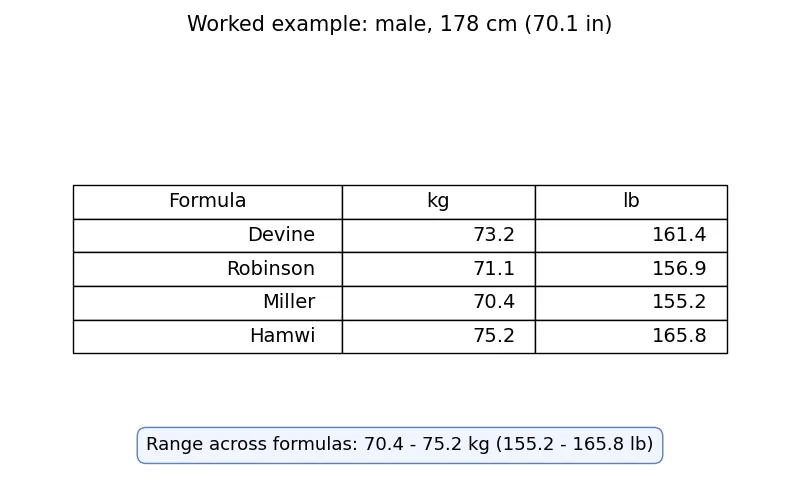
Take a man who is 178 cm tall. First convert to inches: 178 ÷ 2.54 = 70.08 inches. Inches over 60: d = 70.08 − 60 = 10.08. Now apply each formula:
- Devine: 50 + 2.3 × 10.08 = 50 + 23.18 = 73.2 kg (161.3 lb)
- Robinson: 52 + 1.9 × 10.08 = 52 + 19.15 = 71.1 kg (156.9 lb)
- Miller: 56.2 + 1.41 × 10.08 = 56.2 + 14.21 = 70.4 kg (155.2 lb)
- Hamwi: 48 + 2.7 × 10.08 = 48 + 27.22 = 75.2 kg (165.8 lb)
The four results span 70.4 to 75.2 kg. That spread is the point: treat the range as a sensible zone rather than chasing one exact number.
How to use the ideal weight calculator
The calculator needs only two inputs: your height and your sex. Measure your height without shoes, ideally in the morning, and enter it in centimetres or switch to feet and inches.
Step by step
- Choose your height unit. Centimetres or feet and inches — the calculator converts everything to inches internally.
- Enter your height. Use your barefoot morning height; a couple of centimetres of slouch changes the answer by roughly a kilogram.
- Select your sex. The formulas differ by sex because they were fitted to different reference populations.
- Press Calculate. You get all four formula results in kg and lb, plus the range across them.
Read the range, not one number
No single formula is "correct" — they were developed between the 1960s and 1980s for different purposes, from drug dosing to insurance tables. Where they agree, you have a solid target zone; where they differ, the truth is somewhere in between. A result that sits inside the 4-formula range is a reasonable goal for most adults.
How the four formulas differ
Devine is the original, created to estimate drug doses, and it is still the one most clinicians recognise. Robinson and Miller adjusted the base weights and slopes to better fit average builds, while Hamwi gives the highest values of the four and is often used as a generous upper bound.
| Formula | Tends to give | Often used as |
|---|---|---|
| Devine | Middle of the range | The classic reference, still used in dosing |
| Robinson | Slightly below Devine | A leaner target for average builds |
| Miller | The lowest values | A conservative lower bound |
| Hamwi | The highest values | A generous upper bound |
Ideal weight is not the same as a healthy BMI
These formulas output one weight per height, while BMI gives you a range (18.5 to 24.9) that accounts for different builds. The two usually agree: for most heights, the formula results land inside the healthy BMI band. If you want the band rather than a point estimate, check your BMI with our BMI calculator and compare — a weight that satisfies both is a well-supported target.
Interpreting your results
Start with the worked example numbers above: a 178 cm man gets 70.4 to 75.2 kg. If his actual weight is 73 kg, he is comfortably inside the range. If it is 90 kg, every formula agrees he is above the ideal zone — and that agreement across four independent formulas is stronger evidence than any single number.
When the formulas do not apply
These formulas were fitted to average adults and ignore frame size, muscle mass and age. A strength athlete can be "overweight" by every formula while carrying very little fat, and older adults often do better slightly above the formula range. Children, teenagers and pregnant women should not use these formulas at all — the NHS BMI calculator explains which measures suit which groups.
Using the range as a goal
Pick the middle of your 4-formula range as an initial goal, then adjust by how you look, feel and perform. If you lift weights, aim toward the top of the range; if you are slightly built, the bottom is fine. Re-check every few months — the target only changes if your height does, but your progress toward it is what matters.
Ideal weight vs BMI vs body fat
Three common measures answer three different questions. Ideal weight asks "what should I weigh for my height", BMI asks "is my weight proportionate", and body fat percentage asks "how much of me is fat". None of them sees the full picture alone.
| Measure | Inputs | Best for | Blind spot |
|---|---|---|---|
| Ideal weight formulas | Height, sex | A concrete target number | Ignores build and muscle |
| BMI | Height, weight | Quick screening bands | Cannot tell muscle from fat |
| Body fat % | Circumferences or calipers | True composition | Harder to measure well |
Combine them for a fuller picture
Use the formulas on this page for your target, BMI for a quick sanity check, and body fat percentage when you want to know whether weight change is fat or muscle. Our body fat calculator uses the U.S. Navy circumference method, which needs only a tape measure and pairs naturally with the target you found here.
Frequently asked questions
What is the most accurate ideal weight formula?
No single formula is the most accurate for everyone. Devine is the classic reference, Robinson and Miller fit average builds a little better, and Hamwi gives the highest values. The honest approach is to compute all four and use the range — where they agree, the target is well supported.
How is ideal body weight calculated?
Each formula starts from a base weight at 5 feet (60 inches) and adds a fixed amount per inch above that. For example, the male Devine formula is 50 + 2.3 x (inches over 60). For a 178 cm (70.08 in) man, that is 50 + 2.3 x 10.08 = 73.2 kg.
Is ideal weight the same for men and women?
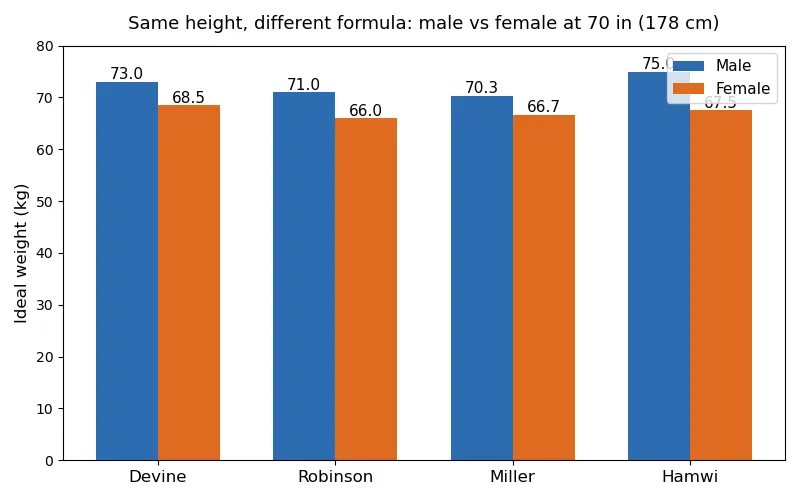
No. Every formula has separate male and female versions, and the female targets are lower at the same height. At 70 inches, for instance, Devine gives 73.0 kg for a man and 68.5 kg for a woman.
Do ideal weight formulas work for muscular people?
Not well. The formulas were fitted to average builds and cannot tell muscle from fat, so a muscular person can exceed every formula while being lean. In that case body fat percentage is the better measure of whether the extra weight is a problem.
What if I am shorter than 5 feet?
Below 60 inches the per-inch term is clamped at zero, so the formula returns its base weight — for example 50 kg (Devine, male) or 45.5 kg (Devine, female). The formulas were not designed for shorter heights, so treat those results as rough guides only.
Should children use ideal weight formulas?
No. These formulas are for adults only. Children and teenagers are still growing, so their healthy weight is assessed with age- and sex-specific BMI percentiles by a clinician, not with adult formulas.
How often should I recheck my ideal weight?
The target itself only changes if your height changes, which for adults is rarely. What changes is your actual weight, so weigh yourself regularly and compare against the range from the calculator rather than recalculating the target.
Related calculators

BMI Calculator
Check your Body Mass Index from height and weight, with your healthy range.
Use calculatorBody Fat Calculator
Estimate your body fat percentage with the U.S. Navy circumference method.
Use calculatorBMR Calculator
Estimate your basal metabolic rate with the Mifflin-St Jeor equation and daily calorie needs.
Use calculator