Body Fat Calculator: Find Your Basal Metabolic Rate
Estimate your body fat percentage with the U.S. Navy circumference method. Enter your measurements below for an instant result.
The U.S. Navy body fat formula
This calculator uses the U.S. Navy circumference method, developed by the Naval Health Research Center. It estimates body fat from simple tape measurements:
- Men: 495 ÷ (1.0324 − 0.19077 × log10(waist − neck) + 0.15456 × log10(height)) − 450
- Women: 495 ÷ (1.29579 − 0.35004 × log10(waist + hip − neck) + 0.22100 × log10(height)) − 450
All measurements use the same unit (inches or centimeters — the calculator converts automatically). The result is your estimated body fat percentage.
Worked example
A man who is 180 cm tall with an 85 cm waist and a 40 cm neck:
- Convert to inches: height = 70.87 in, waist = 33.46 in, neck = 15.75 in
- Waist − neck = 33.46 − 15.75 = 17.72 in
- Body fat = 495 ÷ (1.0324 − 0.19077 × log10(17.72) + 0.15456 × log10(70.87)) − 450
- = 495 ÷ 1.0802 − 450 ≈ 8.2%
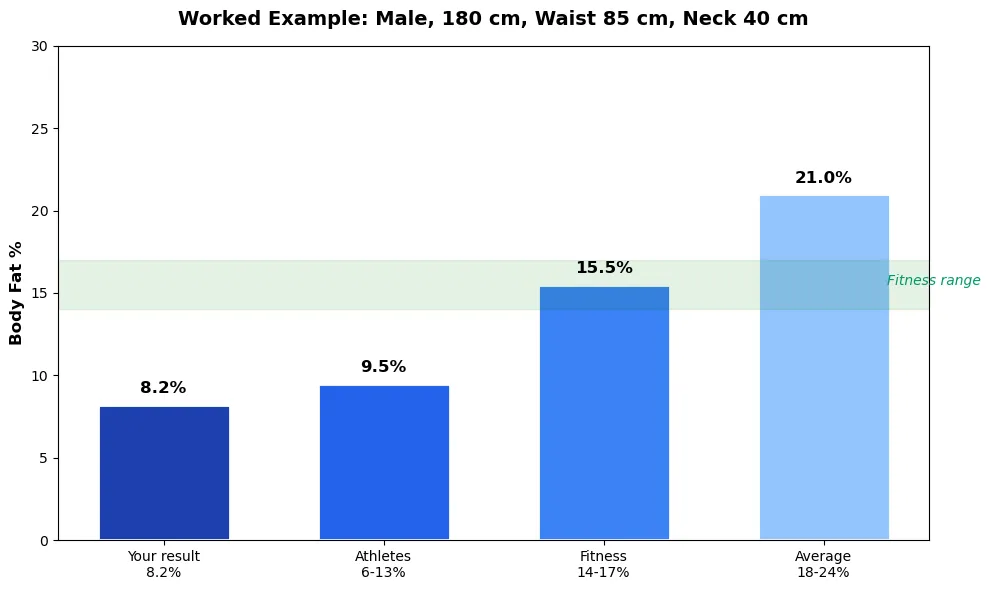
At 8.2%, he falls in the athletes range for men (6–13%).
What is body fat percentage?
Body fat percentage is the share of your total weight that is fat tissue. An 80 kg person at 15% body fat carries 12 kg of fat and 68 kg of lean mass (muscle, bone, water, organs).
Unlike BMI, which only uses height and weight, body fat percentage distinguishes between fat and muscle. Two people can share the same BMI but have very different body compositions — which is why athletes often show as "overweight" on BMI charts despite being lean.
To see where your weight falls on the simpler height-weight scale, try our BMI calculator alongside this tool.
Body fat categories
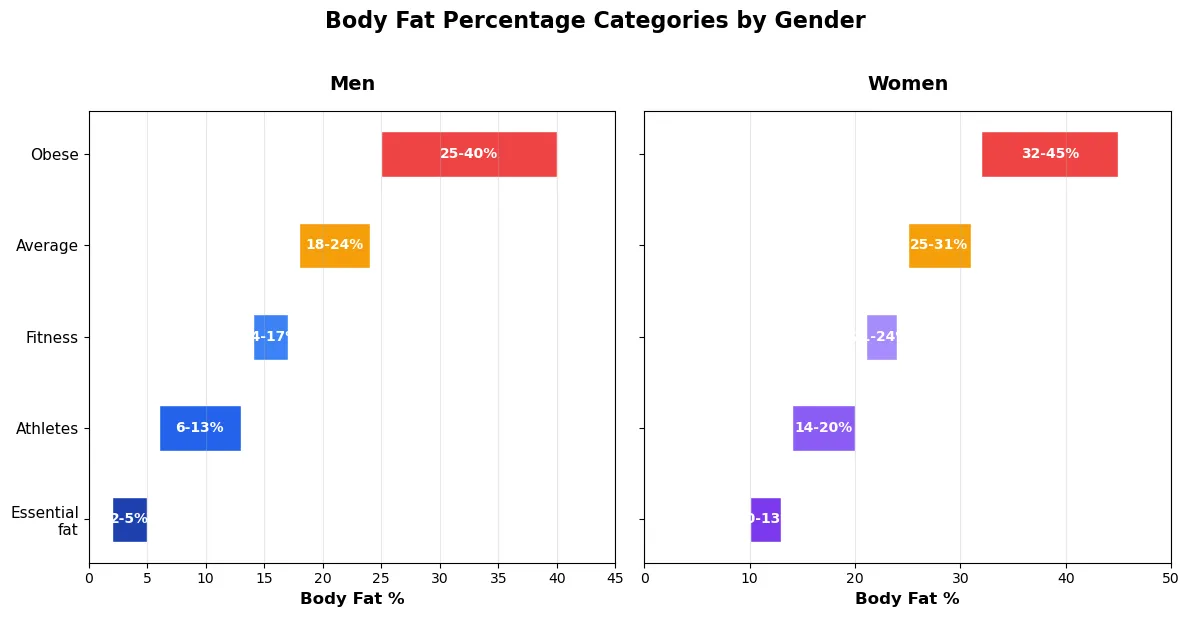
| Category | Men | Women |
|---|---|---|
| Essential fat | 2–5% | 10–13% |
| Athletes | 6–13% | 14–20% |
| Fitness | 14–17% | 21–24% |
| Average | 18–24% | 25–31% |
| Obese | 25%+ | 32%+ |
Essential fat is the minimum needed for basic body functions. Dropping below it can disrupt hormones, immunity, and organ function.
How to take your measurements
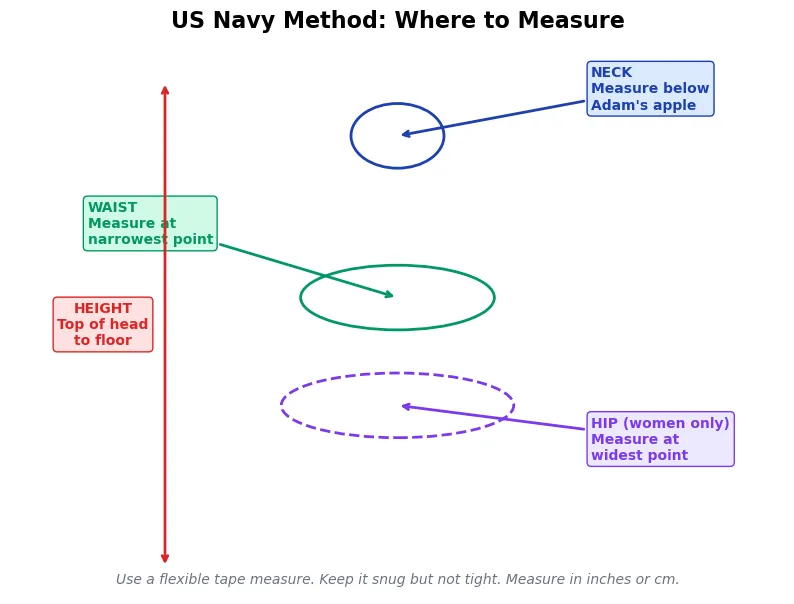
Accurate tape measurements are the key to a reliable result. Use a flexible measuring tape, keep it snug against the skin without compressing it, and measure in the morning before eating.
Step by step
- Height: stand straight against a wall, feet together, and measure from the floor to the top of your head.
- Neck: wrap the tape just below the Adam's apple. Keep your head level and do not push the tape into the skin.
- Waist: find the narrowest point of your torso, usually just above the navel. Breathe out normally before reading.
- Hip (women only): measure around the widest part of the hips, keeping the tape level all the way around.
Tips for consistency
- Measure at the same time of day, ideally in the morning.
- Do not pull the tape tight enough to indent the skin.
- Take each measurement twice; if they differ by more than 1 cm, take a third and average.
- Track changes over weeks, not days — single readings fluctuate with hydration and food.
Worked example and accuracy
Take a man who is 180 cm tall with an 85 cm waist and a 40 cm neck. Converted to inches (70.87 in, 33.46 in, 15.75 in), the U.S. Navy formula gives about 8.2% body fat, in the athletes range.
How accurate is the U.S. Navy method?
The Navy method is accurate within about 3–4 percentage points for most people when measurements are taken carefully. It was validated against hydrostatic weighing and remains the standard field method used by the U.S. military.
It is less reliable for very muscular bodybuilders, pregnant women, and people with unusual fat distribution. For those cases, DEXA scans or skinfold calipers used by a trained professional give better precision.
Body fat vs. BMI
BMI cannot tell fat from muscle, so a muscular person can have a "high" BMI with low body fat. Body fat percentage answers the more useful question: how much of you is fat? Use both together — BMI for a quick screening, body fat for the fuller picture. If you track calories as well, our calorie calculator pairs well with these numbers.
Frequently asked questions
What is a healthy body fat percentage?
For men, 14-17% is the fitness range and 18-24% is average. For women, 21-24% is fitness and 25-31% is average. Athletes run lower: 6-13% for men and 14-20% for women. Below essential fat levels (2-5% men, 10-13% women) is unhealthy.
How accurate is the U.S. Navy body fat method?
The Navy method is accurate within about 3-4 percentage points for most people when measurements are taken carefully. It was validated against hydrostatic weighing. It is less reliable for very muscular bodybuilders, pregnant women, and people with unusual fat distribution.
Why do women need a hip measurement but men do not?
The Navy formula for women includes hip circumference because women naturally store more fat around the hips and thighs. Including this measurement improves accuracy for female body composition. The male formula uses only waist, neck, and height.
What is the difference between body fat percentage and BMI?
BMI uses only height and weight, so it cannot distinguish fat from muscle. A muscular person can have a high BMI with low body fat. Body fat percentage directly measures fat tissue share, making it a better indicator of body composition and health risk.
How often should I measure my body fat?
Measure every 2-4 weeks under consistent conditions (morning, before eating). Daily measurements fluctuate with hydration, food, and sodium. Track the trend over weeks rather than reacting to single readings.
Can I use inches instead of centimeters?
Yes. Select inches from the units dropdown and enter all measurements in inches. The calculator handles the conversion internally. Just be consistent - do not mix inches and centimeters in the same calculation.
Why is my waist measurement so important?
In the Navy formula, the waist-minus-neck difference is the strongest predictor of body fat for men. A larger waist relative to neck indicates more abdominal fat. For women, waist plus hip minus neck serves the same purpose.
Related calculators

BMI Calculator
Check your body mass index from height and weight with healthy range guidance.
Use calculatorCalorie Calculator
Estimate daily calorie needs for your goals from activity level and body stats.
Use calculator
Age Calculator
Find your exact age in years, months, and days from any birth date.
Use calculator