VO2 Max Calculator: Estimate Your Aerobic Fitness
Choose a method, resting heart rate, Cooper 12-minute distance, or 1.5-mile run time, and get your estimated VO2 max in ml/kg/min with a fitness rating.
Formulas verified against standard references. Calculator logic tested with verified worked examples. Last reviewed: October 2026. Our methodology
What VO2 Max Means
VO2 max is the maximum rate at which your body can take in, transport, and use oxygen during intense exercise, measured in milliliters of oxygen per kilogram of body weight per minute. A higher value generally means better cardiovascular fitness and endurance, because the heart, lungs, and muscles work together more efficiently.
The only exact measurement is a lab test with gas analysis during graded exercise to exhaustion. Everything else, including this calculator, estimates VO2 max from a field test or a heart rate ratio, and those estimates carry several ml/kg/min of error. They are best used for tracking change over time with the same method, not for comparing one method against another.
For heart rate training zones, a target heart rate calculator turns age and resting heart rate into zones.
The Three Methods
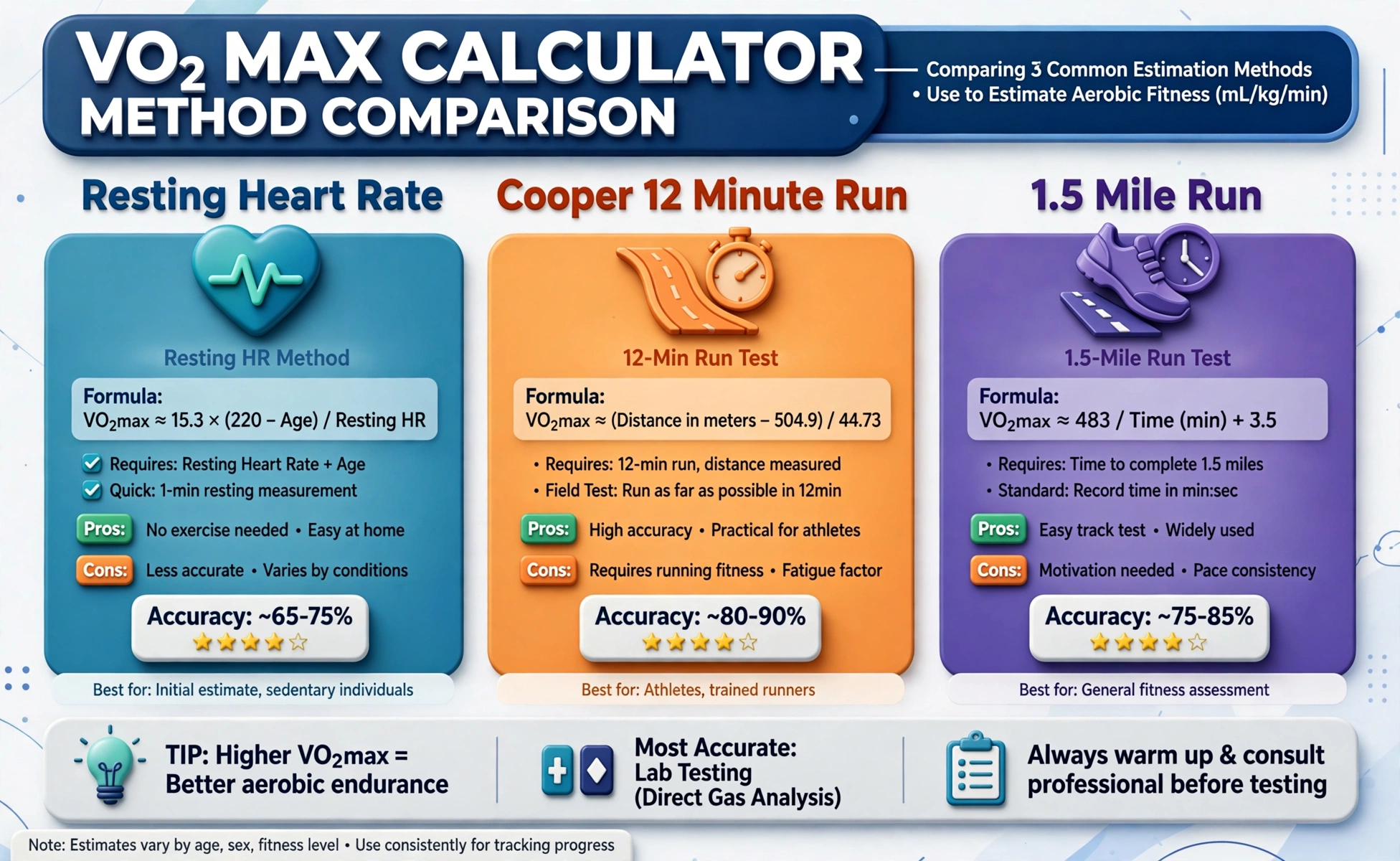
The resting heart rate method uses the Uth-Sorensen formula: VO2 max equals 15.3 times maximum heart rate divided by resting heart rate, with maximum heart rate estimated as 208 minus 0.7 times age. It needs no exercise, which makes it the easiest method, but also the least precise, since age-based maximum heart rate varies widely between people.
The Cooper test runs as far as possible in 12 minutes, then applies VO2 max equals distance in meters minus 504.9, divided by 44.73. The 1.5-mile run method times a fixed distance and applies VO2 max equals 3.5 plus 483 divided by time in minutes. Both exercise methods are more individualized than the heart rate method, but they are strenuous, so they suit people who can run safely.
| Method | Formula | Needs |
|---|---|---|
| Resting heart rate | 15.3 x (HRmax / HRrest) | Age, resting heart rate |
| Cooper 12-minute run | (Distance minus 504.9) / 44.73 | Flat course, 12 minutes |
| 1.5-mile run | 3.5 + (483 / minutes) | Measured 1.5 miles, stopwatch |
Worked Examples
Example 1: age 30, resting heart rate 60. Estimated maximum heart rate is 208 minus 21, which is 187. VO2 max is 15.3 times 187 divided by 60, which is 47.69 ml/kg/min, a good to excellent value for most adults. Example 2: Cooper distance 2,400 meters. VO2 max is 2,400 minus 504.9, divided by 44.73, which is 42.37 ml/kg/min.
Example 3: 1.5-mile run in 12 minutes exactly. VO2 max is 3.5 plus 483 divided by 12, which is 43.75 ml/kg/min. Example 4: age 70, resting heart rate 65. Using the older 220 minus age estimate for maximum heart rate, 150, times 15 gives 34.62, while the 15.3 and 208 formula used here gives a slightly higher estimate, which shows why method details matter.
| Method | Inputs | VO2 max |
|---|---|---|
| Resting heart rate | Age 30, rest 60 bpm | 47.69 |
| Cooper run | 2,400 meters in 12 minutes | 42.37 |
| 1.5-mile run | 12 minutes | 43.75 |
What Counts as a Good VO2 Max
Good depends on age and sex, since VO2 max falls with age and is typically higher in men than in women at the same age. As a rough adult guide, below 30 is below average for most adults, 30 to 39 is average, 40 to 46 is good, 47 to 51 is excellent, and above 52 is superior. For men aged 30 to 39, published tables put superior at 52 and above, excellent at 47 to 51, good at 43 to 46, fair at 39 to 42, and poor at 35 to 38, while the corresponding women aged 30 to 39 bands run lower.
The rating shown by this calculator uses the rough adult guide, not a full age and sex table, so treat it as a starting point. The more useful comparison is with your own past results using the same method, since a rising trend means training is working, whatever the absolute band says.
| VO2 max | Rough adult rating | Men 30 to 39 (published bands) |
|---|---|---|
| Below 30 | Below average | Very poor: under 35 |
| 30 to 39 | Average | Poor 35 to 38, fair 39 to 42 |
| 40 to 46 | Good | Good 43 to 46 |
| 47 to 51 | Excellent | Excellent 47 to 51 |
| 52 and above | Superior | Superior 52 and above |
Common Mistakes
The most common mistake is measuring resting heart rate after coffee, exercise, or stress, which raises it and lowers the estimate. Measure first thing in the morning, before getting out of bed, lying still for a few minutes, and count for a full 60 seconds, or use an overnight tracker average.
Another mistake is comparing methods as if they were interchangeable. A heart rate estimate and a Cooper estimate for the same person can differ by several points, and neither is wrong, since both are estimates with their own error. A third mistake is running a maximal test without a warm-up, a safe course, or medical clearance when health conditions make maximal exercise risky.
How to Improve VO2 Max
VO2 max improves with regular aerobic training: brisk walking, running, cycling, swimming, and rowing, done consistently over weeks and months. Interval training, alternating hard efforts with recovery, tends to raise it faster than steady training alone, but steady training builds the base that intervals need.
Re-test after 4 to 6 weeks with the same method, at the same time of day, on the same course, so the comparison is fair. Small gains of 2 to 3 ml/kg/min are meaningful progress, and plateaus are normal: change the training stimulus, add rest, or check sleep and recovery before chasing a larger jump. For pacing a run test, a pace calculator converts distance and time into pace.
Frequently asked questions
What is a good VO2 max?
It depends on age and sex. Roughly, 40 to 46 is good for most adults, 47 to 51 is excellent, and above 52 is superior, but your own trend over time matters more than any single band.
What is the Uth-Sorensen formula?
VO2 max equals 15.3 times maximum heart rate divided by resting heart rate, with maximum heart rate estimated from age as 208 minus 0.7 times age.
What is the Cooper test?
Run as far as you can in 12 minutes, then VO2 max equals distance in meters minus 504.9, divided by 44.73. For 2,400 meters, that is 42.37 ml/kg/min.
How accurate are VO2 max estimates?
Field estimates carry several ml/kg/min of error. Only a lab test with gas analysis measures VO2 max directly, so use estimates to track change, not as exact values.
How do I measure resting heart rate?
First thing in the morning, before getting out of bed, lying still for a few minutes, then count your pulse for a full 60 seconds, or use an overnight tracker average.
Can I improve my VO2 max?
Yes, with regular aerobic training over weeks and months. Interval training tends to raise it faster, while steady training builds the base.
Is a maximal run test safe for everyone?
No. Maximal tests are strenuous, so people with heart conditions, injuries, or other health risks should get medical clearance first and choose the resting heart rate method instead.