Rule of 72 Calculator
This rule of 72 calculator estimates how many years it takes money to double at a given interest rate, or what annual rate you need to double your money in a set number of years. Enter the rate to see the Rule of 72 estimate next to the exact doubling time, or enter the years to run the rule in reverse.

Formulas verified against standard references. Calculator logic tested with verified worked examples. Published: November 4, 2026 | Last updated: November 4, 2026. Fact-checked: November 4, 2026. Our methodology
What Is the Rule of 72?
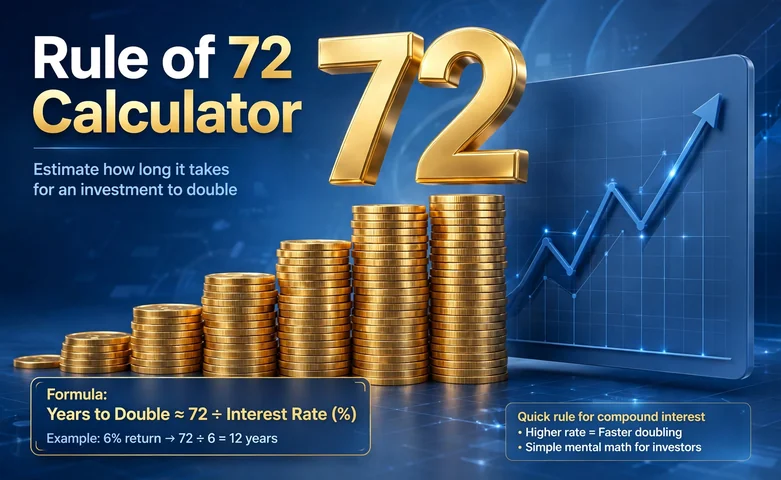
The Rule of 72 is a mental-math shortcut that estimates how long money takes to double at a steady compound interest rate. You divide 72 by the annual rate, and the answer is roughly the number of years to double. No logarithms and no spreadsheet, just one division you can do in your head.
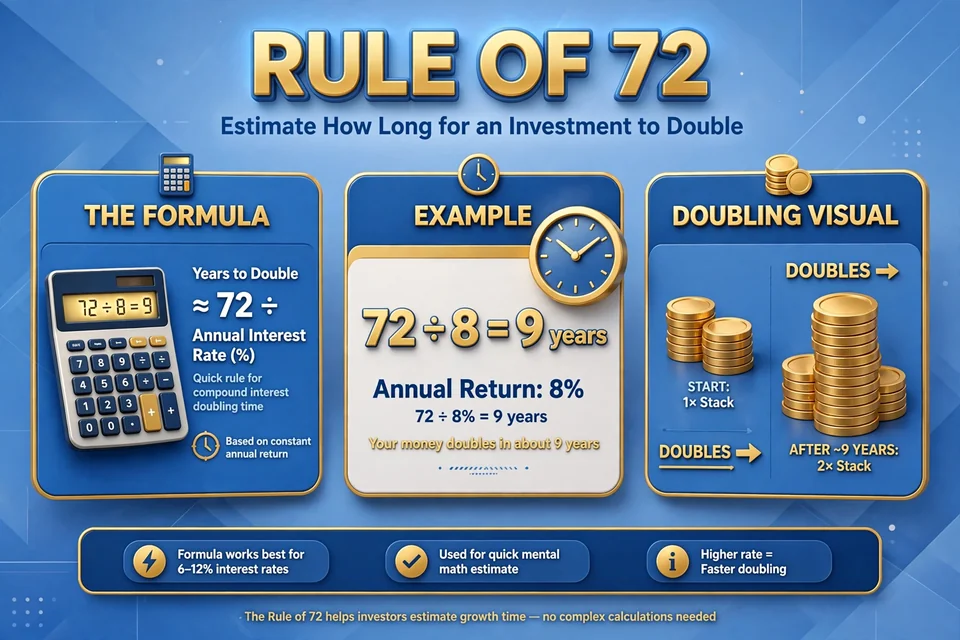
At 8% a year, the rule says 72 ÷ 8 = 9 years. The exact answer is 9.01 years, so the shortcut lands within days of the truth. It works in reverse too: divide 72 by the number of years you have to find the rate you would need, so doubling in 10 years calls for about 7.2% a year.
How to Use the Rule of 72 Calculator
- Choose what you want to find: the years to double at a given rate, or the annual rate needed to double in a set time.
- Enter the annual rate in percent (for example 8) or the number of years (for example 10).
- Press Calculate to see the Rule of 72 estimate next to the exact answer, the difference between them, and the tripling and quadrupling times.
The Rule of 72 Formula
Years to double = 72 ÷ annual rate (%). The rate goes in as a whole number, not a decimal, so you write 8 and not 0.08. At 6%, the rule gives 72 ÷ 6 = 12 years.
The exact doubling time is ln(2) ÷ ln(1 + r), where r is the rate as a decimal and ln is the natural logarithm. The calculator shows both figures side by side so you can see how close the shortcut is at your rate.
The Reverse: Finding the Rate You Need
To find the rate, flip the division: required annual rate (%) = 72 ÷ years. Want to double in 10 years? Then 72 ÷ 10 = 7.2% a year. The exact answer is 7.18%, and the calculator shows it beside the rule's answer.
Why 72?
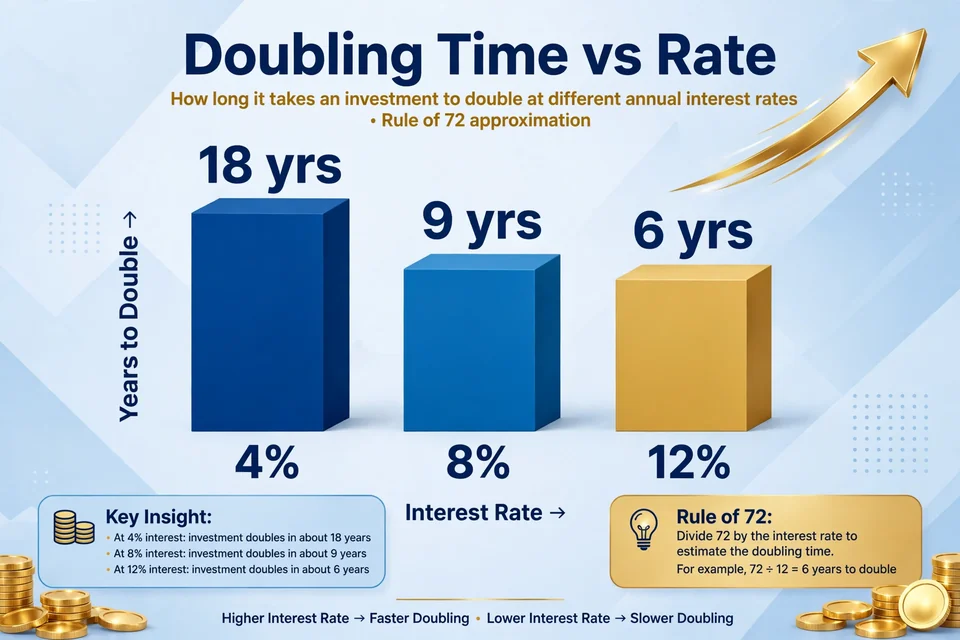
Two reasons make 72 the chosen number. First, it divides evenly by 2, 3, 4, 6, 8, 9, and 12, so the mental math stays easy for the rates people actually meet. Second, the small error from rounding the true numerator up from 69.3 cancels the approximation error in the band where the rule gets used most, roughly 6% to 10%. Near 8%, the rule is almost exact.
The number 69.3 is the mathematically pure choice because ln(2) equals 0.693, and it is the right numerator for continuous compounding. But 69.3 is awkward to divide in your head, and ordinary savings compound in steps rather than continuously, which stretches doubling times slightly. The number 72 trades a little accuracy for arithmetic you can do anywhere, and the trade pays off best around 8%.
How Accurate Is the Rule of 72?
The shortcut is most accurate around 6% to 10%. Below that band it runs a little slow, and above it a little fast. The table compares the rule with the exact doubling time, ln(2) ÷ ln(1 + r).
| Annual return | Rule of 72 (years) | Exact (years) | Difference |
|---|---|---|---|
| 2% | 36.0 | 35.00 | +1.00 |
| 3% | 24.0 | 23.45 | +0.55 |
| 4% | 18.0 | 17.67 | +0.33 |
| 5% | 14.4 | 14.21 | +0.19 |
| 6% | 12.0 | 11.90 | +0.10 |
| 7% | 10.3 | 10.24 | +0.04 |
| 8% | 9.0 | 9.01 | −0.01 |
| 10% | 7.2 | 7.27 | −0.07 |
| 12% | 6.0 | 6.12 | −0.12 |
| 15% | 4.8 | 4.96 | −0.16 |
| 20% | 3.6 | 3.80 | −0.20 |
At 2% the rule says 36 years while the truth is 35.0, a full year off. At 8% the two differ by a hundredth of a year. At 20% the rule promises 3.6 years when the truth is 3.8, a gap of about two months. The error is always predictable, never a surprise.
Rule of 70, Rule of 69.3, and Rule of 115
The same idea works with different numerators for different jobs.
Rule of 70 for low rates
When rates are low, 70 beats 72. At 2%, 70 ÷ 2 = 35 years, which matches the exact answer of 35.0, while 72 gives 36. Inflation is the classic low-rate case: at 3% inflation, the rule of 70 says buying power halves in 70 ÷ 3 = 23.3 years.
Rule of 69.3 for continuous compounding
With continuous compounding, the exact doubling time is ln(2) ÷ r, which equals 69.3 ÷ rate (%). Economists use 69.3 when growth compounds constantly, for example in textbook models. For everyday accounts that compound monthly or yearly, 72 is the handier number.
Rule of 115 for tripling
To estimate tripling instead of doubling, divide 114 or 115 by the rate. At 8%, 114 ÷ 8 = 14.25 years to triple, against an exact answer of 14.27. Quadrupling is simply two doublings, so 144 ÷ 8 = 18 years at 8%, against 18.01 exact. The calculator reports the tripling and quadrupling times for every rate you enter.
The Rule of 72 in Real Life
Doubling investments
An 8% average return doubles money roughly every 9 years. Over 36 years that is four doublings, so $10,000 becomes about $20,000, then $40,000, then $80,000, then $160,000. The last doubling adds more than the first three combined, which is why starting early matters so much. To see how repeated doubling plays out across decades of saving, the retirement calculator projects the complete picture.
Inflation quietly halving your money
Run the rule on an inflation rate instead of a return and it tells you how fast buying power halves. At 3% inflation, money loses half its value in about 24 years by the rule of 72, or 23.3 years by the rule of 70. The exact answer is 22.8 years. This is the quiet cost of cash sitting still.
Debt compounding against you
Unpaid compounding debt doubles the same way investments do. A balance growing at 18% a year doubles in about 4 years, since 72 ÷ 18 = 4. Minimum payments that barely cover interest let the rule run against you, which is why clearing high-rate debt usually beats chasing returns.
Where the Rule Comes From
Start with compound growth: A = P(1 + r)^t, where A is the final amount, P is the starting amount, r is the rate per period as a decimal, and t is the number of periods. Set A to twice P and divide both sides by P to get (1 + r)^t = 2. Taking the natural log of both sides gives t = ln(2) ÷ ln(1 + r), the exact doubling formula. For the rates people meet most, that expression simplifies to about 72 ÷ rate (%), which is the rule.
The rule is old. It appears in Luca Pacioli's 1494 mathematics text Summa de arithmetica, where he states it plainly for doubling at a given yearly percentage, using 6% and 12 years as his example. For exact growth projections with contributions and compounding frequency, the compound interest calculator runs the full math.
Limitations
The rule assumes one constant rate with compound growth, so it is not for simple interest, where money grows by the same dollar amount each year. It assumes returns are reinvested and ignores fees, taxes, contributions and withdrawals, all of which shift the real doubling time. Real returns also vary year to year, and a bumpy path to the same average can double money slower than the smooth math suggests. Treat the answer as a planning estimate, not a promise.
A Note on Estimates
This calculator gives an estimate for planning and education. It is not financial advice, and actual results depend on your account's terms, fees and timing. Read our full disclaimer for the details.
Sources
- CalculatorSoup, Rule of 72 calculator: formula and full derivation. calculatorsoup.com
- Wikipedia, Rule of 72: variations, halving and history. wikipedia.org
- OnlyCalculators, Rule of 72 calculator: divisor switching and doubling projections. onlycalculators.com
- CalculatorPark, Rule of 72 calculator: compounding frequency and tripling. calculatorpark.com
Frequently asked questions
How long does it take money to double at 8% interest?
About 9 years by the Rule of 72, since 72 ÷ 8 = 9. The exact answer is 9.01 years, so the shortcut is off by less than a week. Enter 8 in the calculator above to see both figures side by side.
What is the formula for the Rule of 72?
Years to double = 72 ÷ annual rate (%), with the rate as a whole number. Flipped around, required rate (%) = 72 ÷ years. The exact doubling time is ln(2) ÷ ln(1 + r), where r is the rate as a decimal.
Why is it 72 and not 70?
Because 72 divides evenly by 2, 3, 4, 6, 8, 9, and 12, which makes the mental math easy, and its small upward rounding cancels approximation error near the 6% to 10% rates where the rule is used most. Use 70 for low rates like inflation and 69.3 for continuous compounding.
When should I use the Rule of 70 instead of the Rule of 72?
Below about 4%. At 2%, the rule of 70 gives 35.0 years, which matches the exact answer, while 72 gives 36. Inflation estimates are the most common case for the rule of 70.
How accurate is the Rule of 72?
Very close between about 6% and 10%, where it sits within roughly 1% of the exact answer. It runs a little slow at low rates and a little fast at high ones. At 20%, it says 3.6 years against a true 3.8.
Can the Rule of 72 be used for inflation?
Yes. Divide 72 by the inflation rate to estimate how long until buying power halves. At 3% inflation, that is about 24 years, against 22.8 exact. The rule of 70 is slightly sharper here at 23.3 years.
What is the Rule of 115?
A variation for tripling: years to triple = 114 or 115 ÷ annual rate (%). At 8%, that is about 14.3 years, against an exact 14.27. For quadrupling, use 144, which is simply two doublings.
Does the Rule of 72 work for simple interest?
No. The rule comes from compound growth, where each year’s gains earn their own gains. Simple interest grows by a fixed dollar amount, so doubling takes longer and follows different math.
Related calculators

Compound Interest Calculator
See how your savings grow with compounding interest over time.
Use calculatorInvestment Calculator
Project how your lump sum and monthly contributions grow with compound returns over time.
Use calculatorRetirement Calculator
Project your retirement nest egg from age, savings, contributions and expected returns.
Use calculatorSavings Goal Calculator
Find the monthly savings needed to reach your target from your goal, current savings, rate and timeframe.
Use calculatorInflation Calculator
See what money will be worth and what past prices mean today.
Use calculatorFuture Value Calculator
Project lump-sum and monthly-deposit growth with compound interest.
Use calculatorCAGR Calculator
Compute compound annual growth rate from start and end values.
Use calculatorSavings Calculator
Future savings balance, contributions, and interest earned.
Use calculatorROI Calculator
Measure investment returns with ROI, gain or loss and annualized growth.
Use calculatorPresent Value Calculator
Discount any future payment to its value in today's dollars.
Use calculator