Present Value Calculator: What Is It Worth Today?
A dollar today is worth more than a dollar in ten years — you could invest it. Enter a future amount, the years until you receive it, and a discount rate, and this free present value calculator will tell you what that future money is worth right now.
Formulas verified against standard references. Calculator logic tested with verified worked examples. Last reviewed: October 2026. Our methodology
How present value is calculated
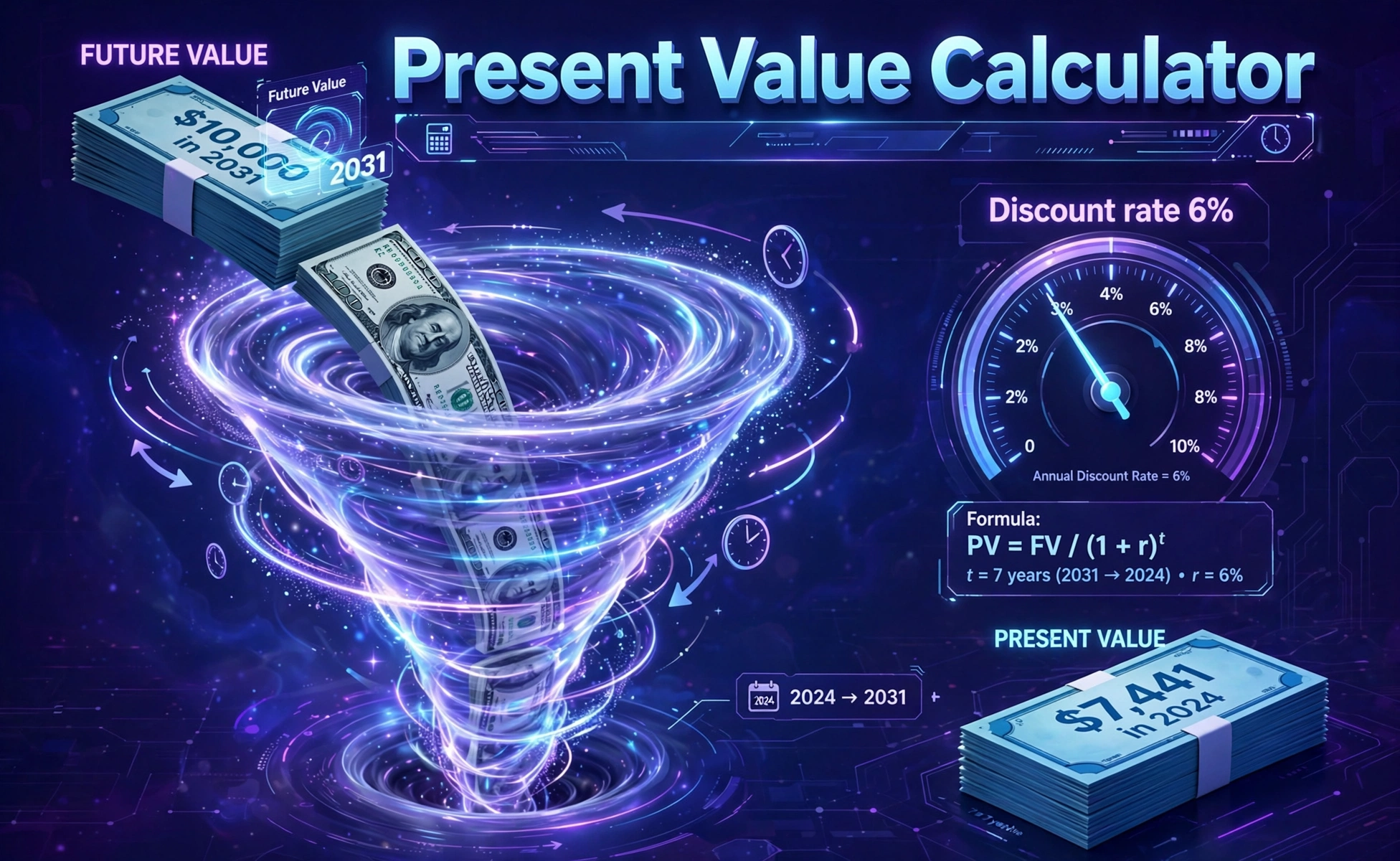
Present value reverses compound growth: instead of growing money forward, it discounts future money backward at the rate you could otherwise earn. The formula is:
- Present value: PV = FV ÷ (1 + r ÷ n)(n × t), where FV is the future amount, r is the discount rate as a decimal, n is compounding periods per year, and t is years.
- Discount: FV − PV — the amount "lost" purely to the passage of time.
- Higher discount rates shrink present value faster, because the assumed alternative investment is more productive.
| Discount rate | PV of $10,000 in 10 years | PV of $10,000 in 20 years |
|---|---|---|
| 3% | $7,440.94 | $5,536.76 |
| 6% | $5,583.95 | $3,118.05 |
| 10% | $3,855.43 | $1,486.44 |
At a 10% discount rate, $10,000 twenty years out is worth under $1,500 today — time is expensive when capital is productive.
Worked example
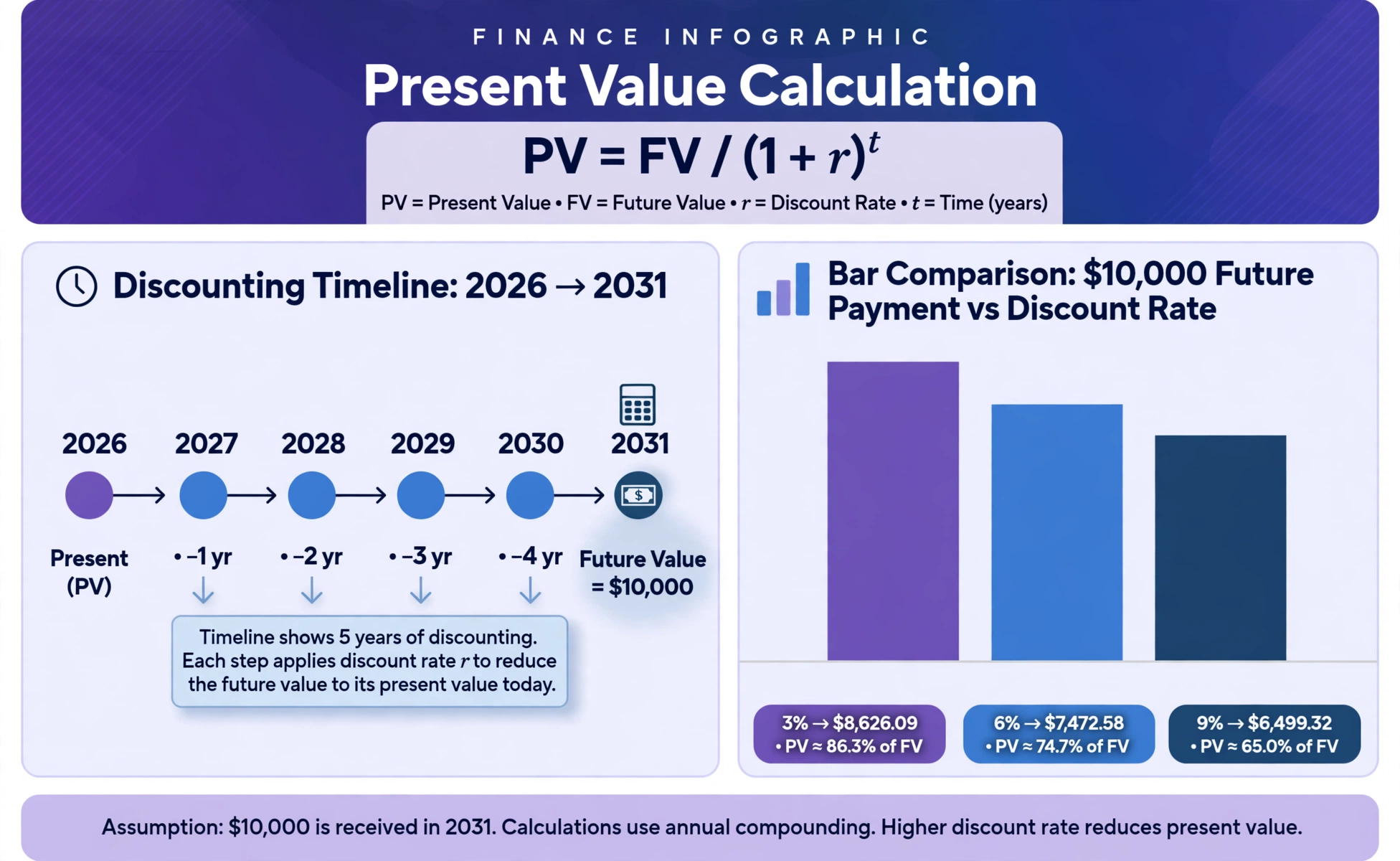
You are offered $10,000 in 5 years, and you use a 6% discount rate with annual compounding. PV = 10,000 ÷ (1.06)5.
First raise 1.06 to the 5th power: 1.065 = 1.33823. Divide: 10,000 ÷ 1.33823 = $7,472.58. The discount is $10,000 − $7,472.58 = $2,527.42 — that is the price of waiting five years at 6%.
How to use the present value calculator
Pick a discount rate that reflects your opportunity cost — what the money could earn elsewhere — then work through the fields.
Step by step
- Enter the future value. The lump sum you will receive down the road.
- Enter the years. How far in the future the payment arrives; decimals work for partial years.
- Enter the discount rate. Common choices: a safe bond yield (4–5%), expected stock returns (7–8%), or your personal required return.
- Pick compounding. Annual is standard for valuation; match the investment you are comparing against.
- Press Calculate. The present value tells you the most you should pay today for that future payment.
What discount rate should you use?
The discount rate is the whole argument — change it and the answer changes. Choose the rate that matches the decision you are making:
| You are deciding… | Sensible discount rate |
|---|---|
| Whether a safe payout beats bonds | Current Treasury / bond yield (~4–5%) |
| Whether to take a lump sum or pension | Your expected portfolio return (~6–8%) |
| Whether a business investment is worth it | Your required return / cost of capital (8–12%+) |
| What a lottery annuity is "really" worth | A safe rate (~4–5%) — the payments are near-guaranteed |
When in doubt, run the calculation at two or three rates. If the decision looks good at all of them, it is robust; if it flips, the rate — not the math — is what you need to think harder about.
Lump sum vs. annuity: the classic use case
The most famous present-value decision is the lottery or pension choice: $1 million today, or $60,000 a year for 20 years? The annuity totals $1.2 million, which looks bigger — but at a 6% discount rate its present value is only about $688,000, far less than the lump sum.
The intuition: money you get later cannot compound for you in the meantime. Present value puts every option on the same footing — today’s dollars — so you can compare honestly. For the reverse question (what will money grow into?), an compound interest calculator runs the math forward.
Present value vs. net present value
Present value (PV) discounts a single future amount to today. Net present value (NPV) goes one step further: it discounts a whole stream of future cash flows and subtracts what you pay upfront.
- PV answers: "What is $10,000 in 5 years worth today?"
- NPV answers: "Is this $8,000 investment worth it, given the cash it will throw off?"
NPV is the workhorse of business finance: positive NPV means the project earns more than your required return. Every NPV calculation is built from individual present values like the one this calculator computes — master this, and NPV is just repetition.

Frequently asked questions
How do you calculate present value?
Divide the future amount by the growth factor: PV = FV ÷ (1 + r)^t, where r is the discount rate and t is years. $10,000 in 5 years at 6% is 10,000 ÷ 1.06^5 = $7,472.58. With compounding n times per year, use (1 + r÷n)^(n×t).
What is a good discount rate?
Match it to your opportunity cost: ~4–5% for safe bond-like comparisons, ~6–8% for stock-market alternatives, 8–12%+ for risky business projects. The rate is the key judgment call — run the numbers at two or three rates to see how sensitive the answer is.
What is the difference between present value and future value?
They are mirror images. Future value grows money forward with compounding (what will it become?); present value discounts money backward (what is it worth today?). Same formula, solved in opposite directions.
Why is money today worth more than money later?
Three reasons: you can invest today's money and earn a return, inflation erodes future purchasing power, and there is always some risk the future payment never arrives. The discount rate bundles all three into one number.
How do you value a series of payments?
Discount each payment separately to today and add them up. A $1,000 payment in year 1 at 6% is worth $943.40, in year 2 $890.00, and so on. Summing discounted cash flows is called a discounted cash flow (DCF) valuation.
What is net present value (NPV)?
NPV discounts all future cash inflows of a project to today and subtracts the upfront cost. Positive NPV means the project beats your required return; negative means it does not. This calculator computes the individual present values that NPV is built from.
Does compounding frequency matter for present value?
Mildly. More frequent compounding discounts slightly harder: $10,000 in 5 years at 6% is $7,472.58 annual but $7,406.43 with daily compounding. The effect is small compared to your choice of rate and time horizon.