Inflation Calculator: What Will Money Be Worth?
Inflation quietly shrinks what your money can buy. Enter an amount, a start and end year, and an annual inflation rate, and this free inflation calculator will project the future price — or show what past money is worth in today’s dollars.
Formulas verified against standard references. Calculator logic tested with verified worked examples. Last reviewed: October 2026. Our methodology
How the inflation math works
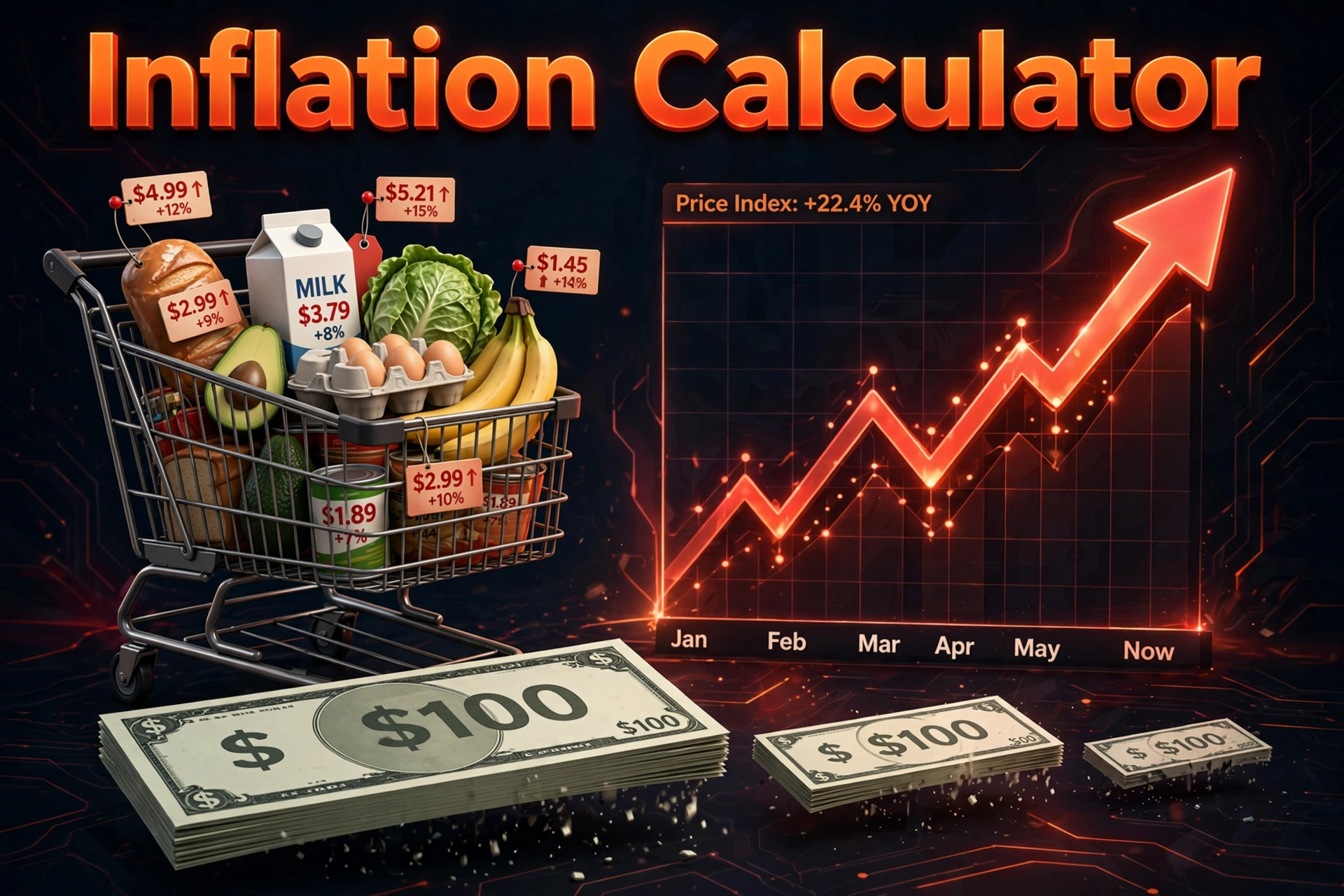
Inflation compounds just like interest, except it works against you: each year’s price increase applies to the already-increased price. The formula mirrors compound growth.
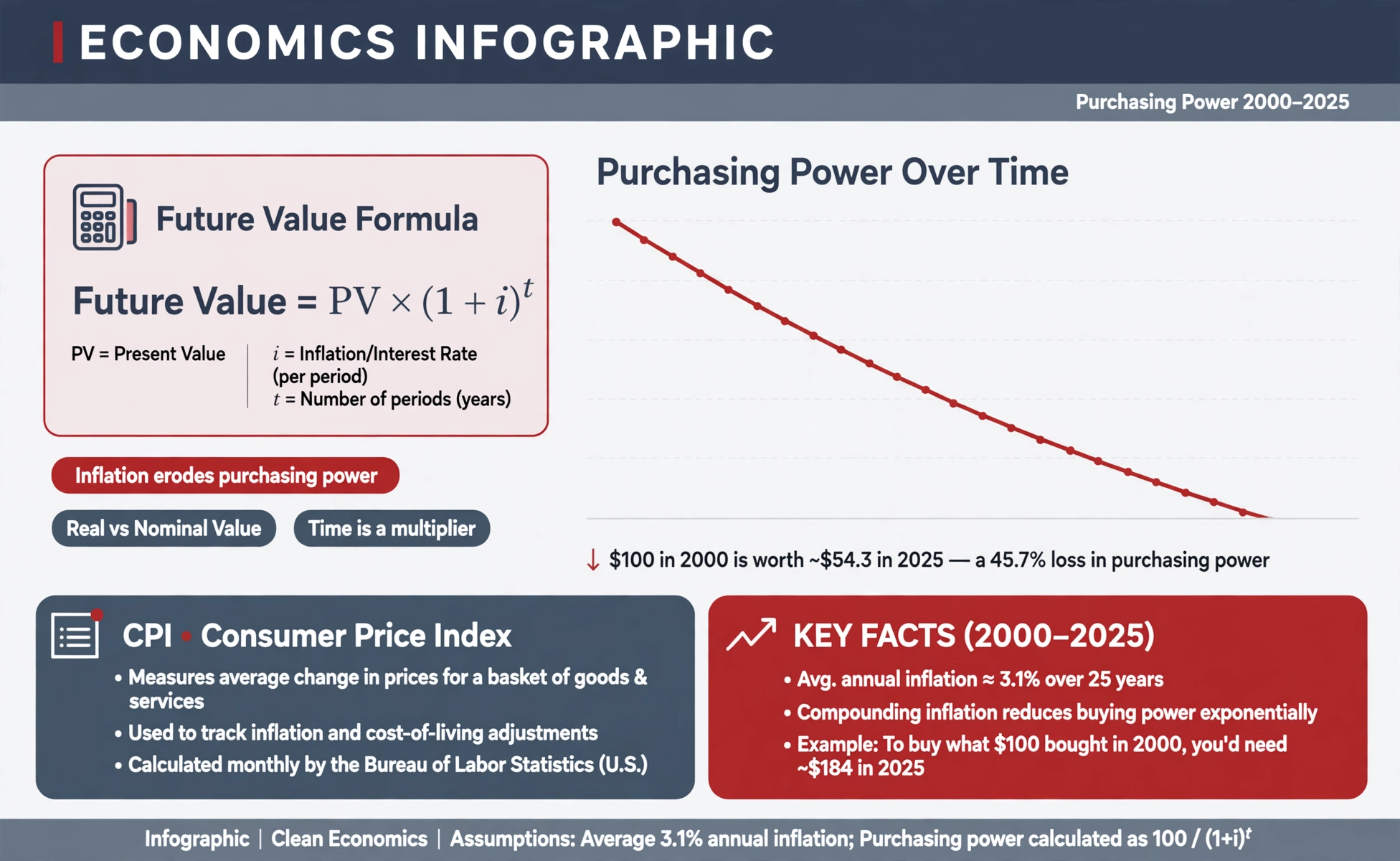
- Future value: FV = PV × (1 + i)t, where PV is the starting amount, i is the annual inflation rate as a decimal, and t is the number of years.
- Purchasing power lost: (1 − PV ÷ FV) × 100. This is the share of buying power that evaporated.
- Past value: run the formula backwards — divide instead of multiply — to express old prices in today’s dollars.
| Annual inflation | $100 after 10 years | $100 after 25 years |
|---|---|---|
| 2% | $121.90 | $164.06 |
| 3% | $134.39 | $209.38 |
| 5% | $162.89 | $338.64 |
| 8% | $215.89 | $684.85 |
Small differences in the rate explode over time: at 2% inflation $100 becomes $164 in 25 years, but at 8% it becomes $685. That is why central banks treat even a couple of percentage points as a big deal.
Worked example
What will $100 of groceries from 2000 cost in 2026 at 3% annual inflation? The span is 26 years. FV = 100 × (1.03)26.
First raise 1.03 to the 26th power: 1.0326 = 2.1566. Multiply by 100: $215.66. So the same basket costs about $216. The purchasing power lost is (1 − 100 ÷ 215.66) × 100 = 53.6% — the 2000 dollar buys less than half of what it used to.
How to use the inflation calculator
Decide which direction you are measuring: forward (what will things cost?) or backward (what was old money worth?). The calculator handles both — just set the years accordingly.
Step by step
- Enter the amount. Any dollar figure: a salary, a house price, a grocery bill.
- Enter the start and end years. For future prices the end year is later; for past values flip them so the end year is the earlier one — the math is symmetric.
- Enter the annual inflation rate. 3% is a common long-run assumption for the US; use actual CPI data for historical work.
- Press Calculate. Read the equivalent value and the purchasing-power loss, then scroll the breakdown for a year-by-year table.
- Sanity-check the rate. A half-point change compounds enormously over decades, so the rate you pick matters more than the exact years.
What inflation rate should you use?
There is no single "correct" rate — it depends on the question you are asking. Pick the one that matches your scenario.
| Scenario | Sensible rate | Why |
|---|---|---|
| US long-run planning | 2–3% | Roughly the post-war average CPI increase |
| Retirement in 30 years | 2.5–3% | Conservative enough to avoid nasty surprises |
| Recent US experience (2021–2023) | 5–8% | Actual CPI ran hot; useful for stress-testing |
| Historical comparison | Actual yearly CPI | Look up the real index rather than guessing |
For retirement math, many planners pair a 3% inflation assumption with expected investment returns to get a "real" return — if your portfolio earns 7% and inflation is 3%, your purchasing power grows about 4% a year. A compound interest calculator shows the growth side of that equation.
Why $1 million is not what it used to be
At 3% inflation, prices double roughly every 24 years (the rule of 72: 72 ÷ 3 = 24). That means a "millionaire" retirement target set today buys what $500,000 buys now by the time a 40-year-old retires — and what $250,000 buys now by the time they are 88.
This is the quiet argument for investing rather than hoarding cash: money sitting in a 0% account loses about half its buying power every 24 years at 3% inflation. Even a modest return that merely matches inflation preserves your purchasing power; anything above it builds real wealth. The calculator above makes the erosion visible — run your own salary or savings target through it before deciding what "enough" means.
Inflation vs. cost of living vs. CPI
People use these terms interchangeably, but they measure different things:
- Inflation is the general rise in prices across the whole economy over time.
- CPI (Consumer Price Index) is the government’s yardstick for inflation — a weighted basket of everyday goods and services tracked month to month.
- Cost of living compares price levels between places (or times) for a similar lifestyle — it is a snapshot, not a rate of change.
Your personal inflation rate can differ from CPI. If you rent in a hot housing market and drive a lot, your costs may rise faster than the official index; if your mortgage is fixed and you rarely drive, they may rise slower. The calculator’s rate field is yours to set — use CPI for the textbook answer, or your own estimate for your real life.
Frequently asked questions
How do you calculate inflation?
With compounding: future value = present value × (1 + inflation rate)^years. A $100 item at 3% annual inflation costs 100 × 1.03^10 = $134.39 after 10 years. To go backwards, divide by the same factor instead of multiplying.
What is a good inflation rate to assume?
For US long-run planning, 2–3% is the standard assumption, roughly the post-war CPI average. Use 2.5–3% for retirement projections, actual historical CPI for past comparisons, and higher rates like 5–8% to stress-test against episodes like 2021–2023.
How long does it take prices to double?
Use the rule of 72: divide 72 by the inflation rate. At 3% inflation prices double every 24 years; at 6% they double every 12 years. Small rate differences have enormous long-run effects.
What is the difference between inflation and CPI?
Inflation is the general rise in prices; CPI (Consumer Price Index) is the official measurement of it — a weighted basket of goods and services tracked by the government. Your personal inflation can differ from CPI depending on what you actually buy.
Does inflation affect savings accounts?
Yes — inflation erodes any cash that earns less than the inflation rate. Money in a 0% account at 3% inflation loses about half its buying power every 24 years. Savings only preserve purchasing power if the interest rate matches or beats inflation.
What was $1 in 1990 worth today?
It depends on the inflation rate you assume. At a steady 3%, $1 in 1990 equals about $2.81 in 2026 (36 years: 1.03^36). For an exact answer use actual yearly CPI data rather than a flat rate.
Can inflation be negative?
Yes — that is deflation, when prices fall across the economy. It sounds pleasant but is usually a sign of weak demand and can trigger a spiral of delayed spending and falling wages. The calculator accepts a 0% rate; for deflation, model it as a negative rate manually.