CD Calculator: How Much Will Your Deposit Grow?
A certificate of deposit locks your money away for a fixed term in exchange for a guaranteed rate. Enter your deposit, APY, term and compounding frequency below, and this free CD calculator will show the maturity value and exactly how much interest you will earn.
Formulas verified against standard references. Calculator logic tested with verified worked examples. Last reviewed: October 2026. Our methodology
How CD interest is calculated
A CD grows by compound interest: each compounding period, the bank adds interest to your balance, and the next period earns interest on the new, larger balance. The formula is:
- Maturity value: A = P × (1 + r ÷ n)(n × t), where P is the deposit, r is the APY as a decimal, n is compounding periods per year, and t is the term in years.
- Interest earned: A − P. This is the part you keep on top of your original deposit.
- More frequent compounding means slightly more interest, because earnings start earning their own interest sooner.
| Compounding | Periods per year (n) | Effect on $10,000 at 4.5% for 1 year |
|---|---|---|
| Annually | 1 | $10,450.00 |
| Quarterly | 4 | $10,457.80 |
| Monthly | 12 | $10,459.40 |
| Daily | 365 | $10,460.22 |
Daily compounding beats annual compounding by about $10 on a $10,000 one-year CD at 4.5% — a real but modest difference that grows with larger deposits and longer terms.
Worked example
You deposit $10,000 into a 1-year CD at 4.5% APY with monthly compounding. Convert the rate to a decimal (0.045) and plug into the formula: A = 10,000 × (1 + 0.045 ÷ 12)(12 × 1).
First divide the rate: 0.045 ÷ 12 = 0.00375. Add one: 1.00375. Raise to the 12th power: 1.0037512 = 1.04594. Multiply by the deposit: 10,000 × 1.04594 = $10,459.40. The interest earned is $10,459.40 − $10,000 = $459.40.
How to use the CD calculator
Grab the rate sheet or offer details from your bank, then work through the fields. The calculator handles the exponent math for you.
Step by step
- Enter the initial deposit. This is the lump sum you will lock away on day one.
- Enter the APY. Use the annual percentage yield, not the plain interest rate — APY already includes compounding. If your bank quotes only a rate, a APR calculator can help you compare true annual costs on the borrowing side.
- Enter the term in years. Use decimals for partial years: 6 months is 0.5, 18 months is 1.5.
- Pick the compounding frequency. Match what your bank uses; most CDs compound daily or monthly.
- Press Calculate. Read the maturity value and interest earned, and check the breakdown for the inputs behind them.
Choosing the right CD term
Banks pay more for longer commitments, but a long term locks your money away from better opportunities. These are the standard CD terms you will see quoted.
| Term | Typical use | Rate note |
|---|---|---|
| 3–6 months | Parking cash you may need soon | Lowest rates, maximum flexibility |
| 1 year | The most popular CD term | A good balance of rate and commitment |
| 18 months – 2 years | Medium-term savings goals | Noticeably higher than 1-year rates |
| 5 years | Money you will not touch for years | Highest rates, steepest early-withdrawal penalties |
Rates move with the economy, so the "best" term changes over time. When rates are high, locking a longer term protects your yield; when rates are rising, shorter terms let you reinvest sooner.
APY vs. interest rate: what is the difference?
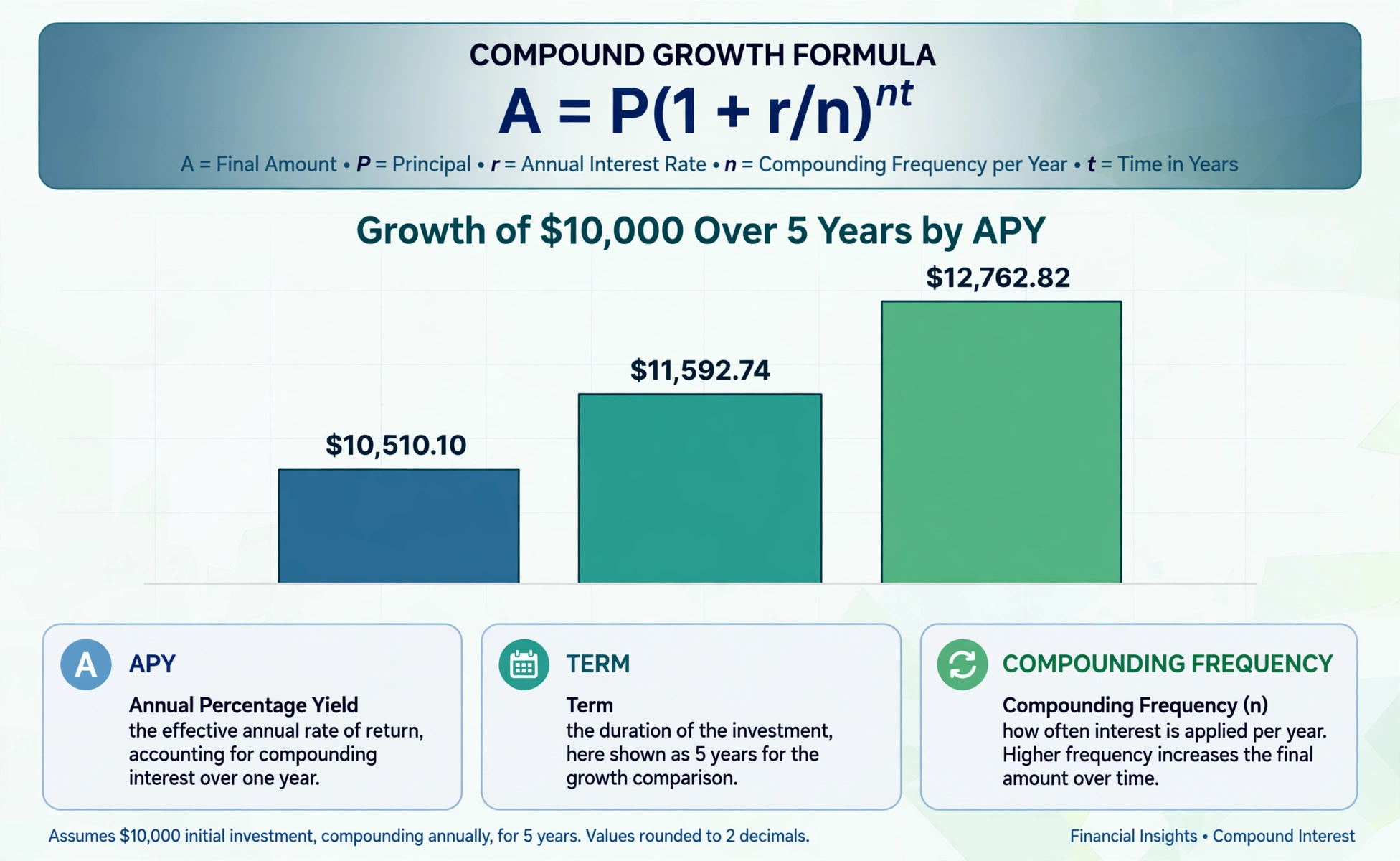
The interest rate is the simple annual rate the bank advertises, while the APY (annual percentage yield) tells you what you actually earn after compounding. A 4.4% rate compounded monthly works out to about 4.49% APY — the APY is the number that lets you compare two CDs fairly, because it already bakes in the compounding frequency.
Always compare CDs by APY, not by the headline rate. Two CDs can quote the same 4.5% rate but pay different APYs if one compounds daily and the other annually. This calculator takes APY directly, so the maturity value it shows is the true amount the bank will pay.
CD laddering: a simple strategy
A CD ladder splits your money across several CDs with staggered maturities — for example, five $2,000 CDs maturing in 1, 2, 3, 4 and 5 years instead of one $10,000 five-year CD. Every year one rung matures: you can spend it or roll it into a new five-year CD at the current rate.
- You earn long-term rates on most of your money while keeping yearly access to a slice of it.
- Rising rates help you because each maturing rung reinvests at the new, higher rate.
- Early-withdrawal penalties shrink — you only ever break one small rung, never the whole deposit.
Laddering takes a few minutes to set up at most online banks and removes the biggest drawback of CDs: having all your cash locked on a single maturity date.

Frequently asked questions
How is CD interest calculated?
With compound interest: maturity value = deposit × (1 + APY ÷ compounding periods)^(periods × years). Each period the bank adds interest to your balance, so later periods earn interest on earlier interest. Interest earned is the maturity value minus your original deposit.
What is APY on a CD?
APY (annual percentage yield) is the true yearly return after compounding. A 4.4% interest rate compounded monthly equals about 4.49% APY. Always compare CDs by APY, since it already accounts for how often interest compounds.
Do CDs compound daily or monthly?
It depends on the bank — most CDs compound daily or monthly, some quarterly. More frequent compounding earns slightly more: on $10,000 at 4.5% for one year, daily compounding pays about $10 more than annual compounding.
What happens if I withdraw from a CD early?
You pay an early-withdrawal penalty, typically several months of interest (for example, 3–6 months on a 1-year CD, up to 12 months on a 5-year CD). The penalty comes out of your interest first, and can eat into principal on very early withdrawals.
Are CDs FDIC insured?
Yes — CDs from FDIC-member banks are insured up to $250,000 per depositor, per bank, just like savings accounts. Credit union CDs (called share certificates) carry the same $250,000 protection through the NCUA.
CD vs. high-yield savings account: which is better?
A CD wins if you will not need the money before maturity and want a guaranteed rate. A high-yield savings account wins if you need flexibility, since its rate can change at any time but your money stays liquid. Compare the CD's APY against the savings APY for the same period.
Do I pay tax on CD interest?
Yes. CD interest is taxed as ordinary income in the year it is credited, even if you leave it in the CD. Your bank sends a 1099-INT if you earn $10 or more. Interest inside an IRA CD grows tax-deferred instead.