APR Calculator: Find the True Cost of a Loan
A loan's interest rate is not its full price. Upfront charges — arrangement fees, origination fees, points — raise the true yearly cost. Enter the loan amount, the fees, the nominal rate and the term to see your monthly payment and the annual percentage rate (APR) that folds those fees in.
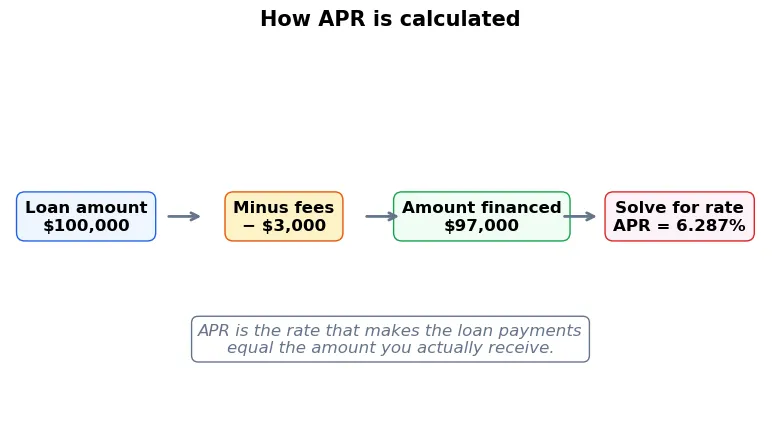
How APR is calculated
APR answers a simple question: what yearly rate makes the loan's payments equal the money you actually receive? Two steps get there. First, the monthly payment is computed from the nominal rate:
- Monthly payment = P × i ÷ (1 − (1 + i)−n), where i is the nominal monthly rate and n the number of payments
Then the APR is the monthly rate j that makes the present value of those payments equal the amount financed — the loan minus the upfront fees:
- Amount financed = loan amount − upfront fees
- Amount financed = payment × (1 − (1 + j)−n) ÷ j, solved for j
- APR = j × 12
There is no closed-form solution for j, so the calculator finds it by bisection — repeatedly halving the search interval until the equation balances. With zero fees, the amount financed equals the loan and the APR comes out exactly equal to the nominal rate.
Worked example
Borrow $100,000 at 6% nominal over 30 years with $3,000 of upfront fees. The monthly payment from the nominal rate is $599.55. But you only receive $97,000 after fees, so the true yearly rate is higher: the calculator solves for it and finds an APR of 6.287%. With $0 fees on the same loan, the APR would be exactly 6.000% — the fees alone add 0.287 percentage points to the true cost.
How to use the APR calculator
Four inputs describe the loan; the calculator does the payment maths and the APR solving in one step.
Step by step
- Enter the loan amount. The full sum borrowed, before any fees are deducted.
- Enter the upfront fees. Arrangement, origination or points charges — everything the lender takes up front. Enter 0 if there are none.
- Enter the nominal annual rate as a percent. This is the rate in the loan's headline offer.
- Enter the term in years and press Calculate. You get the APR, the monthly payment, and the total cost of borrowing.
Compare offers by entering each one's numbers in turn — the APR lets you rank them on a single, like-for-like figure.
APR vs interest rate: what is included
The nominal (headline) rate prices only the interest on the balance. APR folds the upfront cost of getting the loan into one yearly figure, which is why it is almost always higher — and why regulators in many countries require lenders to disclose it.
| Cost | Counted in APR? | Counted in nominal rate? |
|---|---|---|
| Interest on the balance | Yes | Yes |
| Origination or arrangement fees | Yes | No |
| Mortgage points / discount fees | Yes | No |
| Late payment penalties | No | No |
| Optional insurance you can decline | Usually no | No |
The US Consumer Financial Protection Bureau explains the difference between a mortgage interest rate and APR with the same distinction: the rate is the cost of borrowing the principal, while APR reflects the rate plus certain fees.
Why fees raise the APR
Fees shrink the amount you actually receive while the payments stay the same — you are paying full-price instalments on discounted proceeds, which can only mean a higher effective rate. The chart below shows the effect on a $100,000 loan at 6% nominal over 30 years: $5,000 of fees lifts the APR well above the headline rate.
This is also why a lower headline rate is not automatically the cheaper loan. Compare these two $100,000, 30-year offers:
| Loan A | Loan B | |
|---|---|---|
| Nominal rate | 6.00% | 5.75% |
| Upfront fees | $0 | $4,000 |
| Monthly payment | $599.55 | $583.57 |
| APR | 6.000% | 6.129% |
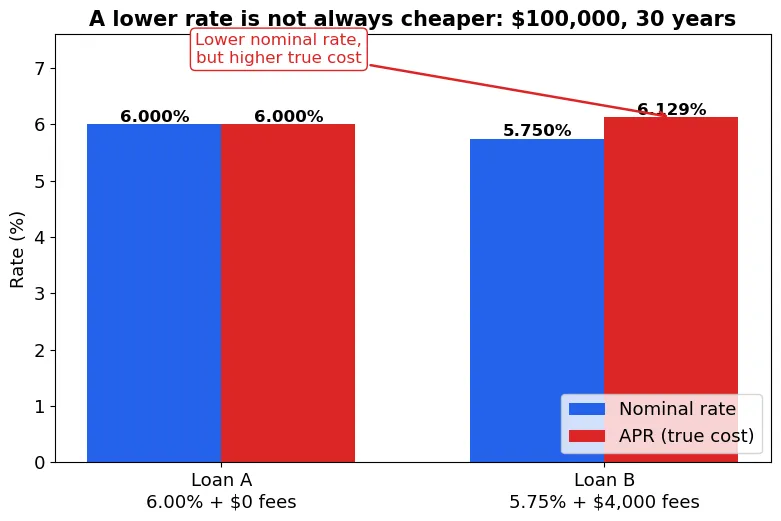
Loan B looks cheaper every month, yet its APR is higher: the $4,000 fee outweighs the rate cut. To see every payment behind either APR, run the same numbers through a loan calculator for the full amortisation schedule.
Limits of APR
- It assumes the full term. Repay early or refinance and the fees are spread over fewer years, so the effective rate you actually paid differs from the quoted APR.
- It assumes on-time payments. Late fees and penalties are excluded from APR by definition.
- It struggles with variable rates. If the nominal rate can change, the APR is computed on the initial rate and may not reflect what you end up paying.
- It excludes some costs. Appraisal or legal fees paid to third parties are often outside the APR, depending on jurisdiction.
For home loans specifically, there are costs APR never tries to capture — property taxes, homeowner's insurance and PMI. A mortgage calculator adds those to the monthly payment so you see the full housing cost, not just the financing cost.
Frequently asked questions
What is APR?
The annual percentage rate: the true yearly cost of a loan expressed as a single percentage. Unlike the nominal interest rate, APR includes upfront lender fees such as origination charges and points, so it is the fairer number for comparing loan offers.
Why is APR higher than my interest rate?
Because fees shrink the amount you actually receive while your payments are calculated on the full loan. Paying full-price instalments on discounted proceeds means a higher effective rate — the gap between APR and the nominal rate is exactly the cost of those fees, annualised.
If there are no fees, does APR equal the interest rate?
Yes. With zero upfront fees the amount financed equals the loan amount, and the APR equation solves to the nominal rate itself. You can verify this in the calculator: enter 0 fees and the APR matches the rate you typed.
Should I always choose the lowest APR?
Only when the loans are otherwise comparable — same amount, same term and same type. APR assumes you keep the loan for the full term and pay on time; if you plan to repay early or refinance, the ranking can change.
Does APR include every fee?
No. It includes most upfront lender charges like origination fees and points, but excludes late payment penalties and usually optional costs such as insurance you can decline. Third-party charges like appraisals are often excluded too, depending on local rules.
Can I use this calculator for credit cards?
No — this calculator is for fixed instalment loans with a set term and regular payments. Credit cards use revolving balances with different APR maths, so the result would not be meaningful.
Does a longer term raise or lower the APR?
With the same fees and nominal rate, a longer term lowers the APR toward the nominal rate, because the fixed fees are spread over more years. That does not make the loan cheaper overall — you pay interest for longer — it only changes the annualised figure.
Related calculators

Loan Calculator
Calculate monthly payment, total interest, and total cost with an amortization breakdown.
Use calculatorMortgage Calculator
Estimate your monthly mortgage payment with taxes, insurance, PMI and HOA — plus the full amortization schedule.
Use calculatorDebt Payoff Calculator
Find your debt-free date, total interest and payoff timeline from balance, APR and payment.
Use calculator