Resting Heart Rate Calculator
This resting heart rate calculator takes your age and your measured resting BPM and shows your fitness category and how you compare to the normal range.

Formulas verified against standard references. Calculator logic tested with verified worked examples. Published: November 4, 2026 | Last updated: November 4, 2026. Fact-checked: November 4, 2026. Our methodology
What Is Resting Heart Rate?
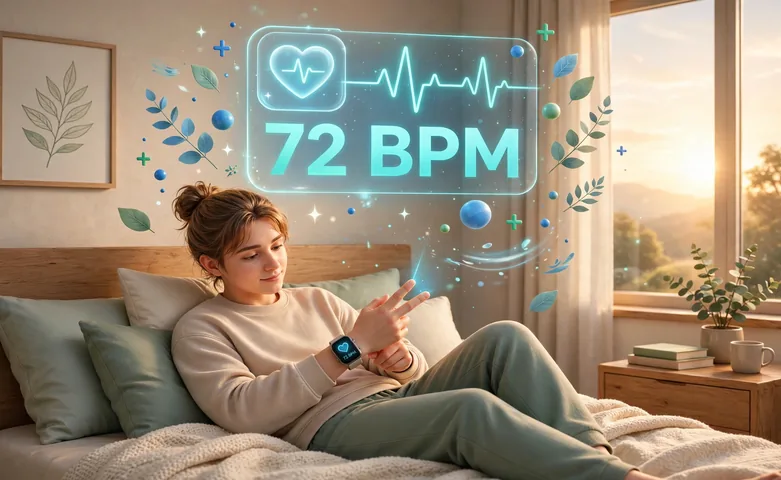
Your resting heart rate is the number of times your heart beats per minute when you are fully at rest. It is one of the simplest and most honest measures of cardiovascular fitness you have. A lower number usually means your heart does its job with less effort.
The reason is stroke volume, the amount of blood your heart pumps with each beat. Regular aerobic exercise strengthens the heart muscle, so each beat moves more blood. Because every beat delivers more, the heart needs fewer beats per minute to meet the body's needs at rest. That is why trained athletes often rest in the 40s or 50s while the average adult sits higher.
How to Measure Your Resting Heart Rate Correctly
A good number starts with a good measurement. Follow this method for the truest reading.
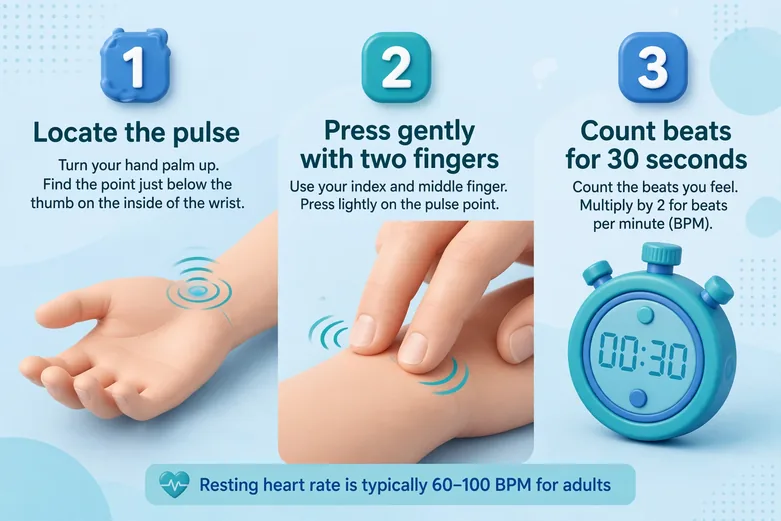
The 60-Second Morning Method
- Measure first thing in the morning, before you get out of bed.
- If you are already up, rest for 5 to 10 minutes first.
- Place your index and middle fingers (not your thumb) on the inside of your wrist or the side of your neck.
- Count the beats for a full 60 seconds.
- Measure at the same time each day so your readings are comparable.
Rest 5 to 10 minutes first if you are already up, then count a full 60 seconds for the best accuracy.
The 3-Morning Average
One reading can be noisy, so measure on three consecutive mornings and average them. For example, readings of 64, 61, and 63 BPM add to 188, and dividing by 3 gives an average of 63 BPM. Enter this average into the calculator.
Manual Count vs Wearables
Garmin, Apple Watch, and Whoop track resting heart rate overnight, which removes the guesswork. A wearable overnight average can differ slightly from a manual morning count, because the wearable averages long stretches of sleep while your manual count is a single snapshot.
Normal Resting Heart Rate by Age
The American Heart Association gives a normal adult resting heart rate of 60 to 100 BPM. That range is wide, so it helps to see where most people your age land. The table below uses the CDC's resting pulse reference data from the National Health and Nutrition Examination Survey, measured from 1999 to 2008.
| Age group | Men: average (middle 50%) | Women: average (middle 50%) |
|---|---|---|
| 20 to 39 | 71 BPM (61 to 76) | 76 BPM (66 to 82) |
| 40 to 59 | 71 BPM (61 to 77) | 73 BPM (64 to 79) |
| 60 to 79 | 70 BPM (60 to 75) | 73 BPM (64 to 78) |
| 80 and over | 71 BPM (61 to 78) | 73 BPM (64 to 77) |
Men aged 20 to 39 average 71 BPM and women the same age average 76 BPM. Women average 2 to 5 BPM higher at every age, mostly because a smaller heart pumps less blood per beat. The averages barely move with age, so a resting rate that climbs steadily over the years usually reflects lost fitness rather than age itself.
The adult 60 to 100 range applies from about age 10 to 15 upward. Children and teens rest higher than adults, so do not judge a child's reading against the adult table.
What Your Resting Heart Rate Says About Your Fitness
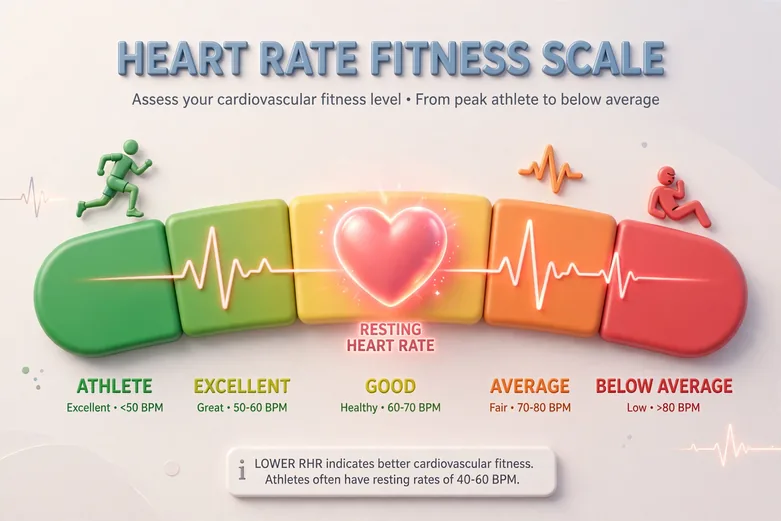
The calculator places your number in one of five bands. These bands are general guidance, not medical cutoffs.
- Athlete, below 60 BPM. Typical of well-trained athletes, whose stronger hearts pump more blood per beat.
- Excellent, 60 to 64 BPM. A strong resting number at the top end of the normal adult range.
- Good, 65 to 73 BPM. A healthy resting number, well inside the normal adult range.
- Average, 74 to 80 BPM. A typical resting number with room to improve through regular aerobic exercise.
- Below Average, above 80 BPM. On the higher end of the normal range. Regular aerobic exercise usually brings this number down over time.
A reading in the 80s or 90s is often explained by a sedentary routine, poor sleep, dehydration, or stress, all things you can change. Track your 3-morning average over a few weeks rather than reacting to a single day. For a deeper measure of cardiovascular fitness beyond resting pulse, the VO2 max calculator estimates your aerobic capacity.
What Affects Your Resting Heart Rate
Your resting rate is not fixed. It shifts a few beats in either direction with factors that have nothing to do with your underlying fitness.
- Fitness level. Regular aerobic training strengthens the heart and lowers resting BPM.
- Age. The averages barely move with age, so a climbing number usually reflects lost fitness rather than age itself.
- Stress. Mental stress activates the same sympathetic response as physical stress and raises the number.
- Caffeine. Coffee or energy drinks a few hours before measuring can raise it temporarily.
- Smoking. Nicotine stimulates the heart and tends to keep resting rates higher.
- Medications. Beta blockers and some other drugs lower resting heart rate, so always follow your doctor's guidance.
- Illness or fever. Fighting an infection raises the resting rate until you recover.
- Altitude. Less oxygen at altitude makes the heart work harder and beat faster.
- Temperature and dehydration. Heat and low fluid intake both push the rate up.
- Sleep. A short or restless night raises the next-morning reading, so a sleep cycle calculator can help you wake at the right point in your sleep cycle.
A single high reading after a bad night is not cause for concern. What matters is your average over several mornings.
Resting Heart Rate vs Target Heart Rate
These two numbers answer different questions, and mixing them up is the most common confusion on this topic.
Your resting heart rate is measured at complete rest and judged against age-based normal ranges, which is what this calculator does. Your target heart rate is the 50% to 85% of maximum heart rate range you aim for during exercise. One number describes your baseline and the other guides your workouts.
The two do connect. Heart rate reserve is your estimated maximum minus your resting rate. The rough maximum formula is 220 minus age, and the Tanaka formula is 208 minus 0.7 times age. While resting rate is measured at complete rest, the target heart rate calculator shows the 50% to 85% zones to aim for during exercise.
When to Talk to a Doctor
This is general information only, never a diagnosis. Talk to a healthcare professional if your resting rate is consistently above 100 BPM, if it sits below 40 to 60 BPM and you feel dizzy, faint, weak, or unusually tired, or if it changes suddenly for no clear reason.
Call your local emergency number if your rate is suddenly very high or very low for you and you have chest pain, shortness of breath, dizziness, or fainting. Do not diagnose yourself from a single reading, and bring a week of morning readings to the appointment so the doctor sees the pattern, not just one day.
This calculator gives general fitness information, not medical advice. If you are worried about your heart rate, talk to a healthcare professional. Our full policy is on the disclaimer page.
Frequently asked questions
What is a good resting heart rate for adults?
For most adults, 60 to 100 beats per minute is normal, according to the American Heart Association. A number toward the lower end of that range usually reflects better cardiovascular fitness. Trained athletes often rest between 40 and 60 BPM.
How do I measure my resting heart rate correctly?
Take it first thing in the morning, before getting out of bed. If you are already up, rest for 5 to 10 minutes first, place your index and middle fingers on your wrist or neck, and count the beats for a full 60 seconds. Measure at the same time each day.
What is the formula to calculate resting heart rate from a pulse count?
BPM = beats counted divided by seconds counted, times 60. So 18 beats in 15 seconds is 18 divided by 15 times 60, which equals 72 BPM. A 30-second count doubles, and a full 60-second count is the BPM as-is.
Why is my resting heart rate lower if I am fit?
Regular training strengthens your heart so it pumps more blood with each beat, which is called stroke volume. With more blood moved per beat, the heart needs fewer beats per minute to serve the body at rest. That is why resting rate drops as fitness improves.
What is the difference between resting heart rate and target heart rate?
Resting heart rate is measured at complete rest and judged against normal ranges, while target heart rate is the 50% to 85% of maximum heart rate range you aim for during exercise. One describes your baseline and the other guides your workouts.
Is a resting heart rate of 50 BPM dangerous?
A resting rate below 60 BPM is called bradycardia, and it is common and normal in well-trained athletes. If you are not very active and your resting rate is this low, mention it to your doctor, especially with dizziness or fainting. This is general information, not a diagnosis.
Can caffeine or stress raise my resting heart rate?
Yes. Caffeine, stress, recent exercise, illness or fever, dehydration, heat, and some medications can all raise your resting rate temporarily. Measure on a calm morning with no caffeine beforehand for the truest reading. If the number stays high for several mornings, talk to your doctor.
When should I see a doctor about my heart rate?
Talk to a healthcare professional if your resting rate is consistently above 100 BPM, below 40 to 60 BPM with symptoms like dizziness or fainting, or changes suddenly for no clear reason. Do not diagnose yourself from a single reading. Bring a week of morning readings to the appointment.
Sources
- American Heart Association, All About Heart Rate, which gives the normal adult resting range of 60 to 100 BPM.
- CDC National Health Statistics Reports No. 41, resting pulse rate reference data from the National Health and Nutrition Examination Survey, 1999 to 2008.
- CalculateMyHeartRate, Resting Heart Rate Calculator, measurement method and 3-morning average example.
Related calculators
Target Heart Rate Calculator
Find your 50% to 85% exercise heart rate zones.
Use calculatorVO2 Max Calculator
Estimate your aerobic fitness level.
Use calculatorSleep Cycle Calculator
Wake up at the right point in your sleep cycle.
Use calculatorSleep Debt Calculator
Measure how much sleep you are missing.
Use calculatorCalories Burned Calculator
Estimate calories burned during exercise.
Use calculatorPace Calculator
Find your pace from distance and time.
Use calculatorRunning Pace Calculator
Pace, time, and distance for runners.
Use calculatorBMI Calculator
Body mass index from height and weight.
Use calculatorTDEE Calculator
Daily calorie burn from activity level.
Use calculatorCalorie Calculator
Daily calorie needs for your goal.
Use calculator