Sleep Cycle Calculator: Wake Up Refreshed
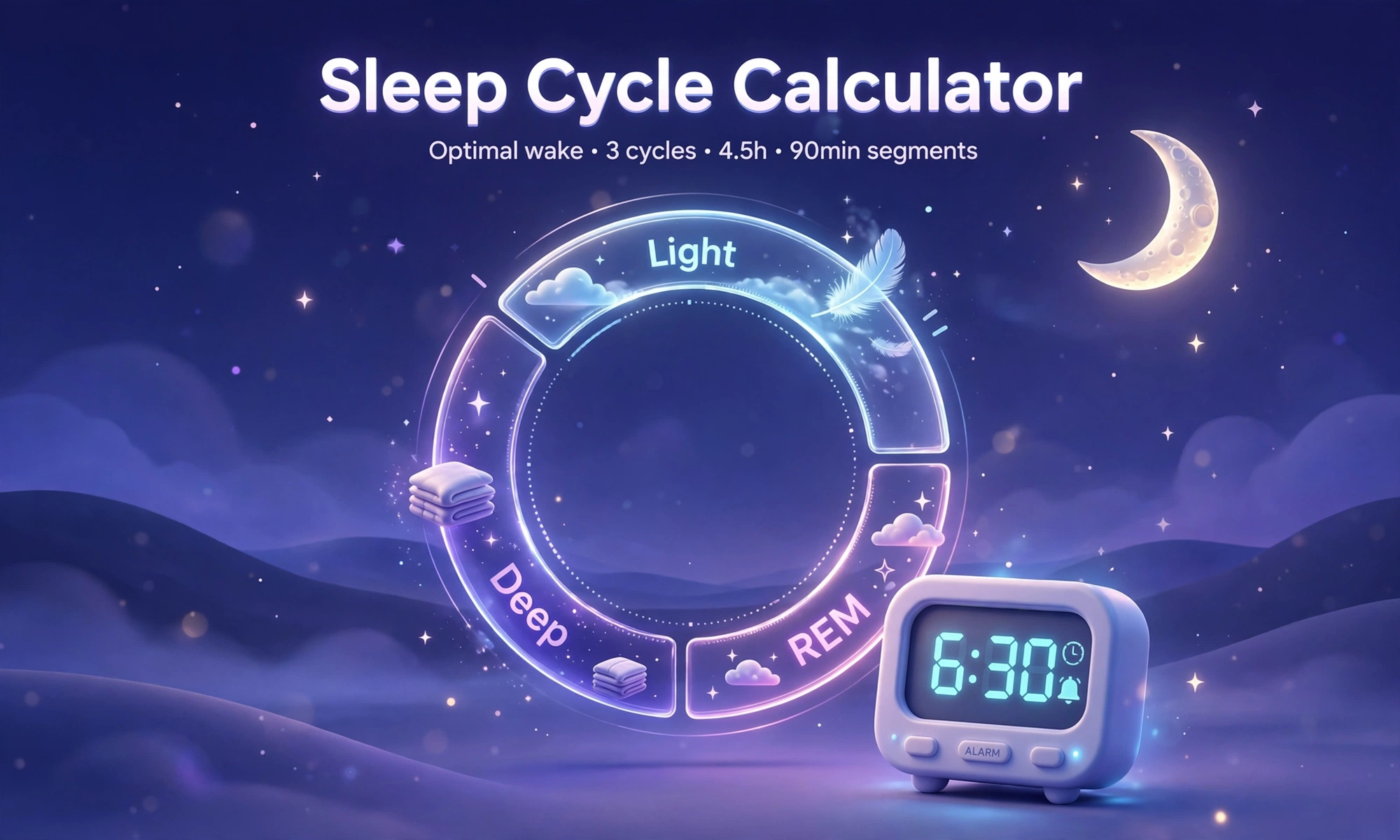
You sleep in cycles of about 90 minutes, and waking up mid-cycle — in deep sleep — is what causes morning grogginess. This sleep cycle calculator works backwards from your alarm time (or forwards from bedtime) to find times that land you at the end of a full cycle, when waking up feels easiest.
Formulas verified against standard nutrition and exercise references. Calculator logic tested with verified worked examples. Last reviewed: October 2026. Our methodology
The sleep cycle math
The calculator uses two averages: a full sleep cycle lasts about 90 minutes, and most people take about 15 minutes to fall asleep (the fall-asleep time is adjustable on the form). Everything else is arithmetic.
- Bedtime from wake time: bedtime = wake-up time − (sleep cycles × 90 min + fall-asleep time)
- Wake time from bedtime: wake-up time = bedtime + fall-asleep time + (sleep cycles × 90 min)
- Sleep shown per option: cycles × 90 minutes — the fall-asleep time is not counted as sleep
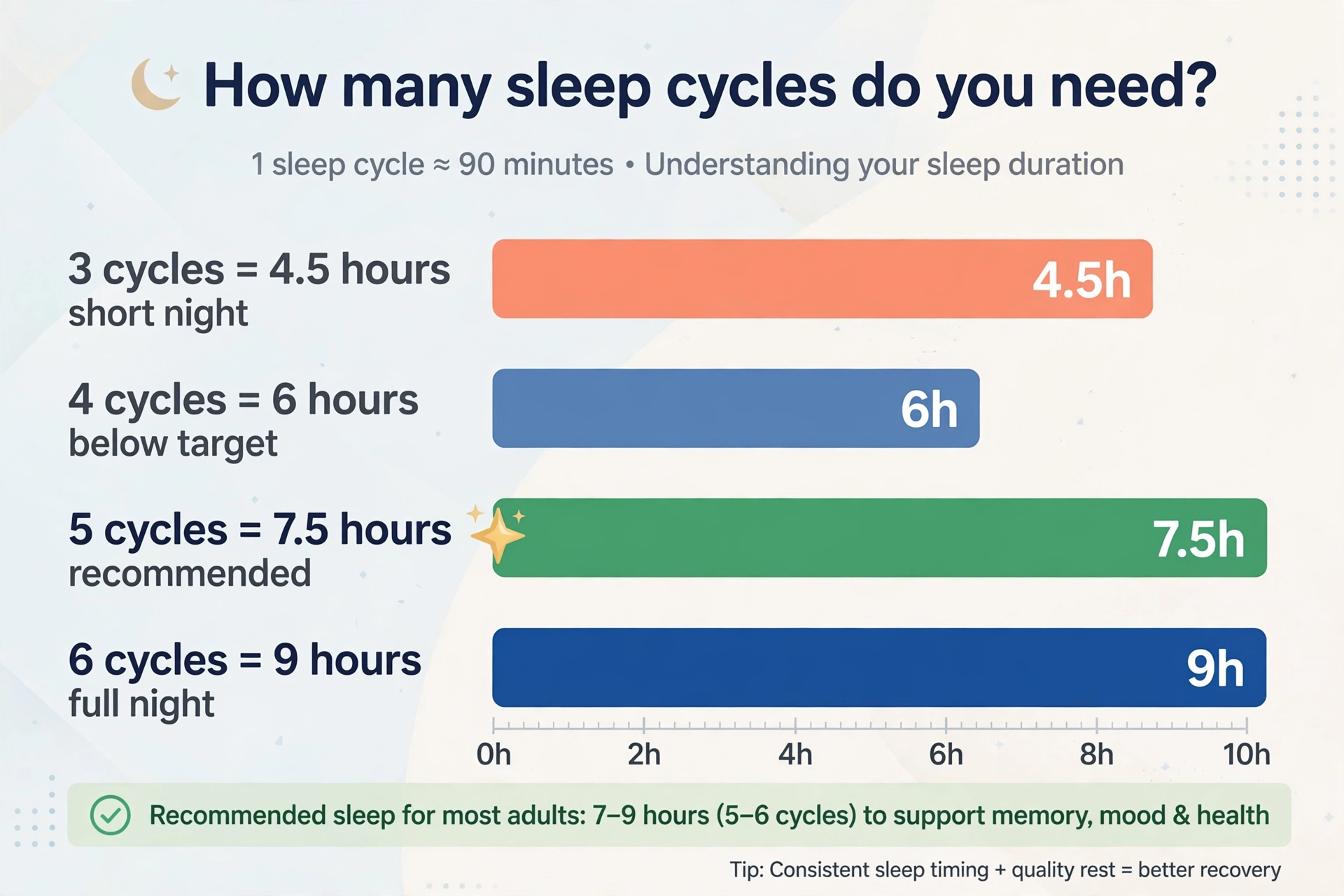
- Recommended: 5-6 complete cycles (7.5-9 hours) for most adults
Cycle length is a population average — real cycles run roughly 70-120 minutes and lengthen across the night, so treat the times as targets to try, not exact predictions.
Worked example
You need to wake up at 6:30 AM and fall asleep in about 15 minutes. The calculator subtracts whole 90-minute cycles plus the 15 minutes:
- 6 cycles: 6:30 AM − (540 + 15) min = 9:15 PM bedtime (9 hours of sleep)
- 5 cycles: 6:30 AM − (450 + 15) min = 10:45 PM bedtime (7.5 hours of sleep)
- 4 cycles: 6:30 AM − (360 + 15) min = 12:15 AM bedtime (6 hours of sleep)
- 3 cycles: 6:30 AM − (270 + 15) min = 1:45 AM bedtime (4.5 hours of sleep)
The 5-cycle option — 10:45 PM bedtime — is the sweet spot for most adults: 7.5 hours ending on a cycle boundary.
How to use the sleep cycle calculator
Pick a mode first — the inputs change meaning with it. In wake-up mode you enter your alarm time; in bedtime mode you enter when you plan to sleep.
Step by step
- Choose the calculation mode. Wake-up mode counts backwards from your alarm; bedtime mode counts forwards from bedtime; sleep-now mode starts from the current time.
- Enter the time. Hour (1-12), minutes (0-59) and AM/PM. For sleep-now mode the current time is used automatically.
- Set your fall-asleep time. The default is 15 minutes. If you usually drift off faster or slower, enter your real number for better results.
- Press Calculate. You get four options — 6, 5, 4 and 3 full cycles — each with the time and total hours of sleep, plus the working underneath.
If you want to know exactly how long you slept between two known times, a time duration calculator gives you the hours, minutes and seconds between them.
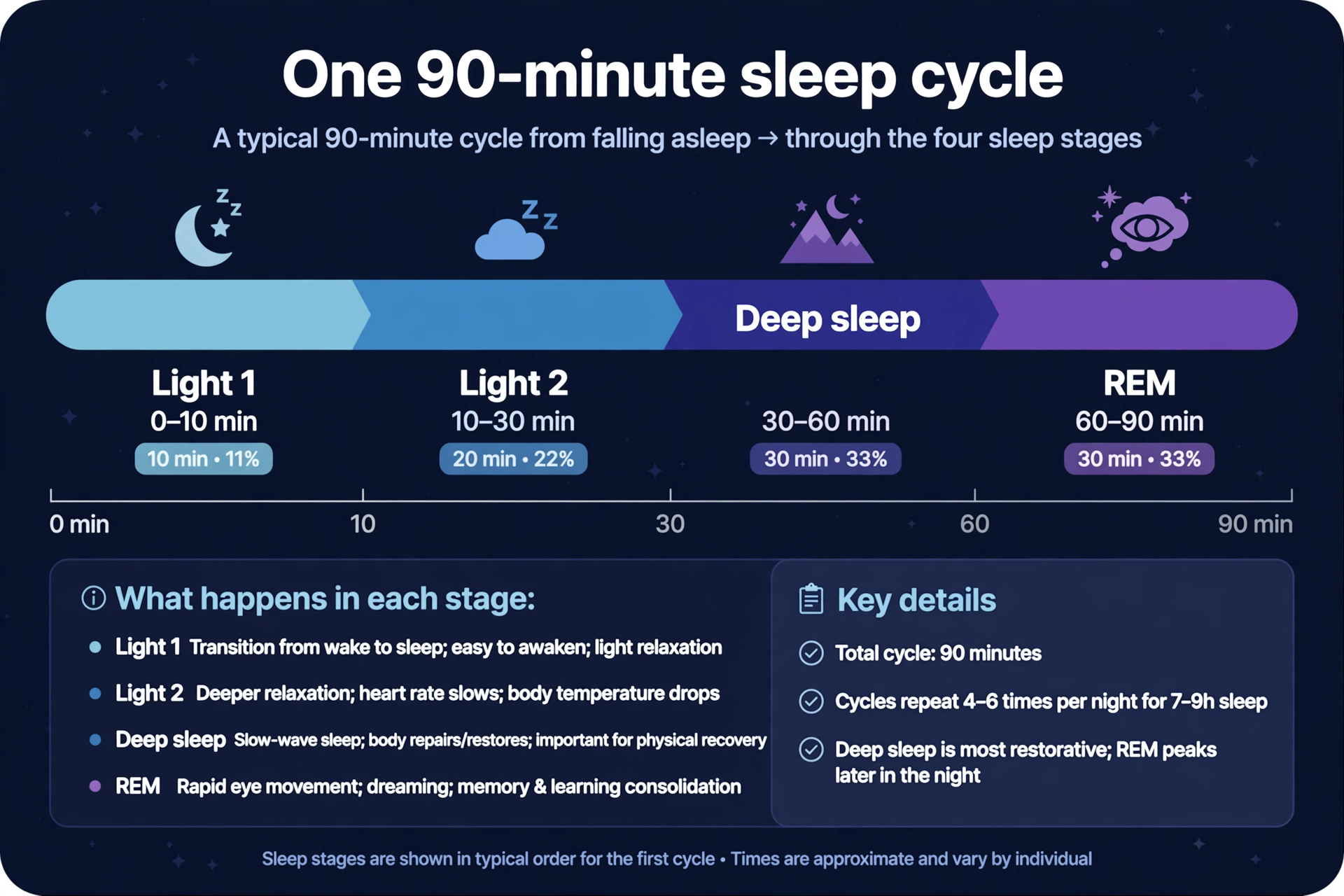
What happens in a 90-minute sleep cycle
Each cycle moves through lighter sleep into deep sleep and then REM (rapid eye movement) — the stage where most dreaming happens. Early cycles in the night are deep-sleep heavy; later cycles are REM heavy, which is why the last hours of sleep matter so much.
| Stage | What happens | Share of a cycle |
|---|---|---|
| Light sleep (N1-N2) | Muscles relax, heart rate slows, easy to wake | About half the cycle |
| Deep sleep (N3) | Body repairs tissue, immune system strengthens; hardest to wake | Early cycles: large; later cycles: small |
| REM sleep | Dreaming, memory consolidation, brain activity near waking levels | Early cycles: small; later cycles: large |
Waking during deep sleep produces sleep inertia — that heavy, disoriented grogginess that can last 30 minutes or more. Waking at the light-sleep boundary between cycles is why the calculator's times feel easier.
How much sleep do you need
Needs change with age. The National Sleep Foundation recommends the following nightly ranges — the calculator's 3-to-6-cycle span (4.5 to 9 hours) covers most of them.
| Age group | Recommended hours | Sleep cycles |
|---|---|---|
| Newborns (0-3 months) | 14-17 hours | 9-11 cycles |
| Infants (4-11 months) | 12-15 hours | 8-10 cycles |
| Toddlers (1-2 years) | 11-14 hours | 7-9 cycles |
| Preschoolers (3-5 years) | 10-13 hours | 7-9 cycles |
| School age (6-13 years) | 9-11 hours | 6-7 cycles |
| Teens (14-17 years) | 8-10 hours | 5-7 cycles |
| Adults (18-64 years) | 7-9 hours | 5-6 cycles |
| Older adults (65+ years) | 7-8 hours | About 5 cycles |
Source: National Sleep Foundation sleep duration recommendations. Children and teens need more cycles than adults, which is why the same calculator inputs should not be applied to a child's bedtime without adjusting the cycle count upward.
Habits that make the calculator work better
The calculator handles the arithmetic; your habits handle the biology. A few evidence-backed ways to fall asleep closer to your target time:
- Keep a consistent schedule. The same wake time every day — including weekends — stabilizes your circadian rhythm more than any gadget.
- Dim the lights before bed. Bright light, especially from screens, suppresses melatonin and delays sleep onset, stretching that 15-minute buffer.
- Watch the caffeine clock. Caffeine has a half-life of about 5-6 hours, so an afternoon coffee can push your real fall-asleep time well past the default.
- Keep the room cool and dark. A cool, dark, quiet room helps you drop into the first cycle faster.
- Stay hydrated earlier in the day. Waking thirsty in the night breaks cycles; front-loading fluids during the day helps. A water intake calculator can set a sensible daily target.
For a deeper dive into sleep stages and disorders, the Sleep Foundation publishes clinician-reviewed guides on sleep science.
Frequently asked questions
How does the sleep cycle calculator work?
It counts sleep in complete cycles of about 90 minutes. Give it a wake-up time and it subtracts whole cycles plus your fall-asleep time (default 15 minutes) to find bedtimes that end on a cycle boundary. Give it a bedtime and it adds cycles forward to find wake-up times.
What time should I go to bed to wake up at 6:30 AM?
With 90-minute cycles and 15 minutes to fall asleep: 9:15 PM for 6 cycles (9 hours), 10:45 PM for 5 cycles (7.5 hours), or 12:15 AM for 4 cycles (6 hours). Most adults should take the 5-cycle option at 10:45 PM.
Is 6 hours of sleep enough?
Six hours is four full 90-minute cycles — it works for an occasional short night, but it is below the 7-9 hours most adults need. Regular 6-hour nights are linked to worse focus, immunity and mood. Aim for 5 cycles (7.5 hours) as your baseline.
Why do I feel groggy when I wake up?
That is sleep inertia: your alarm caught you in deep sleep mid-cycle, when the brain is least ready to wake. Waking at the end of a cycle — in light sleep — eases it for most people, which is exactly what the calculator's times aim for.
Are sleep cycles really exactly 90 minutes?
No — 90 minutes is a population average. Real cycles run roughly 70-120 minutes, and your own cycles change across the night: early cycles are deep-sleep heavy, later ones REM heavy. Treat the calculator's times as good targets to test, and shift by 15 minutes if you consistently wake mid-cycle.
What is the 15-minute fall-asleep time?
It is the estimate of sleep onset latency — the time between getting into bed and actually falling asleep, which does not count as sleep. Fifteen minutes is typical for healthy sleepers. Enter your own number on the form if yours is consistently different.
Should I choose 5 or 6 sleep cycles?
Five cycles (7.5 hours) suits most adults and fits a normal evening routine. Six cycles (9 hours) is better if you train hard, are recovering from sleep debt, or simply feel better with more sleep. Three cycles is a short-night fallback, not a target.