Sleep Debt Calculator
Enter how much sleep you need per night, how much you actually average, and over how many days. Get your total sleep debt, the average nightly shortfall, and how many catch-up nights it takes to repay it.

Formulas verified against standard references. Calculator logic tested with verified worked examples. Last reviewed: November 2026. Our methodology
What Sleep Debt Is
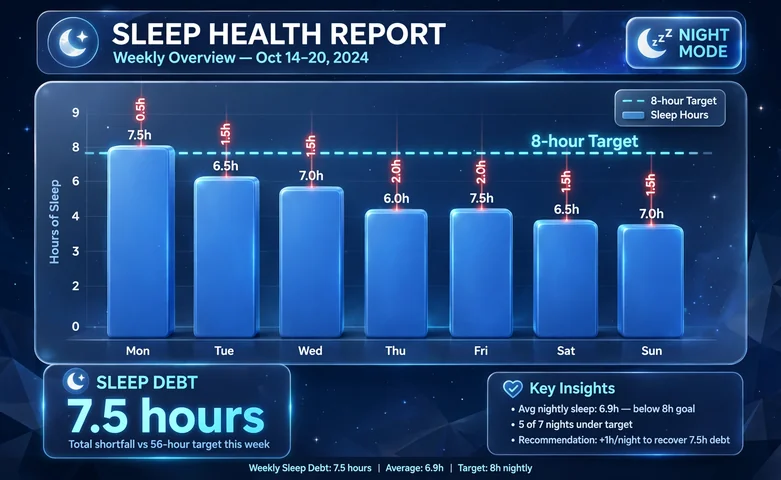
Sleep debt is the running gap between the sleep your body needs and the sleep it actually gets. Miss 90 minutes a night for a week and you have banked over 10 hours of debt, roughly a full night of missed sleep that your brain carries as slower reactions, worse focus, and a shorter fuse.
The debt model comes from sleep-restriction research: in a landmark 2003 study, adults limited to 6 hours a night for two weeks performed as badly on attention tests as people kept awake a full night, yet rated themselves only slightly sleepy. You cannot feel the full size of your own debt.
How the Calculation Works
The arithmetic is deliberately simple. Nightly shortfall = sleep need minus actual sleep. Total debt = shortfall x days. If you need 8 hours, sleep 6.5, and do that for 7 days, the debt is 1.5 x 7 = 10.5 hours.
Count time actually asleep, not time in bed: subtract roughly how long it takes you to fall asleep and any long wake-ups. If you nap, add the nap to that day's total. Nights above your need create a surplus that offsets the debt, which is why one long weekend lie-in chips away at a bad week.
| Step | Example (8 h need) |
|---|---|
| Nightly shortfall | 8 - 6.5 = 1.5 h |
| Days | 7 |
| Total debt | 1.5 x 7 = 10.5 h |
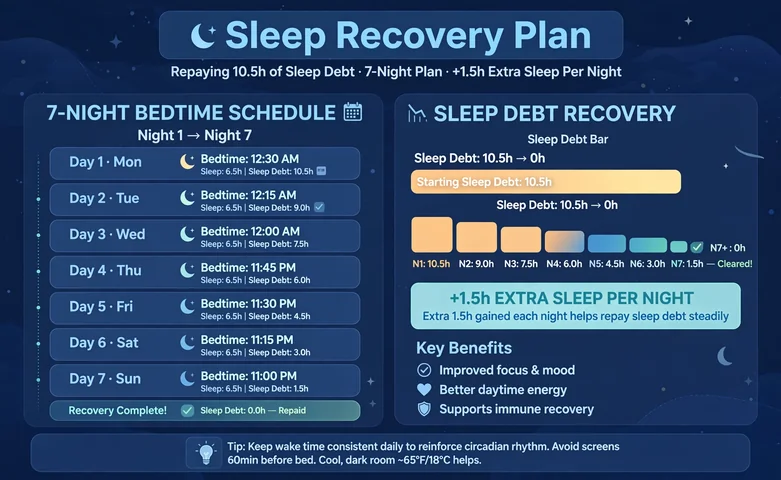
| Recovery at +1.5 h/night | 10.5 / 1.5 = 7 nights |
Reading Your Result: Severity Bands
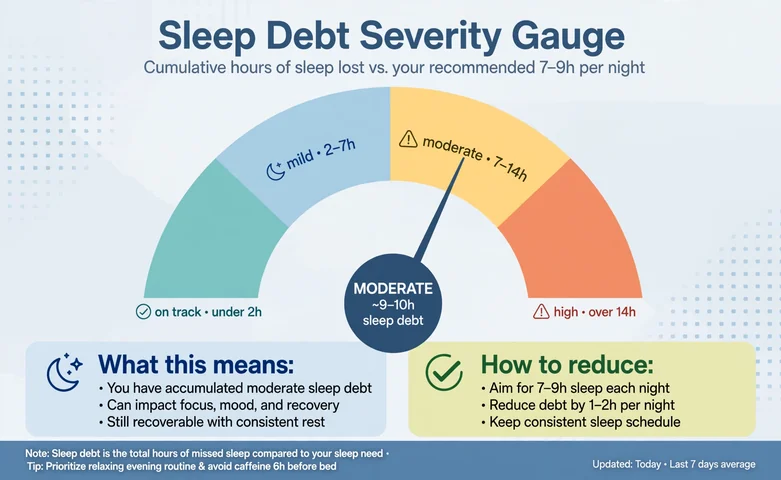
Under 2 hours of debt is essentially on track: normal night-to-night variation. Two to 7 hours is mild and common, worth nudging down with slightly earlier bedtimes. Seven to 14 hours is moderate and likely already dulling your focus. Above 14 hours is high: a serious shortfall that deserves a deliberate recovery plan.
| Total debt | Band | What to do |
|---|---|---|
| Under 2 h | On track | Keep the routine |
| 2 to 7 h | Mild | Add 30-60 min for a few nights |
| 7 to 14 h | Moderate | Plan a week of longer nights |
| Over 14 h | High | Prioritize sleep like a prescription |
Paying It Back Without Wrecking Your Rhythm
Recovery is not one-to-one. Research suggests sleeping an extra 1 to 2 hours a night above your need pays debt down over several days; one giant weekend lie-in does not erase a week of short nights, and big schedule swings upset your body clock.
The calculator's recovery estimate uses 1.5 extra hours a night: a 10.5-hour debt clears in about 7 extended nights. Go to bed earlier rather than sleeping in much later, keep wake time steady, and expect the first few nights to feel disproportionately restorative.
Why Sleep Need Is Personal
Debt is measured against your need, not a generic eight hours. National Sleep Foundation guidelines suggest 7-9 hours for adults 18-64, 7-8 for 65+, and 8-10 for teens, but individuals vary widely: large studies put the median adult need near 8 hours with a real range from about 7 to over 9.
If you consistently wake naturally just before the alarm feeling rested, that duration is close to your need. Use your own number in the calculator; entering 8 when you truly need 9 undercounts every night's debt.
What This Estimate Cannot Do
The calculator counts hours, not quality. Fragmented sleep, apnea, and alcohol-disrupted sleep can leave you unrested at a full 8 hours, and no arithmetic captures that. It is an educational estimate, not medical advice: persistent daytime sleepiness despite enough hours deserves a clinician, not a spreadsheet.
For the other half of the equation, finding the bedtime that protects your cycles, the sleep cycle calculator works backward from your wake time through 90-minute cycles.
Frequently asked questions
How is sleep debt calculated?
Nightly shortfall = sleep need minus actual sleep; total debt = shortfall x number of days. Need 8, sleep 6.5, for 7 days: 1.5 x 7 = 10.5 hours of debt.
Can you really catch up on sleep?
Partly. Sleeping an extra 1-2 hours a night repays debt over several days, but one long lie-in does not erase a week of short nights, and the repayment is not hour-for-hour.
How much sleep do I actually need?
Most adults 18-64 need 7-9 hours (guidelines), with wide individual variation around a median near 8. Teens need 8-10, adults 65+ need 7-8.
What counts as a night of sleep?
Time actually asleep, not time in bed. Subtract sleep-onset time and long wake-ups; add naps to the matching day.
Is a 10-hour sleep debt dangerous?
It sits in the moderate band: research links that level of restriction to attention lapses comparable to a sleepless night. Plan a week of longer nights rather than one marathon sleep.
Does sleeping in on weekends fix sleep debt?
It chips away at it but rarely clears it, and large weekend shifts disrupt your body clock. Earlier bedtimes on weeknights work better.
Why can't I feel my own sleep debt?
In sleep-restriction studies, performance fell steadily while self-rated sleepiness barely moved. Objective impairment outruns subjective tiredness.