Rental Property Calculator
Enter the price, down payment, loan terms, rent and monthly expenses to see the monthly cash flow, cap rate, cash on cash return and DSCR of any rental property.

Formulas verified against standard references. Calculator logic tested with verified worked examples. Published: November 2, 2026 | Last reviewed: November 2026. Our methodology
How the Rental Property Calculator Works
This calculator answers one question, which is whether a rental property earns enough to justify its price. Enter the purchase price, down payment, closing costs, loan rate and term, monthly rent, a vacancy allowance and your monthly operating expenses.
It follows the order lenders use. Income comes first, then operating expenses, then the mortgage. That order produces monthly cash flow, net operating income, the cap rate, your cash on cash return and the DSCR that lenders check before they approve a loan.

The Formulas: NOI, Cap Rate and Cash on Cash
Effective rent = monthly rent x (1 - vacancy rate). The vacancy rate is a share of rent, because empty months are the income you never collect.
Net operating income, or NOI, = (effective rent - operating expenses) x 12. Operating expenses mean taxes, insurance, HOA dues, maintenance, management and utilities. The mortgage is not an operating expense, so it never appears in NOI.
Cap rate = NOI / purchase price x 100. Monthly cash flow = effective rent - operating expenses - mortgage payment. Cash on cash return = annual cash flow / (down payment + closing costs) x 100. DSCR = NOI / annual debt service.
The monthly mortgage payment uses the standard amortization formula M = P x r(1+r)^n / ((1+r)^n - 1), where P is the loan amount, r is the monthly rate (annual rate / 12) and n is the number of payments (years x 12). This matches the mortgage calculator, which you can use to check the loan on its own.
Worked Example: a $200,000 Rental Property
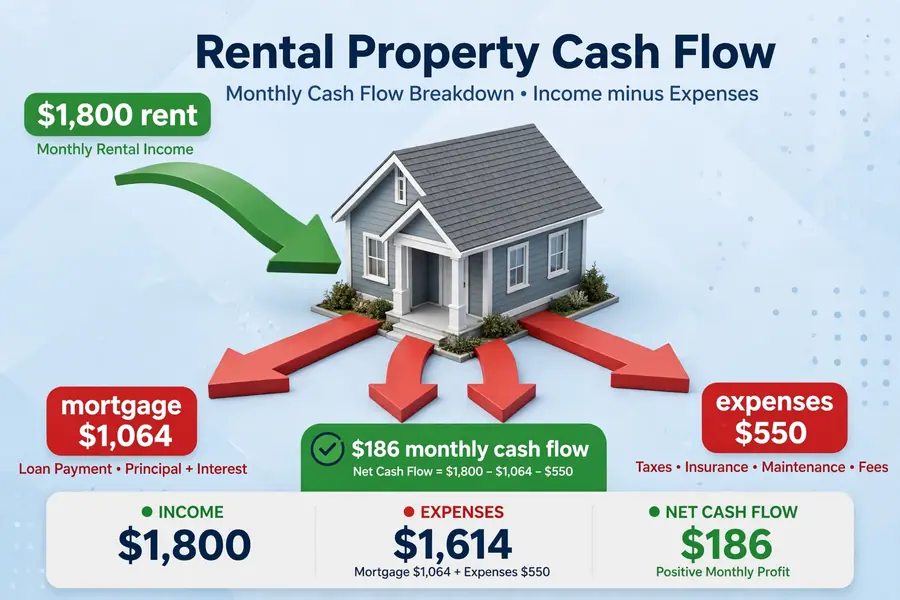
Take a $200,000 property with 20% down ($40,000), $10,000 of closing costs, a 7% loan over 30 years, $1,800 of monthly rent, no vacancy allowance and $550 of monthly operating expenses. The loan is $200,000 - $40,000 = $160,000, and the amortization formula gives a monthly payment of $1,064.48.
NOI = ($1,800 - $550) x 12 = $15,000. Monthly cash flow = $1,800 - $550 - $1,064.48 = $185.52, or $2,226.19 a year. Cap rate = $15,000 / $200,000 x 100 = 7.50%. Cash invested = $40,000 + $10,000 = $50,000, so cash on cash = $2,226.19 / $50,000 x 100 = 4.45%. DSCR = $15,000 / $12,773.76 = 1.17. The amortization calculator shows how that $1,064.48 payment splits between principal and interest each month.
How to Use the Calculator
- Enter the purchase price and your down payment in dollars or as a percentage.
- Add closing costs, the annual interest rate and the loan term, or choose Cash purchase for no loan.
- Enter the monthly rent, a vacancy allowance and your monthly operating expenses without the mortgage.
- Press Calculate to see the cash flow, NOI, cap rate, cash on cash return and DSCR with every step shown.
Cap Rate vs Cash on Cash: Reading Your Results
Cap rate measures the property and cash on cash measures your cash, so the same deal can tell two different stories. Run the worked example with no loan and the cap rate stays exactly 7.50% while the return on your cash changes completely.
| Measure | Cash purchase | 20% down mortgage |
|---|---|---|
| Monthly cash flow | $1,250.00 | $185.52 |
| Cash invested | $210,000 | $50,000 |
| Cap rate | 7.50% | 7.50% |
| Cash on cash return | 7.14% | 4.45% |
| DSCR | not applicable | 1.17 |
Use the cap rate to compare properties against each other, because it ignores your financing entirely. Use cash on cash to judge whether the deal rewards the actual dollars you put in, and use DSCR to check whether the rent can carry the loan.
What the Calculator Leaves Out
This tool models year one only. It does not add appreciation, rent growth, loan principal paydown, income taxes, depreciation or selling costs. All of those can move the true return in either direction.
It also assumes the rent and expenses you enter stay fixed. Maintenance and vacancy allowances are starting points, not guarantees, so re-run the numbers with conservative figures before you make an offer. If you are still deciding between renting and buying a home, the rent vs buy calculator compares those two paths directly.
This is an estimate for planning, not investment advice. Read the full disclaimer.
Frequently asked questions
How do you calculate cash flow on a rental property?
Take the monthly rent, reduce it by your vacancy rate, subtract your operating expenses, then subtract the mortgage payment. The calculator runs the steps in that order so you can check each line.
What is a good cap rate for a rental property?
There is no single target. US residential rentals often fall between 4% and 8%, with higher figures usually signaling more risk or weaker markets. Compare the result with similar properties in the same area, not with a national average.
What is cash on cash return?
Annual cash flow divided by the total cash you invested, which is the down payment plus closing costs, times 100. It answers what your cash actually earns in year one. It leaves out principal paydown and appreciation.
Should the mortgage be included in net operating income?
No. NOI measures the property before financing, so the mortgage payment sits on the line below it. This keeps the cap rate identical whether you pay cash or borrow, which is what makes it comparable across buyers.
What expenses should I include?
Property tax, landlord insurance, HOA dues, maintenance, management fees, owner-paid utilities and a vacancy allowance. The mortgage goes on the line below NOI. A common starting point for maintenance is about 1% of the property value per year.
Can I analyze a cash purchase with no loan?
Yes. Choose Cash purchase in the loan term field. The mortgage payment becomes zero, the cap rate and cash on cash both describe the return without debt, and DSCR shows as not applicable because there is no debt to cover.
Related calculators

Mortgage Calculator
Monthly payment on a home loan, with taxes and insurance.
Use calculatorAmortization Calculator
How each loan payment splits between principal and interest.
Use calculatorLoan Calculator
Monthly payment and total cost for any loan.
Use calculatorAPR Calculator
The true yearly cost of a loan, including fees.
Use calculatorRent vs Buy Calculator
Whether renting or buying costs you less.
Use calculatorHouse Affordability Calculator
How much house your income can support.
Use calculatorROI Calculator
Return on investment for any cash outlay.
Use calculatorCompound Interest Calculator
Growth of savings with compounding interest.
Use calculatorDebt-to-Income Ratio Calculator
How lenders measure your debt load.
Use calculatorDown Payment Calculator
Savings needed for a down payment and closing costs.
Use calculator