Down Payment Calculator: Plan Your Home Purchase
Enter the home price and the down payment percent to see the cash you need up front, the loan you will take, and what the monthly payment looks like.
Formulas verified against standard references. Calculator logic tested with verified worked examples. Last reviewed: October 2026. Our methodology
What a Down Payment Is
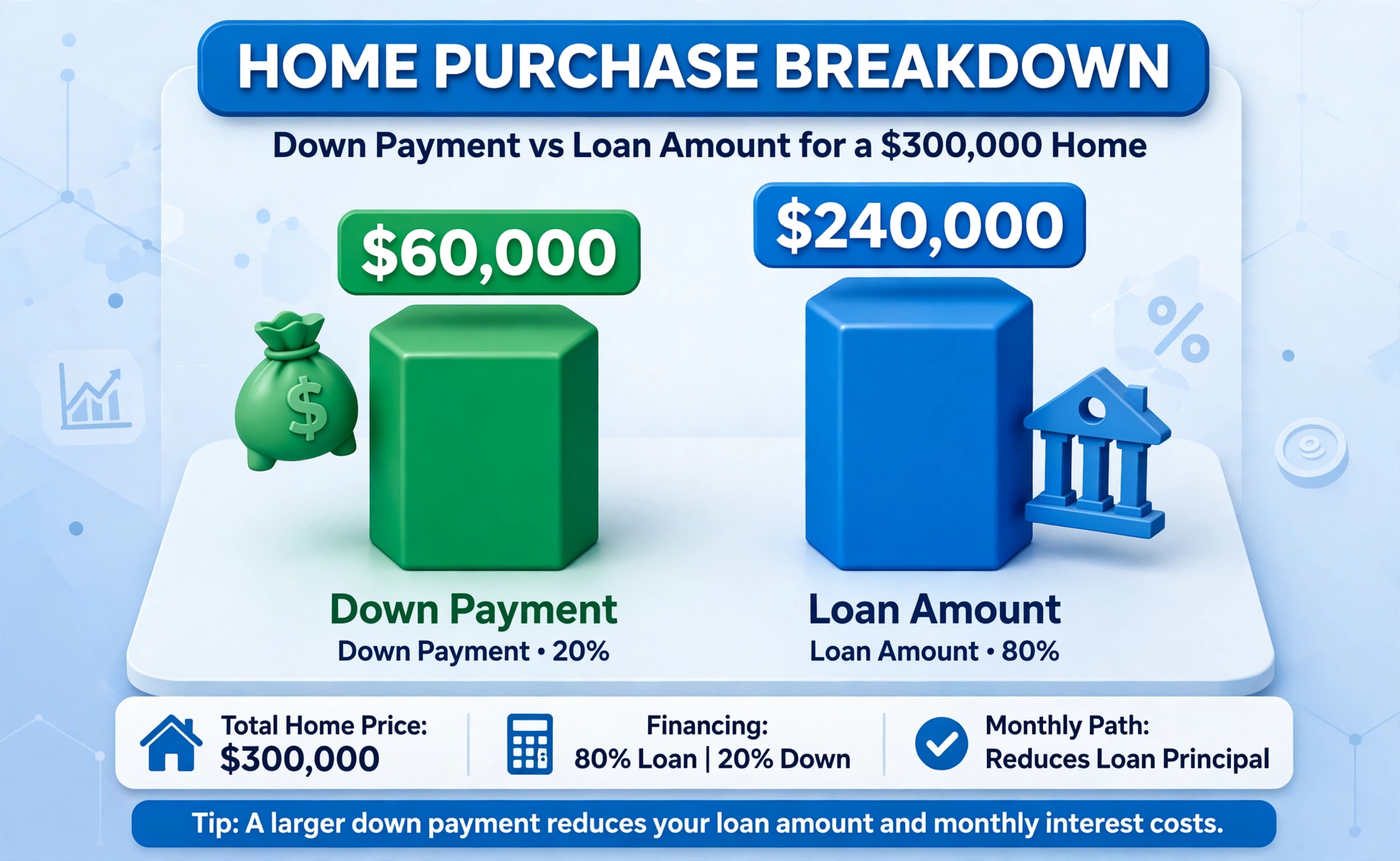
A down payment is the cash you pay up front when buying a home, and the rest is borrowed as a mortgage. If a home costs $300,000 and you put 20 percent down, you pay $60,000 at purchase and borrow $240,000. The down payment percent is always a percent of the full home price, not of the loan.
A bigger down payment means a smaller loan, a lower monthly payment, and less interest over the life of the mortgage. It also builds instant equity: with 20 percent down, you own 20 percent of the home from day one, before any price growth or principal repayment.
For the full monthly picture including the loan schedule, a mortgage calculator breaks down principal and interest over the whole term.
The Down Payment Formulas
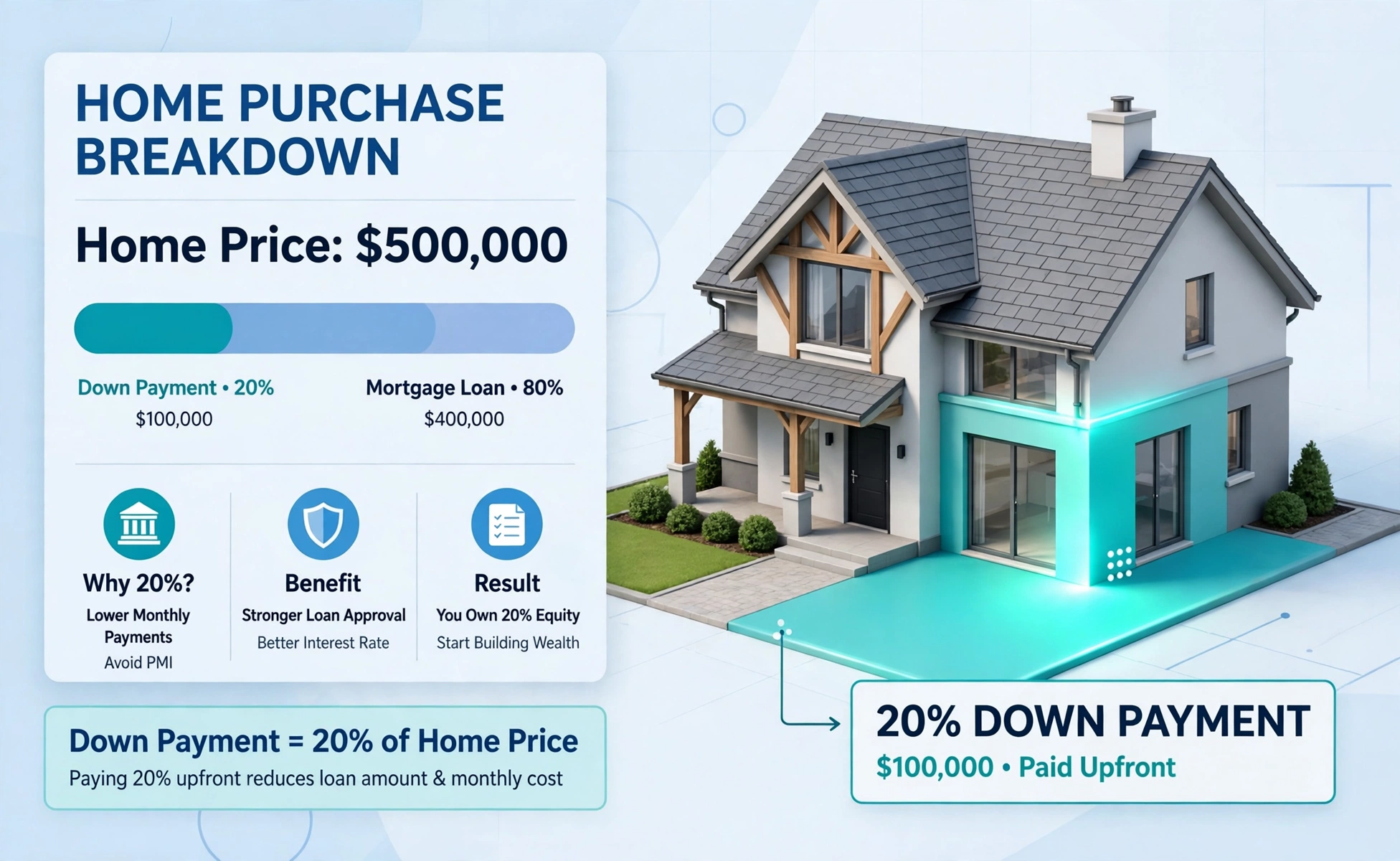
Down payment equals home price times down payment percent. Loan amount equals home price minus down payment. Loan to value, or LTV, equals loan amount divided by home price, times 100, and it is the percent of the home the lender still owns in effect.
The monthly principal and interest payment uses the standard amortization formula: payment equals loan times monthly rate divided by 1 minus 1 plus monthly rate to the power of negative number of payments. That formula is why a small rate change moves the payment more than most buyers expect.
| Item | Formula | Example at $300,000, 20% down |
|---|---|---|
| Down payment | Price x percent | $300,000 x 20% = $60,000 |
| Loan amount | Price minus down payment | $300,000 - $60,000 = $240,000 |
| LTV | Loan / price x 100 | $240,000 / $300,000 = 80% |
| Monthly P and I | Amortization formula | $1,516.96 at 6.5%, 30 years |
How Much Down Payment Do You Need
Conventional loans often allow as little as 3 to 5 percent down, FHA loans allow 3.5 percent with a qualifying credit score, and VA and USDA loans allow 0 percent for eligible buyers. But below 20 percent down, conventional loans add private mortgage insurance, which protects the lender and costs the buyer extra each month until equity reaches 20 percent.
The 20 percent target is a trade-off, not a rule. Waiting years to save 20 percent while prices rise can cost more than buying sooner with 10 percent down and paying PMI for a few years. Compare the PMI cost against the price growth and rent you would pay while waiting.
| Down payment | Cash on $300,000 | Loan | PMI usually? |
|---|---|---|---|
| 0% | $0 | $300,000 | Yes, or loan program fee |
| 3.5% | $10,500 | $289,500 | Yes |
| 10% | $30,000 | $270,000 | Yes |
| 20% | $60,000 | $240,000 | No |
Worked Examples
Example 1: $300,000 home, 20 percent down, 6.5 percent, 30 years. Down payment $60,000, loan $240,000, monthly principal and interest $1,516.96. Example 2: same home, 10 percent down. Down payment $30,000, loan $270,000, monthly payment $1,706.58, plus PMI.
Example 3: $450,000 home, 10 percent down, 6 percent, 30 years. Down payment $45,000, loan $405,000, monthly payment $2,428.33. Example 4: $200,000 home, 5 percent down, 6 percent, 30 years. Down payment $10,000, loan $190,000, monthly payment $1,139.08, LTV 95 percent, so PMI applies.
| Home price | Down | Loan | Monthly P and I |
|---|---|---|---|
| $300,000 | 20% | $240,000 | $1,516.96 |
| $300,000 | 10% | $270,000 | $1,706.58 |
| $450,000 | 10% | $405,000 | $2,428.33 |
| $200,000 | 5% | $190,000 | $1,139.08 |
Common Mistakes
The most common mistake is budgeting only the down payment and forgetting closing costs, which usually add 2 to 5 percent of the price on top. A second mistake is draining every dollar of savings for the down payment and leaving no emergency fund for repairs, which every homeowner eventually needs.
A third mistake is assuming 20 percent down is required. It avoids PMI, but many buyers buy successfully with less, and some loan programs are designed for it. A fourth mistake is ignoring that the monthly payment here excludes taxes, insurance, and HOA dues, which can add hundreds a month.
Practical Uses
Use this calculator before house hunting to set a realistic price range: decide the cash you can put down, add closing costs, and see which prices keep the monthly payment comfortable. Lenders usually want total housing costs under about 28 percent of gross monthly income, a rule worth checking before falling for a house.
Also use it to compare scenarios side by side: 10 percent versus 20 percent down, or a 15 year term versus 30 years, and see exactly what each choice costs per month and in total interest. Small percent differences become tens of thousands over a mortgage.
Frequently asked questions
How much is 20 percent down on a $300,000 home?
$60,000. Multiply the price by 20 percent: $300,000 times 0.20 equals $60,000, leaving a $240,000 loan.
Can I buy a house with less than 20 percent down?
Yes. Conventional loans allow 3 to 5 percent down, FHA allows 3.5 percent, and VA and USDA allow 0 percent for eligible buyers, though PMI usually applies below 20 percent.
What is PMI and when does it apply?
Private mortgage insurance protects the lender when your down payment is below 20 percent. It adds a monthly cost until your equity reaches 20 percent, when you can usually ask to remove it.
What is loan to value (LTV)?
The loan divided by the home price, as a percent. A $240,000 loan on a $300,000 home is an 80 percent LTV.
Does the monthly payment include taxes and insurance?
No, this calculator shows principal and interest only. Property taxes, homeowners insurance, and HOA dues are extra and can add hundreds per month.
Is a 15 year mortgage better than a 30 year one?
A 15 year term has a higher monthly payment but far less total interest. Compare both with this calculator before deciding what your budget can carry.
What are closing costs?
Fees paid at purchase, usually 2 to 5 percent of the price, for appraisal, title, origination, and prepaid taxes and insurance. They are on top of the down payment.