Rent vs Buy Calculator: Should You Rent or Buy?
Should you rent or buy? The honest answer depends on the numbers, not on slogans. Enter the price of the home you would buy, what renting a similar place costs, and how long you plan to stay — this free rent vs buy calculator compares the net worth of both choices year by year and finds your breakeven year.
Formulas verified against standard finance references. Calculator logic tested with verified worked examples. Last reviewed: October 2026. Our methodology
How the comparison is calculated
Comparing rent and buy fairly means comparing net worth after the same number of years — not just the monthly payment against the monthly rent. Each side gets full credit: the buyer keeps home equity, the renter keeps the invested down payment.
- Net worth if you buy (year t): home value after appreciation, minus selling closing costs, minus the remaining mortgage balance.
- Net worth if you rent (year t): your would-be down payment and buying closing costs, invested from day one at your investment return — plus any month where renting costs less than owning, with that difference invested too.
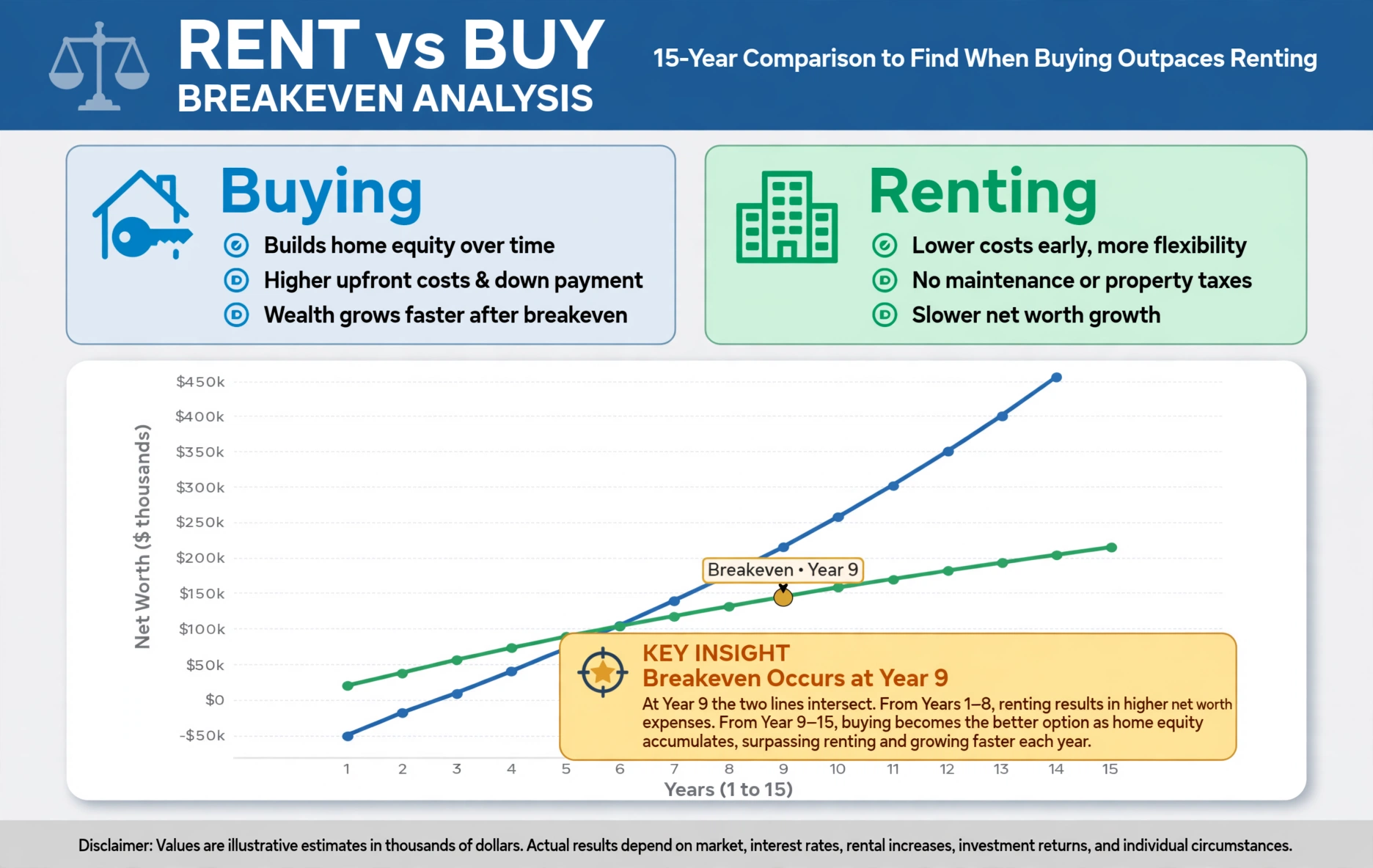
- Breakeven year: the first year in which the buying net worth catches up with the renting net worth. If it never does within your horizon, renting wins outright.
- Monthly owning cost: mortgage principal and interest, plus property tax, insurance and maintenance — tax and maintenance grow as the home appreciates.
Sources: U.S. Department of Housing and Urban Development — homebuying guidance.
Worked example
Consider a $350,000 home with a $70,000 down payment, a 6.5% 30-year mortgage, 2% buying closing costs, 1.2%/year property tax, $2,000/year insurance, 1%/year maintenance, 3.5%/year appreciation and 6% selling costs — against renting a similar home for $1,800/month rising 3% a year, with a 5% investment return over 15 years.
The monthly principal and interest is $1,769.79, and $77,000 goes in upfront (down payment plus closing costs). For the first 9 years the renter stays ahead, because the invested $77,000 compounds while the buyer pays mostly interest. In year 10 the lines cross: buying net worth reaches about $226,714 against $223,286 for renting. By year 15 buying is ahead by roughly $39,718 ($348,024 vs $308,306). Shorten the stay to 5 years and renting wins by about $17,700 — transaction costs punish short stays.
How to use the rent vs buy calculator
Mirror calculator.net's approach: fill in the buying side completely — including the costs people forget, like maintenance and selling costs — then the renting side, then your assumptions about the future.
Step by step
- Enter the buying details. Home price, down payment, mortgage rate and term, plus closing costs as a percentage of the price.
- Enter the ongoing ownership costs. Property tax and maintenance as yearly percentages of the home value, insurance as a yearly dollar amount, and expected appreciation.
- Enter the renting side. What a similar home rents for today and how fast you expect rent to rise each year.
- Set your assumptions. The investment return your down payment would earn if you rented, and how many years you plan to stay.
- Press Calculate. Read the net worth verdict, the breakeven year, and the year-by-year table underneath.
What counts on each side
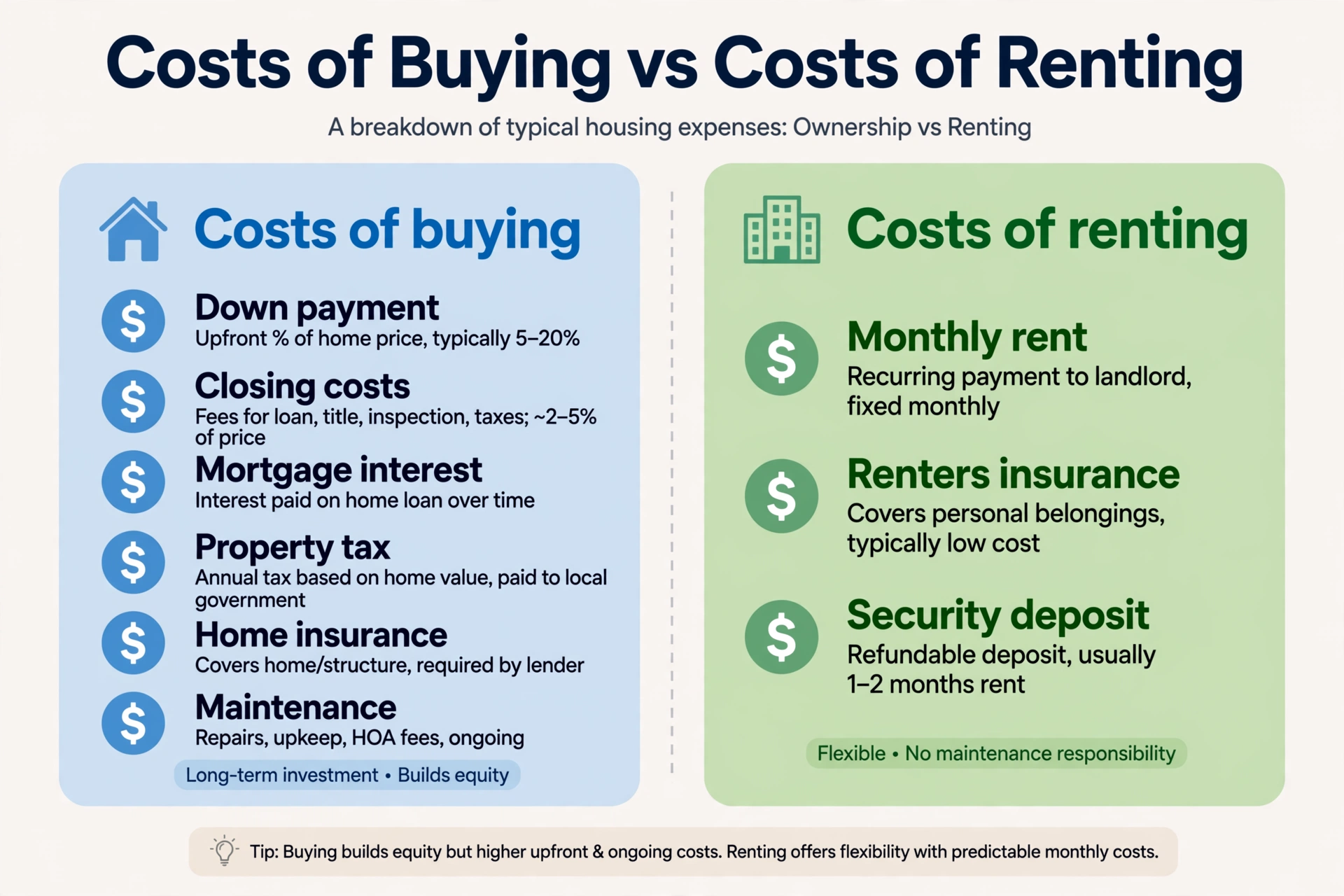
The biggest mistake in rent-vs-buy math is comparing only mortgage payment to rent. The full picture has more lines on each side:
| Buying costs | Renting costs |
|---|---|
| Down payment (cash tied up on day one) | Monthly rent (rises with rent increases) |
| Buying closing costs (2–5% of price) | Renter's insurance (often required) |
| Mortgage principal and interest | Security deposit (refundable, but tied up) |
| Property tax (rises with home value) | Opportunity: down payment stays invested |
| Home insurance | Opportunity: monthly savings stay invested |
| Maintenance and repairs (about 1%/year) | Moving costs at lease end (minor) |
| Selling closing costs (6–7% at the end) | — |
A mortgage calculator is useful alongside this one when you want to inspect the monthly payment itself — principal, interest, tax and insurance — before running the full comparison.
When renting wins vs when buying wins
No universal winner exists — the inputs decide. These patterns hold across most scenarios:
| Renting usually wins when… | Buying usually wins when… |
|---|---|
| You will stay only a few years | You will stay 7–10+ years |
| Home prices are very high relative to rents | Rents are high relative to home prices |
| Mortgage rates are high | You locked in a low fixed rate |
| You can earn strong returns investing instead | Rents in your area rise fast every year |
| You value flexibility and low commitment | You value stability and forced savings |
Remember the comparison is purely financial. Owning brings control — paint the walls, get the dog — and responsibility for every repair. Renting brings flexibility and predictable costs. A compound interest calculator shows exactly how the renter's invested down payment grows, which is the engine behind most "rent wins" results.
The assumptions that matter most
Three assumptions swing the answer more than anything else, so test each one:
- Home appreciation. It applies to the whole home value, so even 1–2% changes move the breakeven by years. Use a conservative number, not a hot-market number.
- How long you stay. This single input decides more outcomes than the price does — buying front-loads its costs and needs time to claw them back.
- Investment return. The higher the return your down payment could earn, the harder buying has to work to keep up. Be honest about what you would actually invest in.
- Rent growth. Fast-rising rents favor buying, because a fixed-rate mortgage payment stays flat while rent compounds.
HUD's homebuying guide walks through affordability, rights, and loan shopping — useful background before you commit to either path.
Frequently asked questions
Is it better to rent or buy a home?
It depends on your numbers, not on a rule of thumb. Buying usually wins for long stays in markets where rents rise steadily, because the mortgage payment stays fixed while equity builds. Renting usually wins for short stays, expensive markets, or when the down payment can earn strong returns invested elsewhere. Run your own figures rather than trusting slogans.
What is the breakeven year in a rent vs buy comparison?
The breakeven year is the first year in which your net worth from buying catches up with your net worth from renting. Before that year renting has left you wealthier; after it, buying has. If the lines never cross within your time horizon, renting wins outright.
How does home appreciation affect the rent vs buy decision?
Enormously — it applies to the entire home value, so small changes swing the result by years. Strong appreciation favors buying; flat or falling values favor renting. Because nobody can predict it reliably, use a conservative long-run figure and check how the verdict changes if you lower it.
What is opportunity cost in the rent vs buy decision?
The return your down payment and closing costs could have earned if you had rented and invested them instead. This calculator credits the renter with that growth every year, which is why high investment returns make renting look better and low returns favor buying.
Do I need to include property tax, insurance and maintenance?
Yes — leaving them out is the most common way to make buying look cheaper than it is. Together they often add 2–4% of the home's value per year on top of the mortgage payment, and they rise over time while the mortgage payment stays fixed.
What happens if I move before the breakeven year?
You will likely have been better off renting. Buying and selling costs — typically 8–10% of the price combined — take years to earn back through equity and appreciation. The shorter the stay, the more those one-time costs dominate.
Does this calculator consider taxes?
It uses a simplified model without itemized tax deductions such as mortgage interest. In reality, deducting mortgage interest and property tax can narrow the gap slightly for buyers who itemize, but it rarely flips the verdict on its own.