Mortgage Refinance Calculator: Break-Even, Savings & New Payment
Thinking about refinancing? Enter your current mortgage and the new loan offer below to compare the monthly payment, monthly and lifetime savings, upfront closing costs and the exact month you break even.
Formulas verified against standard mortgage references. Calculator logic tested with verified worked examples. Last reviewed: October 2026. Our methodology
The refinance formulas
A mortgage refinance is judged by two numbers: how much the monthly payment falls, and how long it takes those savings to pay back the closing costs. Everything on this page flows from the standard amortizing-loan formula.
- Monthly payment: M = P × r ÷ (1 − (1 + r)^−n), where r = annual rate ÷ 12 and n = number of monthly payments
- Monthly savings: current payment − new payment
- Upfront cost: closing fees + (points% × new loan amount); 1 point = 1% of the loan
- Break-even point: upfront cost ÷ monthly savings, in months
- Lifetime savings: (current payment × months left) − (new payment × new months + upfront cost)
- Cash-out: new loan amount = remaining balance + cash-out amount
The calculator compares what is left on your current loan — not what you originally borrowed — against the full cost of the new loan plus its upfront fees. That is the only comparison that tells you whether refinancing leaves you richer.
Sources: the standard amortizing-loan payment formula; break-even computed as upfront cost divided by monthly savings; methodology mirrors calculator.net's refinance calculator.
Worked example
Take a $300,000 mortgage at 7% with 30 years left, and a refinance offer of 6% for 30 years with $6,000 in costs and fees, no points and no cash-out.
- Current payment: 300,000 × 0.005833 ÷ (1 − 1.005833^−360) = $1,995.91 per month.
- Upfront cost: $6,000 in fees + 0% points = $6,000.00.
- New payment: 300,000 × 0.005 ÷ (1 − 1.005^−360) = $1,798.65 per month.
- Monthly savings: $1,995.91 − $1,798.65 = $197.26.
- Break-even: $6,000.00 ÷ $197.26 ≈ 30.4 months (about 2.5 years).
- Lifetime: staying put means $718,526.69 of remaining payments; refinancing means $647,514.57 + $6,000.00 = $653,514.57. You save $65,012.13 — refinancing would be financially LESS expensive.
If you plan to keep the home longer than 30.4 months, the refinance pays for itself and then keeps paying you $197.26 a month.
How to use the mortgage refinance calculator
The calculator compares your remaining obligation against a new loan offer and gives a verdict. You only need the details from your current statement and the quote from your lender.
Step by step
- Enter your current loan. The remaining balance, the interest rate and how many years are left. The calculator works out your current monthly payment from these.
- Enter the new loan offer. The new term, the new rate, plus any points, closing costs and the cash-out amount if you want cash from your equity.
- Press Calculate. Read the new monthly payment, monthly savings, upfront cost, break-even point and the overall verdict.
- Check the comparison table. It lines up the current and new loans row by row — principal, payment, length, rate, total payments, total interest, upfront cost and time to break even — so nothing hides in the fine print.
Points are optional: leave them blank for a no-points quote. Cash-out raises the new loan balance, so a cash-out refinance can still show higher monthly costs even at a lower rate.
What is mortgage refinancing?
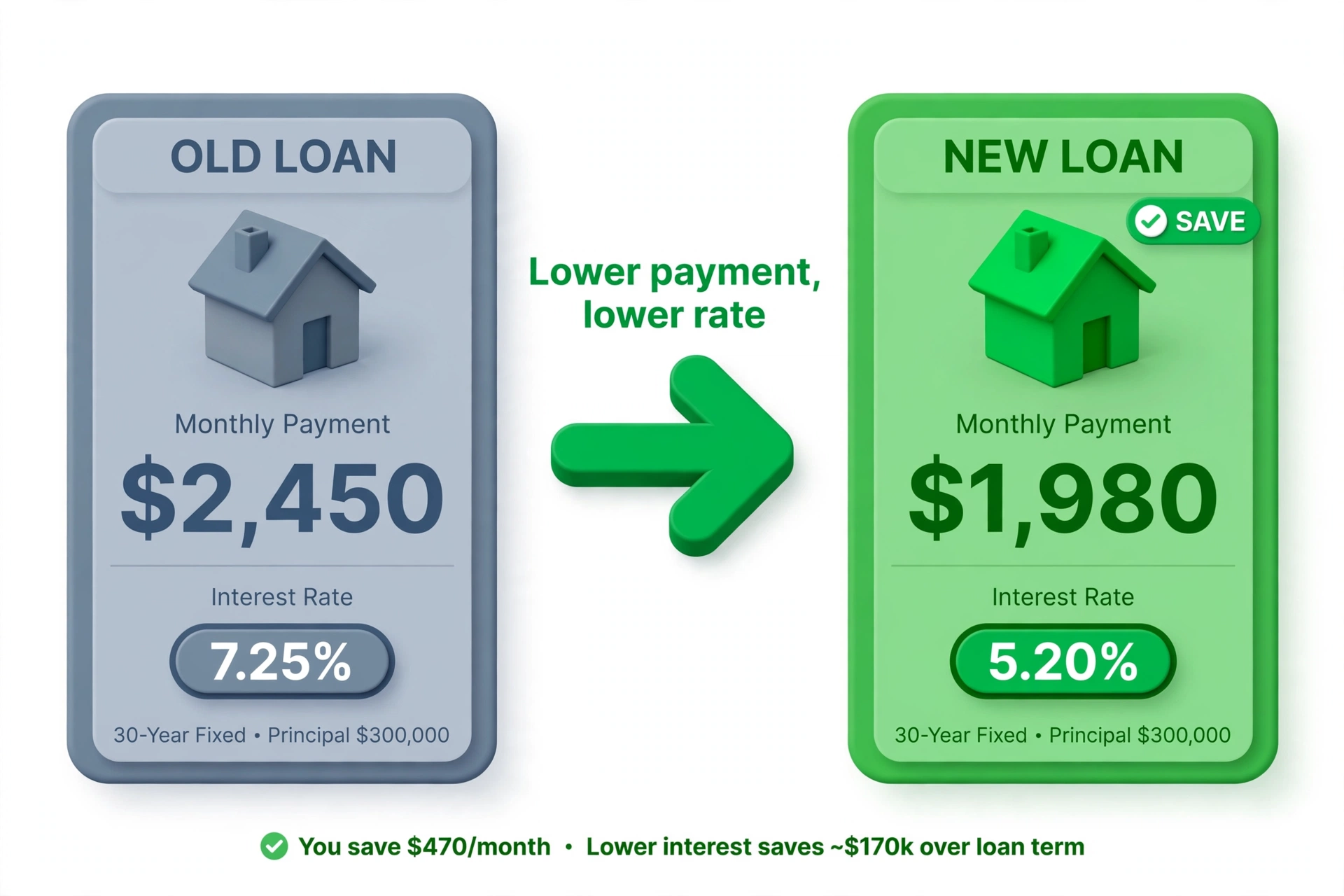
Refinancing means replacing your current mortgage with a new loan, usually at a lower interest rate or with different terms. The new lender pays off your old balance, and from then on you make payments on the new loan. Homeowners most often refinance to lower their rate, shorten or lengthen the term, move from an adjustable to a fixed rate, or tap home equity as cash.
There are a few common flavors. A rate-and-term refinance keeps the loan amount the same and just changes the rate or term. A cash-out refinance replaces the mortgage with a larger one and hands you the difference in cash — the new principal is the old balance plus the cash-out amount. A cash-in refinance goes the other way: you bring money to closing to shrink the balance.
Why homeowners refinance
Rates move, incomes change and equity grows. When market rates fall below what you signed years ago, refinancing can cut hundreds off the monthly payment — the first step is to estimate your current payment with a mortgage calculator so you know exactly what you are comparing against. Shortening the term is the other classic move: a 30-year loan refinanced into a 15-year loan usually raises the payment but slashes total interest.
When does refinancing make sense?
A lower rate alone does not make a refinance a good deal — the closing costs have to be paid back by the savings. The table below shows the situations where refinancing usually wins, and what to watch for in each.
| Situation | Usually worth it because… | Watch out for… |
|---|---|---|
| Rate drop of about 1 point or more | Monthly savings are large enough to recover closing costs quickly | A short remaining term leaves fewer months for the savings to add up |
| You will stay past the break-even point | Every month after break-even is pure savings | Selling or refinancing again soon wipes out the benefit |
| Switching an ARM to a fixed rate | Payment certainty, even if the payment is slightly higher | Compare total remaining payments, not just the monthly figure |
| Cash-out to replace high-interest debt | Swapping 20% credit-card debt for 6% mortgage debt | The new loan balance — and total interest — grows |
| Shortening the term (30 years to 15) | Much less total interest and a faster payoff | The monthly payment usually rises, so the budget must absorb it |
The golden rule is the break-even test: if you expect to keep the home longer than the break-even point, refinancing almost always pays. Also compare the APR rather than the headline rate — an APR calculator folds points and fees into the true yearly cost, so a "low rate" with heavy points cannot hide behind a cheap quote.
The break-even rule
The break-even point is the month when your cumulative savings finally cover what the refinance cost you upfront. Before that month you are still paying off the privilege of refinancing; after it, every payment is cheaper than the old one would have been.
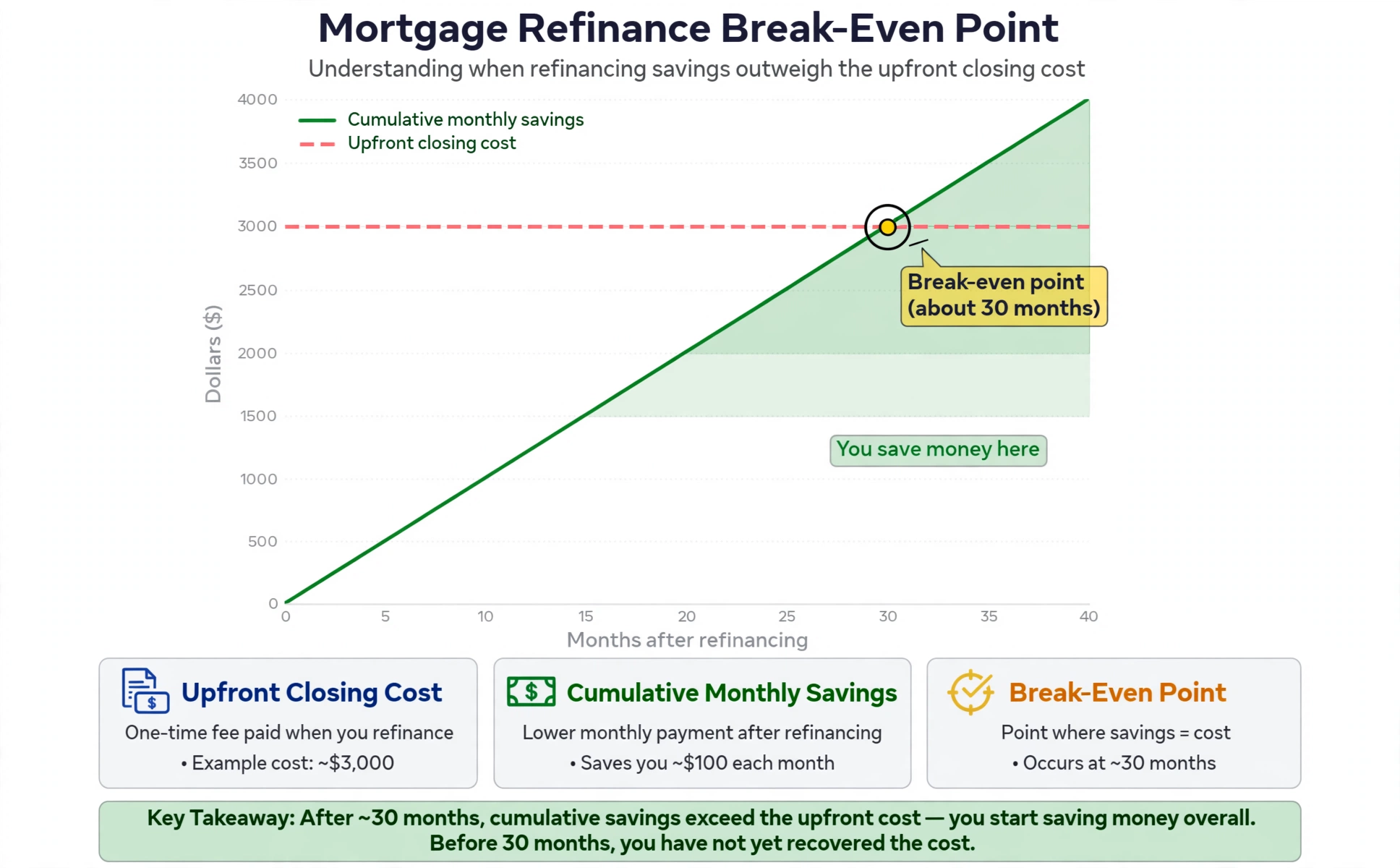
Here is the full side-by-side comparison for the worked example above ($300,000 at 7% with 30 years left, refinanced to 6% for 30 years with $6,000 in costs):
| Current loan (remaining) | New loan | Difference | |
|---|---|---|---|
| Principal / loan amount | $300,000.00 | $300,000.00 | $0.00 |
| Monthly payment | $1,995.91 | $1,798.65 | −$197.26 |
| Remaining length | 360 months | 360 months | 0 months |
| Interest rate | 7.00% | 6.00% | −1.00 pts |
| Total of remaining payments | $718,526.69 | $647,514.57 | −$71,012.12 |
| Total interest | $418,526.69 | $347,514.57 | −$71,012.12 |
| Cost + points (upfront) | $0.00 | $6,000.00 | $6,000.00 |
| Months to break even | — | 30.4 | — |
Points and fees
Points are prepaid interest: paying 1 point (1% of the loan) buys the rate down, typically by about a quarter of a point. Points only pay off if you keep the loan long enough to recover them — the same break-even logic applies. Closing costs on a refinance typically run 2% to 5% of the loan amount. For an independent walkthrough of the trade-offs, the Consumer Financial Protection Bureau's "Should I refinance?" guide is a solid starting point.
Frequently asked questions
What is mortgage refinancing?
Refinancing means replacing your current mortgage with a new loan, usually at a lower interest rate or with different terms. The new loan pays off the old balance, and you start making payments on the new loan instead.
How do you calculate the break-even point on a refinance?
Divide the upfront closing costs by the monthly savings: break-even (months) = upfront cost ÷ monthly savings. If refinancing costs $6,000 and saves you $200 a month, you break even after 30 months.
How much lower should my new rate be before refinancing is worth it?
A common rule of thumb is that the new rate should be at least 0.75 to 1 percentage point below your current rate. But the real test is the break-even point: if you plan to keep the home longer than it takes to recover the closing costs, refinancing usually pays off.
What are mortgage points, and should I pay them?
Points are prepaid interest: 1 point equals 1% of the loan amount, paid upfront in exchange for a lower rate. Paying points makes sense when you plan to keep the loan long enough to recover the cost — otherwise the upfront payment outweighs the rate discount.
Does refinancing restart my mortgage clock?
Often, yes. Refinancing a 30-year loan that you have already paid down for 8 years into a new 30-year loan restarts the term to 360 months, which can increase the total interest you pay even at a lower rate. Consider a shorter term or compare the total remaining payments to see the full picture.
What is a cash-out refinance?
A cash-out refinance replaces your mortgage with a larger loan, and you receive the difference as cash. The new loan balance is your remaining balance plus the cash-out amount, so your payment is calculated on the bigger principal.
How much does it cost to refinance a mortgage?
Closing costs on a refinance typically run 2% to 5% of the loan amount and include lender fees, appraisal, title search and recording fees. This calculator treats those costs as the upfront cost you must recover through monthly savings.
Related calculators

Mortgage Calculator
Estimate your monthly mortgage payment and see how interest adds up over the loan term.
Use calculatorLoan Calculator
Work out the monthly payment and total interest for any loan, from auto to personal.
Use calculatorAPR Calculator
Find a loan's true yearly cost with fees and points included, so offers can be compared fairly.
Use calculator