House Affordability Calculator: How Much House Can You Afford?
How much house can you afford? Lenders answer that with two simple ratios: housing costs should stay under 28% of your gross income, and all debts under 36%. Enter your income, debts, down payment and loan details, and this free house affordability calculator estimates the maximum home price and monthly payment you can afford.
Formulas verified against standard finance references. Calculator logic tested with verified worked examples. Last reviewed: October 2026. Our methodology
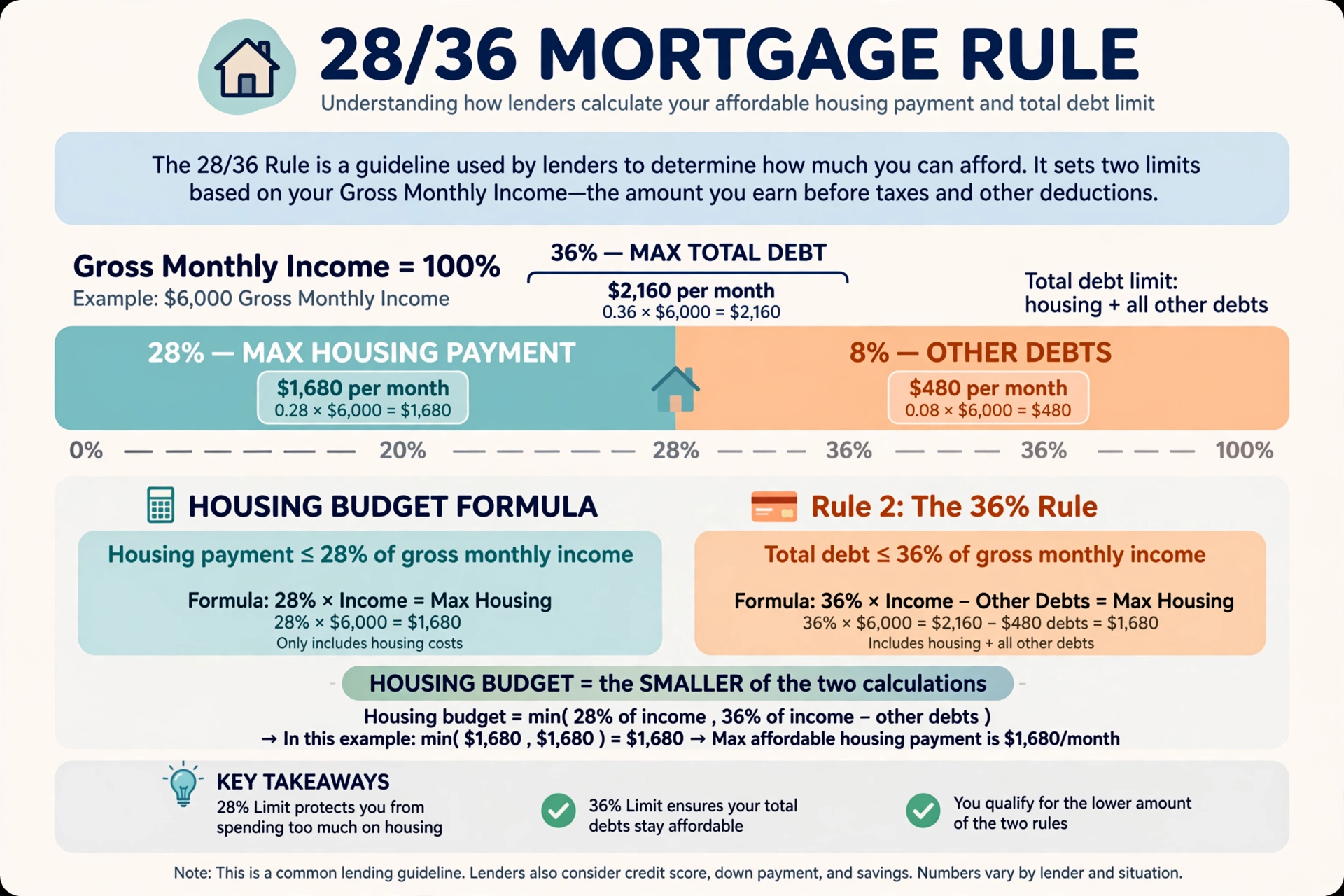
The 28/36 rule formulas
Most conventional lenders use the 28/36 rule: your housing payment should stay at or under 28% of gross monthly income, and all monthly debts combined at or under 36%. The calculator runs the mortgage math backwards — from the payment your income supports to the home price that payment can buy.
- Gross monthly income: annual income ÷ 12. Lenders use gross (pre-tax) income here.
- Front-end limit: monthly income × 0.28 — the most housing you can carry.
- Back-end limit: monthly income × 0.36 − monthly debts — the most housing you can carry after other debts.
- Housing budget: the smaller of the two limits. This is the binding number.
- Available for principal and interest: housing budget − monthly property tax − monthly insurance − monthly HOA.
- Max loan: available P&I × the annuity factor [(1 + r)n − 1] ÷ [r(1 + r)n], where r is the monthly rate and n the number of payments.
- Max home price: max loan + down payment (or max loan ÷ (1 − down-payment %) for a percent down payment).
Sources: U.S. Department of Housing and Urban Development — homebuying guidance.
Worked example
Take an annual income of $120,000 ($10,000/month), $500/month in existing debts, a 20% down payment, a 7% 30-year loan, and no tax, insurance or HOA for simplicity.
Front-end limit: $10,000 × 0.28 = $2,800. Back-end limit: $10,000 × 0.36 − $500 = $3,100. The smaller number, $2,800, is the housing budget. At 7% over 360 payments the annuity factor is about 150.31, so the max loan is $2,800 × 150.31 ≈ $420,861. With 20% down, the max home price is $420,861 ÷ 0.80 ≈ $526,076 — a $105,215 down payment. Add $4,000/year of property tax and the affordable price falls, because tax eats into the same $2,800 budget.
How to use the house affordability calculator
Enter gross income (before tax) — that is what lenders use. Be honest about debts: car loans, student loans, and credit-card minimums all shrink the house you can buy.
Step by step
- Enter your annual gross income and monthly debt payments. Include every recurring debt minimum.
- Enter your down payment as a fixed dollar amount or a percent of the price.
- Enter the interest rate, loan term, and yearly tax, insurance and HOA. Use real quotes where you have them.
- Press Calculate. Read your maximum home price, max loan, max monthly payment, and which of the two rules binds you.
What counts as a housing payment
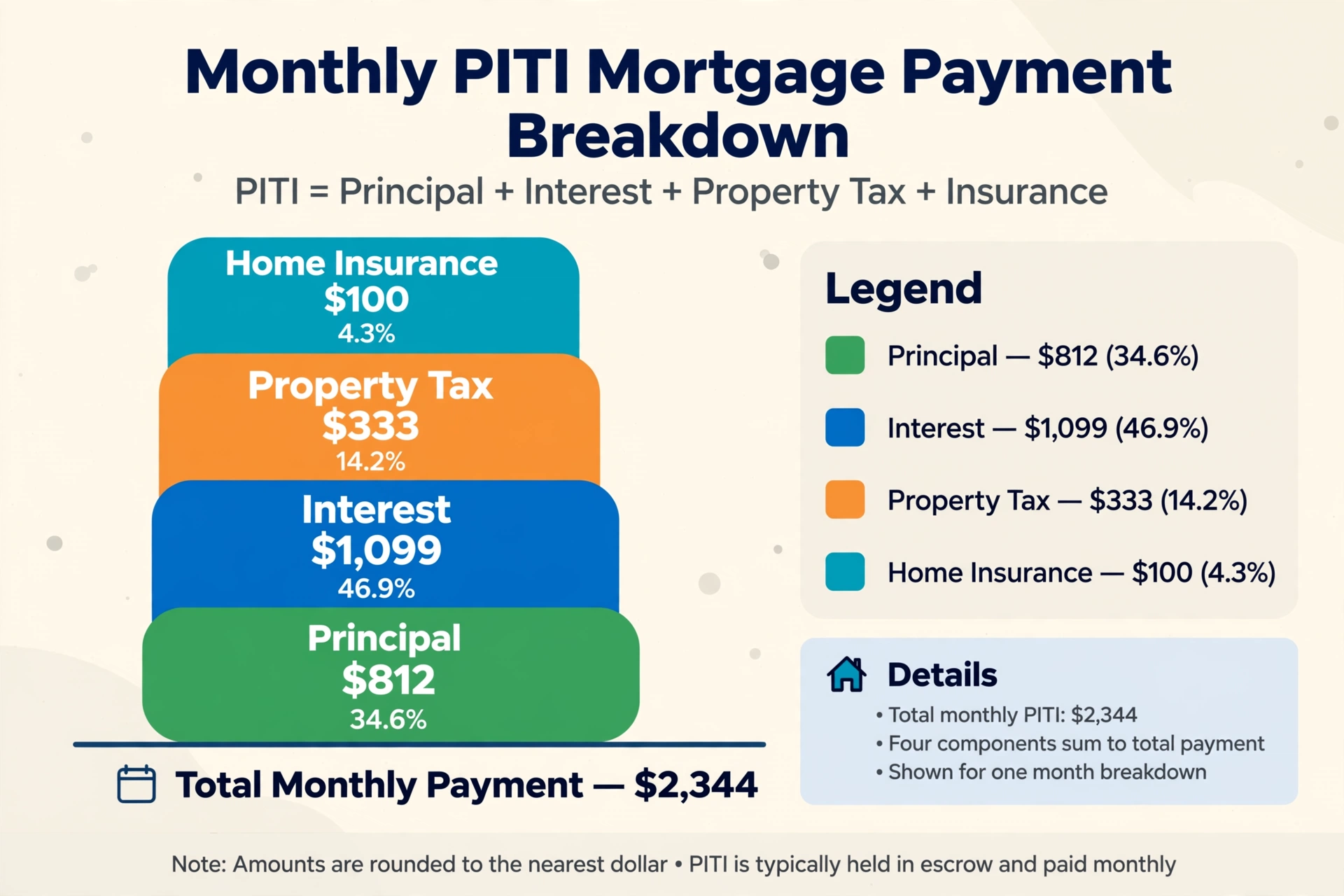
Lenders do not count just principal and interest toward the 28%. They count the full PITI payment plus HOA and PMI — the number that actually leaves your account each month:
| Component | What it is | Typical size |
|---|---|---|
| Principal | The part of the payment that pays down the loan | Grows over the life of the loan |
| Interest | The lender's charge for the loan | Largest early on; shrinks over time |
| Property tax | Charged by your county or city | Roughly 0.3–2%+ of value per year, varies widely |
| Home insurance | Required by the lender | Often $1,000–$3,000 per year |
| HOA dues | If the property has an association | $0 to several hundred per month |
| PMI | If your down payment is under 20% | Roughly 0.3–1.5% of the loan per year |
Many first-time buyers forget taxes and HOA, then wonder why the payment is hundreds higher than a simple mortgage quote showed. A mortgage calculator breaks any loan into these exact pieces so nothing hides.
What raises or lowers your affordable price
Five levers move your affordable price. Knowing them lets you plan instead of guess:
| Change | Effect on affordable price | Why |
|---|---|---|
| Pay down $200/month of debts | Price rises noticeably | Every debt dollar frees a dollar of the 36% budget |
| Rate drops 1% (e.g. 7% to 6%) | Price rises roughly 10–12% | Cheaper money services more principal per payment |
| Bigger down payment | Price rises dollar for dollar | Plus reaching 20% removes PMI |
| Shorter term (30yr to 15yr) | Price falls | Higher monthly payment per dollar borrowed |
| Higher property tax area | Price falls | Tax consumes the fixed housing budget |
Debts are the lever most buyers control fastest: a debt payoff calculator shows how clearing a car loan or card balance before house-hunting directly raises the price you qualify for.
Beyond the ratios: what lenders also check
The 28/36 rule is a guideline, not a law. Automated underwriting stretches further for strong files, and loan programs have their own caps:
- Credit score. It does not change the ratios, but it changes the rate you are offered — and the rate changes everything downstream.
- Cash reserves. Lenders like to see several months of payments left over after closing.
- FHA loans commonly allow up to about 31/43, which is friendlier to buyers with modest down payments.
- VA loans have no fixed DTI cap and no down payment requirement for eligible borrowers.
- Comfort vs qualification. The rule is a lending ceiling, not a budget — many buyers are happier a notch below their max.
HUD's homebuying guide explains affordability, borrower rights, and how to shop for a loan — worth reading before you start touring homes.
Frequently asked questions
How much house can I afford on my salary?
A quick estimate: multiply your gross monthly income by 0.28 for the max housing payment, and by 0.36 and subtract your monthly debts for the max total-debt payment. Take the smaller number, subtract monthly tax, insurance and HOA, and see what loan that payment supports at current rates. Add your down payment for the price. This calculator does all of it for you.
What is the 28/36 rule?
A lending guideline used by most conventional mortgage lenders. The 28% front-end ratio caps your total monthly housing payment (PITI plus HOA and PMI) at 28% of gross monthly income. The 36% back-end ratio caps your housing payment plus all other monthly debts at 36% of gross monthly income. The lower of the two caps controls how much you can borrow.
What is front-end vs back-end DTI?
Front-end DTI (debt-to-income) is your housing payment divided by gross monthly income — the 28% side. Back-end DTI is your housing payment plus all other monthly debts divided by gross monthly income — the 36% side. Lenders check both; either one can be the binding constraint.
Does the 28/36 rule include property tax and insurance?
Yes. The 28% housing figure is the full PITI payment — principal, interest, property taxes and homeowners insurance — plus HOA dues and PMI when they apply. Forgetting taxes is the most common reason buyers overestimate what they can afford.
How do my debts affect how much house I can afford?
Directly and dollar for dollar: every $1 of monthly debt payment removes $1 from the 36% back-end housing budget. Paying off a $300/month car loan before applying can raise your affordable home price by tens of thousands.
Can I afford a house with less than 20% down?
Yes — many buyers put down 3–10%, especially with FHA or conventional low-down-payment programs. The tradeoff is private mortgage insurance (PMI), which adds to the monthly payment and therefore slightly reduces the price you qualify for under the 28% rule.
Is the 28/36 rule a law lenders must follow?
No, it is a guideline. Conventional lenders use it as a standard, but automated underwriting can approve higher ratios for borrowers with strong credit and reserves, and government programs like FHA and VA use their own limits. Treat the result as a planning estimate, not a guaranteed approval.