Personal Loan Calculator
Find the true monthly cost of a personal loan before you sign. Enter the loan amount, annual interest rate and term in years, then get your fixed monthly payment, total interest and total cost, with every step of the math shown.

Formulas verified against standard references. Calculator logic tested with verified worked examples. Published: November 2, 2026 | Last reviewed: November 2026. Our methodology
What the Personal Loan Calculator Shows
This personal loan calculator tells you the true monthly cost of borrowing before you sign. Enter the loan amount, the annual interest rate and the term in years, and it returns your fixed monthly payment, the total interest you will pay and the total cost of the loan.
Every result uses the standard amortization formula that lenders use for fixed-rate loans, and the page shows each step of the math beside the answer. Run two offers through it the same way to see which one really costs less. The loan calculator covers the same math for personal, auto and student loans in one place.
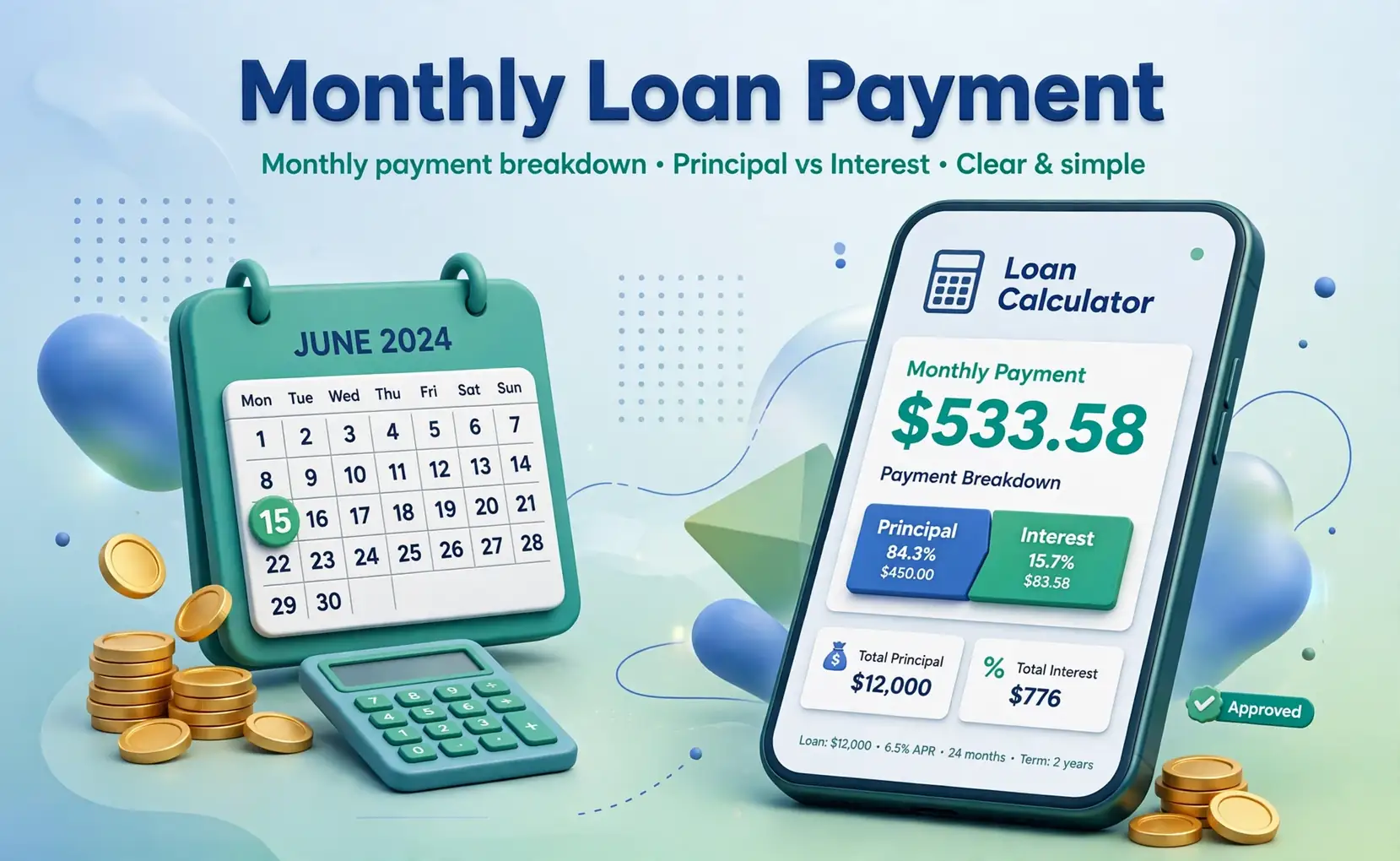
The Personal Loan Payment Formula
Monthly payment = P × r ÷ (1 − (1 + r)^−n). P is the loan amount in dollars, r is the monthly interest rate (the annual rate divided by 12) and n is the number of monthly payments (years × 12). The formula solves for one fixed payment that clears the loan exactly at the end of the term.
At a 0% interest rate the formula simplifies and the payment is just the loan amount divided by the number of months. Every lender prices a fixed-rate personal loan this way before fees, so the payment here matches the one your lender computes.
Worked Example: $10,000 at 8% for 5 Years
Borrow $10,000 at an 8% annual rate for 5 years. The monthly rate is 0.08 ÷ 12 = 0.0066667, and 5 years gives 60 monthly payments.
M = 10000 × 0.0066667 ÷ (1 − 1.0066667^−60) = $202.76 a month. Over 60 payments you hand over 202.76 × 60 = $12,165.60, so the loan costs $12,165.60 − $10,000 = $2,165.60 in total interest.
Try it above with amount 10000, rate 8 and term 5, and you will see the same three numbers with every step shown.
How to Use the Calculator
- Type the loan amount in dollars, for example 10000.
- Type the annual interest rate as a percent, for example 8. Use the interest rate from the offer, not the APR.
- Type the term in years, for example 5.
- Press Calculate. The monthly payment appears first and large, then the total interest and the total cost, followed by the step-by-step math.
How Interest Builds Over Time
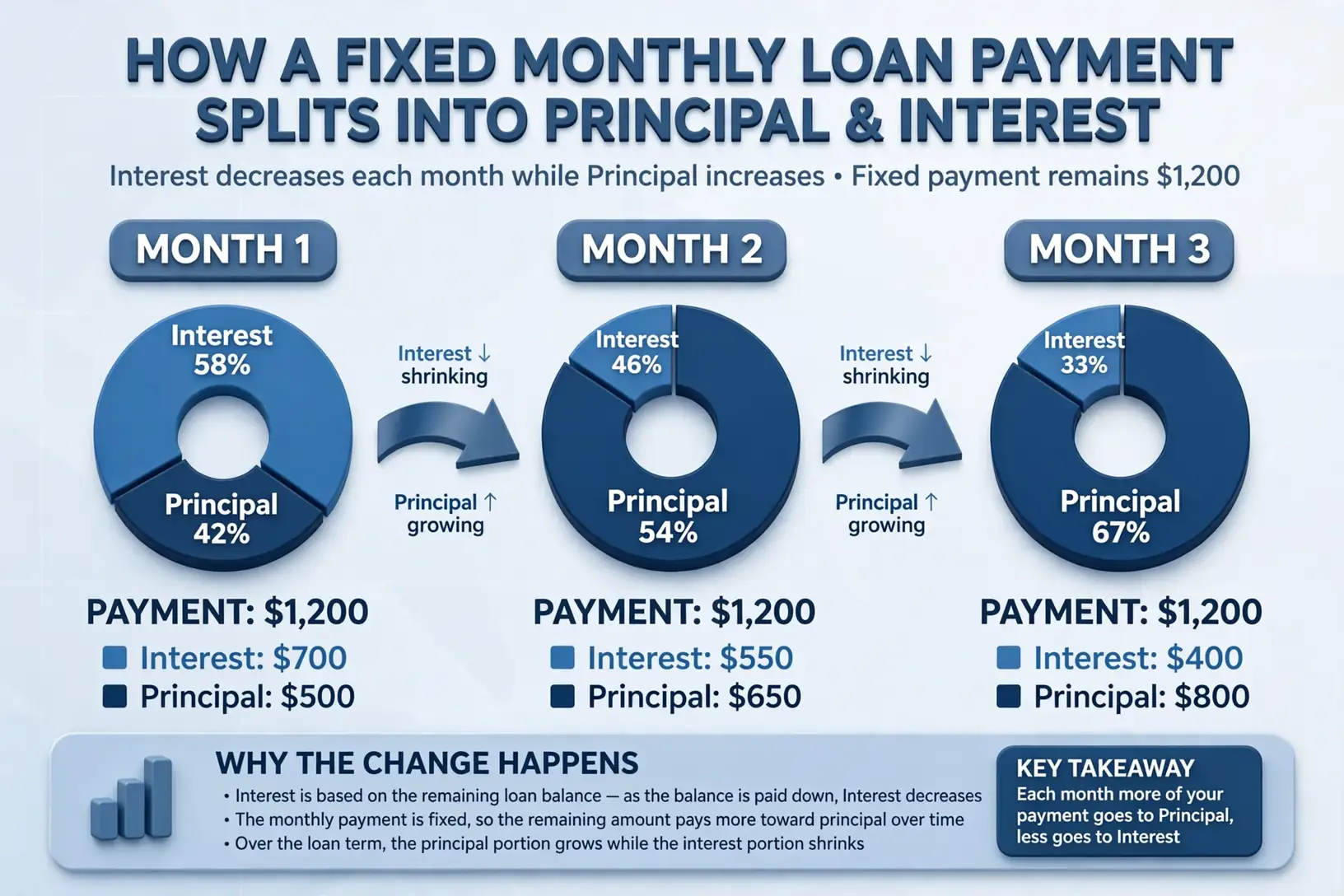
Every payment stays the same, but the split inside it changes. Each month you pay interest on the balance you still owe, and the rest comes off the debt. Early payments are mostly interest because the balance is at its largest.
On the $10,000 example at 8%, the first payment of $202.76 breaks into $66.67 of interest and $136.09 of principal. By the final payment the balance is tiny, so almost the whole $202.76 clears principal. This front-loading is why paying extra early in the loan saves more than paying extra later.
An amortization calculator shows this split for every single payment when you want the full schedule.
Short Term or Long Term: The Real Tradeoff
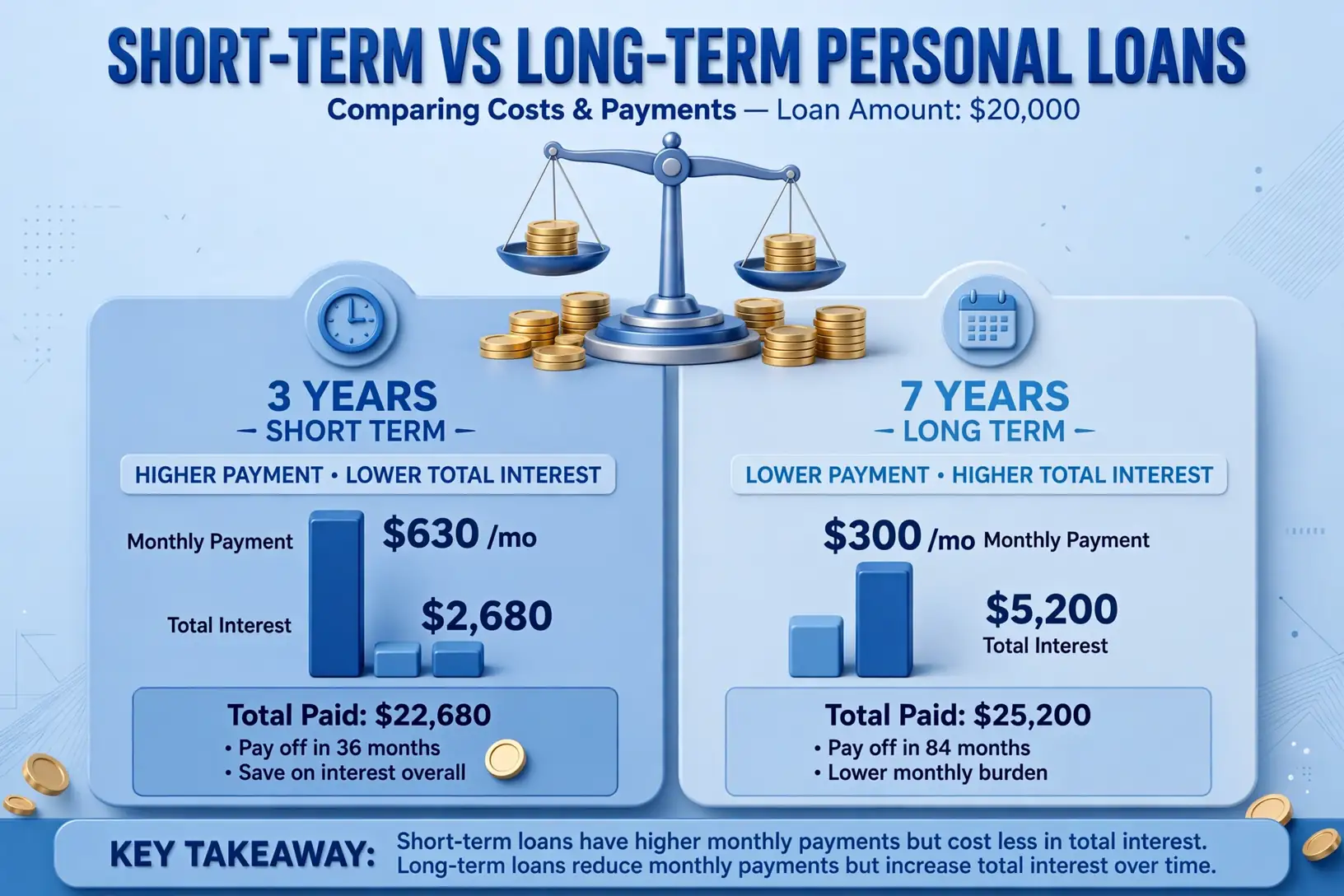
A longer term cuts the monthly payment but adds months of interest. The rate stays the same, yet the total cost moves a lot. Here is the $10,000 loan at 8% across three common terms.
| Term | Monthly payment | Total interest | Total paid |
|---|---|---|---|
| 3 years | $313.36 | $1,280.96 | $11,280.96 |
| 5 years | $202.76 | $2,165.60 | $12,165.60 |
| 7 years | $155.86 | $3,092.24 | $13,092.24 |
The 7-year term feels cheaper month to month, yet it costs $1,811.28 more in interest than the 3-year term. Pick the shortest term whose payment you can make every month without strain.
What Extra Payments Change
Any extra amount you pay goes straight at the balance, and it also removes all the interest that balance would have charged for the rest of the term. On the $10,000 example at 8% over 5 years, adding $50 to each payment, $252.76 in total, pays the loan off in 47 months instead of 60.
Total interest drops from $2,165.89 to $1,647.68, a saving of $518.21, and the loan ends about 14 months early. Before you do this, check the loan agreement for a prepayment penalty and tell the lender the extra is for principal. A debt payoff calculator plans extra payments across several loans at once.
Interest Rate or APR: Which One to Type
Type the interest rate, not the APR. The interest rate is the yearly price of the money itself, and your payment is computed from it. The APR is wider. It folds in fees like origination charges and shows everything as one yearly percentage.
When the loan has no fees the two numbers are the same, and you can use either one. To compare two offers with different fees, run each through this calculator with its own interest rate and compare the totals. An APR calculator shows the true yearly cost when fees are involved.
Disclaimer
This calculator gives an estimate for planning. Actual terms come from your lender.
Frequently asked questions
How is a personal loan payment calculated?
With the standard amortization formula: M = P × r ÷ (1 − (1 + r)^−n). P is the loan amount, r is the annual rate divided by 12 and n is the total monthly payments. At 0% the payment is simply the loan amount divided by the number of months.
What is the monthly payment on a $10,000 personal loan?
It depends on the rate and term. At 12% for 3 years the payment is $332.14 a month with $1,957.04 total interest. At 10% for 5 years it is $212.47 a month with $2,748.20 total interest. Enter your own numbers above for an exact answer.
Does a longer loan term save money?
It lowers the monthly payment but raises the total interest. On $10,000 at 8%, stretching from 3 to 7 years drops the payment from $313.36 to $155.86 yet adds $1,811.28 in interest. The shortest term you can afford comfortably is usually the cheapest.
What is the difference between the interest rate and the APR?
The interest rate prices the borrowed money alone. The APR adds lender fees and expresses the full cost as one yearly percentage, which is why it is usually higher. Use the interest rate in this calculator and the APR to compare offers.
Can I pay off a personal loan early?
Often yes. Extra payments cut the balance directly and cancel all future interest on that balance. Check your loan agreement first for a prepayment penalty, and confirm the lender applies the extra to principal.
Why is my lender's payment slightly different?
Small gaps come from rounding, a first payment date that is not exactly one month out, or fees added to the loan. Your loan agreement shows the exact payment. Treat this calculator as a planning figure and confirm it with the lender's disclosure.
Related calculators

Loan Calculator
Monthly payments for any loan.
Use calculatorAmortization Calculator
Loan payments broken into principal and interest.
Use calculatorAPR Calculator
True yearly cost with fees included.
Use calculatorCar Loan Calculator
Monthly payments for a car purchase.
Use calculatorStudent Loan Calculator
Plan student loan repayment.
Use calculatorAuto Lease Calculator
Monthly cost of leasing a car.
Use calculatorDebt Payoff Calculator
A plan to become debt free.
Use calculatorCredit Card Payoff Calculator
Pay down card balances faster.
Use calculatorDebt-to-Income Ratio Calculator
Check how lenders size you up.
Use calculatorCompound Interest Calculator
Growth of savings with compounding interest.
Use calculator