Car Loan Calculator: Monthly Payment and Total Cost
Work out exactly what a car loan will cost — each month and over the life of the loan. Enter the vehicle price, down payment, trade-in value, APR and loan term to see your monthly payment, loan amount, total interest and total paid.
The car loan formula
A car loan is a fixed-rate installment loan: you borrow one amount and repay it in equal monthly payments. The standard formula is:
Monthly payment = L x r / (1 - (1 + r)-n)
- L = loan amount (vehicle price - down payment - trade-in value)
- r = monthly interest rate (APR / 100 / 12)
- n = number of monthly payments (years x 12)
From there: total paid = monthly payment x n, and total interest = total paid - loan amount. With a 0% APR the math is simpler: monthly payment = loan amount / n.
Worked example
A $30,000 car with a $5,000 down payment, no trade-in, a 6% APR and a 5-year term:
| Step | Calculation | Result |
|---|---|---|
| Loan amount | 30,000 - 5,000 - 0 | $25,000 |
| Monthly rate | 6 / 100 / 12 | 0.005 |
| Payments | 5 x 12 | 60 |
| Monthly payment | 25,000 x 0.005 / (1 - 1.005-60) | $483.32 |
| Total paid | 483.32 x 60 | $28,999.20 |
| Total interest | 28,999.20 - 25,000 | $3,999.20 |
So the loan costs $483.32 a month and $3,999.20 in interest over five years. Try these exact numbers in the calculator above to see it work.
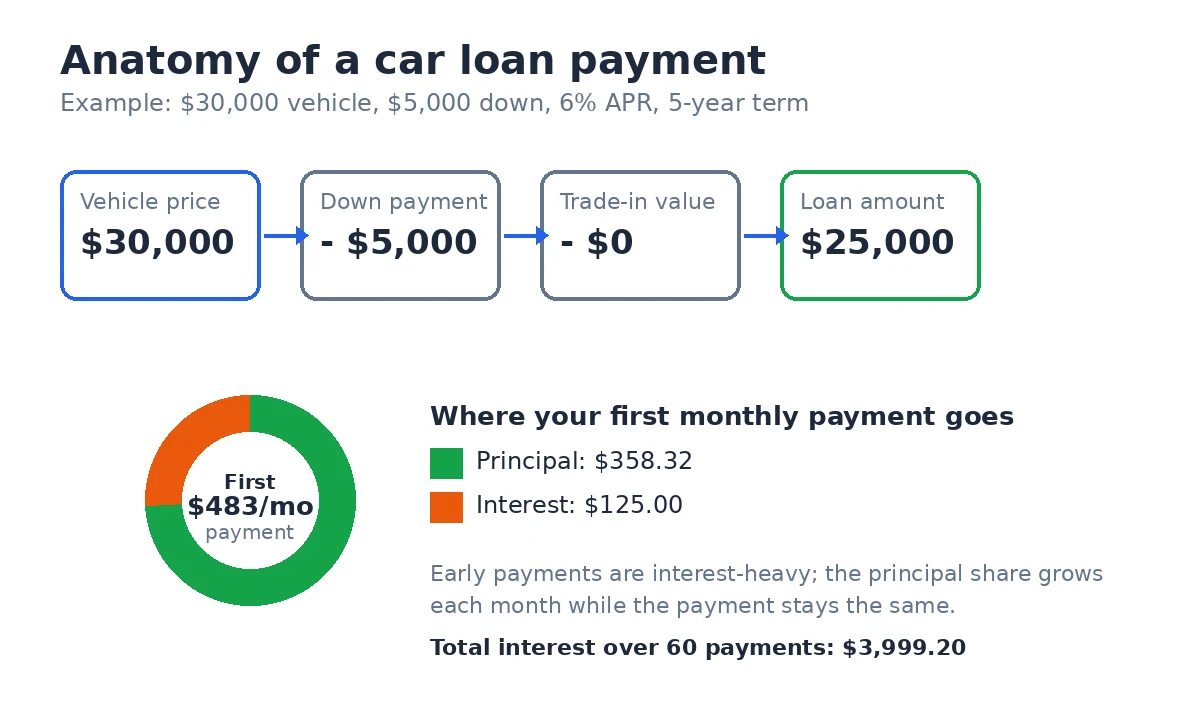
How the loan amount is set and where your first monthly payment goes.
How to use the car loan calculator
- Enter the vehicle price. Use the sticker price or the negotiated price you agreed with the dealer.
- Add your down payment. Cash you pay up front reduces the amount you borrow. Leave it blank if you have none.
- Add your trade-in value. The calculator subtracts it from the price just like a down payment. Defaults to 0.
- Enter the APR the lender quoted you. Defaults to 6%.
- Choose the loan term in years. Defaults to 5. Press Calculate to see your monthly payment, loan amount, total interest and total paid.
The result is the loan payment only — it does not include sales tax, title, registration, dealer fees or insurance, which you pay on top. If you are comparing a car loan with a general personal loan, our loan calculator covers the same math without the down payment and trade-in fields.
How the loan term changes your payment
The loan term is the biggest lever you have. A longer term cuts the monthly payment but stretches the interest over more months, so the total cost rises. Here is the same $25,000 loan at 6% APR across common terms:
| Term | Monthly payment | Total interest |
|---|---|---|
| 3 years | $760.55 | $2,379.74 |
| 4 years | $587.13 | $3,182.03 |
| 5 years | $483.32 | $3,999.20 |
| 6 years | $414.32 | $4,831.20 |
| 7 years | $365.21 | $5,677.96 |
A 3-year term costs $277 more per month than 5 years but saves $1,619 in interest. Stretching to 7 years saves $118 a month versus 5 years but costs $1,679 more in interest — and you risk owing more than the car is worth if it depreciates faster than you repay.
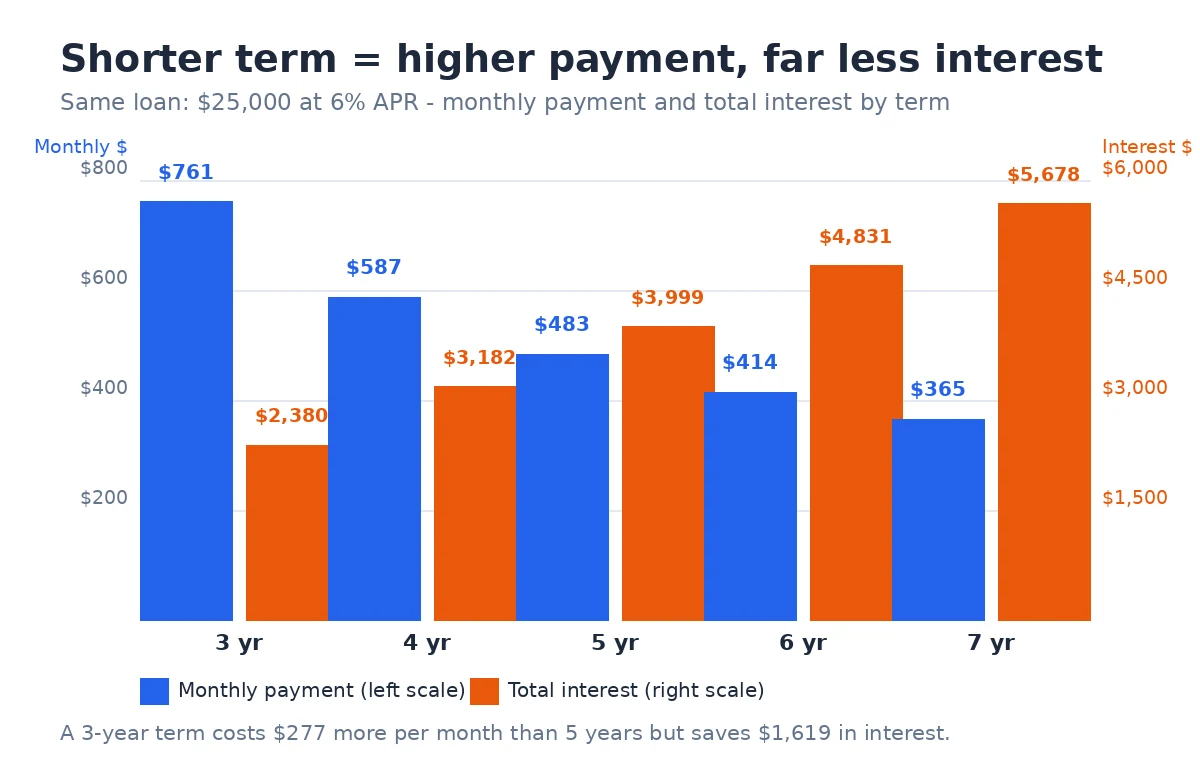
Shorter terms mean a higher payment but far less interest overall.
Where your payment goes: principal vs interest
Every monthly payment is split into two parts: principal, which reduces what you owe, and interest, which is the lender's charge. Early on the balance is high, so interest takes the bigger share; as the balance shrinks, more of each payment goes to principal. Your payment amount never changes — only the mix does.
| Year | Interest paid | Principal paid |
|---|---|---|
| Year 1 | $1,379.76 | $4,420.08 |
| Year 5 | $184.18 | $5,615.66 |
In year one, interest is about 24% of what you pay; by year five it is about 3%. This is why selling or refinancing early in the loan saves less than people expect — most of the interest has already been paid. Home loans work exactly the same way, which our mortgage calculator shows for longer 15- and 30-year terms.
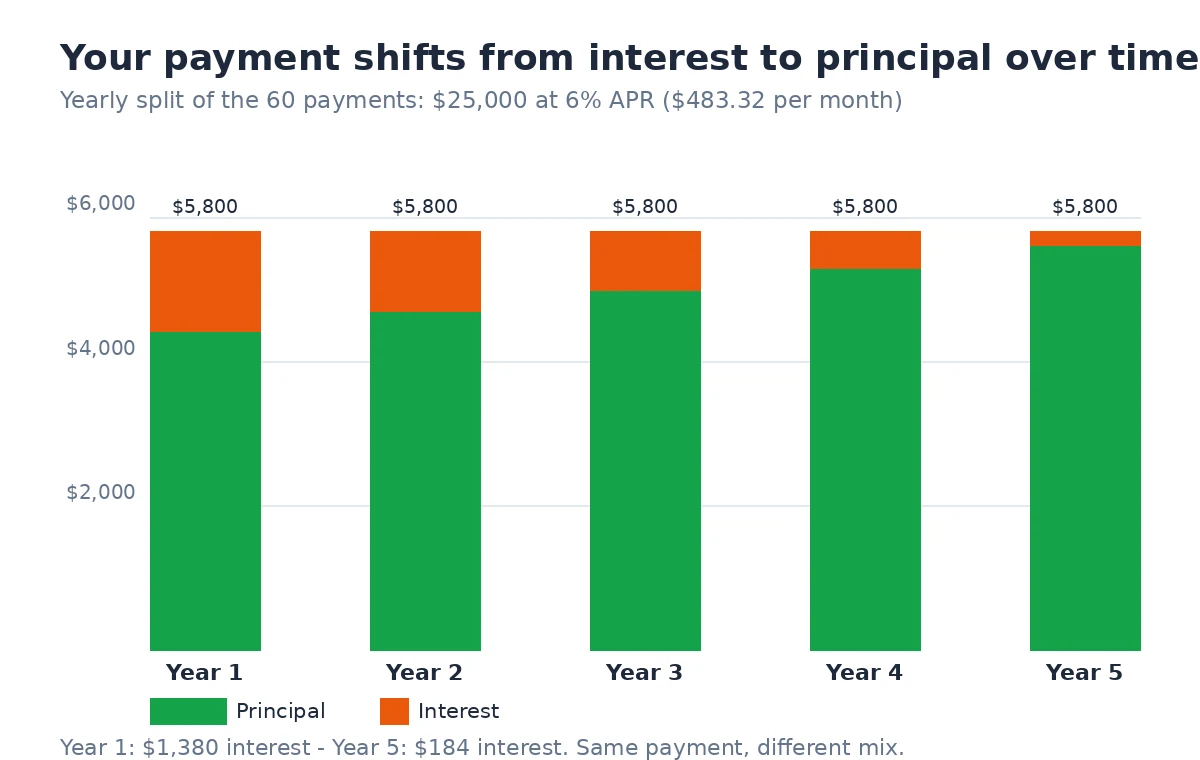
The same $483.32 payment shifts from interest-heavy to principal-heavy over the life of the loan.
Lower your total cost before you sign
Three things move the total cost: the price you negotiate, the down payment, and the APR. A bigger down payment borrows less and is the easiest lever — see what it does to a $30,000 car at 6% APR over 5 years:
| Down payment | Loan amount | Monthly payment | Total interest |
|---|---|---|---|
| $0 | $30,000 | $579.98 | $4,799.04 |
| $2,500 | $27,500 | $531.65 | $4,399.12 |
| $5,000 | $25,000 | $483.32 | $3,999.20 |
| $10,000 | $20,000 | $386.66 | $3,199.36 |
- Negotiate the price first, then talk financing. Every $1,000 off the price saves about $19 a month and $166 in interest on this loan.
- Put more down if you can. A $10,000 down payment instead of $0 saves about $1,600 in interest and keeps you ahead of depreciation.
- Shop the APR. Get quotes from at least two lenders plus the dealer before you sign — a lower APR cuts both the payment and the total interest.
- Avoid stretching past the car's useful life. Seven-year terms are common now, but you may still owe money when major repairs arrive.
For an independent walkthrough of auto loan offers, fees and your rights as a borrower, the Consumer Financial Protection Bureau's auto loans guide is a solid starting point.
Frequently asked questions
How is a monthly car payment calculated?
With the installment loan formula: monthly payment = loan amount x monthly rate / (1 - (1 + monthly rate)^-n), where the loan amount is the vehicle price minus your down payment and trade-in, the monthly rate is APR / 100 / 12, and n is the number of monthly payments. For example, a $25,000 loan at 6% APR over 60 months gives $483.32 per month.
What is a good APR for a car loan?
There is no single good APR — it depends on your credit score, whether the car is new or used, the loan term and the lender. New-car loans usually price lower than used-car loans, and shorter terms usually price lower than longer ones. The practical move is to get written quotes from at least two lenders plus the dealer and compare the APR, not just the monthly payment.
How much down payment should I put on a car?
A widely cited guideline is 20% down for a new car and 10% for a used car, though it is a rule of thumb, not a requirement. A bigger down payment shrinks the loan, lowers the monthly payment and total interest, and protects you from owing more than the car is worth as it depreciates.
Is a longer loan term better?
It lowers the monthly payment but raises the total cost. On a $25,000 loan at 6% APR, stretching from 5 years to 7 years cuts the payment from $483.32 to $365.21 but adds $1,678.76 in interest. Choose the shortest term whose payment fits your budget comfortably.
Does trading in my car lower my monthly payment?
Yes. A trade-in works exactly like a down payment: it is subtracted from the vehicle price before the loan amount is set. A $5,000 trade-in on a $30,000 car cuts the loan to $25,000, which at 6% APR over 5 years lowers the payment from $579.98 to $483.32.
What is the difference between APR and interest rate?
The interest rate is the percentage the lender charges on the balance. The APR (annual percentage rate) is a broader measure that also folds in most lender fees, spread over the loan term. When comparing two offers, the APR is the more honest number because it reflects the true yearly cost of borrowing.
How much car can I afford?
A commonly cited rule of thumb is to keep total car costs — payment, insurance, fuel and maintenance — at or below 15% of your take-home pay, and to avoid a payment that leaves no room for savings. Run your numbers through the calculator with the APR you were actually quoted, not the advertised rate, before you commit.