Auto Lease Calculator: What Will Your Monthly Payment Be?
Leasing math is deliberately confusing — dealers quote money factors instead of interest rates. Enter the vehicle price, residual value, money factor and term, and this free auto lease calculator will translate it all into the one number that matters: your monthly payment.
Formulas verified against standard references. Calculator logic tested with verified worked examples. Last reviewed: October 2026. Our methodology
How a lease payment is calculated
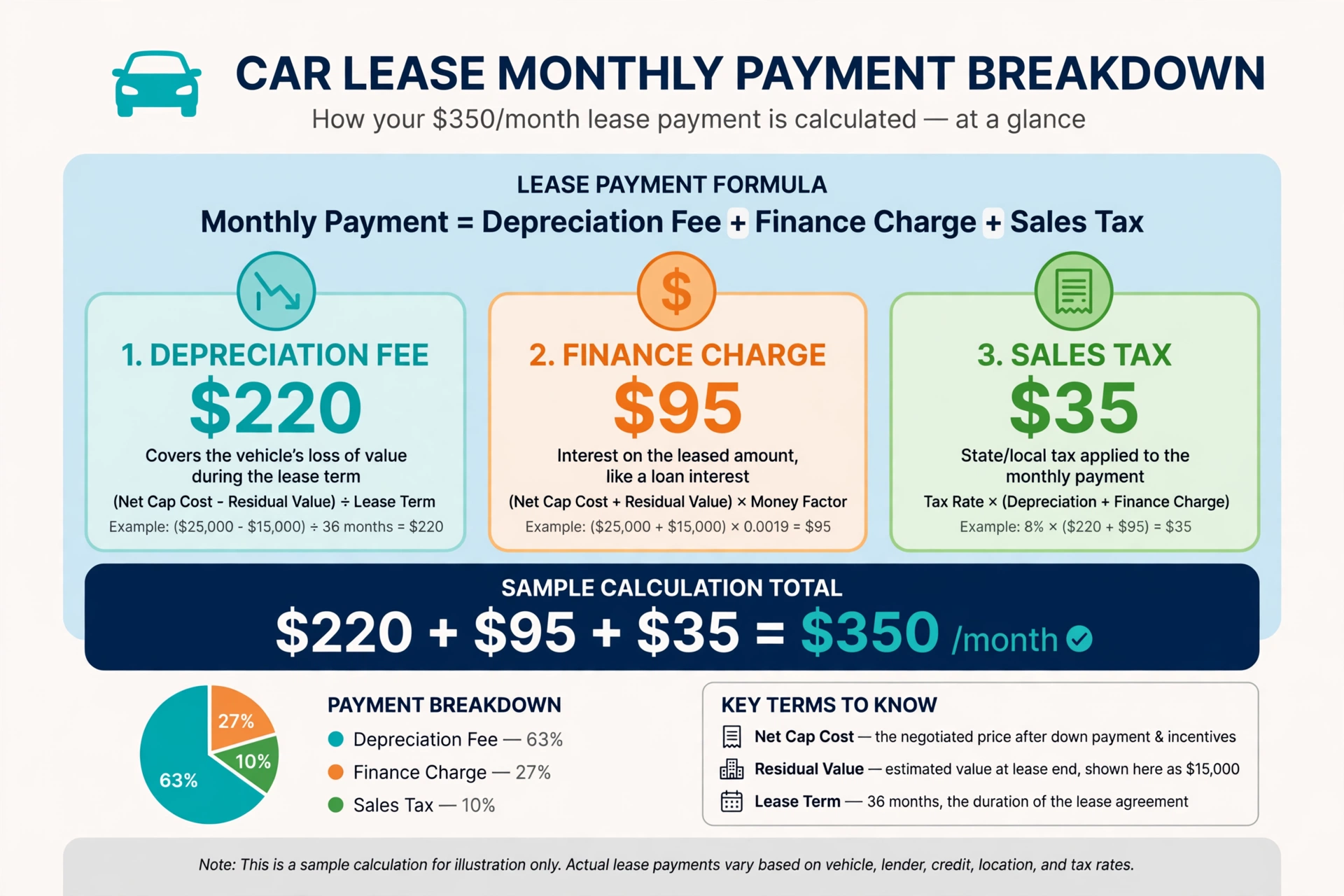
A lease charges you for depreciation plus interest on the money tied up, then adds tax:
- Capitalized cost = price − down payment − trade-in — the amount actually being financed.
- Depreciation fee = (capitalized cost − residual) ÷ term — the value you "use up" each month.
- Finance charge = (capitalized cost + residual) × money factor — interest on the average balance.
- Monthly payment = (depreciation + finance) × (1 + tax rate).
- Money factor × 2,400 ≈ APR — 0.0025 is about 6% interest.
| Lease component | $30,000 car, 36 mo, 60% residual |
|---|---|
| Depreciation fee | $250.00/mo |
| Finance charge | $112.50/mo |
| Before tax | $362.50/mo |
| With 7% tax | $387.88/mo |
The residual is the biggest lever: a 60% residual means you only pay depreciation on 40% of the car. High-residual cars lease cheaply even with high sticker prices.
Worked example
A $30,000 car, $3,000 down, 36-month lease, money factor 0.0025, residual 60%, tax 7%.
Capitalized cost: 30,000 − 3,000 = $27,000. Residual: 30,000 × 0.60 = $18,000. Depreciation: (27,000 − 18,000) ÷ 36 = $250.00. Finance: (27,000 + 18,000) × 0.0025 = $112.50. Monthly before tax: $362.50. With tax: 362.50 × 1.07 = $387.88/month. Total lease cost: 387.88 × 36 + 3,000 = $16,963.68.
How to use the auto lease calculator
Get the four key numbers from the dealer's lease worksheet — price, residual, money factor, term — and verify their payment yourself.
Step by step
- Enter the vehicle price. The negotiated selling price, not MSRP if you haggled lower.
- Enter down payment and trade-in. Both reduce the capitalized cost (experts suggest minimal down on leases).
- Enter the lease term in months. 24–48 are typical; 36 is the sweet spot.
- Enter the money factor. Ask the dealer explicitly — e.g. 0.0025. Multiply by 2,400 to see the APR.
- Enter residual % and tax rate, then press Calculate.
Money factor decoded: the dealer's favorite disguise
Dealers quote money factors because 0.0025 looks smaller than 6%:
| Money factor | ≈ APR | Verdict |
|---|---|---|
| 0.00125 | 3.0% | Excellent — subsidized lease deal |
| 0.00250 | 6.0% | Average market rate |
| 0.00400 | 9.6% | Expensive — negotiate or walk |
Always convert before signing: money factor × 2,400. If the dealer will not disclose the money factor, treat it as a red flag — the finance charge is where padded profit hides. Compare the APR against a car loan calculator to see what buying the same car would cost monthly.
Residual value: why some cars lease for less
The residual — the car's predicted value at lease end — decides how much depreciation you pay for:
- High residual (65%+): you "use" only 35% of the car — payments stay low. Typical of reliable brands with strong resale.
- Low residual (50%): you pay for half the car in 3 years — often cheaper to buy outright.
- Residuals are set by the lender, not the dealer — but dealers can mark up the money factor, so negotiate the price and rate, not the residual.
- Mileage limits (usually 10k–12k/year) protect the residual; excess miles cost $0.15–$0.30 each at turn-in.
This is why a $45,000 car with a 68% residual can lease cheaper than a $35,000 car with a 52% residual. Shop the lease payment, not the sticker.
Lease vs. buy: the honest math
Neither is universally better — it depends on how long you keep cars:
| Lease wins when… | Buy wins when… |
|---|---|
| You want a new car every 3 years | You keep cars 6+ years |
| You drive predictable, low miles | You drive high or unpredictable miles |
| Maintenance-free driving matters | You want no payments eventually |
| Business write-off applies | You want to modify the car |
The break-even is usually around year 4–5: before that, leasing's lower payments win on cash flow; after that, the buyer's paid-off car wins on total cost. Run both scenarios with real numbers before choosing.

Frequently asked questions
How is a car lease payment calculated?
Monthly = [(cap cost − residual) ÷ term + (cap cost + residual) × money factor] × (1 + tax). Cap cost is price minus down payment and trade-in; residual is the end-of-lease value.
What is a money factor?
The lease's interest rate in disguise. Multiply by 2,400 to get the approximate APR: 0.0025 ≈ 6%. Always convert before comparing deals.
What is a good money factor?
Around 0.00125–0.00250 (3–6% APR) is competitive; subsidized manufacturer deals go lower. Above 0.00350 (~8.4%) is expensive — negotiate or consider buying.
What does residual value mean?
The car's predicted value when the lease ends, set by the lender as a % of MSRP. Higher residual = less depreciation you pay for = lower monthly payment.
Is it better to lease or buy a car?
Lease if you want a new car every ~3 years with low payments and drive predictable miles. Buy if you keep cars 6+ years — the paid-off years make buying cheaper long-term.
Should I put money down on a lease?
Ideally minimal. A big down payment only pre-pays depreciation — if the car is totaled, gap insurance covers the lender, not your down payment. Keep cash and accept the slightly higher monthly.
What happens at the end of a car lease?
Return the car (paying excess-mileage and wear charges), buy it for the residual value, or trade it toward a new lease. Check the car's market value first — buying out a lease can be a bargain if the car held value.