Credit Card Payoff Calculator: Find Your Debt-Free Date
Enter your balance, APR and monthly payment to see how many months it takes to become debt-free, how much interest you will pay in total, and your projected payoff date.
Formula
Monthly rate = APR ÷ 100 ÷ 12. Each month the card adds an interest charge of balance × monthly rate, then your payment is subtracted: new balance = balance + interest − payment. This repeats until the balance reaches zero. Total interest = total paid − starting balance, and the debt-free date is today plus the number of months. The last payment is usually smaller than the rest, because you only owe what is left.
Worked example
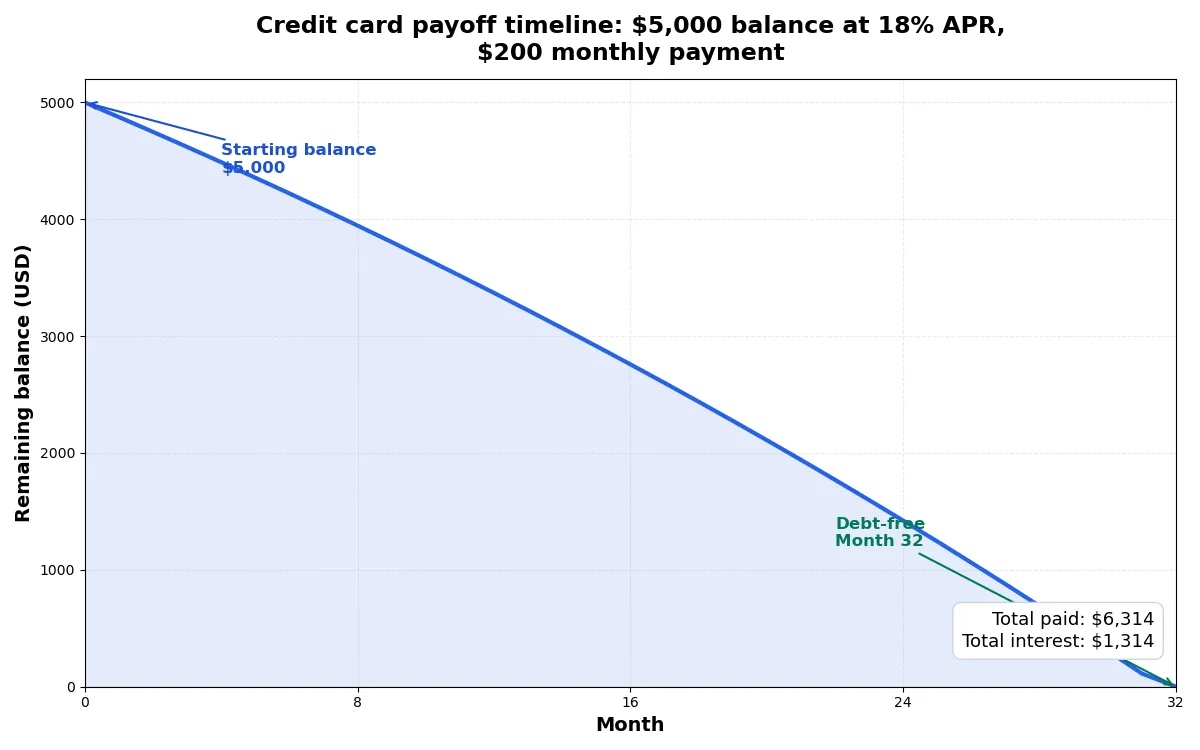
A $5,000 balance at 18% APR with $200 monthly payments: the monthly rate is 18 ÷ 100 ÷ 12 = 1.5%. In month 1 the interest charge is $5,000 × 0.015 = $75.00, so $125.00 of the $200 payment reduces the balance, leaving $4,875.00. Repeating this for 32 months clears the balance. Total paid = $6,313.96, total interest = $1,313.96, and the debt-free date lands about 2 years and 8 months out.
How to use the credit card payoff calculator
A credit card payoff calculator turns three numbers from your statement — the balance, the APR and what you pay each month — into a payoff plan: how long the debt lasts, what it costs in interest, and the month you become debt-free.
Step by step
- Enter your current balance in dollars, exactly as shown on your statement.
- Enter your APR. The field starts at 19.99%; replace it with your card's exact rate.
- Enter your monthly payment — what you actually pay, not the minimum due.
- Press Calculate. The result appears below the form.
What you get
- Time to pay off, in months and years
- Debt-free date, the calendar month the balance hits zero
- Total interest, what the debt costs you beyond the balance
- Total paid, balance plus interest
Reading the timeline
The balance falls fastest near the end. Early on, a large slice of each payment covers interest — in month 1 of the example above, $75 of the $200 payment is interest. As the balance shrinks, the interest charge shrinks with it, and more of each payment attacks the principal. That is why the payoff curve bends downward instead of falling in a straight line.
What raising your monthly payment saves you
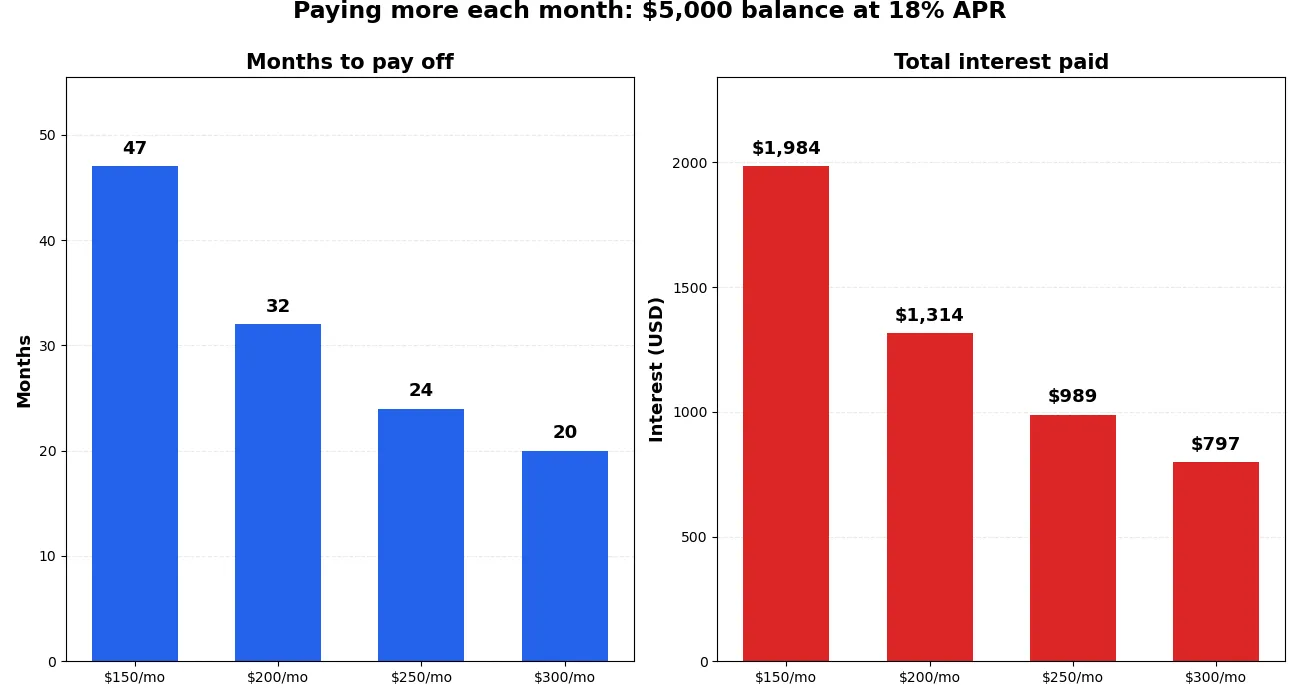
Every extra dollar you pay above the interest charge shortens the payoff, and a shorter payoff means fewer months of interest charges. On a $5,000 balance at 18% APR, doubling the payment from $150 to $300 a month cuts the payoff time from 47 months to 20 months and saves about $1,186 in interest.
| Monthly payment | Months to pay off | Total interest | Total paid |
|---|---|---|---|
| $150 | 47 | $1,983.60 | $6,983.60 |
| $200 | 32 | $1,313.96 | $6,313.96 |
| $250 | 24 | $989.13 | $5,989.13 |
| $300 | 20 | $797.17 | $5,797.17 |
Why the savings are so large
Interest is charged on the remaining balance every month, so a bigger payment does double duty: it reduces the balance directly and shrinks every future interest charge. Moving from $150 to $200 a month saves about $670 in interest; moving from $200 to $250 saves another $325. Even a $50 increase is worth testing in the calculator above.
The same principal-and-interest math applies to fixed-term borrowing too — our loan calculator breaks down each payment of a loan with a set end date.
How your APR changes the total cost
The APR sets the monthly interest rate, so it controls how much of each payment is eaten by interest before it touches the balance. On a $5,000 balance with $200 monthly payments, moving from 15% to 24% APR adds five months and nearly $968 in interest.
| APR | Months to pay off | Total interest | Total paid |
|---|---|---|---|
| 15% | 31 | $1,032.66 | $6,032.66 |
| 18% | 32 | $1,313.96 | $6,313.96 |
| 21% | 34 | $1,633.20 | $6,633.20 |
| 24% | 36 | $2,000.56 | $7,000.56 |
Where the interest goes
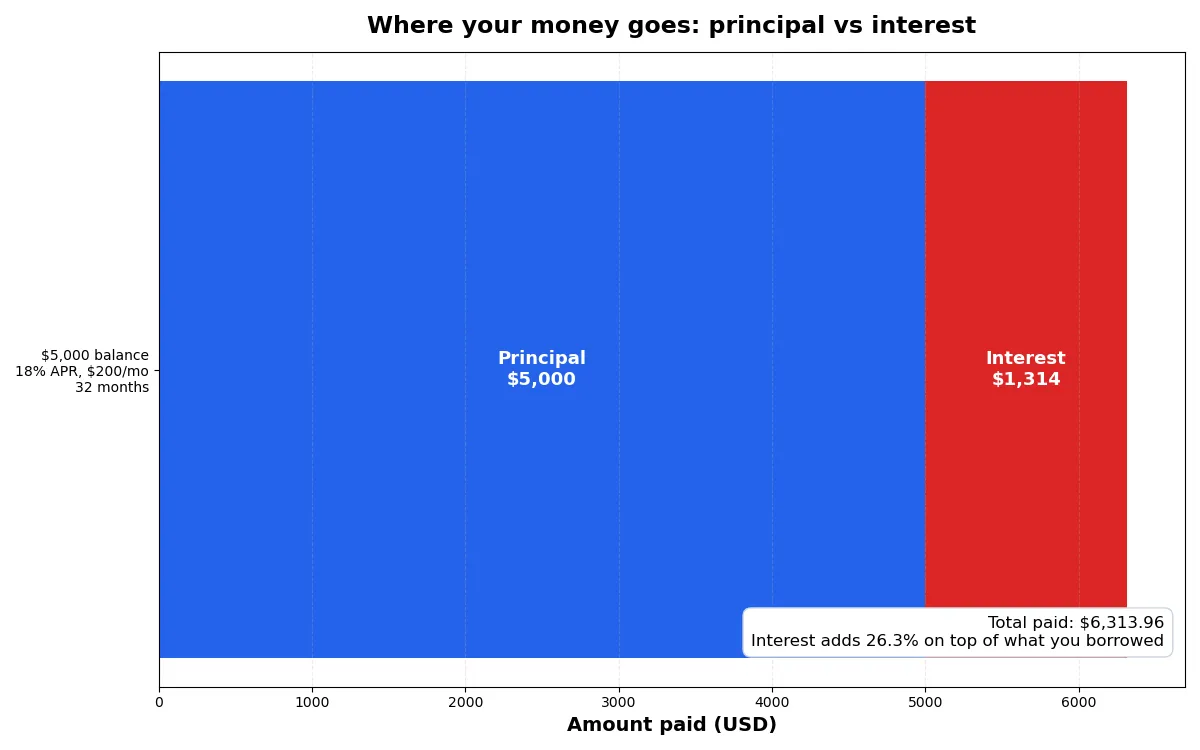
At 18% APR the $6,314 total splits into $5,000 of principal and $1,314 of interest — the interest alone adds 26.3% on top of the original balance. A lower APR leaves more of each payment for the principal, which is why a lower-rate card can matter as much as paying extra each month.
The minimum-payment trap
Minimum payments are designed to keep the account current, not to clear the debt quickly. On a $5,000 balance at 18% APR, paying just $125 a month takes 62 months and costs $2,693.11 in interest. Paying $200 a month instead clears the same balance in 32 months with $1,313.96 of interest: 30 fewer months and $1,379 less interest.
The trap is arithmetic. The first month's interest on that balance is $75, so a $125 payment only reduces the balance by $50. More than half the payoff time is spent chipping away at a balance that barely moves. The Consumer Financial Protection Bureau lists making only the minimum payment among the credit mistakes that cost consumers money.
Breaking out of it
Pay the minimum as a floor, never as a plan. Pick a fixed amount above the minimum and pay it every month — the calculator above shows exactly what that fixed amount buys you in months and dollars. If you carry balances on several cards, our debt payoff calculator compares strategies for tackling them together.
Frequently asked questions
How does this credit card payoff calculator work?
Enter your current balance, APR and the amount you pay each month. The calculator applies the monthly interest rate (APR divided by 12), subtracts your payment, and repeats month by month until the balance reaches zero. It then reports the number of months, your debt-free date, total interest and total paid.
What happens if my monthly payment does not cover the interest?
Then the balance grows instead of shrinking, and you would never pay it off. For example, the monthly interest on a $5,000 balance at 18% APR is $75 — a $75 payment only treads water, and anything less lets the balance climb. The calculator shows a warning and asks for a larger payment.
Should I pay more than the minimum payment?
If you can afford to, yes. On a $5,000 balance at 18% APR, paying $200 a month clears the debt in 32 months with $1,313.96 of interest, while $125 a month takes 62 months and costs $2,693.11 in interest — more than twice the interest for $75 extra a month.
Why does the calculator assume I will not add new charges?
Because new purchases restart the interest clock on the added amount. The projection only holds if the balance only moves down. If you keep using the card, treat the result as a best case and run the numbers again with a higher starting balance.
Does the result include fees or penalty APRs?
No. The calculator assumes a fixed APR, no annual fees, no late fees and no penalty rate. Fees and a penalty APR both slow the payoff, so the real timeline can be longer. Check your card agreement for the exact terms.
Which card should I pay off first if I have several?
A common approach is to direct extra payments at the highest-APR balance first while paying minimums on the rest, since that balance generates the most interest per dollar of debt. Whichever card you target, keep every account current to avoid late fees.
How accurate is the payoff date?
It is a close estimate, not a promise. Real cards use daily balance calculations and grace periods, while this calculator compounds monthly. The month count usually lands within one month of a daily-balance calculation, which is why the date is shown as a month and year rather than an exact day.
Related calculators

Debt Payoff Calculator
Compare payoff strategies when you carry balances on more than one card.
Use calculatorLoan Calculator
Break down a fixed-term loan into principal and interest per payment.
Use calculatorCompound Interest Calculator
See how savings grow when interest compounds over time.
Use calculator