Student Loan Calculator: Monthly Payment and Payoff Time
Student loans amortize like any other loan — fixed monthly payments, with interest charged on the remaining balance. Enter your loan amount, rate and term, plus any extra you can pay each month, to see your monthly payment, total interest, and exactly how much faster extra payments get you debt-free.
Formulas verified against standard references. Calculator logic tested with verified worked examples. Last reviewed: October 2026. Our methodology
How student loan payments are calculated
A student loan is an amortized loan: you pay the same amount every month, sized so the balance reaches exactly zero on the final payment. Each payment covers that month's interest first; the rest reduces the principal.
M = P × r(1 + r)n ÷ ((1 + r)n − 1)
| Symbol | Meaning |
|---|---|
| M | Monthly payment (principal + interest) |
| P | Loan amount — what you borrowed |
| r | Monthly interest rate = annual rate ÷ 12 ÷ 100 |
| n | Total monthly payments = years × 12 |
Total interest is (M × n) − P. Extra payments are simulated month by month: each extra dollar goes straight to principal, which shrinks the balance that future interest is charged on — so the payoff shortens and the interest bill drops.
Worked example
Borrow $35,000 at 5.5% APR on a 10-year term:
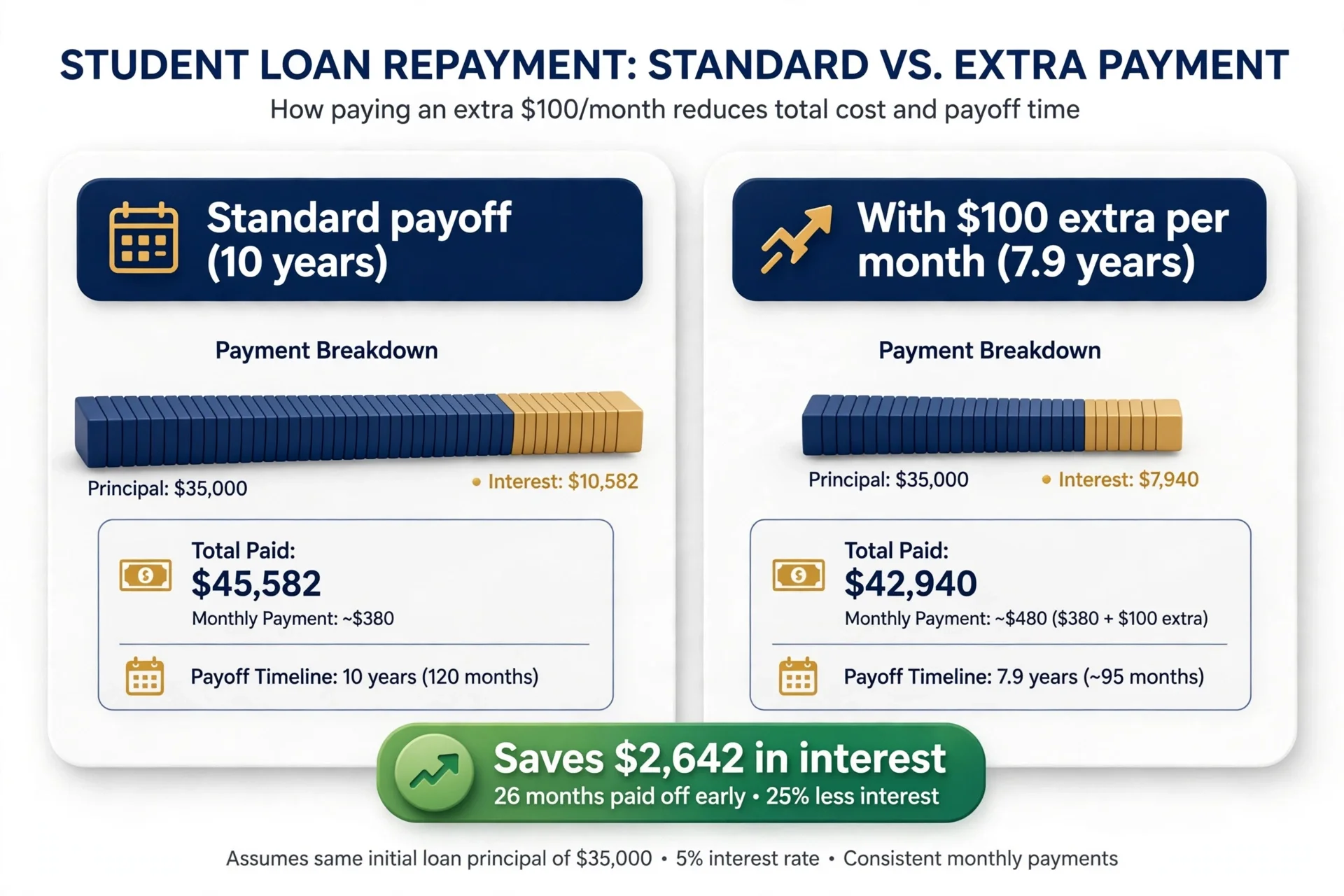
r = 5.5 ÷ 12 ÷ 100 = 0.0045833, n = 120 → M = $379.84/month. Total paid = $45,581.04, so total interest = $10,581.04. Add $100 extra per month ($479.84 total) and the loan is gone in 89 months (7 years, 5 months) — 31 months early. Total paid drops to $42,700.56 and interest to $7,700.56, a saving of $2,880.48 in interest alone.
How to use the student loan calculator
Find the three core numbers on your loan statement or award letter, then experiment with the extra-payment field.
Step by step
- Enter the loan amount. The principal you borrowed (or still owe).
- Enter the annual interest rate. Use the rate on your statement, as a percentage.
- Enter the loan term in years. 10 is the federal standard repayment term.
- Add an extra monthly payment (optional). Any amount you could pay above the minimum — even $50 matters.
- Press Calculate. Compare the standard schedule against the extra-payment schedule.

How student loan repayment works
Federal student loans enter repayment after a 6-month grace period following graduation (or dropping below half-time enrollment). The default Standard Repayment Plan spreads the balance over up to 10 years of fixed payments — the fastest standard way out, and the one with the least total interest.
Private loans follow their own terms but amortize the same way: fixed payments, interest on the balance, principal shrinking over time. Longer terms (15–25 years) cut the monthly payment but can more than double the interest — which is exactly what the calculator's comparison table is for.
Carrying balances on more than one loan — student loans plus cards or a car note? The debt payoff calculator compares payoff strategies across all of them so your extra dollars attack the most expensive debt first.
Why extra payments work so well
An extra payment does something your regular payment cannot: it bypasses interest entirely and lands directly on principal. Because next month's interest is charged on the new, lower balance, one extra dollar today keeps saving you a little interest every month until the loan ends.
| $35,000 at 5.5%, 10 years | Extra/month | Payoff | Interest |
|---|---|---|---|
| Standard schedule | $0 | 10 years | $10,581 |
| With extra payments | $100 | 7 years 5 months | $7,701 |
| With extra payments | $200 | 5 years 11 months | $6,067 |
The pattern holds at any scale: doubling the extra payment roughly doubles the interest saved. Need just the monthly figure for any loan? The loan EMI calculator computes it from amount, rate and term in one step.
Federal loans: plans worth knowing
Beyond the standard 10-year plan, federal borrowers have options — each a trade-off between monthly payment and total interest:
- Graduated plan: payments start low and rise every two years; you pay more interest overall.
- Extended plan: stretches repayment up to 25 years for larger balances; much more interest.
- Income-driven plans: payments tied to income and family size, with forgiveness after 20–25 years — but interest keeps accruing.
Refinancing with a private lender can lower your rate, but it permanently gives up federal protections (income-driven plans, deferment, forgiveness). Run the numbers here first, then confirm current plan terms at Federal Student Aid, the official US source for federal loan repayment.
Frequently asked questions
How is my student loan monthly payment calculated?
With the standard amortization formula M = P × r(1 + r)n ÷ ((1 + r)n − 1), where P is the loan amount, r is the monthly interest rate, and n is the number of payments. The payment is sized so the balance reaches zero on the final payment.
How much interest will I pay on $35,000 at 5.5% for 10 years?
About $10,581 in interest. The monthly payment is $379.84, so 120 payments total $45,581.04, and $45,581.04 minus the $35,000 borrowed is $10,581.04 in interest.
Do extra payments really shorten my student loan payoff?
Yes. On a $35,000 loan at 5.5% for 10 years, paying $100 extra per month finishes the loan in 89 months instead of 120 — nearly 2.5 years early — and saves about $2,880 in interest, because extra dollars go straight to principal.
What is the standard repayment plan for student loans?
For US federal loans, the Standard Repayment Plan uses fixed monthly payments over up to 10 years. It pays the loan off fastest among the standard options and charges the least total interest.
Should I pay interest on my student loans while in school?
If you can, yes. On unsubsidized loans, unpaid interest capitalizes — it is added to the principal — so you end up paying interest on interest. Paying interest during school keeps the balance from growing.
What happens if I miss a student loan payment?
You may owe late fees, and the missed payment can be reported to credit bureaus once it is 90 days past due on federal loans. Continued non-payment can lead to default. Contact your servicer early — deferment or an income-driven plan may be available.
Can I refinance my student loans?
Private lenders offer refinancing that can lower your rate, but refinancing federal loans privately permanently gives up federal protections such as income-driven repayment, deferment, and forgiveness programs. Compare the trade-off with this calculator first.