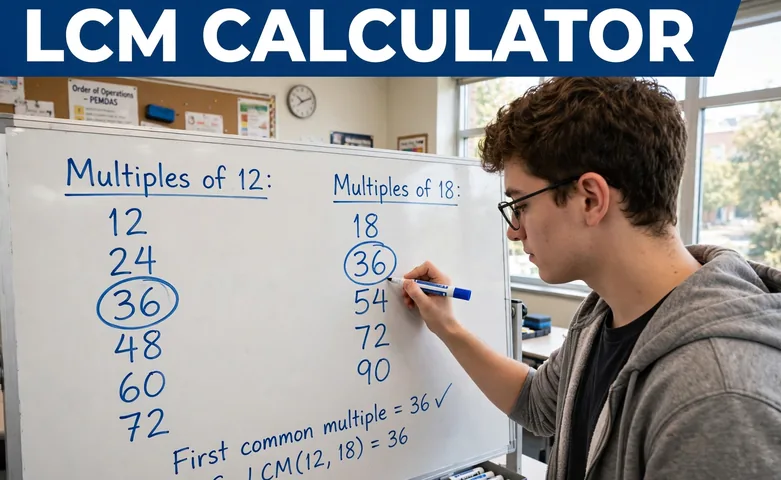
The listing method is the most direct. Write out the multiples of each number until one appears in both lists. It works well for small numbers, and it shows what the LCM means, but it gets slow when the numbers are large.
The prime factorization method works for any size. Break each number into primes, take the highest power of each prime that appears, and multiply them. For 12 and 18, that is 2 squared x 3 squared = 36. This is the method the calculator shows in its steps.
The GCF method is the fastest for two numbers. Find the GCF with the Euclidean algorithm, then divide the product of the numbers by it. For three or more numbers, find the LCM two at a time. The LCM of 12, 18 and 24 is the LCM of 36 and 24, which is 72. Check it by prime factors. 36 = 2 squared x 3 squared and 24 = 2 cubed x 3, so the highest powers give 2 cubed x 3 squared = 8 x 9 = 72. Our fraction calculator uses the LCM to find a common denominator when you add fractions.