Prime Factorization Calculator
Break any whole number into its prime building blocks with this prime factorization calculator. Type a number and press Calculate to see its prime factors in exponent form and expanded form, with every division step shown. One common mix-up is worth clearing up. Our Prime Number Calculator answers whether a number is prime. This tool answers a different question, which primes multiply together to make the number. The prime checker says 60 is not prime. This calculator says 60 = 2^2 x 3 x 5. If you only want to test whether a number is prime, use our Prime Number Calculator. Free, no sign-up, and everything runs in your browser.

Formulas verified against standard references. Calculator logic tested with verified worked examples. Published: November 4, 2026 | Last updated: November 4, 2026. Our methodology
How to Use the Prime Factorization Calculator
- Type the whole number you want to factor. Any number from 2 to 999,999,999,999 works.
- Press Calculate, or just press Enter. The answer appears first, followed by the supporting numbers and the step-by-step division.
- Read the exponent form first, then the expanded form, the factor counts, and the divisor count below it.
- Press Reset to clear the form and try another number.
What Is Prime Factorization?
Prime factorization breaks a whole number into the prime numbers that multiply together to make it. A prime is a whole number greater than 1 whose only divisors are 1 and itself. The primes start 2, 3, 5, 7, 11, and continue without end. The number 2 is the only even prime, because every larger even number is divisible by 2. The prime factorization of 60 is 2^2 x 3 x 5, because 2 x 2 x 3 x 5 = 60. Every whole number greater than 1 has exactly one prime factorization, apart from the order of the factors, so 60 always breaks into the same primes no matter which method you use.
How to Read the Answer
The calculator shows the same answer three ways.
Exponent Form vs Expanded Form vs CSV
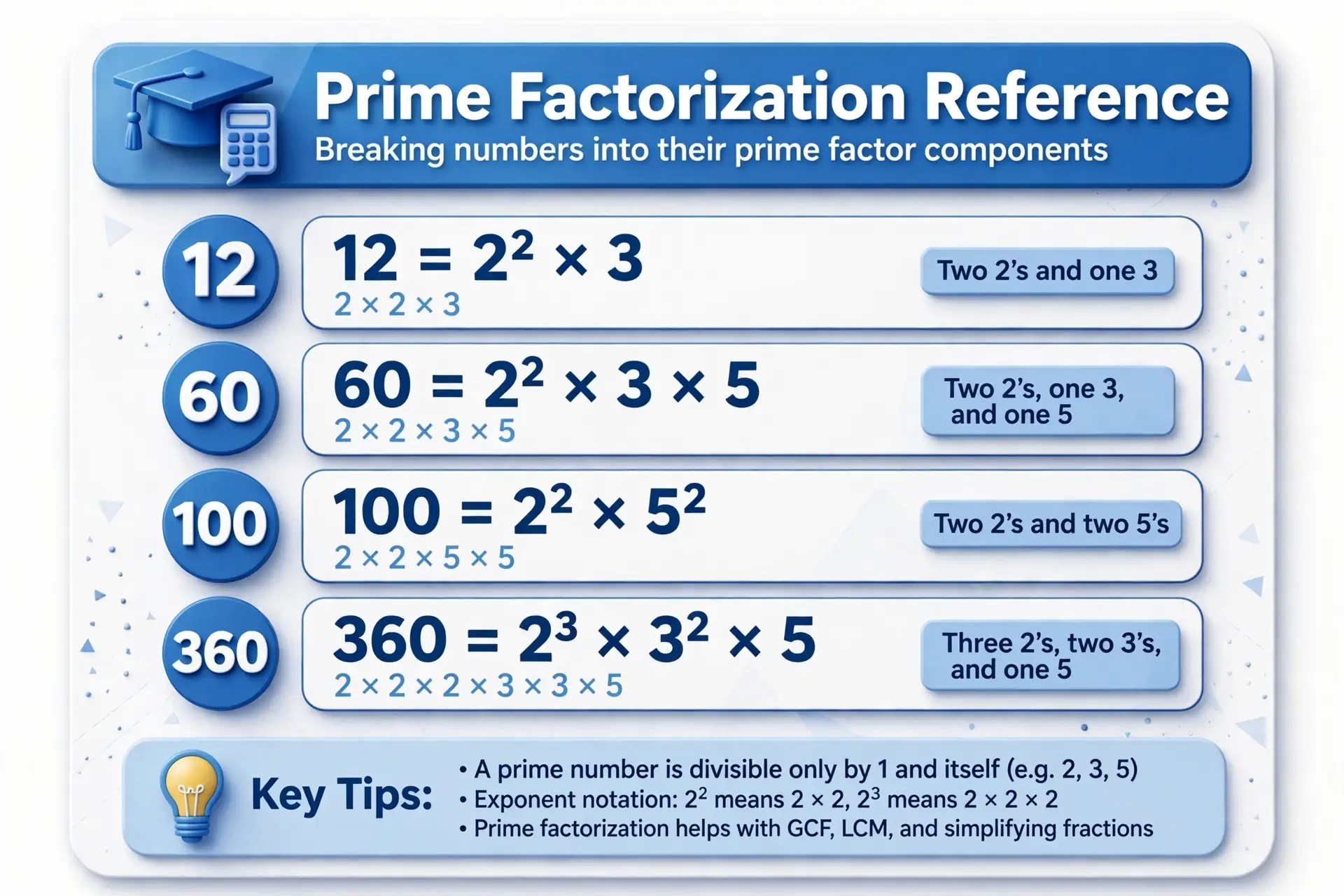
Exponent form groups repeated primes as powers. For 360 the answer is 2^3 x 3^2 x 5. The exponent counts how many times each prime appears, so 2^3 means 2 x 2 x 2 = 8 and 3^2 means 3 x 3 = 9, which gives 8 x 9 x 5 = 360. Expanded form lists every prime on its own, so 360 becomes 2 x 2 x 2 x 3 x 3 x 5. The CSV form is the same list with commas, 2, 2, 2, 3, 3, 5, which is handy for pasting into a spreadsheet. Under the forms you also get the distinct prime factors, the total count with multiplicity, whether the number is prime, and how many divisors the number has.
Method 1: The Factor Tree
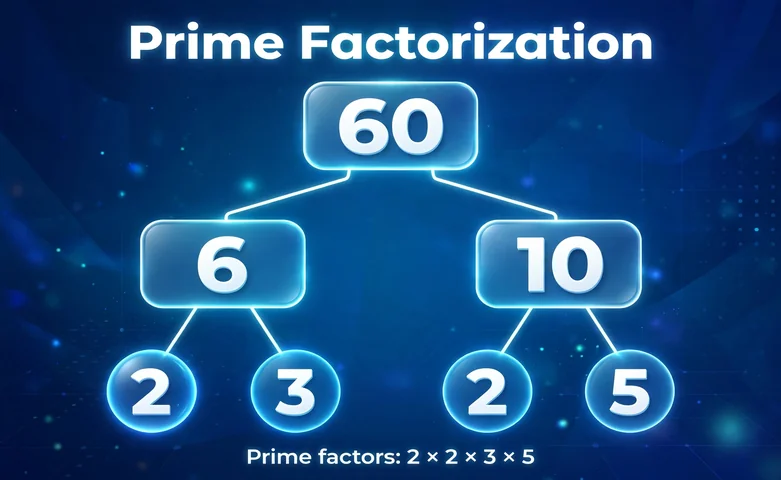
A factor tree splits a number into any two factors, then splits each composite factor again, and keeps going until only primes remain. For 60, split 60 into 6 x 10. Then split 6 into 2 x 3 and 10 into 2 x 5. The primes at the ends are 2, 2, 3, and 5, so 60 = 2^2 x 3 x 5. Any valid tree gives the same primes. If you start 60 as 4 x 15 instead, the 4 gives 2 x 2 and the 15 gives 3 x 5, which is the same set of primes in a different order.
Method 2: Trial Division (Ladder Method)
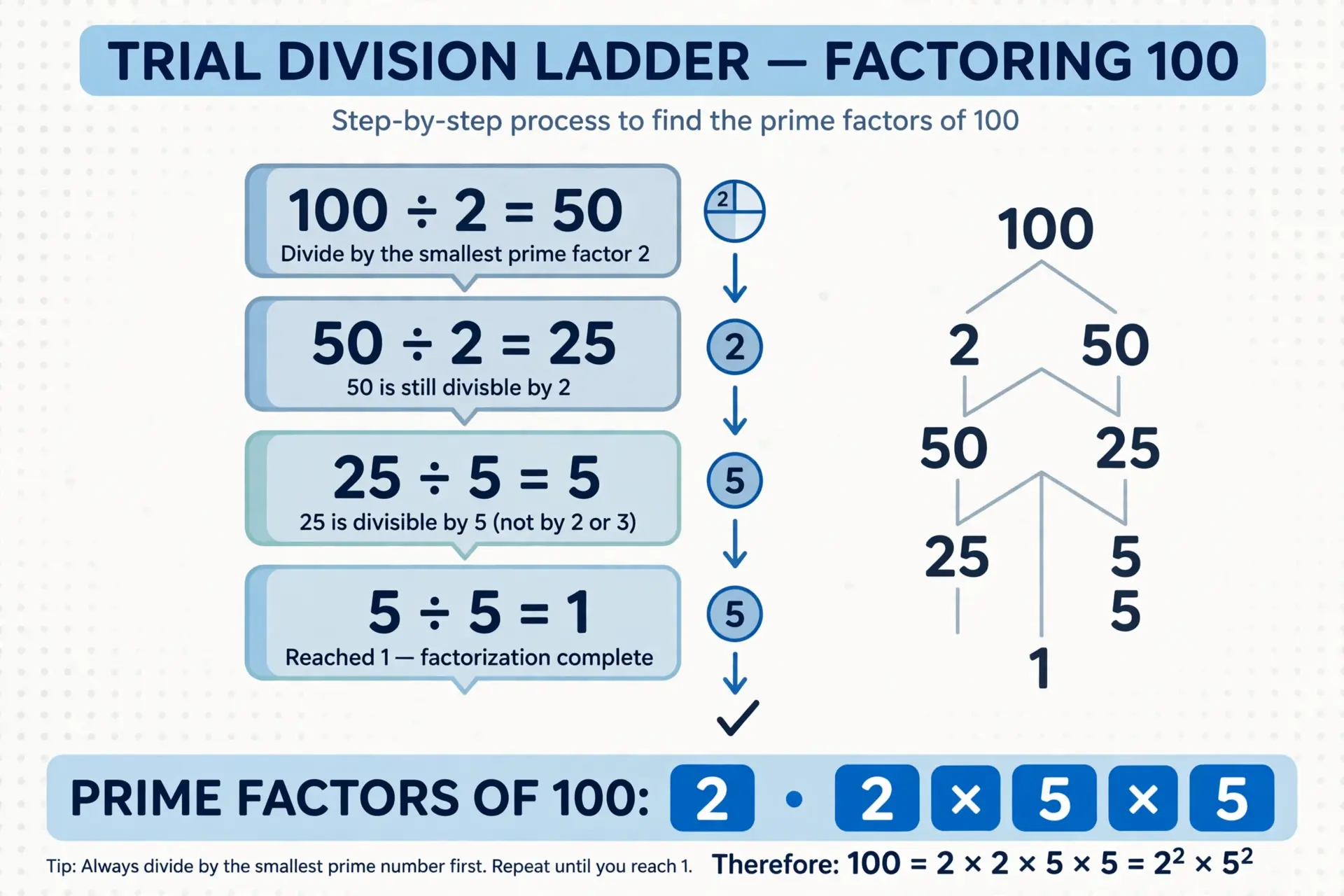
This is the method the calculator uses. Start with the smallest prime, 2, and divide it out as many times as it fits. Then move to the next candidate and repeat. For 100 the ladder looks like this. 100 / 2 = 50, 50 / 2 = 25, 25 / 5 = 5, 5 / 5 = 1. The divisors used were 2, 2, 5, and 5, so 100 = 2^2 x 5^2. Trial division only needs to test divisors up to the square root of the current remainder, because any factor larger than the square root would already have a smaller partner that was found earlier. When nothing divides the remainder, the remainder itself is prime.
The Fundamental Theorem of Arithmetic
Every whole number greater than 1 has exactly one prime factorization, apart from the order of the factors. This is the Fundamental Theorem of Arithmetic. It is the reason the factor tree and the ladder always agree with each other. It also makes the factorization a fingerprint of the number, because two numbers are equal exactly when their factorizations match.
From Factors to Divisors
Once you have the factorization, several useful counts follow without listing every divisor.
Counting Divisors
Each divisor is built by choosing an exponent for each prime, from 0 up to the exponent in the factorization. So the number of divisors is the product of (exponent + 1) over every prime. For 60 = 2^2 x 3 x 5, that is (2+1)(1+1)(1+1) = 12 divisors. They are 1, 2, 3, 4, 5, 6, 10, 12, 15, 20, 30, and 60.
Euler's Totient
Euler's totient, written phi(n), counts how many integers from 1 to n share no common factor with n. From the factorization it equals the product of p^(a-1) x (p-1) for each prime. For 360 = 2^3 x 3^2 x 5, that gives 2^2 x (2-1) x 3 x (3-1) x (5-1) = 4 x 1 x 3 x 2 x 4 = 96. So 96 of the integers from 1 to 360 are coprime to 360.
Why Prime Factorization Matters
Factorization is the master key for working with whole numbers. To simplify a fraction, divide the top and bottom by their greatest common divisor, which you can read straight from the factorizations. To add fractions with different denominators, you need the least common multiple, which comes from the same source. Our LCM and GCD calculator turns both of those jobs into one step. The same idea protects most encrypted web traffic. RSA cryptography multiplies two large primes to make a key, and its security rests on the fact that factoring the product back apart is extremely hard.
Prime Factorization Reference Table
A quick lookup for the numbers people factor most often.
| Number | Prime factorization |
|---|---|
| 12 | 22 x 3 |
| 18 | 2 x 32 |
| 24 | 23 x 3 |
| 36 | 22 x 32 |
| 48 | 24 x 3 |
| 60 | 22 x 3 x 5 |
| 100 | 22 x 52 |
| 120 | 23 x 3 x 5 |
| 180 | 22 x 32 x 5 |
| 210 | 2 x 3 x 5 x 7 |
| 360 | 23 x 32 x 5 |
Frequently asked questions
What is prime factorization?
Prime factorization breaks a whole number into the prime numbers that multiply together to make it. A prime is a whole number greater than 1 whose only divisors are 1 and itself, like 2, 3, or 5. For example, 60 equals 2^2 x 3 x 5, because 2 x 2 x 3 x 5 = 60.
What is the prime factorization of 60?
60 = 2^2 x 3 x 5. Divide out 2 twice, so 60 becomes 30 and then 15. Then divide out 3 once, which leaves 5, and 5 is prime. In expanded form that is 2 x 2 x 3 x 5, and multiplying them gives 60 back.
What is the difference between prime factorization and checking if a number is prime?
Primality testing answers a yes or no question, which is whether a number is prime. Factorization answers a which question, which prime numbers multiply together to make the number. The prime checker says 60 is not prime, while this calculator says 60 = 2^2 x 3 x 5. For the yes or no question, use the Prime Number Calculator.
How do you make a factor tree?
Split the number into any two factors, then split each composite factor again, and keep going until only primes remain. For 60, write 6 x 10, then 2 x 3 under the 6 and 2 x 5 under the 10. The end primes 2, 2, 3, and 5 are the factorization. Any valid tree gives the same primes.
What is the Fundamental Theorem of Arithmetic?
It states that every whole number greater than 1 has exactly one prime factorization, apart from the order of the factors. Because of this uniqueness, the factor tree and the ladder method always produce the same primes for the same number. The factorization works as a fingerprint, since two numbers are equal exactly when their factorizations match.
How do you find the number of divisors from a prime factorization?
Multiply (exponent + 1) for every prime in the factorization. For 60 = 2^2 x 3 x 5, the count is (2+1)(1+1)(1+1) = 12 divisors. This works because each divisor independently picks an exponent from 0 up to the prime's maximum exponent.
What is Euler's totient function?
It counts the integers from 1 to n that share no common factor with n, and it is written phi(n). From the factorization, it equals the product of p^(a-1) x (p-1) for each prime. For 360, phi(360) = 96, so 96 integers from 1 to 360 are coprime to 360.
Can 1 or 0 be prime factorized?
No. The number 1 has no prime factors at all, and it is neither prime nor composite. The number 0 is divisible by every integer, so it has no finite prime factorization. Prime factorization is defined only for whole numbers of 2 and above, which is why the calculator rejects 0 and 1.
Related calculators

Prime Number Calculator
Check whether any whole number is prime, with the smallest divisor shown.
Use calculatorLCM and GCD Calculator
Find the least common multiple and greatest common divisor of two numbers.
Use calculatorExponent Calculator
Raise any base to any exponent, with steps.
Use calculatorModulo Calculator
Remainder of any division, with full working steps.
Use calculatorFraction Calculator
Add, subtract, multiply, and divide fractions.
Use calculatorRounding Calculator
Round to tens, ones, tenths, or significant figures.
Use calculatorBinary Converter
Convert between binary, decimal, octal, and hex.
Use calculatorScientific Notation Converter
Standard form to scientific notation and back.
Use calculatorPercentage Calculator
Find P percent of any number, with steps.
Use calculatorDecimal to Fraction Converter
Turn decimals into simplified fractions, with steps.
Use calculator