Decimal to Fraction Converter: Exact Fractions Instantly
Enter a decimal and get its simplified fraction, its mixed number when it is larger than 1, and the divisor used to simplify it.
Formulas verified against standard references. Calculator logic tested with verified worked examples. Last reviewed: October 2026. Our methodology
How Decimal to Fraction Conversion Works
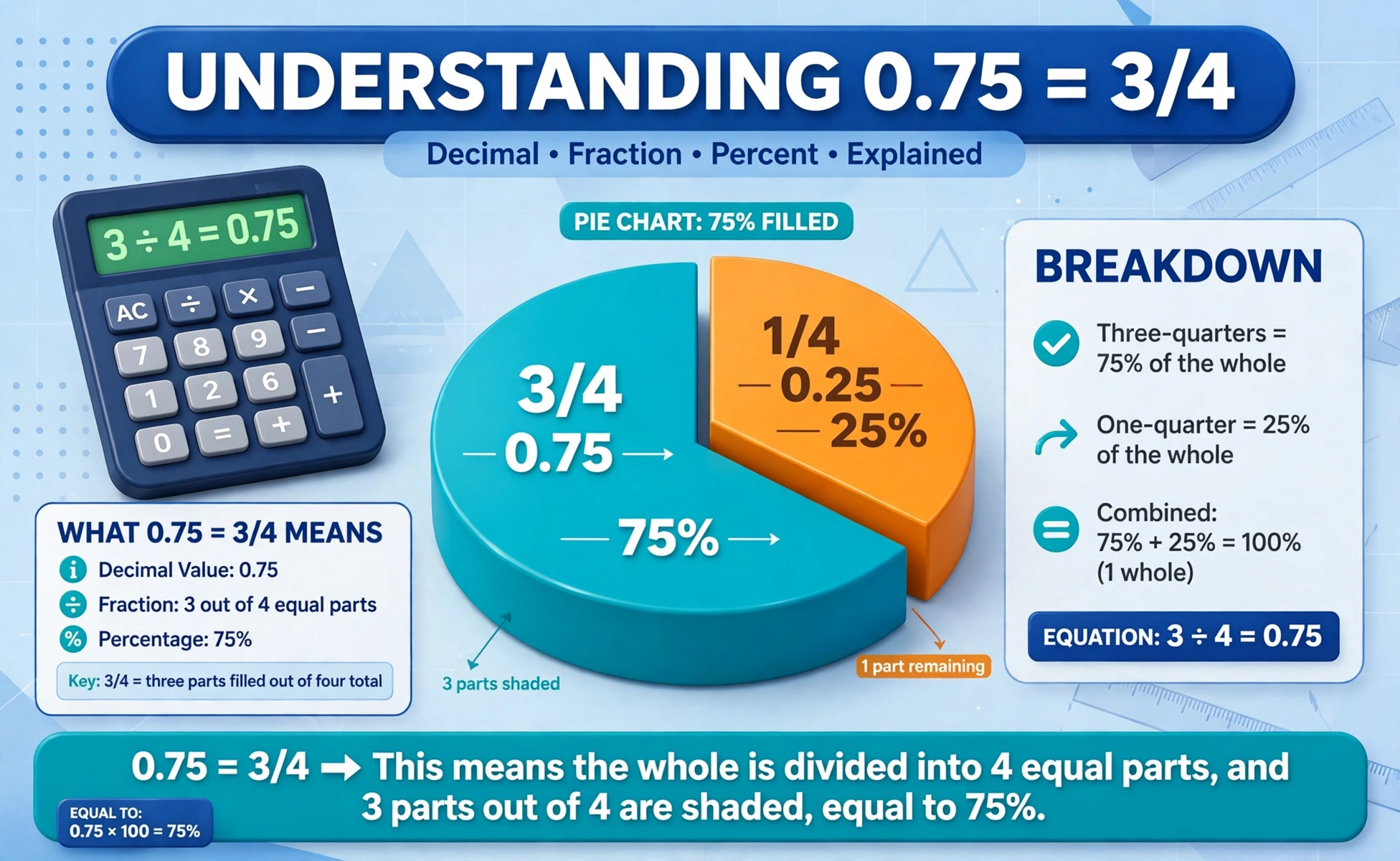
A decimal is already a fraction in disguise: each digit after the point is a fraction with a denominator of 10, 100, 1000, and so on. So 0.75 means 75 hundredths, or 75/100, and 0.125 means 125 thousandths, or 125/1000. The conversion writes the decimal digits over the matching power of 10, then simplifies.
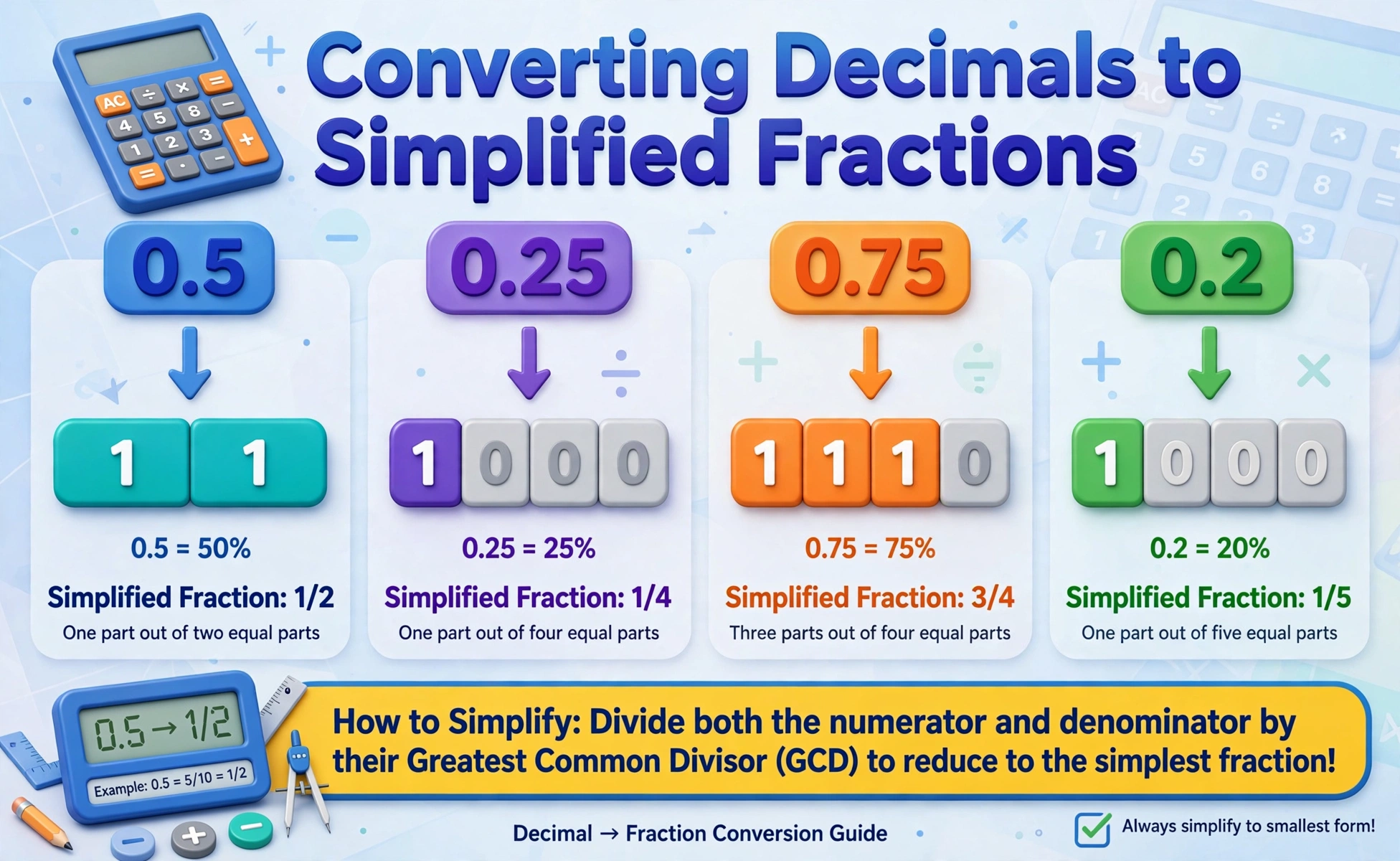
Simplifying means dividing the top and bottom by their greatest common divisor, the largest number that divides both. For 75/100, the greatest common divisor is 25, so dividing gives 3/4. The value never changes during simplifying: 75/100 and 3/4 are the same number, just written more simply.
For turning a decimal into a percent first, a percentage calculator covers percent conversions, while this converter keeps the exact fraction.
The Steps, In Order
Step 1: count the decimal places. One place means tenths, two means hundredths, three means thousandths. Step 2: write the digits as the numerator over 10, 100, or 1000. Step 3: find the greatest common divisor of numerator and denominator. Step 4: divide both by it. Step 5: if the fraction is larger than 1, split off the whole part to make a mixed number.
Example: 1.25. Two decimal places, so 125/100. The greatest common divisor of 125 and 100 is 25, so 125/100 simplifies to 5/4. Since 5/4 is larger than 1, it becomes the mixed number 1 1/4.
| Decimal | Over power of 10 | Simplified | Mixed number |
|---|---|---|---|
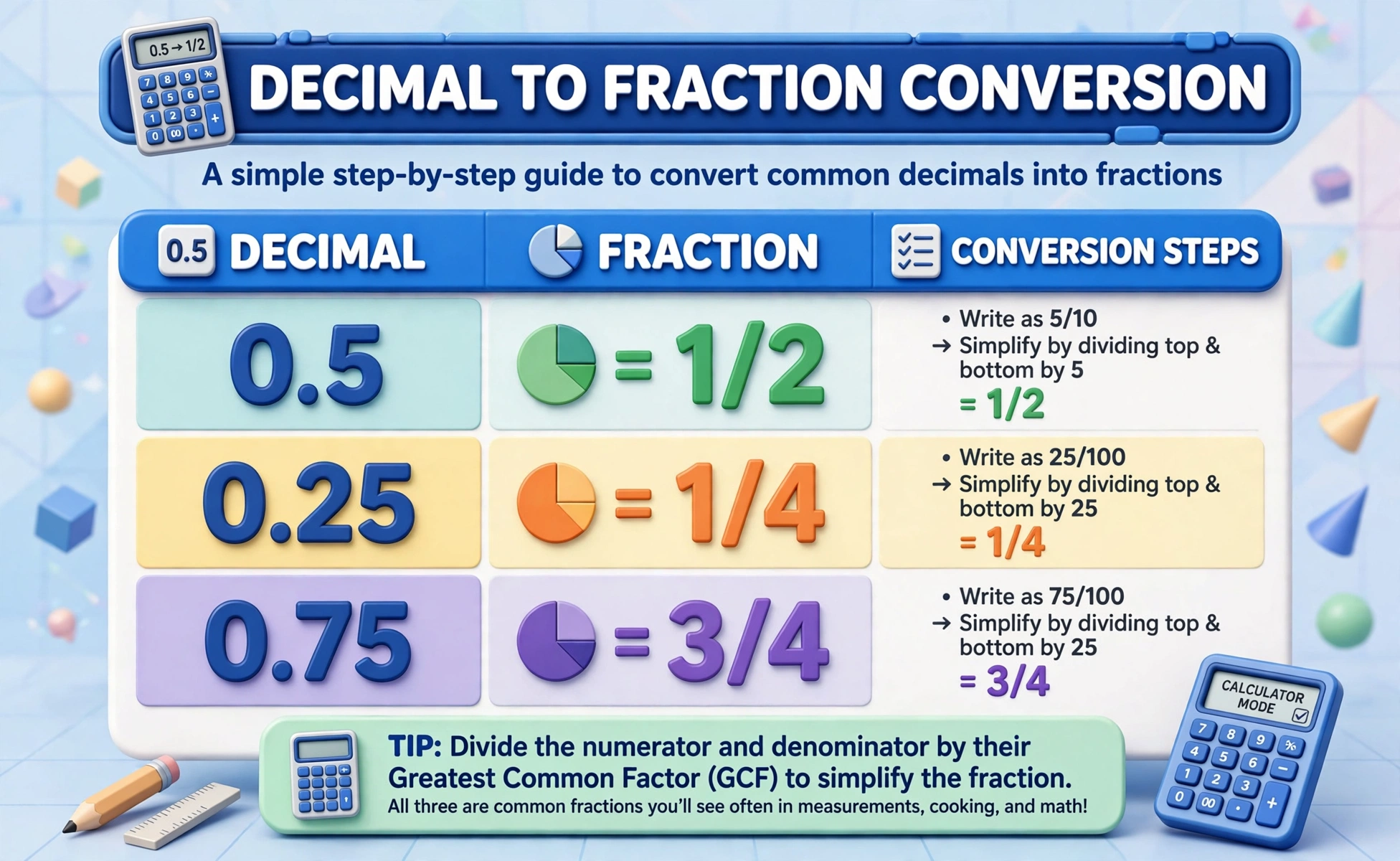
| 0.5 | 5/10 | 1/2 | 1/2 |
| 0.75 | 75/100 | 3/4 | 3/4 |
| 0.125 | 125/1000 | 1/8 | 1/8 |
| 1.25 | 125/100 | 5/4 | 1 1/4 |
Common Decimals Worth Memorizing
A handful of decimals come up so often that memorizing them saves time: 0.5 is 1/2, 0.25 is 1/4, 0.75 is 3/4, 0.2 is 1/5, 0.125 is 1/8, and 0.333... is 1/3. The thirds are special: 1/3 is 0.333 repeating forever, so no finite decimal equals it exactly, and 0.333 is only an approximation.
Repeating decimals like 0.333... or 0.1666... cannot be converted by the power-of-10 method directly, because they never end. They need algebra: for 0.333..., call it x, note 10x is 3.333..., subtract to get 9x = 3, so x = 1/3. This converter handles finite decimals, the kind you type into a calculator.
| Decimal | Fraction | Decimal | Fraction |
|---|---|---|---|
| 0.5 | 1/2 | 0.2 | 1/5 |
| 0.25 | 1/4 | 0.125 | 1/8 |
| 0.75 | 3/4 | 0.4 | 2/5 |
| 0.1 | 1/10 | 0.05 | 1/20 |
Worked Examples
Example 1: 0.6. That is 6/10, and the greatest common divisor of 6 and 10 is 2, so 3/5. Example 2: 2.4. That is 24/10, which simplifies by 2 to 12/5, or 2 2/5 as a mixed number. Example 3: 0.35. That is 35/100, and dividing by 5 gives 7/20.
Example 4: 0.004. Three decimal places after the point beyond the first zero still count: 4/1000, which simplifies by 4 to 1/250. Leading zeros after the point do not change the method, they just make the denominator bigger.
| Input | Unsimplified | GCD | Answer |
|---|---|---|---|
| 0.6 | 6/10 | 2 | 3/5 |
| 2.4 | 24/10 | 2 | 2 2/5 |
| 0.35 | 35/100 | 5 | 7/20 |
| 0.004 | 4/1000 | 4 | 1/250 |
Common Mistakes
The most common mistake is forgetting to simplify: 0.75 as 75/100 is correct but incomplete, and most marking schemes want 3/4. A second mistake is miscounting decimal places: 0.05 is 5/100, not 5/10, because the 5 sits in the hundredths place.
A third mistake is simplifying only once when a bigger divisor remains: 50/100 divided by 10 gives 5/10, which still simplifies by 5 to 1/2. Using the greatest common divisor in one step avoids that trap.
Practical Uses
Fractions beat decimals for exact work: a recipe that needs 3/4 cup is clearer than 0.75 cup, a woodworker cutting 5/8 inch works in fractions, and a probability of 1/3 is exact where 0.333 is rounded. Money, cooking, construction, and sewing all still run on fractions in daily life.
Converting the other way matters too: dividing the numerator by the denominator turns any fraction into its decimal, so 3/4 becomes 0.75 on a calculator. Knowing both directions makes it easy to switch to whichever form a problem wants.
Frequently asked questions
What is 0.75 as a fraction?
3/4. Write 75/100, then divide top and bottom by their greatest common divisor, 25, to get 3/4.
How do you convert 0.125 to a fraction?
Write 125/1000, then divide by 125 to get 1/8.
What is 1.5 as a mixed number?
1 1/2. The decimal 1.5 is 15/10, which simplifies to 3/2, and 3/2 is 1 whole plus 1/2.
Can every decimal become a fraction?
Every finite decimal can, by writing it over a power of 10 and simplifying. Repeating decimals can too, but they need algebra rather than this direct method.
What is 0.333 as a fraction?
333/1000, which cannot simplify further. Note that 0.333 is only an approximation of 1/3, which is 0.333 repeating forever.
Why simplify the fraction?
Because 3/4 is easier to read, compare, and use than 75/100, and most answers are expected in simplest form.
How do I check my answer?
Divide the numerator by the denominator. If the result equals your decimal, the fraction is right: 3 divided by 4 is 0.75.