Rounding Calculator: Round Any Number Instantly
Enter a number, pick the place to round to, and get the rounded value, whether it went up or down, and the digit that decided it.
Formulas verified against standard references. Calculator logic tested with verified worked examples. Last reviewed: October 2026. Our methodology
How Rounding Works
Rounding replaces a number with a nearby number that has fewer digits, so it is easier to use while staying close to the original. To round to a place, look at the digit just to its right: if that digit is 5 or more, round the place digit up, and if it is 4 or less, leave the place digit unchanged and drop the rest.
This calculator uses the half up rule, the rule taught in most schools: a tie at exactly 5 rounds up. So 2.5 rounds to 3, 47.5 rounds to 48, and 0.125 to the nearest hundredth rounds to 0.13. Banks and some software use other tie rules, but half up is the standard for school and everyday math.
For the reverse skill, a decimal to fraction converter turns a rounded decimal back into an exact fraction when you need precision again.
Rounding to Whole Places
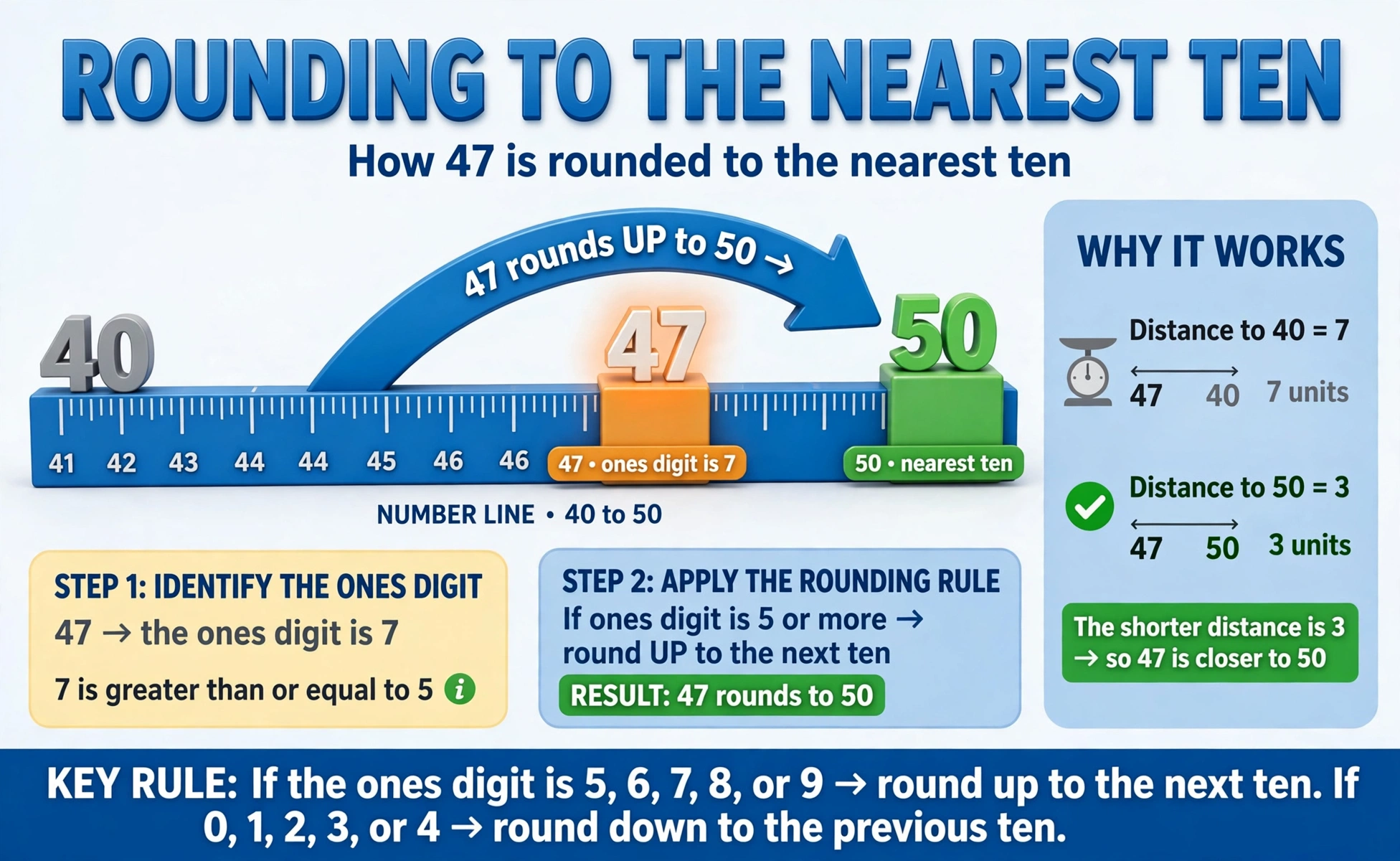
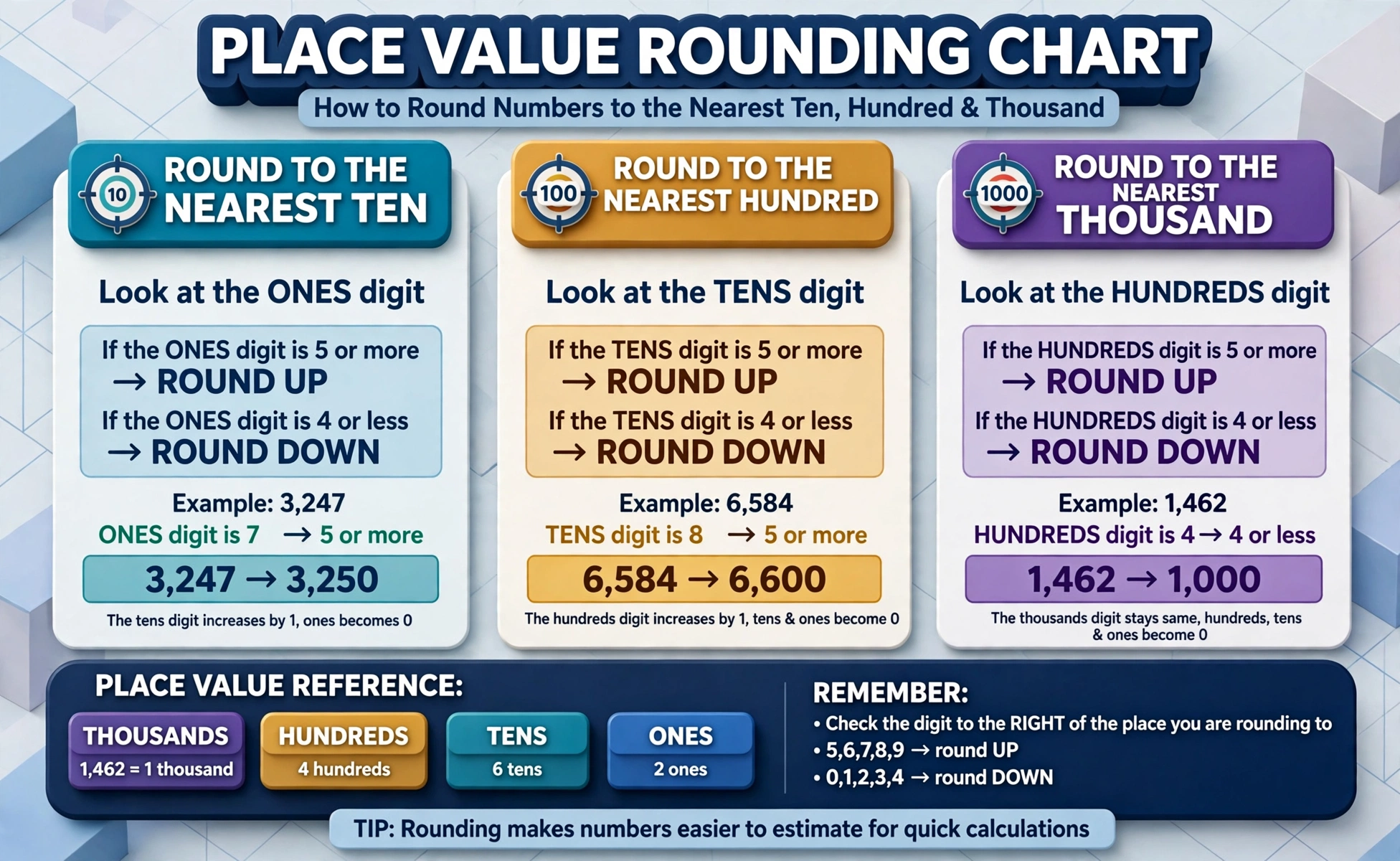
Rounding to the nearest ten means the answer ends in zero in the ones place: 47 rounds to 50 because 47 is closer to 50 than to 40, and 43 rounds to 40. Rounding to the nearest hundred works the same way one place further left: 847 rounds to 800, and 850 rounds to 900 under half up.
A quick check is the distance test: 47 is 3 away from 50 and 7 away from 40, so 50 wins. When the number sits exactly halfway, like 45 to the nearest ten, half up sends it to 50.
| Number | Nearest ten | Nearest hundred |
|---|---|---|
| 47 | 50 | 0 |
| 43 | 40 | 0 |
| 847 | 850 | 800 |
| 850 | 850 | 900 |
Rounding Decimals
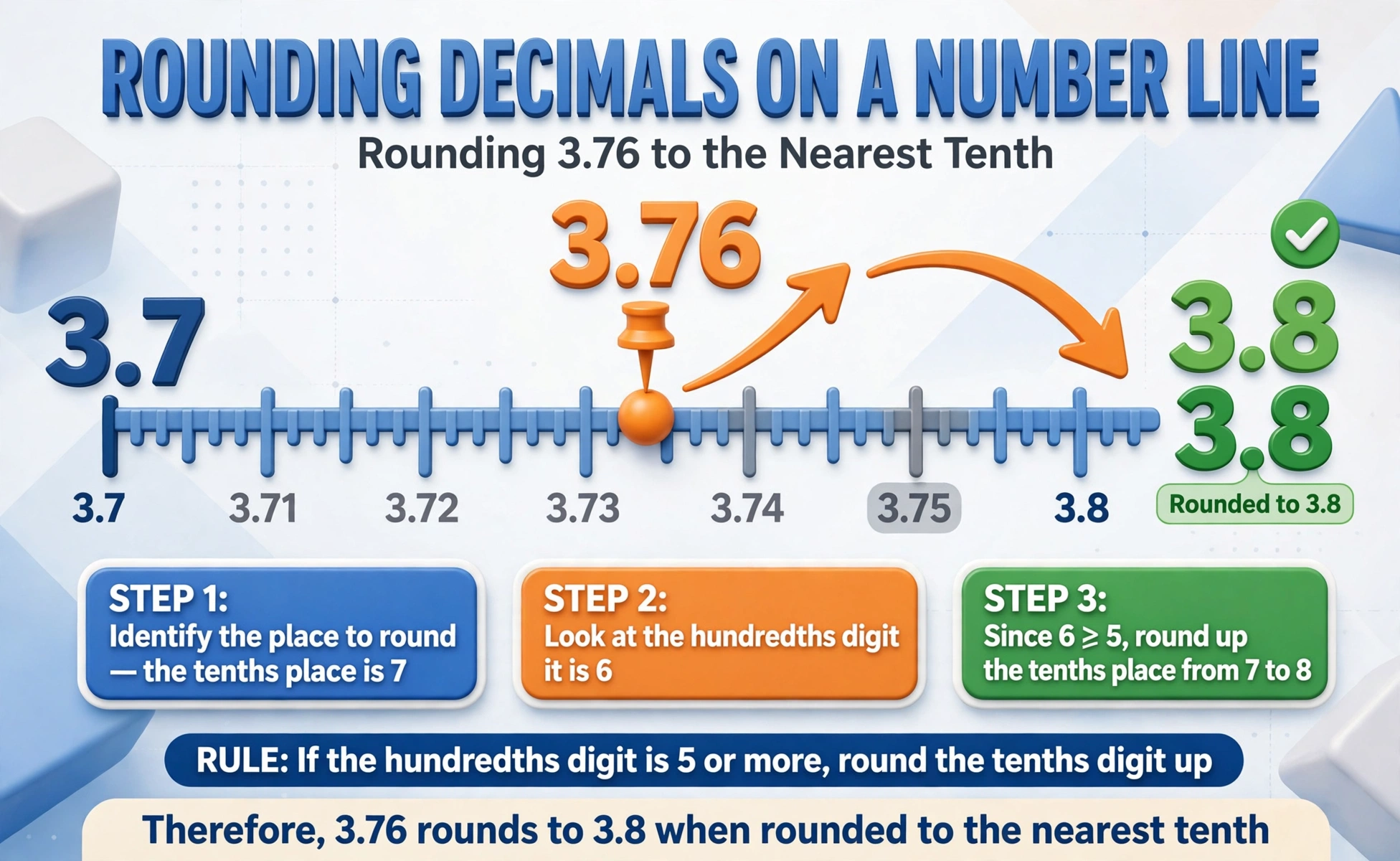
Rounding a decimal to the nearest tenth keeps one digit after the point: 3.76 rounds to 3.8, because the hundredths digit 6 is 5 or more. To the nearest hundredth, 3.764 rounds to 3.76, because the thousandths digit 4 rounds down.
Zeros after the point still count as digits of precision: 2.5 rounded to the nearest hundredth is 2.50, which says the value is known to the hundredth, not just the tenth. Dropping those zeros changes what the number claims about its own accuracy.
| Number | Nearest tenth | Nearest hundredth |
|---|---|---|
| 3.76 | 3.8 | 3.76 |
| 3.74 | 3.7 | 3.74 |
| 0.125 | 0.1 | 0.13 |
| 9.95 | 10 | 9.95 |
Worked Examples
Example 1: 47.65 to the nearest tenth. The hundredths digit is 5, so round up: 47.7. Example 2: 1234 to the nearest hundred. The tens digit is 3, so round down: 1200. Example 3: 0.125 to the nearest hundredth. The thousandths digit is 5, so round up: 0.13.
Example 4: -7.5 to the nearest one under half up. This calculator rounds -7.5 to -7, because JavaScript Math.round rounds halves toward positive infinity. Note that some textbooks round -7.5 to -8 instead, rounding halves away from zero, so check which convention your class uses for negatives.
| Input | Place | Result |
|---|---|---|
| 47.65 | Tenth | 47.7 |
| 1234 | Hundred | 1200 |
| 0.125 | Hundredth | 0.13 |
| 847 | Ten | 850 |
Common Mistakes
The most common mistake is rounding in stages: rounding 4.45 to one decimal place by first rounding to 4.5 and then to 5 is wrong. Always round once, directly from the original number, using the digit right after the target place: 4.45 to the nearest one is 4, not 5.
A second mistake is forgetting that rounding changes the value, so rounded numbers should not be added as if they were exact: two numbers rounded to the nearest ten can be off by up to 10 in total. A third mistake is dropping trailing zeros that carry precision: 3.80 is not the same claim as 3.8.
Practical Uses
Rounding turns messy measurements into usable numbers: a bill of $47.65 is about $48, a distance of 847 meters is about 850 meters, and a class average of 83.47 percent is reported as 83 percent. Shops round prices, scientists round measurements to the precision of their instruments, and budgets round to whole dollars.
The rule of thumb is to round only at the end of a calculation. Keep full precision through the working, then round the final answer to the place the question asks for, so small rounding errors do not pile up along the way.
Frequently asked questions
What is 47 rounded to the nearest ten?
50. The ones digit is 7, which is 5 or more, so the tens digit rounds up from 4 to 5, giving 50.
Does 5 round up or down?
Up, under the half up rule used here. A digit of 5 or more in the next place rounds the target digit up, so 2.5 rounds to 3.
How do you round 3.76 to the nearest tenth?
3.8. The hundredths digit is 6, which rounds the tenths digit 7 up to 8.
Should I round at each step of a calculation?
No. Keep full precision through the working and round only the final answer, so small errors do not pile up.
What is the difference between rounding and truncating?
Rounding picks the nearest value, while truncating just cuts digits off. Truncating 3.76 to one decimal gives 3.7, but rounding gives 3.8.
How do negative numbers round?
This calculator uses half up toward positive infinity, so -7.5 rounds to -7. Some textbooks round halves away from zero, giving -8, so check your class convention.
Why does 2.50 keep its trailing zero?
Because the zero shows precision: 2.50 claims accuracy to the hundredth, while 2.5 claims only the tenth. Dropping it changes the claim.