Absolute Value Calculator: Find |x| Instantly
Enter any number, positive, negative, or zero, and get its absolute value plus its distance from zero, its sign, and its opposite, with each step shown.
Formulas verified against standard references. Calculator logic tested with verified worked examples. Last reviewed: October 2026. Our methodology
What Absolute Value Means
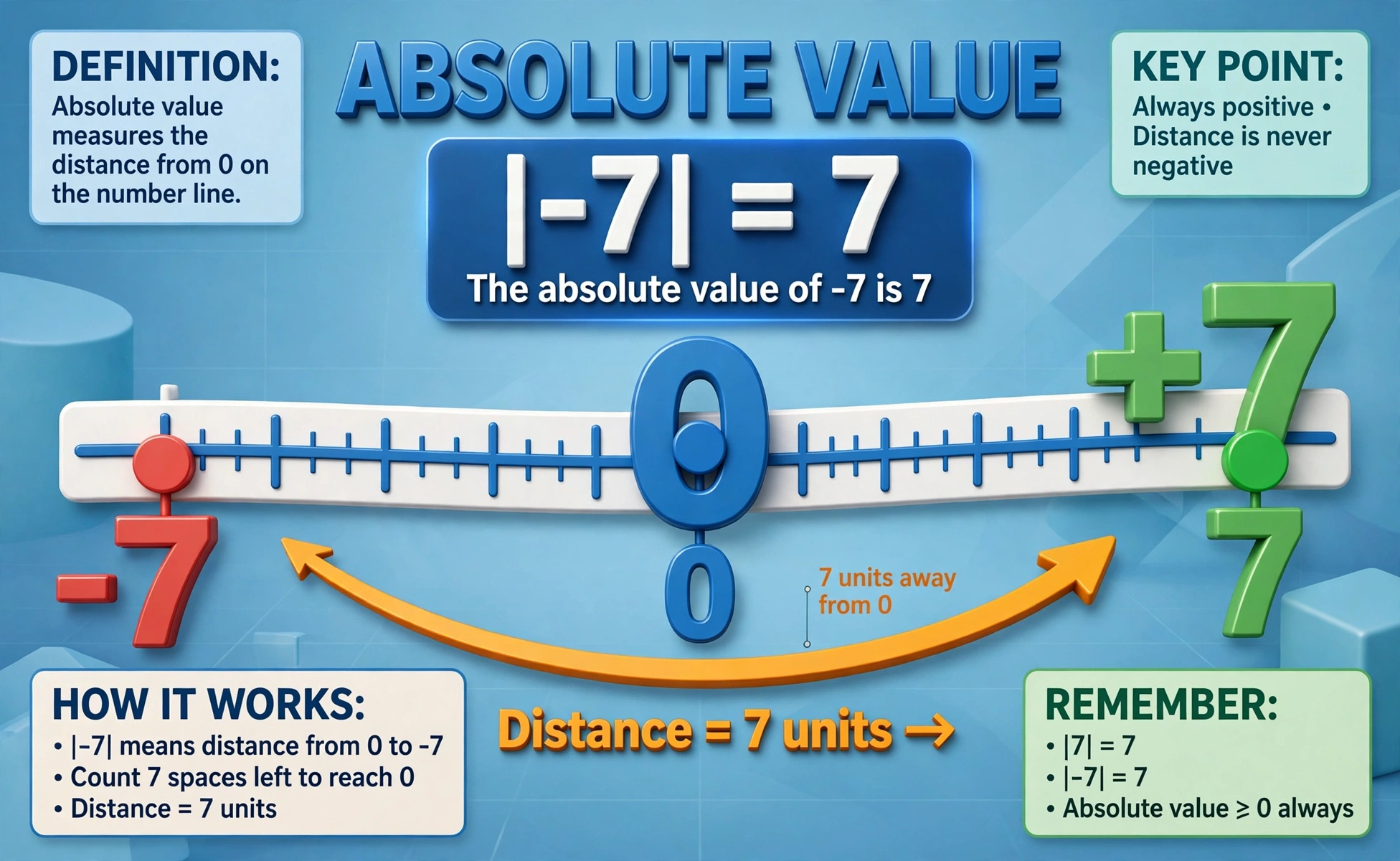
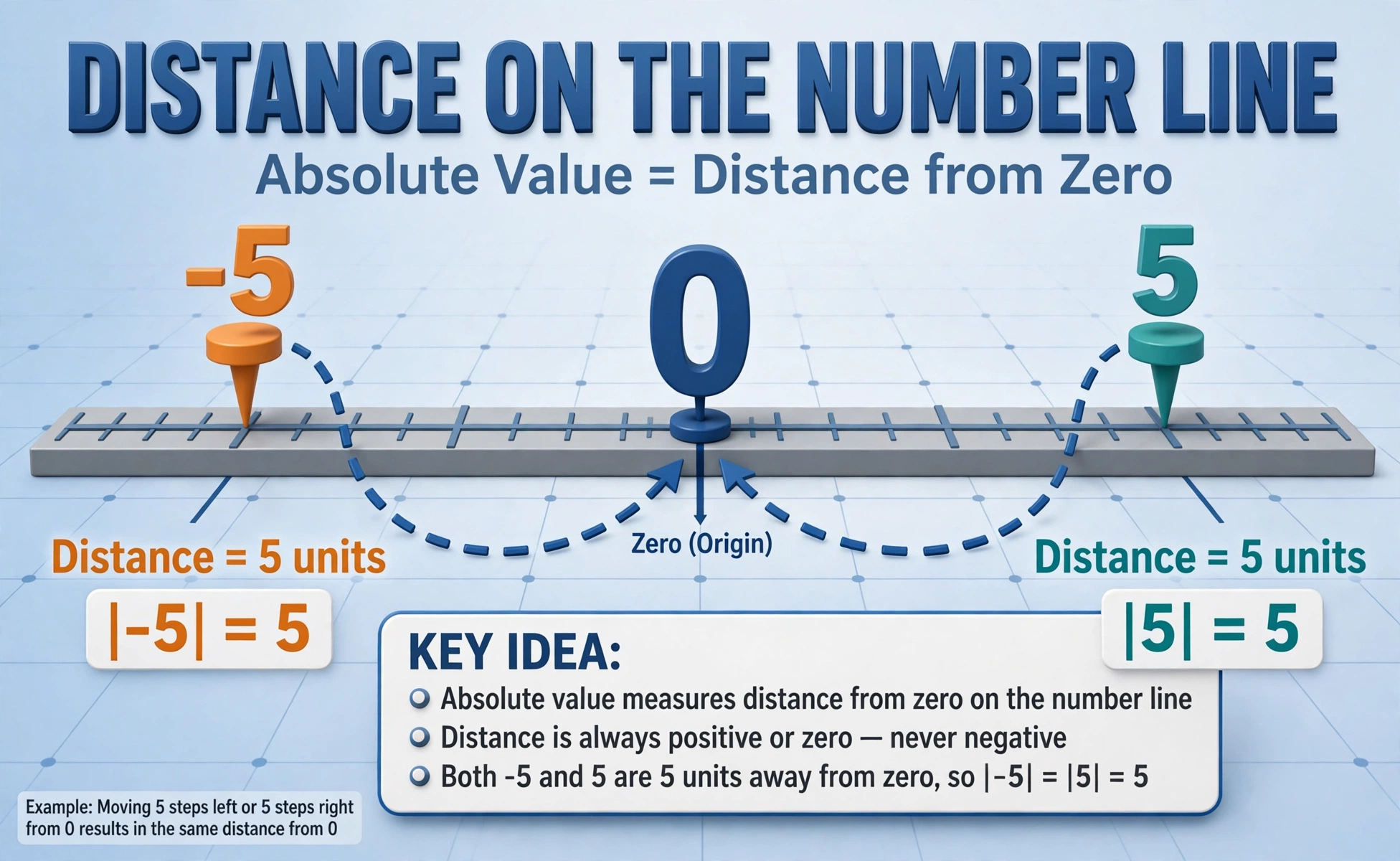
The absolute value of a number is its distance from zero on the number line, ignoring direction. The symbol is two vertical bars: |x|. So |7| is 7 and |-7| is also 7, because both 7 and -7 sit 7 units away from zero, just on opposite sides.
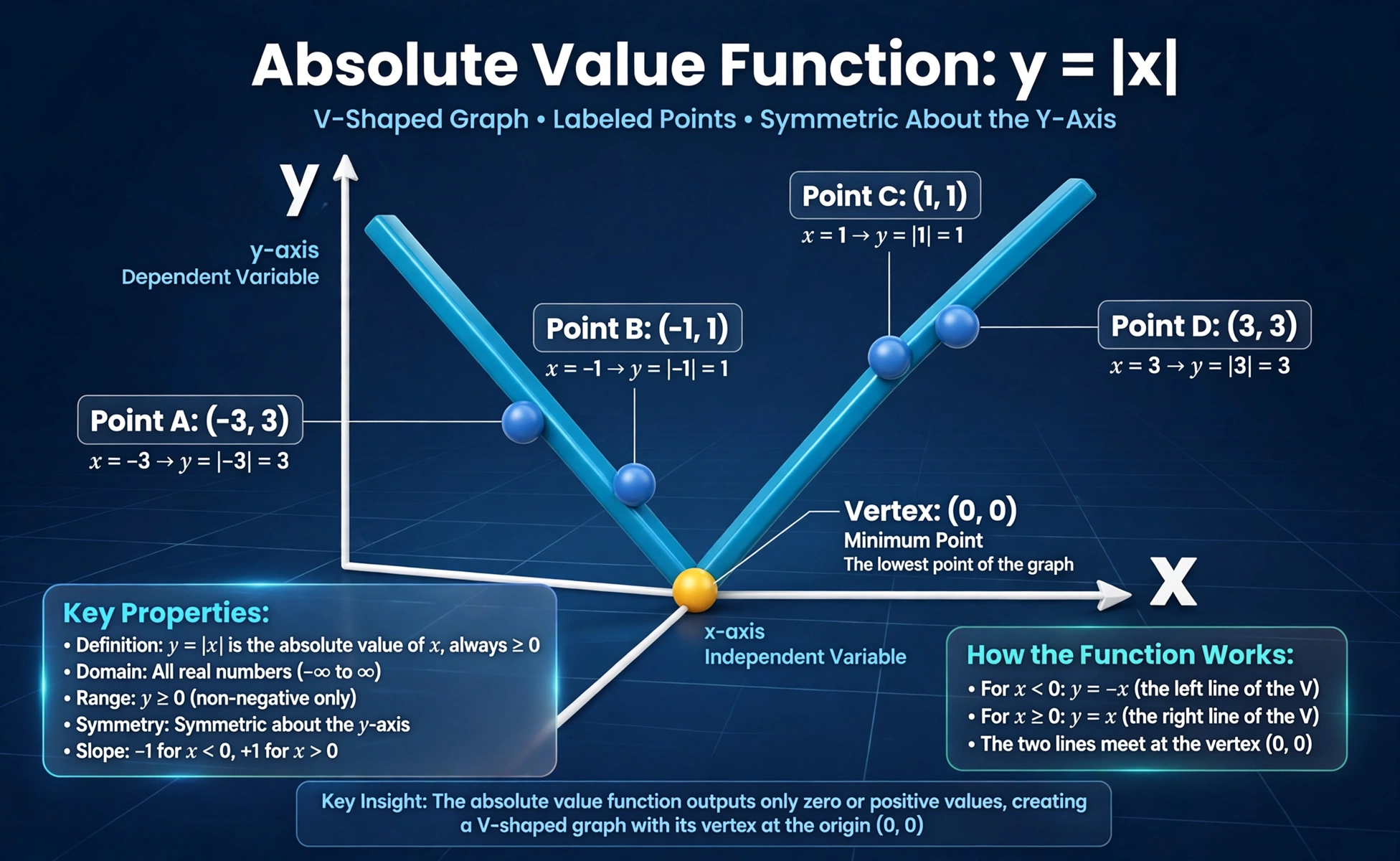
That is why absolute value is never negative. Distance cannot be less than zero, and the absolute value of zero itself is zero, since zero is no distance from zero. In symbols, |x| equals x when x is positive or zero, and equals -x when x is negative, which flips the sign to make it positive.
For roots and powers, a square root calculator handles the related idea that squaring removes sign, since the square root of x squared is |x|, not x.
The Definition, Case by Case
The definition splits into two cases. If the number is zero or positive, the absolute value is the number itself: |5| = 5 and |0| = 0. If the number is negative, the absolute value is the number with its sign flipped: |-5| = -(-5) = 5.
The minus sign in -x does not mean the result is negative. It is the operation of negating x, and negating a negative number gives a positive number. That is the step beginners trip over most, and it is worth checking with a concrete pair: |3| = 3 and |-3| = -(-3) = 3.
| Number | Case | Absolute value |
|---|---|---|
| 5 | Positive, keep it | 5 |
| 0 | Zero | 0 |
| -5 | Negative, flip the sign | 5 |
| -12.5 | Negative, flip the sign | 12.5 |
Worked Examples
Example 1: |-7| = 7, because -7 is 7 units from zero. Example 2: |42| = 42, because a positive number keeps its value. Example 3: |0| = 0. Example 4: |-3.25| = 3.25, because flipping the sign of -3.25 gives 3.25.
Example 5: |100 - 140| = |-40| = 40. This pattern appears whenever you measure a difference: the error between a measured value and a true value is reported as an absolute error, so a reading 40 units low and a reading 40 units high both have absolute error 40.
| Input | Working | Result |
|---|---|---|
| -7 | Flip the sign | 7 |
| 42 | Already positive | 42 |
| 0 | Zero stays zero | 0 |
| 100 - 140 = -40 | Flip the sign | 40 |
Absolute Value in Equations and Inequalities
An equation like |x| = 5 has two solutions, x = 5 and x = -5, because both numbers are 5 units from zero. In general, |x| = a with a positive has the two solutions x = a and x = -a, while |x| = 0 has only x = 0, and |x| = -3 has no solution, since an absolute value can never be negative.
An inequality like |x| < 5 means x is within 5 units of zero, so -5 < x < 5. The reverse, |x| > 5, means x is more than 5 units from zero, so x < -5 or x > 5. Drawing the two cases on a number line turns an abstract inequality into a visible interval.
| Statement | Meaning | Solution |
|---|---|---|
| |x| = 5 | 5 units from zero | x = 5 or x = -5 |
| |x| < 5 | Within 5 of zero | -5 < x < 5 |
| |x| > 5 | More than 5 from zero | x < -5 or x > 5 |
| |x| = 0 | No distance from zero | x = 0 |
Common Mistakes
The most common mistake is writing |-5| = -5, keeping the negative sign. Absolute value strips the sign, it never preserves it, so |-5| = 5. A second mistake is treating -x as automatically negative: if x is -4, then -x is 4, not -4.
A third mistake is assuming |x| = x is always true. It holds only for x at or above zero. A fourth is forgetting the second solution of |x| = a: both a and -a satisfy it, and dropping one loses half the answer.
Practical Uses
Absolute value measures errors, differences, and distances wherever direction does not matter. A temperature 3 degrees below forecast and 3 degrees above it are both 3 degrees off. A stock that falls $2 and one that rises $2 both moved $2 in magnitude. GPS and mapping use absolute differences in coordinates to find distances.
In programming, absolute value appears in sorting by closeness, in graphics for distances between points, and in statistics for mean absolute error, where overestimates and underestimates count equally. Whenever a problem asks how far apart two values are, absolute value is the tool.
Frequently asked questions
What is the absolute value of -7?
7. The number -7 is 7 units from zero on the number line, and absolute value reports distance, which is never negative.
Can absolute value ever be negative?
No. Absolute value is a distance from zero, and distance is zero or positive. The smallest possible absolute value is 0, for the number 0 itself.
What is the absolute value of 0?
0. Zero is no distance from zero, so |0| = 0.
How do you solve |x| = 5?
Both x = 5 and x = -5 work, because both are 5 units from zero. In general, |x| = a (with a positive) has the two solutions a and -a.
What does |x| < 5 mean?
It means x is within 5 units of zero, so -5 < x < 5. The inequality describes an interval centered on zero.
Is -x the same as a negative number?
Not always. If x is negative, -x is positive. For example, if x = -4, then -x = 4. The minus sign means negate, not make negative.
Where is absolute value used in real life?
For errors, differences, and distances: temperature error, price movement, GPS distance, and mean absolute error in statistics all ignore direction and report magnitude.