Exponent Calculator: Raise Any Base to Any Power
Enter a base and an exponent to get the power, the step-by-step expansion when the exponent is small, and scientific notation for very large or very small results.
Formulas verified against standard references. Calculator logic tested with verified worked examples. Last reviewed: October 2026. Our methodology
How Exponents Work
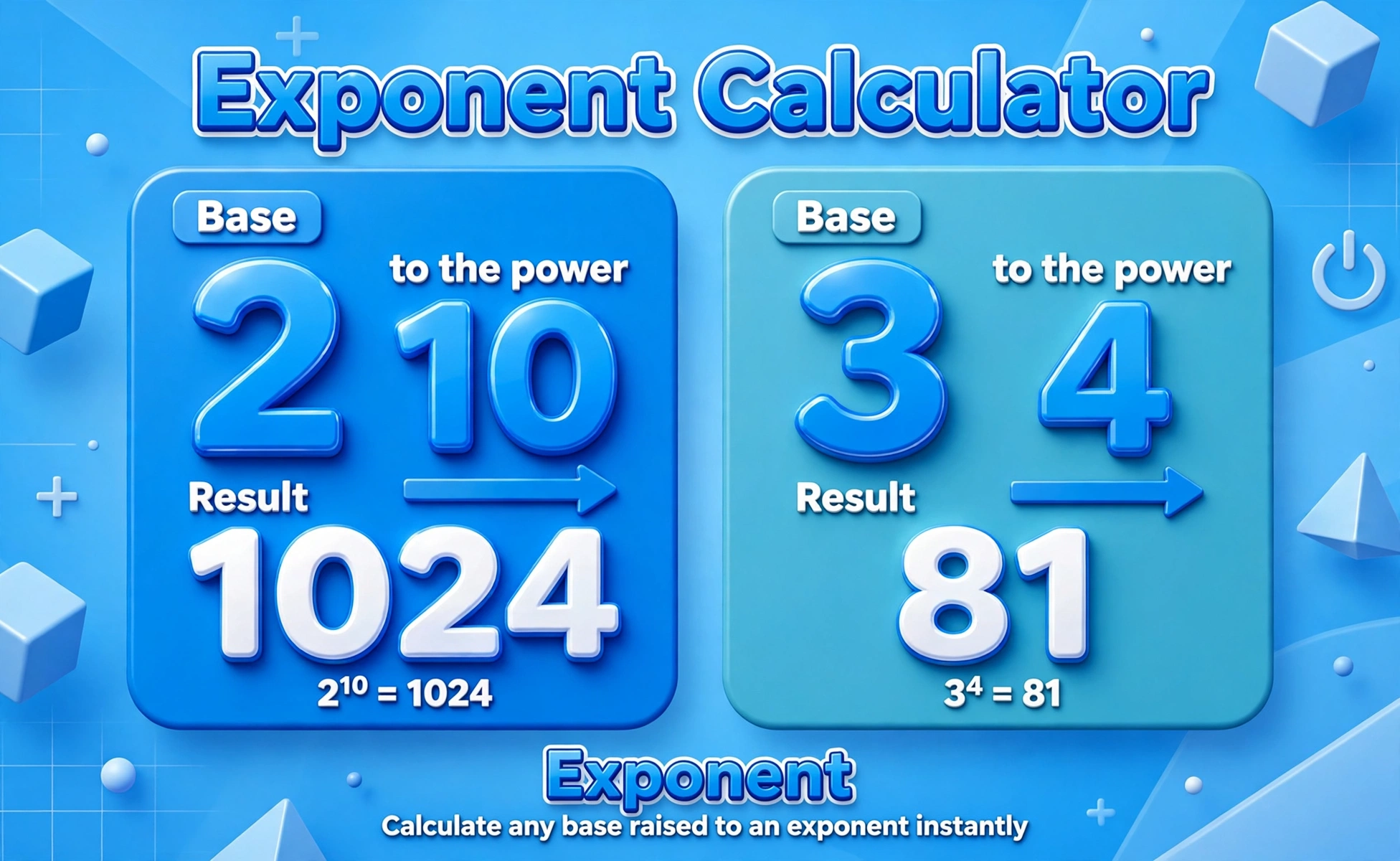
An exponent tells you how many times to multiply the base by itself. In 2 to the power 10, the base is 2 and the exponent is 10, so the value is 2 multiplied by itself ten times, which equals 1024. In 5 to the power 3, the value is 5 times 5 times 5, which equals 125.
Exponents are not repeated addition, and that is where most errors come from. Two to the power 10 is not 2 times 10, which is 20, and it is not 2 plus itself ten times. The growth is multiplicative, which is why powers grow so fast: each extra step in the exponent multiplies the whole result by the base again.
For the reverse problem, finding the base from a power, use a square root calculator, which handles square, cube, and nth roots.
The Rules for Special Exponents
A zero exponent always gives 1 for a non-zero base, so 7 to the power 0 equals 1. A negative exponent gives the reciprocal: 5 to the power negative 2 equals 1 over 25, which is 0.04. A fractional exponent gives a root: 9 to the power one half equals the square root of 9, which is 3, and 8 to the power one third equals the cube root of 8, which is 2.
Two more rules save a lot of work. Multiplying powers with the same base means adding the exponents: 2 to the power 3 times 2 to the power 4 equals 2 to the power 7, which is 128. Raising a power to a power means multiplying the exponents: 2 to the power 3, all to the power 2, equals 2 to the power 6, which is 64.
| Case | Rule | Example |
|---|---|---|
| Zero exponent | Any non-zero base to the power 0 = 1 | 7 to the power 0 = 1 |
| Negative exponent | Base to the power negative n = 1 over base to the power n | 5 to the power negative 2 = 0.04 |
| Fractional exponent | Base to the power 1 over n = nth root | 9 to the power 1/2 = 3 |
| Same base, multiply | Add the exponents | 2 to the power 3 x 2 to the power 4 = 128 |
Worked Examples
Example 1: 2 to the power 10. Expand it as ten 2s multiplied together, and the result is 1024, the number behind kilobytes and binary counting. Example 2: 3 to the power negative 2. The negative exponent flips it to 1 over 9, which is about 0.1111. Example 3: 10 to the power 6. That is 1 followed by six zeros, which is 1,000,000.
Example 4: 1.5 to the power 2. The expansion is 1.5 times 1.5, which equals 2.25. Decimals work exactly like whole numbers here, which matters for growth rates: a 50 percent yearly increase over two years is a factor of 1.5 squared, not a factor of 3.
| Expression | Expansion | Result |
|---|---|---|
| 2 to the power 10 | 2 x 2 x 2 x 2 x 2 x 2 x 2 x 2 x 2 x 2 | 1024 |
| 3 to the power negative 2 | 1 / (3 x 3) | 0.1111 |
| 10 to the power 6 | 1 followed by six zeros | 1,000,000 |
| 1.5 to the power 2 | 1.5 x 1.5 | 2.25 |
Powers of 2 and 10 to Remember
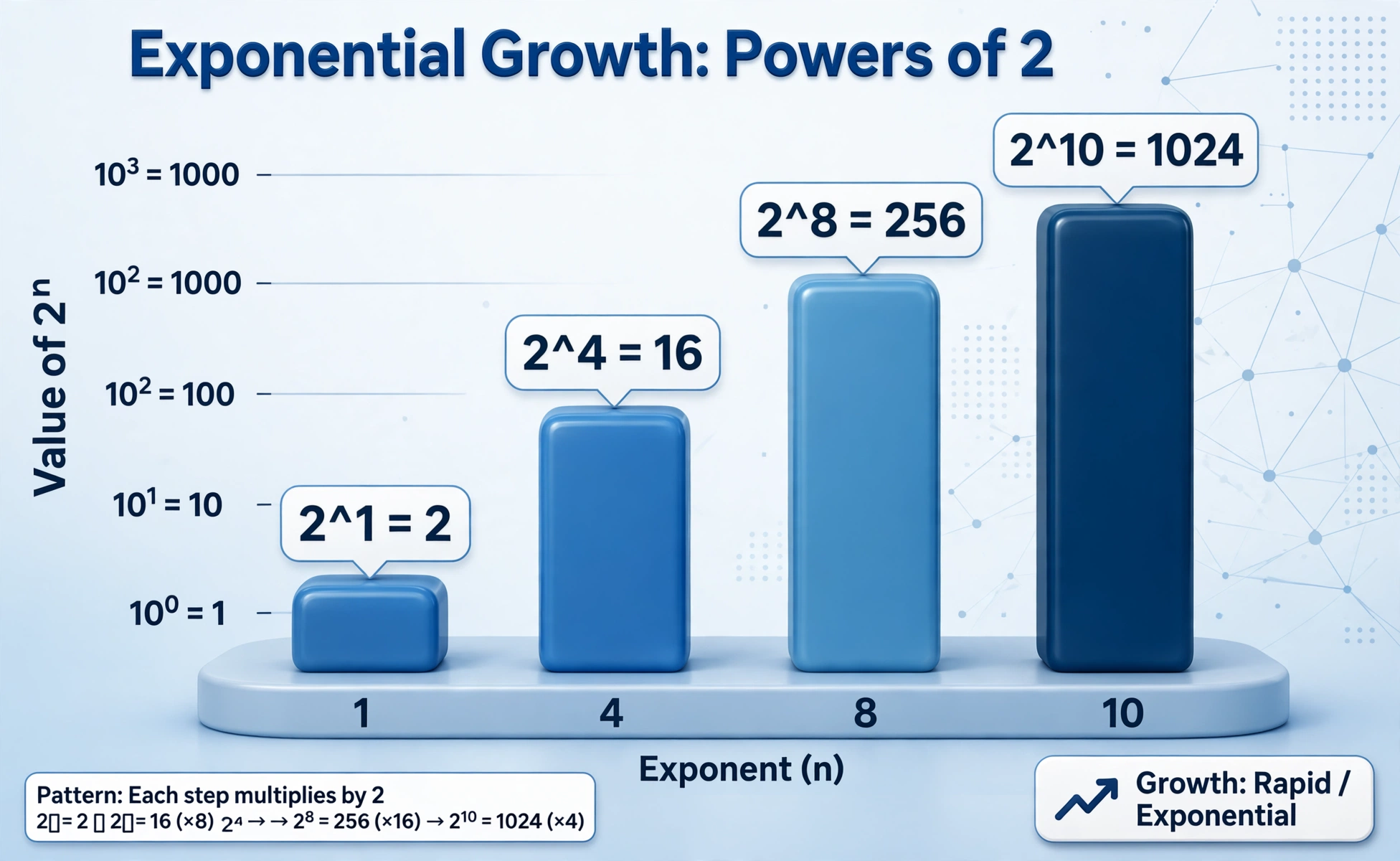
Powers of 2 run computing, music, and doubling problems, while powers of 10 run scientific notation and metric prefixes. Knowing the first few by heart makes estimation fast, and the calculator confirms the rest. A useful check: 2 to the power 10 is about 10 to the power 3, which is why a kilobyte is 1024 bytes rather than exactly 1000.
For very large or very small results, scientific notation keeps the answer readable. Instead of writing 0.000000123, write 1.23 times 10 to the power negative 7. Instead of writing 123,000,000,000, write 1.23 times 10 to the power 11.
| Power of 2 | Value | Power of 10 | Value |
|---|---|---|---|
| 2 to the power 5 | 32 | 10 to the power 3 | 1,000 |
| 2 to the power 8 | 256 | 10 to the power 6 | 1,000,000 |
| 2 to the power 10 | 1024 | 10 to the power 9 | 1,000,000,000 |
Common Mistakes
The classic mistake is treating an exponent as a multiplier: 2 to the power 4 is 16, not 8. Another is mishandling a negative base: negative 2 to the power 2 is 4 when the negative sign is inside the power, because negative 2 times negative 2 is positive, but negative 2 squared in the sense of negative of 2 squared is negative 4. This calculator treats an entered negative base as the base itself, so negative 2 to the power 2 gives 4.
A third mistake is adding exponents when the bases differ: 2 to the power 3 times 3 to the power 3 is not 6 to the power 3. The add-the-exponents rule only works for the same base. A fourth is forgetting that zero to a negative power is undefined, because it would mean dividing by zero.
Where Exponents Show Up
Compound interest grows by a power: money at 5 percent for 10 years grows by a factor of 1.05 to the power 10, about 1.63. Population growth, radioactive decay, and sound levels all use exponents, as do area and volume, where doubling a side multiplies area by 4 and volume by 8.
For logarithms, which answer the question of which exponent gives a value, use a logarithm calculator. Exponents and logarithms are inverse operations, and fluency with both makes growth and decay problems straightforward.

Frequently asked questions
What is an exponent?
A number that tells you how many times to multiply the base by itself. In 2 to the power 4, the base 2 is multiplied by itself 4 times, giving 16.
What is 2 to the power 10?
1024. It is 2 multiplied by itself ten times, and it is the reason a kilobyte holds 1024 bytes.
What does a negative exponent mean?
It means the reciprocal. 5 to the power negative 2 equals 1 over 25, which is 0.04.
What is any number to the power 0?
1, for any non-zero base. 7 to the power 0 equals 1, and so does 100 to the power 0.
What is a fractional exponent?
A root. 9 to the power 1/2 is the square root of 9, which is 3, and 8 to the power 1/3 is the cube root of 8, which is 2.
Is 0 to the power 0 equal to 1?
In many calculator contexts it is treated as 1, but in analysis it is indeterminate. This calculator asks for a different pair rather than guessing.
How do I calculate a power on paper?
Expand it for small exponents: 3 to the power 4 is 3 x 3 x 3 x 3, which is 81. For large exponents, use logarithms or a calculator.