Square Root Calculator: Find Any Root in Seconds
Enter a number and choose square, cube, or a custom nth root to get the decimal answer, the simplified radical for whole numbers, and a check that the answer squares back to your number.
Formulas verified against standard references. Calculator logic tested with verified worked examples. Last reviewed: October 2026. Our methodology
How a Square Root Works
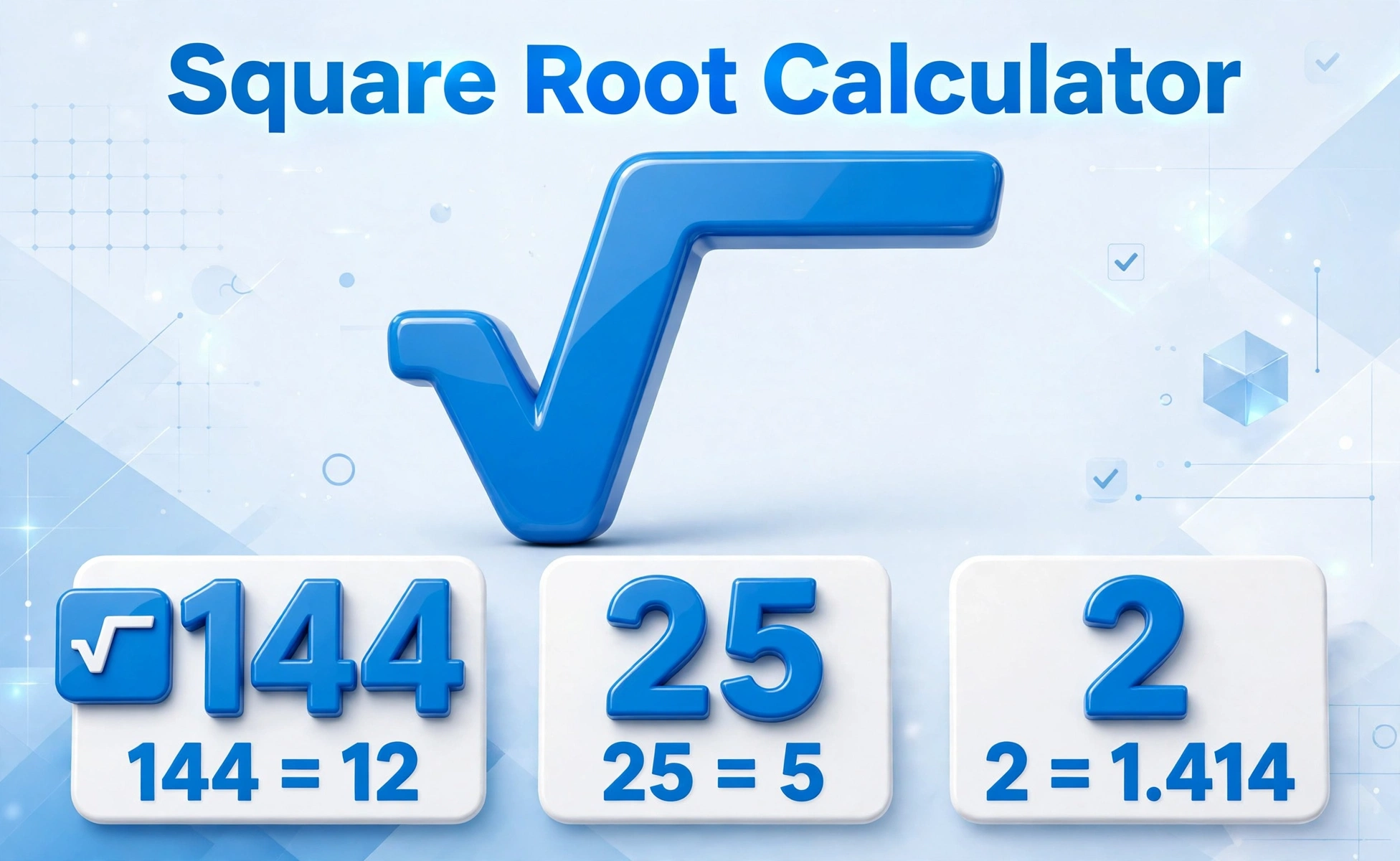
A square root asks a simple question: which number, multiplied by itself, gives the number you started with. The square root of 144 is 12, because 12 times 12 equals 144. The square root of 2 is about 1.4142, because 1.4142 times 1.4142 is very close to 2, but no whole number or simple fraction ever lands on 2 exactly.
Every non-negative number has one principal square root, which is the non-negative answer this calculator reports. A number such as 144 also has a negative root, negative 12, because negative 12 times negative 12 is also 144. In most school, geometry, and engineering work, the principal root is the one you need, and the negative root is noted only when you are solving an equation such as x squared equals 144.
This calculator also handles cube roots and nth roots. A cube root reverses cubing: the cube root of 27 is 3, because 3 times 3 times 3 equals 27. An nth root reverses raising to the nth power, so the 4th root of 16 is 2. For a quick check on a related idea, a prime number calculator shows whether a whole number has exactly two divisors.
The Root Formulas
The square root of x is written as the square root symbol over x, and it is the same as x to the power one half. The cube root is x to the power one third, and the nth root is x to the power one over n. Those power forms are useful because they work on any scientific calculator: type the number, press the power key, and enter the fraction.
For whole numbers, the calculator also simplifies the radical. It pulls out the largest perfect square factor it can find. For 72, the factor 36 comes out as 6, leaving 2 under the radical, so the simplified form is 6 times the square root of 2. That exact form is often worth more than the decimal, because it keeps full precision for later steps.
| Expression | Power form | Value |
|---|---|---|
| Square root of 144 | 144 to the power 1/2 | 12 |
| Cube root of 27 | 27 to the power 1/3 | 3 |
| 4th root of 16 | 16 to the power 1/4 | 2 |
| Square root of 72 | 72 to the power 1/2 | 8.4853, or 6 times root 2 |
Worked Examples
Example 1: find the square root of 144. The factors pair up as 12 times 12, so the answer is exactly 12, and the number is a perfect square. Example 2: find the square root of 72. No whole number squares to 72, so the decimal answer is about 8.4853, and the simplified radical is 6 times the square root of 2, which you can verify because 6 times 6 times 2 equals 72.
Example 3: find the cube root of negative 27. Cube roots of negative numbers are real, because a negative number cubed stays negative: negative 3 times negative 3 times negative 3 equals negative 27. Example 4: find the 5th root of 32. The answer is 2, because 2 to the power 5 equals 32.
| Problem | Answer | Check |
|---|---|---|
| Square root of 144 | 12 | 12 x 12 = 144 |
| Square root of 72 | 8.4853 | 6 x 6 x 2 = 72 |
| Cube root of negative 27 | negative 3 | negative 3 cubed = negative 27 |
| 5th root of 32 | 2 | 2 to the power 5 = 32 |
Perfect Squares to Remember
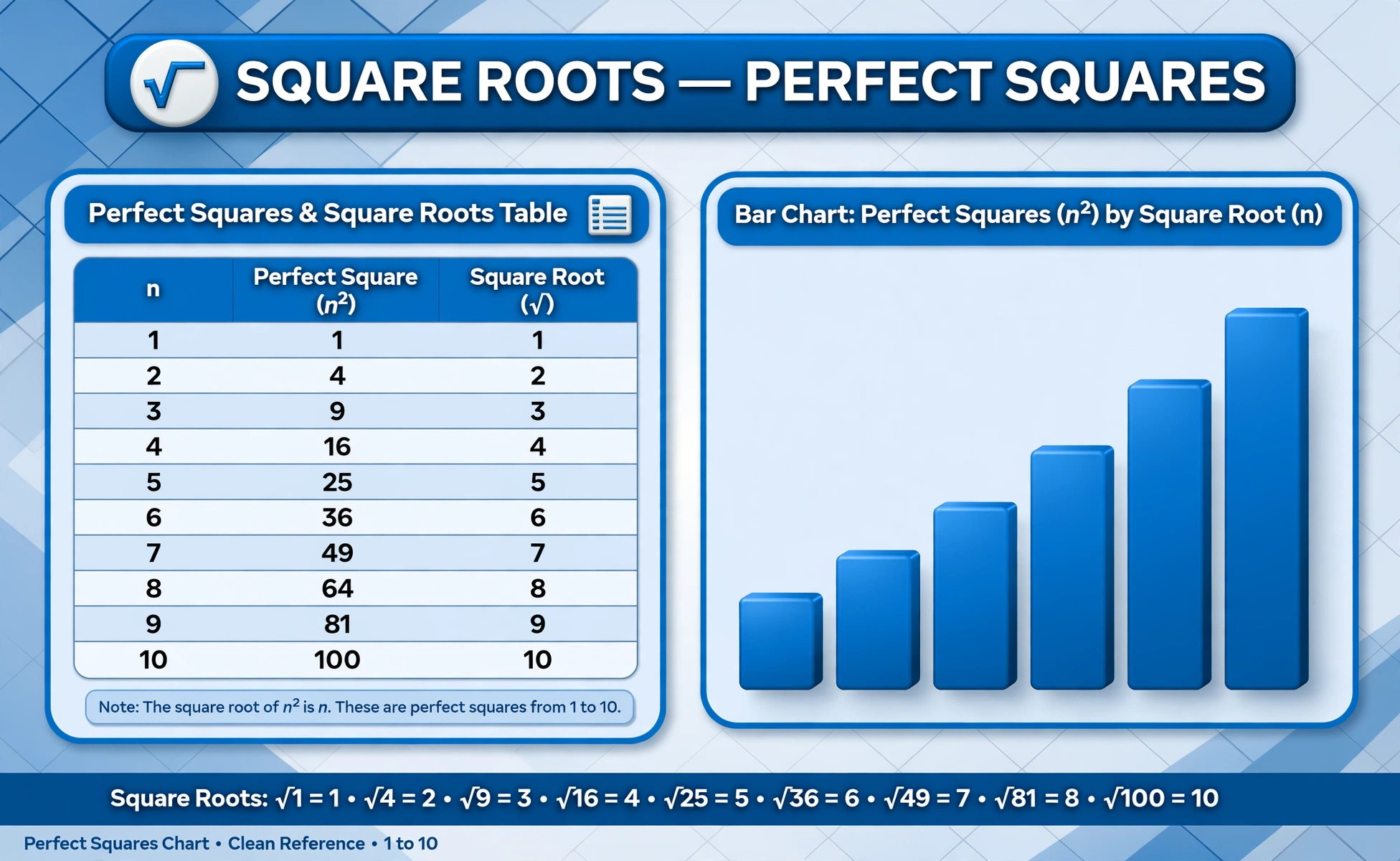
Memorizing the first perfect squares makes root problems much faster, because you can spot an exact answer before reaching for a calculator. The squares of 1 through 15 cover most textbook problems, and the square roots in the table below are the values you will meet most often.
Notice the pattern: each perfect square grows by the next odd number. From 25 to 36 is a jump of 11, from 36 to 49 a jump of 13, and so on. That pattern is one way to estimate a root by hand: if your number sits between two perfect squares, its root sits between their roots.
| Number | Square | Square root |
|---|---|---|
| 5 | 25 | 5 |
| 10 | 100 | 10 |
| 12 | 144 | 12 |
| 15 | 225 | 15 |
| 20 | 400 | 20 |
Common Mistakes
The most common mistake is adding roots as if they were ordinary numbers: the square root of 9 plus 16 is not 3 plus 4 in the way people hope, because the square root of 25 is 5, while 3 plus 4 is 7. Roots do not split over addition. They do split over multiplication and division, so the square root of 9 times 16 equals the square root of 9 times the square root of 16, which is 12.
Another mistake is forgetting that a negative number has no real square root. If your problem gives a negative radicand and asks for a square root, the answer is not a real number, and you need complex numbers or a different root. A third mistake is rounding too early: keep the simplified radical or several decimals until the final step, then round once.
When to Use a Root Calculator
Square roots appear in geometry through the Pythagorean theorem, in statistics through standard deviation, in physics through speed and distance formulas, and in finance through volatility. Cube roots appear in volume problems, where the side of a cube comes from its volume. Nth roots appear in compound growth, where the average yearly rate comes from a total growth factor.
For power problems in the other direction, a scientific calculator raises a base to any exponent. Use this root calculator whenever the unknown is the base and the power is known.

Frequently asked questions
What is a square root?
The number that, multiplied by itself, gives the original number. The square root of 144 is 12, because 12 times 12 equals 144.
What is the square root of 2?
About 1.4142. It is irrational, so its decimal never ends or repeats, and the exact form is simply the square root of 2.
Can a square root be negative?
The principal square root reported here is never negative for a non-negative input. The equation x squared equals 144 has two solutions, 12 and negative 12.
What is the square root of a negative number?
There is no real square root of a negative number. In complex numbers, the square root of negative 1 is written as i, so the square root of negative 9 is 3i.
What is a cube root?
The number that, multiplied by itself three times, gives the original number. The cube root of 27 is 3, and the cube root of negative 27 is negative 3.
What does a simplified radical mean?
It means the largest perfect square factor has been pulled out of the radical. The square root of 72 simplifies to 6 times the square root of 2, because 72 equals 36 times 2.
How do I estimate a square root by hand?
Find the two perfect squares your number sits between. For 50, the roots are between 7 and 8, since 49 and 64 bracket 50, and a closer estimate is about 7.07.