Scientific Notation Converter
Convert any number into scientific notation, E-notation, and engineering notation in one step, or go the other way and expand scientific notation back into standard decimal form. The calculator accepts plain numbers, e-notation like 6.02e23, and forms like 6.02x10^23, and breaks every result into its coefficient and exponent so you can see exactly how the conversion works.

Formulas verified against standard references. Calculator logic tested with verified worked examples. Last reviewed: October 2026. Our methodology
How to Read Scientific Notation
Scientific notation writes a number as a coefficient between 1 and 10 multiplied by a power of 10: a × 10^n. The exponent tells you how far the decimal point moved. Move it left for big numbers and the exponent is positive; move it right for small numbers and the exponent is negative.
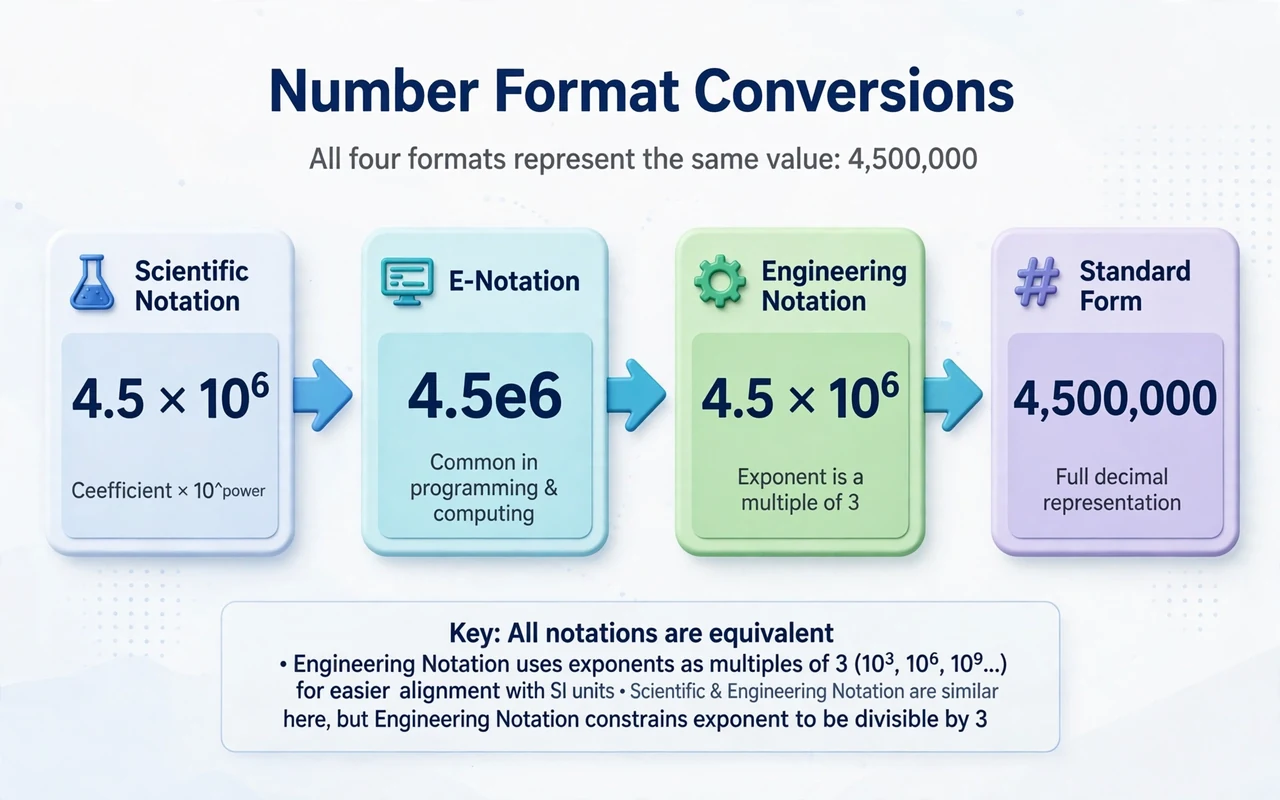
Take 4,500,000. Slide the decimal point six places left and you get 4.5, so the notation is 4.5 × 10^6. For 0.00032, slide four places right: 3.2 × 10^-4. The coefficient always keeps exactly one non-zero digit before the decimal point, which is what makes the form standard.
| Number | Decimal moves | Scientific notation |
|---|---|---|
| 4,500,000 | 6 left | 4.5 x 10^6 |
| 0.00032 | 4 right | 3.2 x 10^-4 |
| 6,022,000,000,000,000,000,000,000 | 23 left | 6.022 x 10^23 |
| 0.0000000001 | 10 right | 1 x 10^-10 |

E-Notation and Engineering Notation
E-notation is the compact keyboard form of scientific notation: 4.5e6 means 4.5 × 10^6. Calculators and programming languages print it because the × 10^ part does not fit on small displays. It means exactly the same thing as the superscript form.
Engineering notation is a cousin that restricts the exponent to multiples of 3 (..., -6, -3, 0, 3, 6, ...), so the coefficient can run from 1 to 999. That lines up with metric prefixes engineers actually use: 4.7 × 10^3 ohms is 4.7 kilohms, and 2.2 × 10^-6 farads is 2.2 microfarads. The converter shows all three forms side by side.
Converting Back to Standard Form
Reversing the process is just moving the decimal point the other way. A positive exponent moves it right: 3.456 × 10^4 becomes 34,560. A negative exponent moves it left: 3.456 × 10^-4 becomes 0.0003456. Count the places carefully; being off by one place means being off by a factor of ten.
The calculator accepts scientific input written as 4.5e6, 4.5E6, or 4.5x10^6 and expands it to the full standard number. For very large exponents (beyond about 15 digits), floating-point arithmetic cannot hold every digit exactly, so the tool says so plainly instead of printing false precision.
| Scientific notation | Decimal moves | Standard form |
|---|---|---|
| 3.456 x 10^4 | 4 right | 34,560 |
| 3.456 x 10^-4 | 4 left | 0.0003456 |
| 1.5 x 10^7 | 7 right | 15,000,000 |
| 9.11 x 10^-31 | 31 left | 0.000...000911 (31 places) |
Arithmetic Rules in Scientific Form
Multiplication is easy in scientific notation: multiply the coefficients and add the exponents. (3 × 10^4) × (2 × 10^3) = 6 × 10^7. Division reverses it: divide coefficients, subtract exponents.
Addition and subtraction need matching exponents first. To add 4 × 10^6 and 3 × 10^5, rewrite the second as 0.3 × 10^6, then add coefficients: 4.3 × 10^6. Skipping that step is the most common arithmetic error with scientific notation. For heavy mixed calculations, the scientific calculator handles the exponents for you.
Common Mistakes
The number one mistake is leaving the coefficient outside 1 to 10: 45 × 10^2 is not proper scientific notation; normalize it to 4.5 × 10^3. Related is forgetting that 10^0 = 1, so plain 7 is 7 × 10^0.
Second, sign confusion on the exponent: numbers smaller than 1 get negative exponents, numbers larger than 10 get positive ones. Third, in E-notation, 4.5e-6 means 4.5 × 10^-6 (tiny), while 4.5e6 is 4,500,000; that little minus sign is worth a factor of 10^12. Always double-check it.
Where Scientists Actually Use It
Avogadro's number (6.022 × 10^23) counts the atoms in 12 grams of carbon, and the mass of an electron (9.11 × 10^-31 kg) needs the negative-exponent side. Astronomy lives in the positive side: the observable universe is about 8.8 × 10^26 meters across.
Whenever a quantity spans many orders of magnitude, the exponent carries the story and the coefficient carries the detail. That split is exactly why the calculator reports the order of magnitude with every conversion.

Frequently asked questions
What is scientific notation?
A way of writing very large or very small numbers as a coefficient between 1 and 10 times a power of 10, for example 4.5 x 10^6 for 4,500,000.
How do I convert a number to scientific notation?
Move the decimal point until one non-zero digit is left of it, then count the moves: left moves give a positive exponent, right moves a negative one.
What is E-notation?
A compact form where e replaces x 10^: 4.5e6 means 4.5 x 10^6. Calculators and code print results this way.
What is engineering notation?
Like scientific notation, but the exponent is restricted to multiples of 3, matching metric prefixes: 4.7 x 10^3 ohms is 4.7 kilohms.
How do I convert scientific notation back to a normal number?
Move the decimal point right for positive exponents and left for negative ones, by the number of places in the exponent.
Can the coefficient be bigger than 10?
Not in proper scientific notation. 45 x 10^2 must be normalized to 4.5 x 10^3 by shifting one more place.
What does 10^0 mean?
1. Any non-zero number to the power 0 is 1, so 7 in scientific notation is 7 x 10^0.