LCM & GCD Calculator: Least Common Multiple & Greatest Common Divisor
Enter two or more whole numbers separated by commas and this free LCM and GCD calculator returns their least common multiple and greatest common divisor — with the prime factorization of every number and each step of the working shown.
Formulas verified against standard references. Calculator logic tested with verified worked examples. Last reviewed: October 2026. Our methodology
How LCM and GCD are calculated
Three equivalent routes reach the same answer — the calculator uses all of them and shows the working:
- Prime factorization: factor every number, take the highest power of each prime that appears, and multiply. For the GCD, take the lowest power of each prime shared by all numbers instead.
- GCD-first identity: LCM(a, b) = |a × b| ÷ GCD(a, b) — fast for two numbers once the GCD is known.
- Pairwise: LCM(a, b, c) = LCM(LCM(a, b), c) — fold any length of list down two numbers at a time. The GCD comes from the Euclidean algorithm: GCD(a, b) = GCD(b, a mod b), repeating until the remainder is 0.
| Numbers | LCM | GCD |
|---|---|---|
| 8, 12 | 24 | 4 |
| 6, 10 | 30 | 2 |
| 12, 30 | 60 | 6 |
| 5, 7 | 35 | 1 |
| 6, 8, 12 | 24 | 2 |
If any number in the list is 0, the LCM is 0 by definition — there is no smaller positive multiple shared with 0. Zeros are skipped when computing the GCD.
Worked example
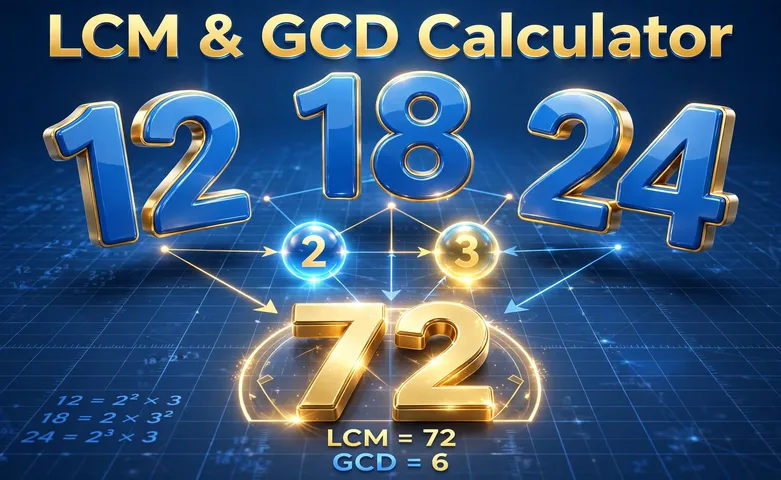
Find the LCM and GCD of 12, 18 and 24.
Factor each: 12 = 2² × 3, 18 = 2 × 3², 24 = 2³ × 3. LCM: highest powers of each prime — 2³ (from 24) and 3² (from 18) — so LCM = 2³ × 3² = 8 × 9 = 72. GCD: lowest powers of the primes shared by all three — 2¹ (from 18) and 3¹ (from 12 or 24) — so GCD = 2 × 3 = 6. Check: 72 ÷ 12 = 6, 72 ÷ 18 = 4, 72 ÷ 24 = 3 (all whole), and 12 ÷ 6 = 2, 18 ÷ 6 = 3, 24 ÷ 6 = 4 (all whole).
How to use the LCM and GCD calculator
Type the numbers exactly as you would say them — commas or spaces both work.
Step by step
- Enter at least two whole numbers. Separate them with commas or spaces, e.g. 12, 18, 24.
- Press Calculate. The LCM and GCD appear at the top of the results.
- Read the factorizations. Each number's prime factorization is printed in a table.
- Follow the highest powers. The working shows which prime powers were kept for the LCM and which for the GCD.
- Copy the working. The steps are written out so they double as a study aid for homework.
LCM vs. GCD: what each one tells you
The two answers solve opposite problems. The LCM looks upward for the first number every input divides into evenly; the GCD looks downward for the biggest number that divides every input evenly.
| LCM (least common multiple) | GCD (greatest common divisor) | |
|---|---|---|
| Answers the question | What is the smallest number all of these divide into? | What is the largest number that divides all of these? |
| Size vs. inputs | Always at least the largest input | Never larger than the smallest input |
| Coprime inputs (e.g. 5, 7) | Equals the product (35) | Equals 1 |
| Main classroom use | Common denominators for fractions | Simplifying fractions |
The fraction connection is the one you will use most: the LCM of two denominators is their least common denominator, and dividing numerator and denominator by their GCD reduces a fraction to lowest terms — a fraction calculator handles both operations directly.
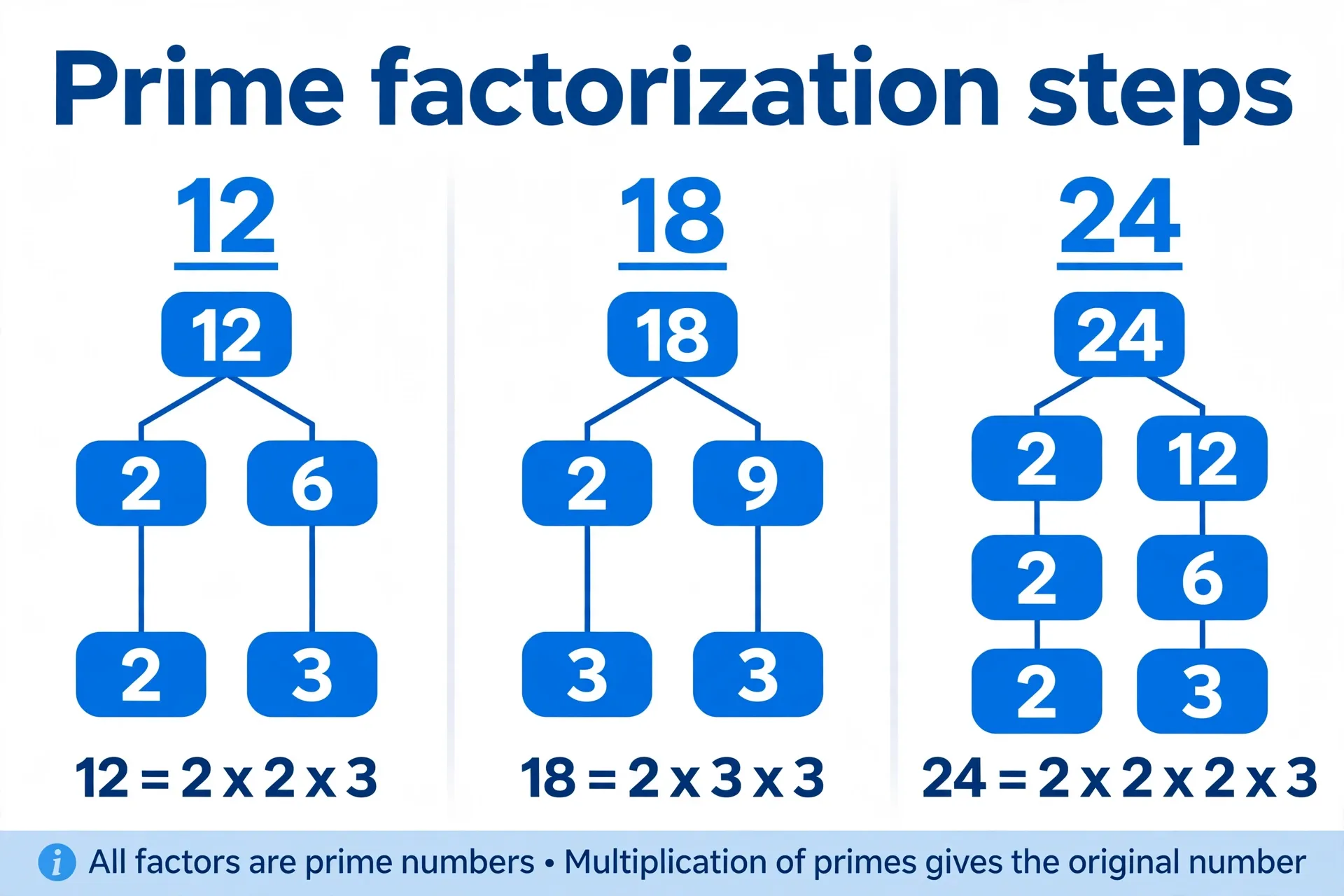
Prime factorization: the method that always works
Listing multiples works for small numbers but gets long fast; factorization scales. For 12, 18 and 24 the exponent table is:
| Prime | Highest power | From which number |
|---|---|---|
| 2 | 2³ | 24 |
| 3 | 3² | 18 |
LCM = 2³ × 3² = 72. For the GCD the same table flips to lowest powers of the primes every number shares: 2¹ × 3¹ = 6. This highest-power / lowest-power symmetry is why one factorization answers both questions at once.
Factorization shows up everywhere in number theory — if you enjoy this kind of counting, a permutation and combination calculator puts the same systematic thinking to work on arrangements and selections.
Where the LCM shows up: fractions, schedules and cycles
The LCM is a scheduling number — it answers "when do these cycles line up again":
- Fractions: to add 1/12 + 1/18, the LCM of the denominators (36) is the least common denominator: 3/36 + 2/36 = 5/36.
- Repeating schedules: two buses leaving every 12 and 18 minutes depart together every 36 minutes.
- Gears and cycles: meshed gears with 12 and 18 teeth return to the same alignment every 36 teeth.
- Calendar repeats: events on different cycles coincide after the LCM of their periods.
Whenever a problem asks for the first time several repeating things happen together, reach for the LCM; whenever it asks for the biggest thing several quantities share, reach for the GCD.
Frequently asked questions
What is the LCM of 12 and 18?
36. Prime factorizations: 12 = 2² × 3 and 18 = 2 × 3². Take the highest power of each prime: 2² × 3² = 4 × 9 = 36.
What is the difference between LCM and GCD?
The LCM is the smallest number divisible by all inputs; the GCD is the largest number dividing all inputs. For 12 and 18: LCM = 36, GCD = 6.
How do you find the LCM of three or more numbers?
Either pairwise — LCM(a, b, c) = LCM(LCM(a, b), c) — or by prime factorization: take the highest power of every prime across all numbers and multiply.
What is the GCD of 12 and 18?
6. Common prime factors at their lowest powers: 2 × 3 = 6. Equivalently, the Euclidean algorithm: 18 mod 12 = 6, 12 mod 6 = 0.
Can the LCM be smaller than the numbers I enter?
No — the LCM is always at least as large as the biggest input. When the numbers share no common factor, the LCM is simply their product (for example, 7 and 5 give 35).
Do I need to factor the numbers myself?
No — the calculator prints each number's prime factorization and the highest-power working automatically, so the steps double as a study aid.
What if I enter a zero or a negative number?
Negatives are treated as their absolute value. If any number is zero, the LCM is 0 by definition; zeros are skipped when computing the GCD.